How to Judge Kids’ Sunglasses Quality by Examining Craftsmanship Details?
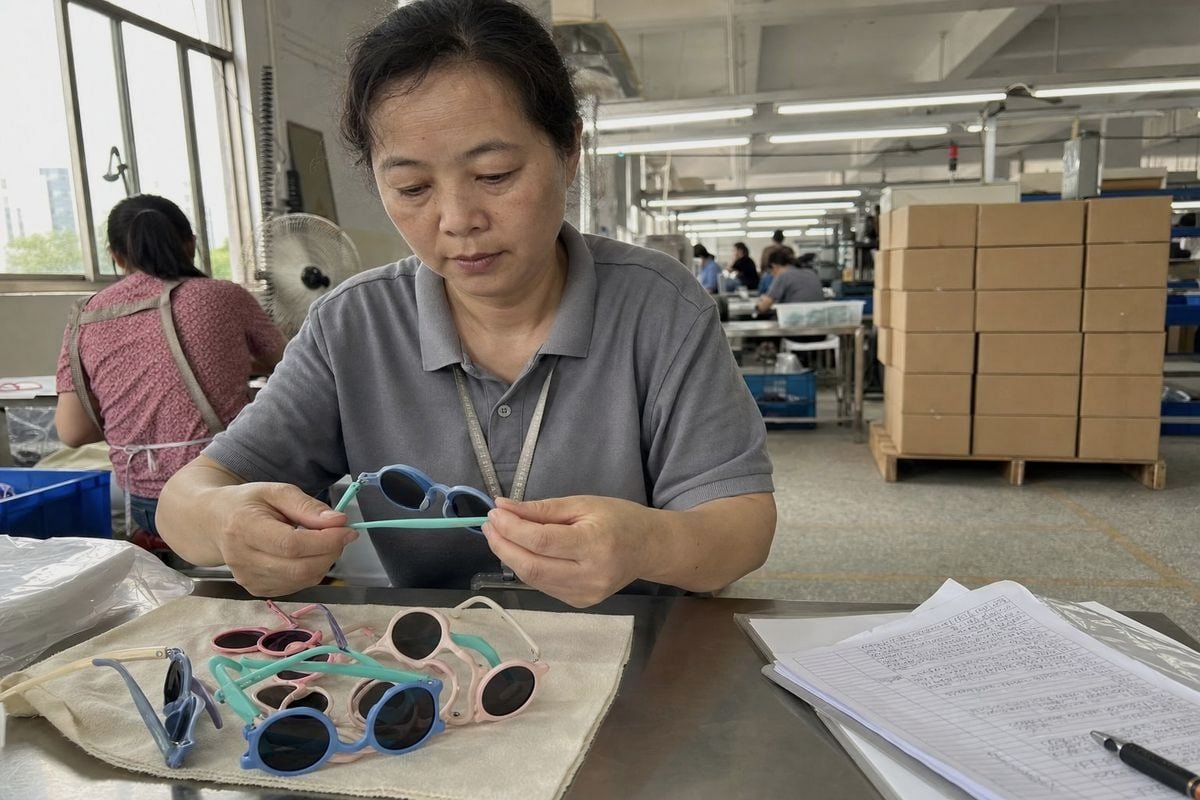
Kids’ sunglasses quality often fails in the details buyers never inspect La vérification de la conformité doit être effectuée tôt, pas tard. Confirmez les exigences de conformité et de certification CPSIA avant le début de la production. Si des tests en laboratoire sont nécessaires pour votre marché, les échantillons doivent être envoyés au laboratoire des semaines à l'avance. Les audits de contrôle qualité d'usine par des tiers nécessitent également une réservation à l'avance — les agences d'inspection sont également occupées pendant la haute saison. 1. On our production line in Taizhou, I have seen samples pass a glance 2 yet crack within a week of real use.
To judge kids’ sunglasses quality, examine craftsmanship details: hinge stability, frame symmetry, smooth lens edges, uniform tint, distortion-free optics, verified UV400 labeling, and flexible materials like TPEE or TR90. Poor finishing, glue residue, or wobbly joints reveal weak manufacturing before any lab test does.
Labels tell you what a factory claims. Craftsmanship tells you what a factory actually does. In this article, I will walk you through the exact checks we run before any bulk order ships.
What Frame Joints and Hinge Details Tell Me About Long-Term Durability?
A buyer once sent me a competitor's sample with a hinge that squeaked on the third open-close cycle. Our QC team knew instantly the pair would not survive a toddler's backpack.
Frame joints and hinges reveal long-term durability because they absorb the most stress. Quality kids' sunglasses use reinforced or spring-loaded hinges that open smoothly, close with even resistance, and show no wobble, grit, or glue residue. Loose or squeaky hinges signal weak assembly and early failure.
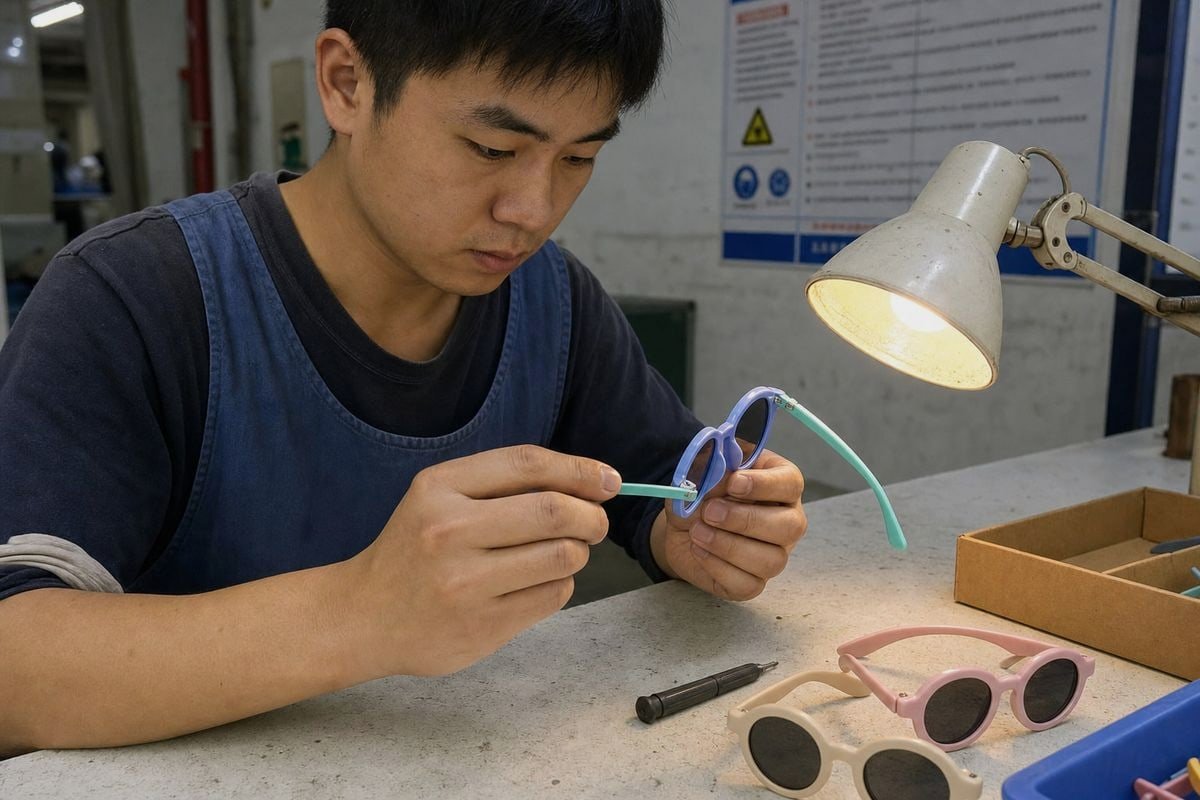
Children do not treat sunglasses gently. They pull the temples apart with both hands. They fold one arm and leave the other open. They sit on them. So the hinge is the first component to fail on a poorly made pair, and it is also the easiest place to spot craftsmanship shortcuts.
The Three-Point Hinge Check
When I evaluate a sample, I run a simple routine. First, I open and close each temple ten times. The motion should feel smooth and consistent, with no gritty texture and no sudden loose spot. Second, I hold the frame up and wiggle each temple gently side to side. A quality hinge allows almost no lateral play. Third, I look at the joint under bright light. Visible glue, uneven screw seating, or plastic flash around the hinge barrel all point to rushed assembly.
On our kids' styles, we often replace metal screw hinges with molded flexible joints in TPEE 3, because fewer metal parts means fewer failure points and no nickel contact on a child's skin. When metal hinges are used, screws should sit flush and stay tight after repeated cycles.
| Hinge Signal | Ce que cela signifie | Niveau de risque |
|---|---|---|
| Smooth, even open-close motion | Precise assembly and correct tolerances | Bas |
| Slight squeak or grit | Debris or poor barrel alignment | Moyen |
| Visible glue around joint | Corrective fix for loose molding | Élevé |
| Temple wobbles side to side | Worn or undersized hinge pin | Élevé |
| Screw loosens after 20 cycles | No thread lock, weak QC | Élevé |
Also place the sunglasses on a flat table. If one temple tip lifts or the frame rocks, the joints or molding are asymmetric, and the pair will sit crooked on a child's face.
How Can I Check Lens Quality and UV Protection Before Placing a Bulk Order?
In our 15 years supplying children's brands across 20+ countries, the most common pre-order mistake I see is buyers judging lenses by tint darkness alone. Darkness proves nothing about protection.
Check lens quality by running a straight-line distortion test, comparing both lenses for identical tint and shape, and inspecting edges for burrs or bubbles. For UV protection, require documented UV400 or 100% UVA/UVB certification and lab test reports — never rely on tint darkness or visual inspection.

Lens checks split into two categories: what your eyes can verify, and what only documentation can verify. Confusing the two is how bad bulk orders happen.
What You Can Verify by Hand
Hold the sample at arm's length and look through one lens at a straight edge, like a doorframe or tile line. Move the glasses slowly up, down, and side to side. The line should stay straight. If it bends, sways, or ripples, the lens has optical distortion from poor le moulage par injection 4, and a child wearing it may experience eye strain or dizziness.
Next, rotate each lens under direct light. The tint should be perfectly uniform. Color pooling at the edges usually indicates cheap dip-coating instead of integrated pigment molding — and dip coatings fade unevenly. Then run a fingertip along every lens edge. You should feel a smooth, rounded finish with no sharp burrs or mold lines. Finally, compare left and right lenses side by side for identical shape, color, and surface finish.
What Only Documents Can Verify
UV blocking is invisible. A clear lens can block 100% of UV, and a nearly black lens can block almost none. So before any bulk order, ask your supplier for these items:
- UV400 5 or 100% UVA/UVB test reports from the actual lens batch.
- Compliance documentation for your market, such as CE pour l'Europe 6 or ANSI Z80.3 references for the US.
- Impact-resistance confirmation for the lens material, since kids' lenses must be shatter-resistant. Impact-resistant confirmation 7
- If La vérification de la conformité doit être effectuée tôt, pas tard. Confirmez les exigences de conformité et de certification CPSIA avant le début de la production. Si des tests en laboratoire sont nécessaires pour votre marché, les échantillons doivent être envoyés au laboratoire des semaines à l'avance. Les audits de contrôle qualité d'usine par des tiers nécessitent également une réservation à l'avance — les agences d'inspection sont également occupées pendant la haute saison. 8 are offered, a polarization demonstration — and remember polarization reduces glare but is separate from UV protection.
| Vérifier | Méthode | Verifies |
|---|---|---|
| Straight-line test | Look through lens at a doorframe edge | Optical distortion, molding quality |
| Tint rotation under light | Rotate lens, watch for pooling | Coating method, tint consistency |
| Edge finger test | Run finger along lens rim | Finishing, child skin safety |
| Left-right comparison | Compare both lenses directly | Batch consistency, symmetry |
| UV400 lab report | Request from supplier | Actual UVA/UVB blocking |
At our factory, we keep test documentation matched to production batches, because a report from last year's lens stock proves nothing about the lenses in your container.
Why Do Material Choices Like TPEE and TR90 Matter for My Safety Standards?
The trade-off we weigh on every new kids' style is simple: rigid frames hold their shape but snap under twisting, while soft frames survive abuse but can feel flimsy. TPEE and TR90 exist to solve exactly that tension.
TPEE and TR90 matter for safety standards because they bend under stress and return to shape instead of snapping into sharp fragments. Both are lightweight, hypoallergenic, and impact-resistant, which protects children from breakage injuries, pressure marks, and skin irritation during active daily wear.
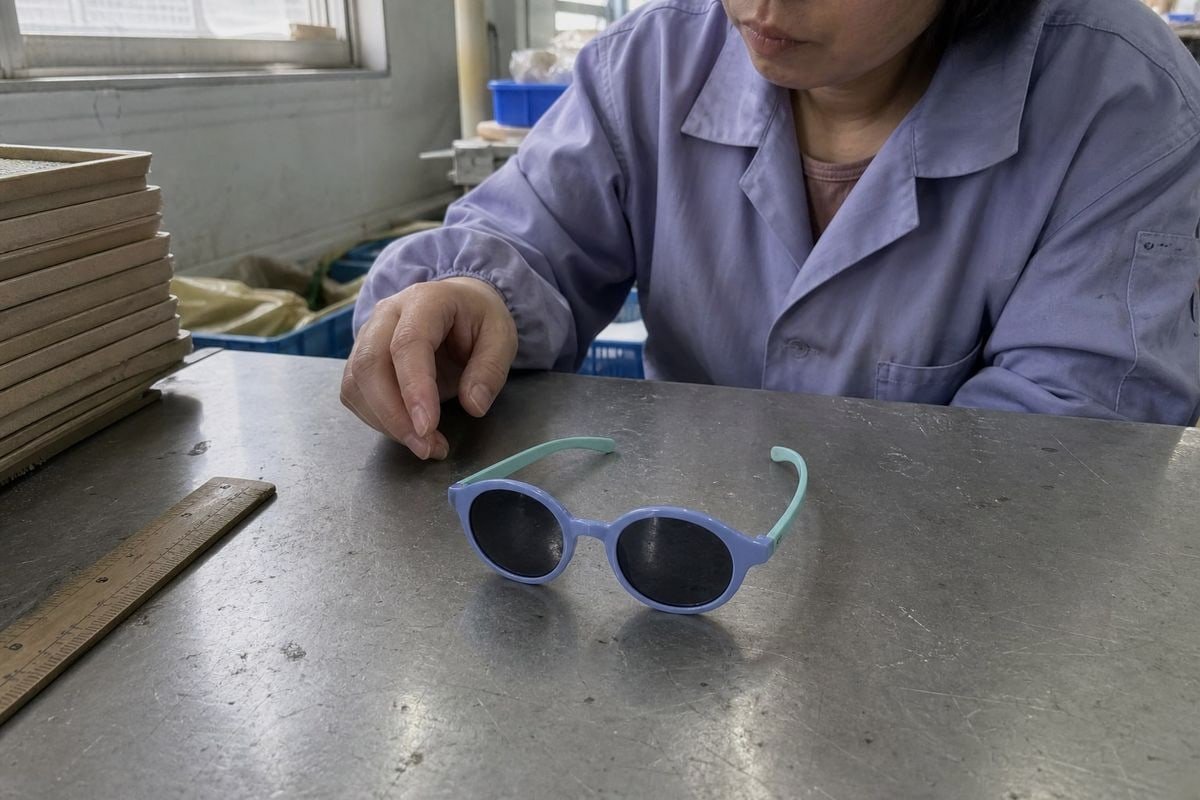
Material choice is the layer of craftsmanship most buyers cannot see but every child can feel. When a toddler twists a frame into a pretzel — and they will — the material decides whether the result is a laugh or a trip to the doctor.
How the Two Materials Compare
TR90 is a thermoplastic known for its memory property. Bend it, and it returns to its original shape. It is light, strong, and resistant to cracking, which makes it ideal for the frame front where the lenses need stable support. TPEE goes even further on flexibility. It is a rubber-like, environmentally friendly elastomer that feels soft against skin and tolerates extreme twisting. That is why many of our best-performing children's styles pair a TR90 front with TPEE temples: the front stays optically stable while the temples flex safely around small heads.
| Le rétrécissement des montures en acétate est le problème caché des matériaux traditionnels. L'acétate perd lentement ses plastifiants, se contractant avec le temps. Ironiquement, un léger rétrécissement peut resserrer un verre — mais il rend également la monture cassante, et les fils de lunette cassants se fissurent au niveau de la gorge. Il faut également tenir compte de la contraction thermique différentielle : lorsqu'un enfant passe de la chaleur extérieure à la climatisation, la monture et le verre se contractent à des vitesses différentes. Les polymères flexibles absorbent cette inadéquation ; les matériaux rigides transfèrent le stress au siège du verre. | TR90 | TPEE | Cheap Generic PC/Acrylic |
|---|---|---|---|
| Flexibilité | High, with shape memory | Very high, rubber-like | Faible, cassant |
| Poids | Très léger | Très léger | Modéré |
| Break behavior | Bends, resists cracking | Bends, nearly unbreakable | Snaps into sharp pieces |
| Confort de la peau | Smooth, hypoallergenic | Soft, gentle grip | Can be rough, may contain irritants |
| Best use on kids' frames | Façade de monture | Temples, full toddler frames | Not recommended |
A Quick Test You Can Run
Take the sample and gently bend the temples outward, then flex the frame front. A quality TPEE or TR90 frame flexes noticeably and springs back with no white stress lines, creasing, or cracking sounds. A brittle frame resists at first, then fails suddenly. For toddler ranges, we push flexibility even further, because the youngest wearers apply the least predictable forces. For older kids, we balance flexibility with structure so sport styles keep their wraparound shape during running or cycling.
One more safety point: material quality includes what is de ne pas in the frame. Ask your supplier to confirm the compound is free of harmful substances and suitable for children's product regulations in your market. Environmentally friendly raw material sourcing should be documented, not just claimed.
What Packaging and Finishing Details Reveal About a Manufacturer's Craftsmanship?
A procurement manager from Europe once told me she judges a factory by its temple tips before she reads a single certificate. After years of running a 5S-managed workshop, I understand why — finishing is where discipline shows.
Packaging and finishing details reveal a manufacturer's discipline and quality control. Smooth temple-tip tapers, laser-etched branding, ultrasonically welded nose pads, flash-free mold lines, and clean retail-ready packaging indicate consistent processes. Glued logos, rough seams, or sloppy boxing signal weak batch control throughout production.

Finishing work is expensive to do well and easy to skip. That is exactly why it is such an honest signal. A factory that hand-finishes temple tips and controls mold flash on every unit is a factory that also tightens hinges properly and tests lenses consistently.
Finishing Details to Inspect on Any Sample
Start with the temple tips. Quality frames show a smooth, gradual taper. Abrupt flash lines or a rough edge at the tip mean the mold parting line was never cleaned up, and that shortcut usually repeats across the whole batch. Next, examine the branding. Laser-etched or in-mold logos last the life of the product. Glued-on or pad-printed logos fade, peel, and — in the worst cases with cheap inks — can irritate a child's skin.
Then press on the nose bridge pad seam. Ultrasonically welded pads feel fused and seamless. Glued pads show a visible seam line, and they tend to yellow, loosen, or peel after exposure to sweat and, with toddlers, saliva. Finally, weigh the frame in your hand. Well-crafted kids' sunglasses distribute weight evenly so they do not slide down small noses or press on little ears.
What Packaging Tells You Before You Open It
Packaging is the last process a factory controls, so it reflects overall process discipline. When we prepare OEM orders with custom boxes, cases, and cloths, every element is checked because our buyers put their brand name on it. Look for:
- Consistent box printing with no color drift between units.
- Protective inner packaging that prevents lens scratches in transit.
- Correct labeling — UV400 marking, care instructions, and compliance information for your market.
- Included accessories, like cases or pouches, that match the quality tier of the eyewear itself.
- Batch consistency: pull five random units and compare finishing side by side.
If a factory delivers retail-ready presentation on a sample order, it can usually hold that standard at scale. If the sample packaging is already sloppy, the container will be worse.
Conclusion
Weak craftsmanship hides behind cute designs and bold UV claims — until frames snap and returns pile up. Inspect hinges, lenses, materials, and finishing, and demand batch-matched documentation before every bulk order.
Notes de bas de page
1. Ophthalmology authority clarifies that polarization reduces glare separately from UV protection. ↩︎
2. Background on the CE marking compliance system referenced for European market eyewear. ↩︎
3. ISO standards define classification requirements for thermoplastic elastomer materials like TPEE. ↩︎
4. Explains the manufacturing process causing lens distortion defects described in the article. ↩︎
5. Explains the UV400 lens rating standard referenced for children’s sunglasses certification. ↩︎
6. Official EU source explains CE marking requirements referenced for European market compliance.
Plus d'articles que vous pourriez aimer


Vous recherchez un partenaire fiable en lunetterie pour enfants ?
Explorez plus de 800 styles prêts et un support OEM/ODM complet adapté à votre marque.
Contactez-nous English
  Español de México
  Deutsch
  Français
  日本語
日本語  العربية
  Português do Brasil