How to Reverse-Calculate Landed Cost From a $1.99 Retail Price for Kids Sunglasses?
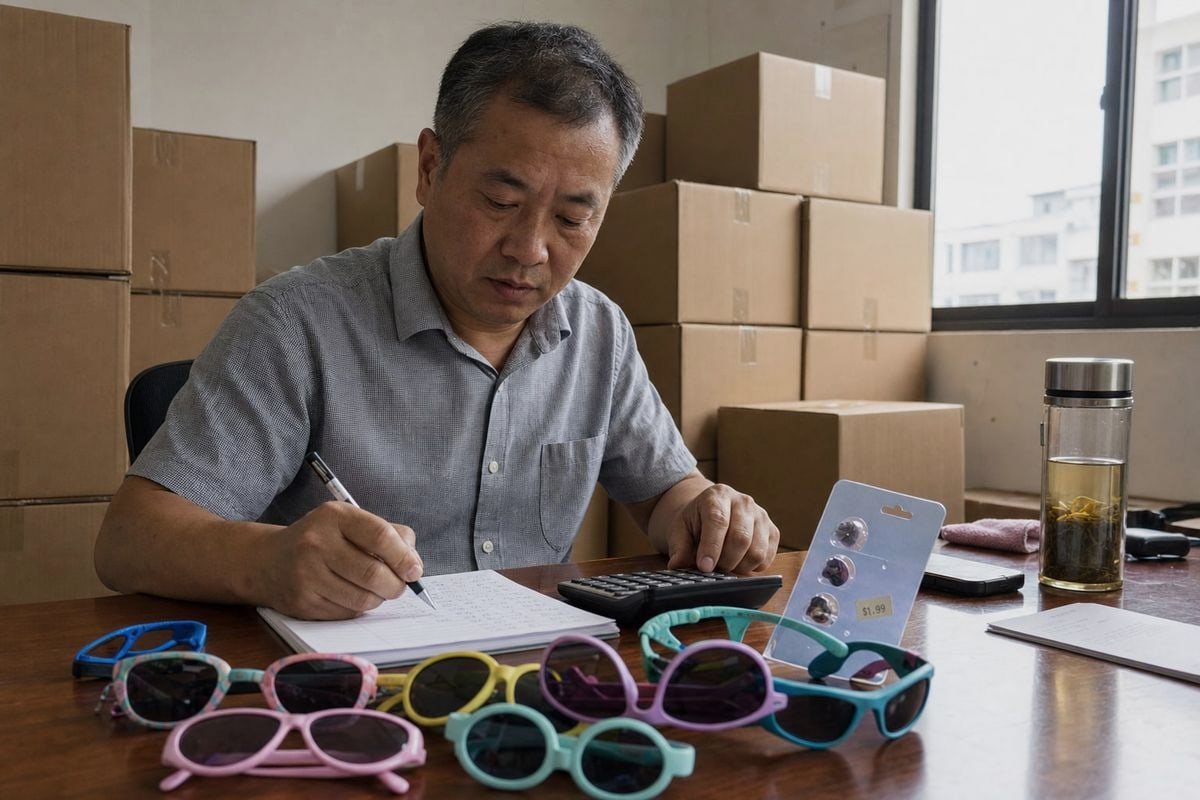
Buyers often ask me to reverse-calculate coût rendu 1 from a $1.99 retail price for kids sunglasses. On our production line, that math decides whether a deal survives or collapses.
To reverse-calculate landed cost from a $1.99 retail price, subtract the retailer’s gross margin target (typically 50–70%), leaving roughly $0.60–$1.00 as maximum landed cost. Then subtract freight, duty, insurance, brokerage, and compliance costs to find your maximum allowable FOB factory price per unit.
The formula sounds simple. The details are not. Below, I walk through each step the way we do it with our own B2B buyers, so you can run the numbers yourself before you commit to an order.
How do I work backward from a $1.99 retail price to find my maximum landed cost per unit?
A procurement manager from Australia once sent our team a target shelf price before she even asked about styles customs duty under HTS 9004.10 2. That was smart. In our experience, the shelf price should always drive the sourcing math, not the other way around.
Divide the $1.99 retail price by your channel's markup multiplier (usually 2.5x–4x). That gives a maximum landed cost of roughly $0.50–$0.80 per unit. Everything you spend — factory price, freight, duty, fees — must fit inside that ceiling, or the price point fails.

The key mindset shift is this: you are not summing costs forward ASTM F963 3. You are solving for an allowable cost backward. Landed cost is the total of everything it takes to get the sunglasses from our workshop in Taizhou to your warehouse shelf. Retail price minus required margin sets the hard ceiling for that total.
The Step-by-Step Reverse Calculation
Here is the sequence we recommend to buyers who bring us a fixed retail price:
- Start with the shelf price: $1.99.
- Subtract the retailer's gross margin requirement. Discount and dollar-store channels often demand 60–70%.
- Subtract distribution and fulfillment costs (warehousing, pick and pack, inland trucking).
- Subtract import costs: ocean freight, duty, customs broker fees, insurance.
- What remains is your maximum FOB factory price — the number you can actually pay us.
Sample Scenario Table
| Line Item | Amount per Unit | Running Balance |
|---|---|---|
| Retail price | $1.99 | $1.99 |
| Retailer gross margin (65%) | −$1.29 | $0.70 |
| Inland freight and warehousing | −$0.06 | $0.64 |
| Ocean freight (container share) | −$0.04 | $0.60 |
| Duty and customs fees | −$0.04 | $0.56 |
| Compliance testing (amortized) | −$0.04 | $0.52 |
| Maximum FOB factory price | — | $0.52 |
Notice how fast $1.99 shrinks. Small fixed costs — a broker minimum, a testing invoice — hit low-ticket items much harder than they hit a $20 product. That is why we always tell buyers to run this math per channel and per destination country. A number that works for a US mass retailer may not work for a Japanese specialty chain, and vice versa.
What landed cost components do I need to include beyond the factory unit price?
During fifteen years of exporting children's eyewear to buyers in more than twenty countries, our sales team has seen the same mistake repeat: importers compare FOB quotes and forget everything that happens after the container leaves the port.
Beyond the factory unit price, landed cost must include international freight, marine insurance, customs duty under HTS 9004.10 (typically 2–5%), broker fees, inland trucking, warehousing, a 3–5% currency buffer, a 2–4% shrinkage allowance, and amortized compliance testing costs for children's products.
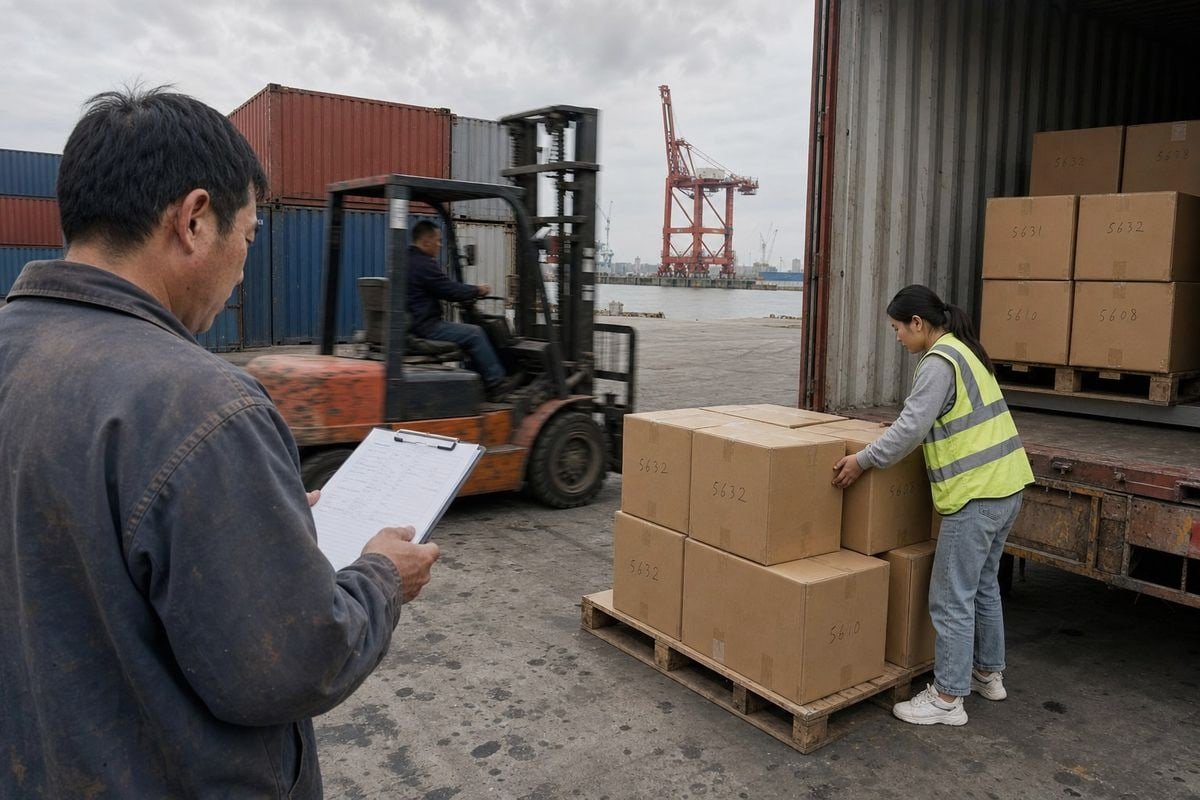
There are two definitions of landed cost, and you should know both. The narrow definition covers purchase price, freight, duty, and taxes. The broad definition — the one we find more useful for pricing decisions — also covers insurance, brokerage, warehousing, inventory risk, and handling. If you use the narrow version to set your maximum factory price, you will feel profitable on paper and lose money in practice.
The Full Cost Stack for Kids Sunglasses
| Component | Typical Range per Unit | Often Forgotten? |
|---|---|---|
| FOB factory price | $0.35–$0.90 | No |
| Ocean freight (FCL share) | $0.02–$0.06 | Sometimes |
| Marine insurance 4 | $0.005–$0.01 | Yes |
| Customs duty (HTS 9004.10) | 2–5% of value | Sometimes |
| Broker and customs fees | $0.01–$0.05 | Yes |
| Inland trucking | $0.02–$0.04 | Yes |
| exigences CPSIA 5/ASTM F963 testing (amortized) | $0.02–$0.10 | Frequently |
| Currency fluctuation buffer | 3–5% | Frequently |
| Shrinkage and damage allowance | 2–4% | Frequently |
Why Small Fixed Costs Dominate at $1.99
Sunglasses are light. Freight per unit is genuinely cheap when you ship container loads. But fixed fees do not scale down. A $150 broker fee spread over 2,000 units adds $0.075 per unit — a huge share of a $0.55 target. Spread over 20,000 units, it becomes negligible. This is why order size, not just unit price, determines whether the reverse calculation closes. One more note from our export experience: VAT and GST 6 treatment differs by market. In many countries, the $1.99 shelf price already includes consumption tax, which shrinks your real margin room further. Always confirm whether your target retail price is tax-inclusive before you run the math.
How do I know if a $1.99 price point still allows for safe, quality materials like TPEE or TR90?
Material choice is the trade-off I weigh most carefully when a buyer brings us an aggressive price target. Our engineers build frames in flexible TPEE and TR90 7 precisely because rigid cheap plastic snaps — and a snapped frame near a child's eye is not an acceptable risk.
A $1.99 retail price rarely supports full TPEE or TR90 construction through standard retail margins. It typically forces basic PC plastic frames. Safe flexible materials usually need a $4.99–$9.99 shelf price, or very high container volumes combined with a lower-margin channel to remain viable.

Let me be direct, because I would rather lose a quote than mislead a buyer. When we cost out a TR90 frame with TPEE temples — the combination we developed for active kids because it flexes instead of breaking — the material and molding cost alone usually exceeds the entire $0.50–$0.60 landed-cost ceiling that a $1.99 shelf price allows. That is before lenses, hinges, freight, and testing.
What Each Material Realistically Costs to Produce
| Matériel | Flexibility & Safety | Typical FOB Range | Fits $1.99 Retail? |
|---|---|---|---|
| Basic PC / injection plastic | Low; can snap under stress | $0.30–$0.60 | Marginally, at high volume |
| TR90 frame | High; memory flex, lightweight | $0.80–$1.50 | No, under standard margins |
| TR90 + TPEE temples | Very high; bends fully, soft touch | $1.00–$2.00 | No |
| UV400 lens 8 upgrade | Essential for eye safety | +$0.05–$0.15 | Tight but possible |
| Polarized lens upgrade | Premium sun protection | +$0.30–$0.60 | No |
The Honest Conclusion for Brand Buyers
If your channel truly locks you at $1.99, you are building an impulse item, not a children's safety product. That can be a legitimate business — promotional giveaways and party-favor sunglasses exist for a reason. But if you are a kids' brand whose customers are parents who read labels, the smarter move is to reposition at $6.99–$12.99 retail. At that level, the reverse calculation leaves room for flexible TPEE or TR90 construction, UV400 lenses, and proper drop-testing. We have watched buyers from Europe and Australia make this exact pivot, and their reorder rates told the story: parents pay more for frames that survive being sat on.
How can I choose the right MOQ and packaging to protect my margin at this price?
A lesson we learned early in our factory's history: packaging decisions sink more low-price programs than product decisions do. One buyer insisted on printed boxes for a sub-$2 shelf item, and the box cost more than the hinge assembly.
Choose container-load MOQs of 10,000+ units to reach the lowest FOB tiers, and use minimal packaging — poly bag with header card, around $0.03–$0.08 per unit. Avoid printed boxes below $2 retail. Confirm whether packaging is bundled into the FOB quote or billed separately.

MOQ and packaging work together. A higher MOQ lowers your per-unit FOB price and dilutes fixed costs like testing, broker fees, and mold amortization. Packaging then determines how much of that saving survives. At a $1.99 price point, every cent of packaging is a cent taken directly from product quality or your margin.
How MOQ Changes Your Achievable FOB Price
Volume tiers matter more at low price points than anywhere else. From our quoting experience, the pattern looks like this: small trial orders of 1,000–2,000 units carry setup and handling costs that push FOB prices up sharply. At 5,000 units, prices ease. At 10,000–20,000 units per style or per color program, you reach the pricing tiers that make a $0.50-class landed cost even conceivable. One advantage we deliberately built for smaller brands: with roughly 800 existing styles in our catalog, buyers can skip mold investment entirely. Choosing an open-mold style instead of a custom tool can remove thousands of dollars of upfront cost, which is often the difference between a viable program and a dead one at this price.
Packaging Options Ranked by Margin Impact
- Poly bag only — lowest cost, acceptable for promotional channels.
- Poly bag + header card — the sweet spot for $1.99 retail; adds branding for pennies.
- Hang card with die-cut — good shelf presence, moderate cost.
- Printed box — retail-ready and premium, but rarely survives the math below $2.
- Counter display (48–72 units) — cost is shared across many units, so it can work if the retailer requires it.
One final caution: always ask your supplier to break packaging out as a separate line in the quote. When it is bundled invisibly into the FOB price, your reverse calculation gets distorted, and you cannot compare quotes fairly. We quote packaging separately for exactly this reason — clear numbers make long-term partnerships easier.
Conclusion
Reverse-calculating landed cost from $1.99 exposes a hard truth: the ceiling is tiny. Run the math by channel, protect margin with smart MOQs, and price honestly for safe materials.
Working backward from the shelf price is the only reliable way to set a maximum factory cost before you commit. Subtract retail
Plus d'articles que vous pourriez aimer

1 août 2026
L'usine doit-elle gérer l'emballage et l'étiquetage des lunettes pour enfants, ou utiliser un fournisseur désigné ?
1 août 2026
Entrepôt propre vs. exécution directe par le fournisseur : lequel réduit les coûts de retour pour les marques de lunettes pour enfants ?
1 août 2026
Entrepôt direct au port ou staging outre-mer : lequel permet d'économiser le plus sur l'expédition des lunettes pour enfants ?
Vous recherchez un partenaire fiable en lunetterie pour enfants ?
Explorez plus de 800 styles prêts et un support OEM/ODM complet adapté à votre marque.
Contactez-nous English
  Español de México
  Deutsch
  Français
  日本語
日本語  العربية
  Português do Brasil