How to Reduce Shipping Costs for Kids Sunglasses via Packaging Optimization?
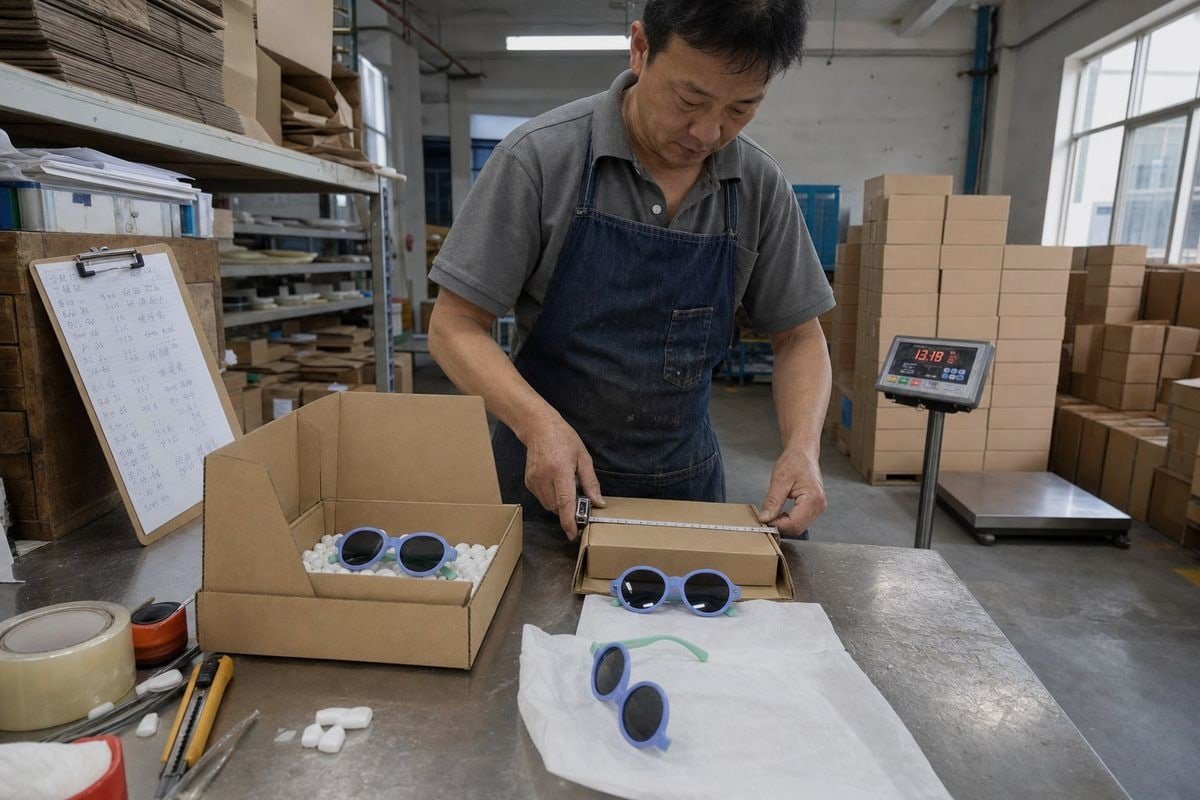
Packaging optimization for kids sunglasses became urgent for me when a buyer showed me two freight quotes corrugated cartons 1. Same product, same quantity — one shipment cost nearly a third more, purely because of the box.
To reduce shipping costs for kids sunglasses, right-size every packaging layer to cut dimensional weight, switch to lighter materials like slim inserts and poly mailers, standardize master carton dimensions for better container utilization, and consolidate units per carton — all while keeping enough protection to prevent damage and returns.
The cheapest package is not the smallest one. It is the smallest one that still protects the product sea freight 2. Let me walk you through how we approach this at our factory, layer by layer.
How can I redesign my kids sunglasses packaging to save on freight without sacrificing shelf appeal?
A few seasons ago, we helped a European kids' brand shrink their gift box by just 12mm in one dimension. Their air freight bill dropped noticeably, and the retail look stayed identical.
Redesign packaging by measuring the actual product footprint, removing dead interior space, replacing thick rigid boxes with high-strength cardstock, and moving graphics-heavy branding to smaller surfaces. Shelf appeal comes from print quality and structure, not from oversized dimensions.

Kids sunglasses give you a real advantage here. The frames are smaller than adult eyewear, so overpackaging is easy to spot. Our flexible TR90 3 and TPEE frames are also more forgiving than rigid acetate, which means the box does not need to be a fortress. But most brands still ship children's eyewear in boxes sized for adult sunglasses. That is wasted volume, and carriers charge you for it.
Start with the product, not the box
When we develop packaging with clients, we measure the folded sunglasses first. Then we build the box around that footprint, plus a small protection margin. Working backward from a standard box size almost always leaves empty air inside — and you pay to ship that air.
Where shelf appeal actually comes from
Retail buyers respond to print finish, window placement, color, and structure. None of those require extra cubic volume. Here is how we compare common redesign moves:
| Redesign Change | Freight Impact | Shelf Appeal Impact |
|---|---|---|
| Shrink box to product footprint | High savings | None if graphics adapt |
| Switch rigid gift box to cardstock | Moderate weight savings | Slight, offset by finish quality |
| Move paper manual to QR code on box | Small weight savings | Neutral or positive |
| Flat-shipped pillow box format | High inbound savings | Strong for value lines |
| Remove double-wall where unneeded | Moderate savings | Aucun |
A QR code for warranty and care instructions removes physical paper inserts. That small change can keep a DTC parcel under a weight-tier threshold. Over thousands of orders, those thresholds add up.
What packaging materials help me cut shipping weight while keeping my children's eyewear safe in transit?
Material choice is a trade-off we weigh on nearly every OEM project. A buyer wants protection, but every extra gram multiplied across ten thousand pairs becomes real freight money.
Use lightweight microfiber pouches, slim die-cut inserts, thin-wall high-strength corrugated cartons, and poly mailers or bubble mailers for DTC orders. These materials cut packaging material weight significantly while still preventing lens scratches, frame bending, and crush damage during transit.
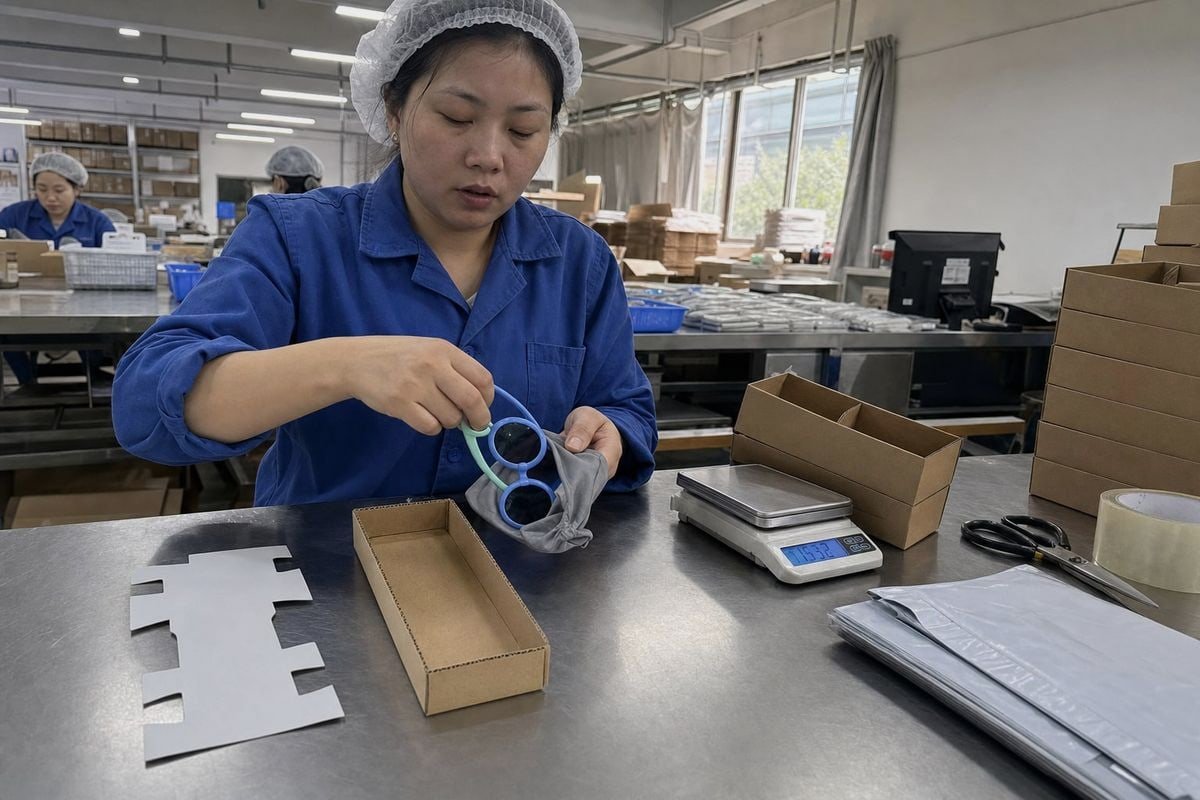
Our flexible TPEE and TR90 frames help here. Because the frames bend and recover, they tolerate rougher handling than brittle plastic frames. So the packaging does not need to compensate for a fragile product. The main risks for kids sunglasses in transit are lens scratching, crushing under stacked weight, and temple deformation from pressure. Each risk has a lightweight answer.
Match the material to the risk
A microfiber pouch stops lens scratching and doubles as a retail accessory. A slim protective insert holds the frame in place, so bulky void fill becomes unnecessary. Void fill reduction is one of the fastest wins we see — loose paper and air pillows add volume, weight, and packing time, yet a properly sized insert makes them redundant.
| Material Option | Weight | Protection Level | Best Use Case |
|---|---|---|---|
| Microfiber pouch | Very light | Scratch protection | Every pair, all channels |
| Die-cut paper insert | Light | Holds frame, stops movement | Retail boxes |
| Thin-wall corrugated carton | Light-moderate | Crush resistance | Master cartons |
| Bubble mailers | Very light | Impact cushioning | Single-pair DTC orders |
| Poly mailers with pouch inside | Lightest | Basic protection | Flexible-frame DTC orders |
| Rigid gift box | Heavy | High but often excessive | Premium gift sets only |
Do not cut below the safety line
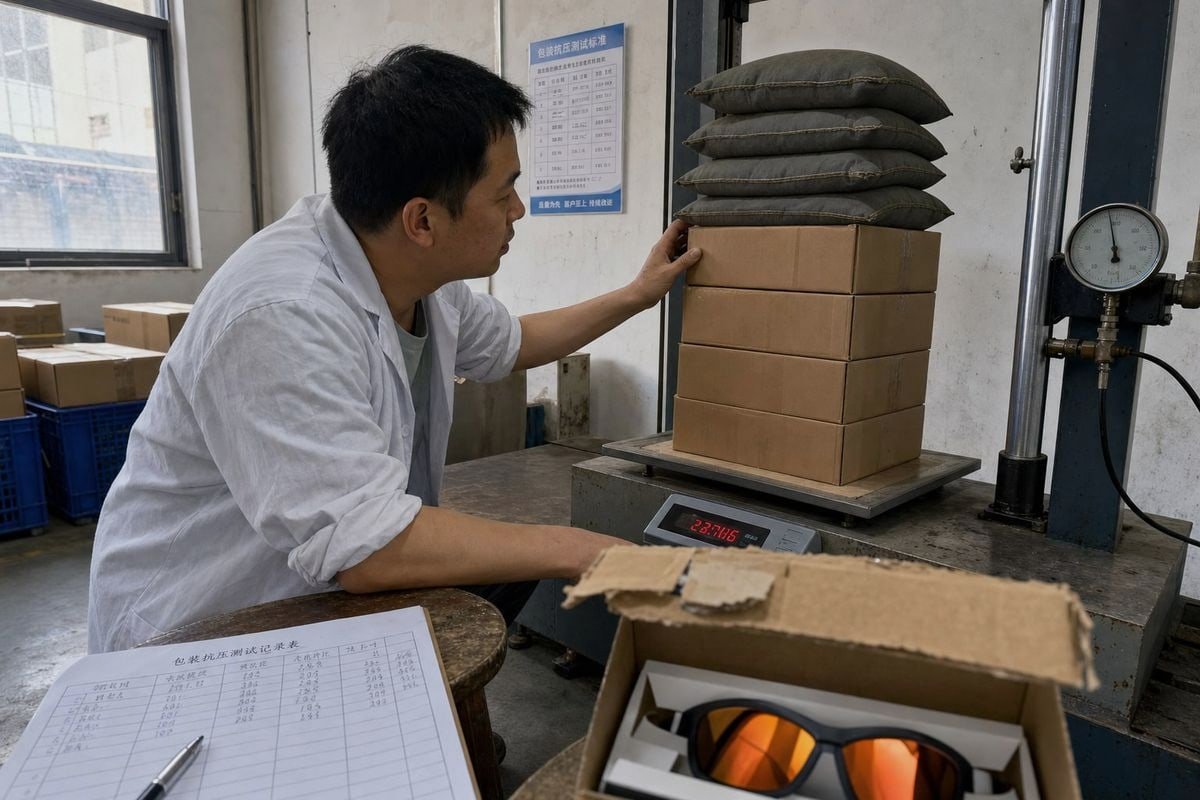
One caution from experience: thinner corrugated works only if the flute grade still passes crush testing. We once trialed an ultra-thin master carton that saved weight but dented at the bottom of a container 5 stack. Damaged corners mean rejected goods at the retail level. Always re-test after any downgrade. The savings from lighter packaging material weight disappear instantly if the damage rate rises.
Can compact, stackable packaging designs really lower my container and air freight costs?
Container math is something our export team runs weekly. When a buyer asks for a freight quote, the first numbers we check are carton dimensions, gross weight, net weight, and CBM — because those drive the entire quote.
Yes. Compact, stackable designs directly lower freight costs because sea freight is priced by CBM and air freight by volumetric weight. Standardized cartons that stack cleanly on pallets can fit meaningfully more units per container, cutting per-unit landed cost.

Here is the core logic in plain terms. A container has fixed space. If your master carton wastes 15% of its internal volume on air, you ship 15% fewer sunglasses per container while paying the same freight. Air freight is even less forgiving. Carriers bill whichever is higher: actual weight or volumetric weight. Light products like kids sunglasses almost always get billed by volume. So dimensional weight is your real enemy, not scale weight.
A practical optimization process
This is the workflow we run with wholesale buyers:
- Measure the retail unit precisely, including the pouch and insert.
- Calculate how many units fit a candidate master carton with zero wasted rows.
- Adjust custom box dimensions so unit boxes tile the carton perfectly — no half-filled layers.
- Check the carton footprint against standard pallet dimensions 6 for clean stacking.
- Standardize on two or three carton sizes across the whole product line.
- Recalculate CBM and volumetric weight, then compare freight quotes.
Nesting and multi-pack designs
For kids' multi-packs, interlocking or nesting case designs can shrink bundled volume substantially. Two pairs nested head-to-toe occupy far less space than two pairs boxed side by side. For premium sets, a Ship-in-Own-Container approach removes the secondary outer box entirely — the retail package becomes the shipping package, cutting both material weight and volume.
Standardization also improves fulfillment efficiency downstream. Warehouses pack faster when carton sizes are predictable, and 3PL storage fees drop when cartons stack without wasted rack space.
How do I balance branded, retail-ready packaging with cost-efficient shipping for my kids' eyewear line?
A procurement manager from Australia once told me her dilemma directly: her brand needed premium retail presentation, but her coût rendu 7 target left little room for heavy packaging. We solved it by splitting the packaging strategy by channel.
Balance the two by designing channel-specific packaging: compact branded boxes for retail, lightweight mailers with pouches for DTC, and optimized bulk cartons for wholesale. Calculate total landed cost — packaging plus freight plus damage rate — rather than judging shipping cost alone.
Branding and freight efficiency are not opposites. They only conflict when a brand uses one heavy, oversized package for every channel. In our OEM/ODM work, we routinely produce custom colors, logos, lenses, and packaging for the same product line in two or three formats. The retail box carries the shelf presence. The DTC format carries the unboxing moment at minimal weight. The wholesale carton carries pure efficiency.
Think in total landed cost
Judging packaging by its unit price alone misleads you. A cheaper generic box that forces a larger parcel size can cost more overall than a custom box that fits perfectly. Here is the comparison framework we share with buyers:
| Cost Factor | Generic Oversized Box | Right-Sized Custom Box |
|---|---|---|
| Packaging unit cost | Lower | Higher |
| Dimensional weight charge | Higher | Lower |
| Units per master carton | Fewer | More |
| Damage and return risk | Higher (product moves) | Lower (snug fit) |
| Brand presentation | Weaker | Stronger |
| Total landed cost | Often higher | Usually lower at volume |
When does custom packaging pay off?
Custom tooling has setup costs. For very low order volumes, generic packaging plus protective inserts may still win. But once a brand orders regularly, custom packaging almost always pays for itself through freight savings and lower damage rates. This is one reason our library of roughly 800 existing styles matters — new brands can launch without heavy mold investment, then reinvest early margin into packaging optimization once volume justifies it. Some DTC sellers also explore flat rate shipping options, where a compact package that fits the carrier's flat-rate envelope or small box locks in predictable costs regardless of destination.
Track three numbers monthly after any packaging change: shipping cost per order, damage rate, and return rate. If all three hold or improve, the redesign worked.
Plus d'articles que vous pourriez aimer

1 août 2026
L'usine doit-elle gérer l'emballage et l'étiquetage des lunettes pour enfants, ou utiliser un fournisseur désigné ?
1 août 2026
Entrepôt propre vs. exécution directe par le fournisseur : lequel réduit les coûts de retour pour les marques de lunettes pour enfants ?
1 août 2026
Entrepôt direct au port ou staging outre-mer : lequel permet d'économiser le plus sur l'expédition des lunettes pour enfants ?
Vous recherchez un partenaire fiable en lunetterie pour enfants ?
Explorez plus de 800 styles prêts et un support OEM/ODM complet adapté à votre marque.
Contactez-nous English
  Español de México
  Deutsch
  Français
  日本語
日本語  العربية
  Português do Brasil