How to Prevent Deformation and Scratches When Shipping Kids’ Eyewear?
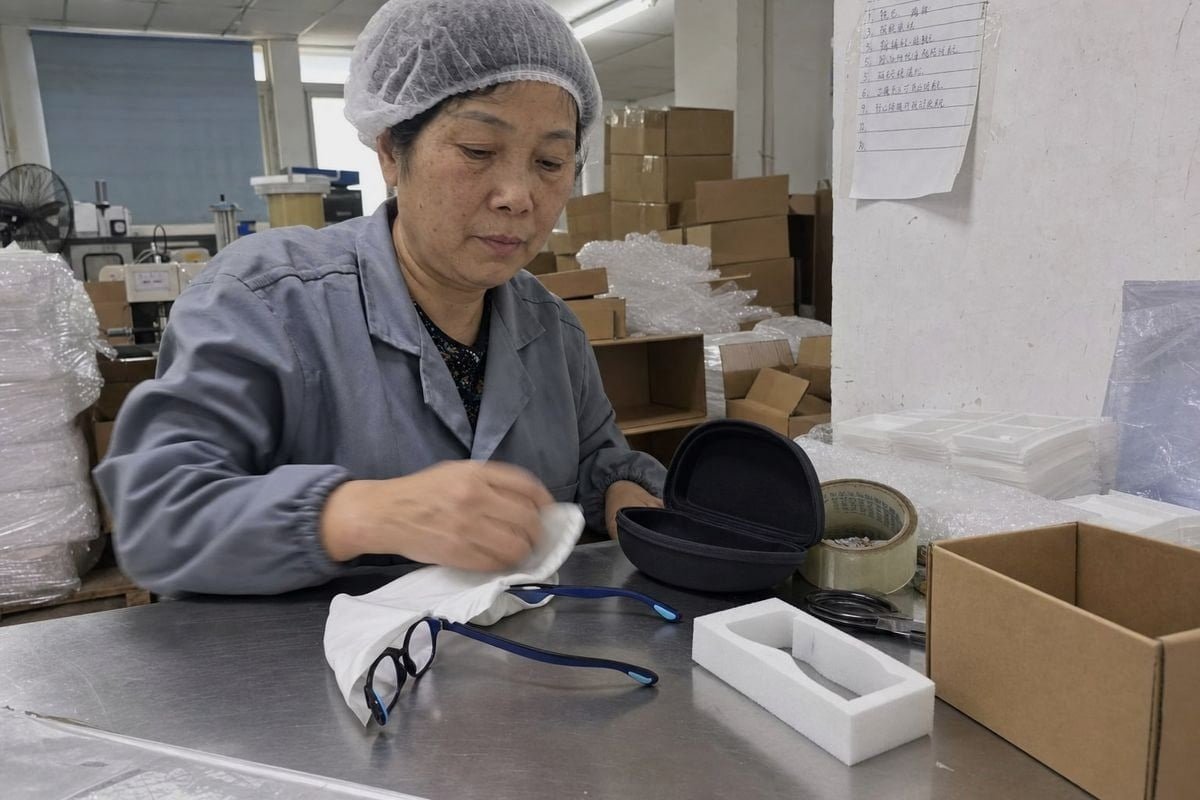
[Shipping kids’ eyewear safely](https://okayeyewear.com/how-avoid-lens-frame-damage-shipping-kids-sunglasses-bulk/) is harder than most buyers expect. On our production line in Taizhou, we learned this the hard way years ago with a badly packed export order.
To prevent deformation and scratches when shipping kids’ eyewear, use layered packaging: wrap lenses in microfiber, immobilize each frame in a rigid or fitted case, add protective foam inserts, then ship in a snug corrugated box with zero internal movement.
That single sentence hides a lot of detail. Below, I break down each layer, the costs involved, and the checks that keep your shipment intact.
What packaging materials actually protect kids' eyewear from deformation during long-distance shipping?
A buyer from Australia once sent us photos of a competitor's shipment: forty pairs of bent frames, all shipped loose in one polybag. That image still shapes how we pack every carton today.
Hard shell cases, microfiber storage pouches, protective foam inserts, and double-walled corrugated mailing boxes protect kids' eyewear best. The case stops bending, the pouch stops abrasion, foam absorbs shock, and the rigid carton resists stacking pressure during long-distance shipping.
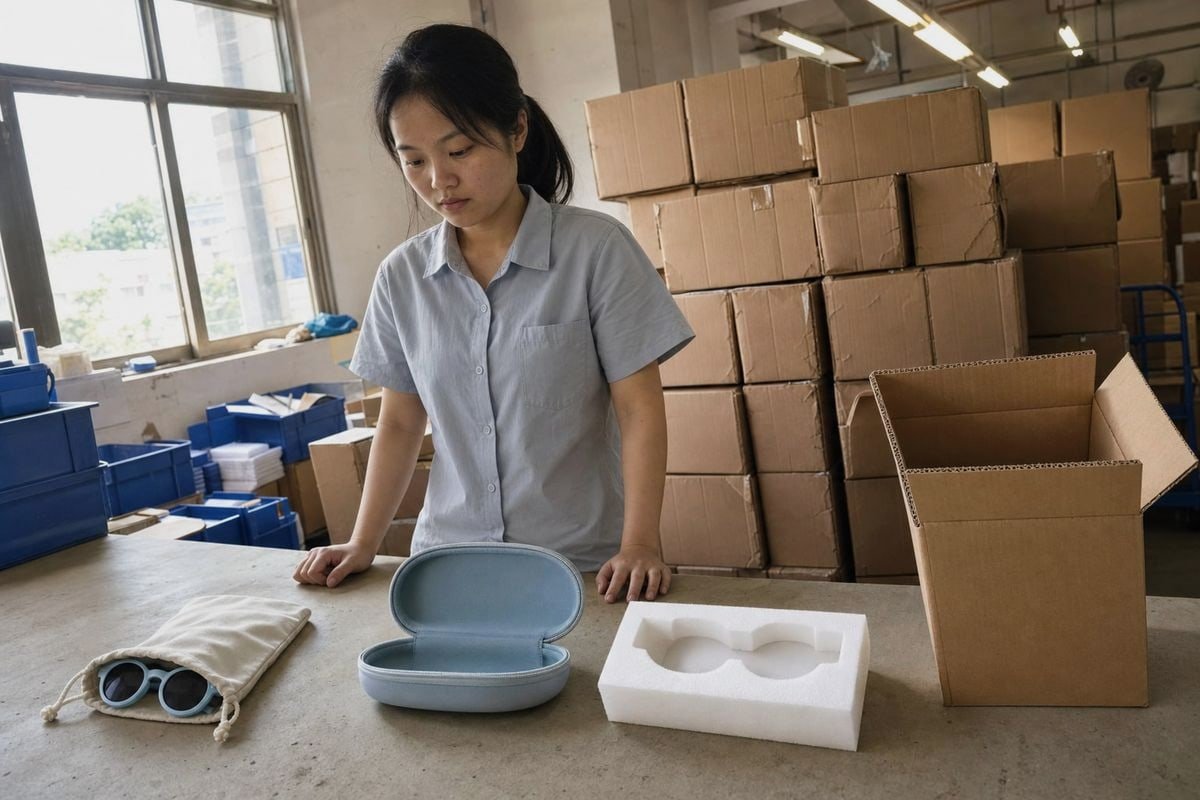
The core principle behind secure transit packaging 1 is simple: think inside-out. Each layer solves one specific problem, and no single layer solves them all. Skipping one layer creates a gap that long-distance freight will find.
The four-layer protection stack
| Couche | Matériel | Damage it prevents |
|---|---|---|
| Lens-safe layer | Microfiber storage pouches or acid-free tissue | Scratches, coating abrasion, dust rubbing |
| Immobilization layer | Hard shell cases (EVA or clamshell) | Frame twisting, temple bending, hinge stress |
| Shock-absorption layer | Protective foam inserts, bubble wrap, molded pulp | Drops, vibration, impact shock |
| Crush-resistance layer | Corrugated mailing boxes, double-walled preferred | Stacking pressure, compression, punctures |
Deformation almost always comes from sustained pressure, not from a single drop. A sea container stacks cartons five or six high for weeks. If the outer box flexes, that force transfers to the frames inside. This is why we never rely on a padded mailer alone. A flexible mailer transmits pressure straight to the bridge and temples.
Scratches come from a different failure: movement. When a pair rattles inside its case or the case shifts inside the box, the lens rubs against whatever it touches. Even polycarbonate lens durability 2 has limits when grit sits between the lens and a rough surface for a three-week voyage. Immobilization matters as much as cushioning. Fill every void, so a shaken box makes no sound.
For premium orders, we add corner protectors and internal dividers. For humid routes, silica gel desiccant packs 3 protect anti-reflective coatings from clouding. Small additions, big difference.
How can I choose scratch-resistant protective cases without adding too much cost to my order?
Cost per unit is the first question nearly every new brand asks us during sampling. My honest answer: case cost is a trade-off you should calculate against your return rate, not against zero.
Choose EVA hard shell cases for transit protection at moderate cost, or pair a low-cost microfiber pouch with a fitted foam tray for bulk orders. Ordering cases with your eyewear from one factory cuts sourcing, shipping, and assembly costs significantly.
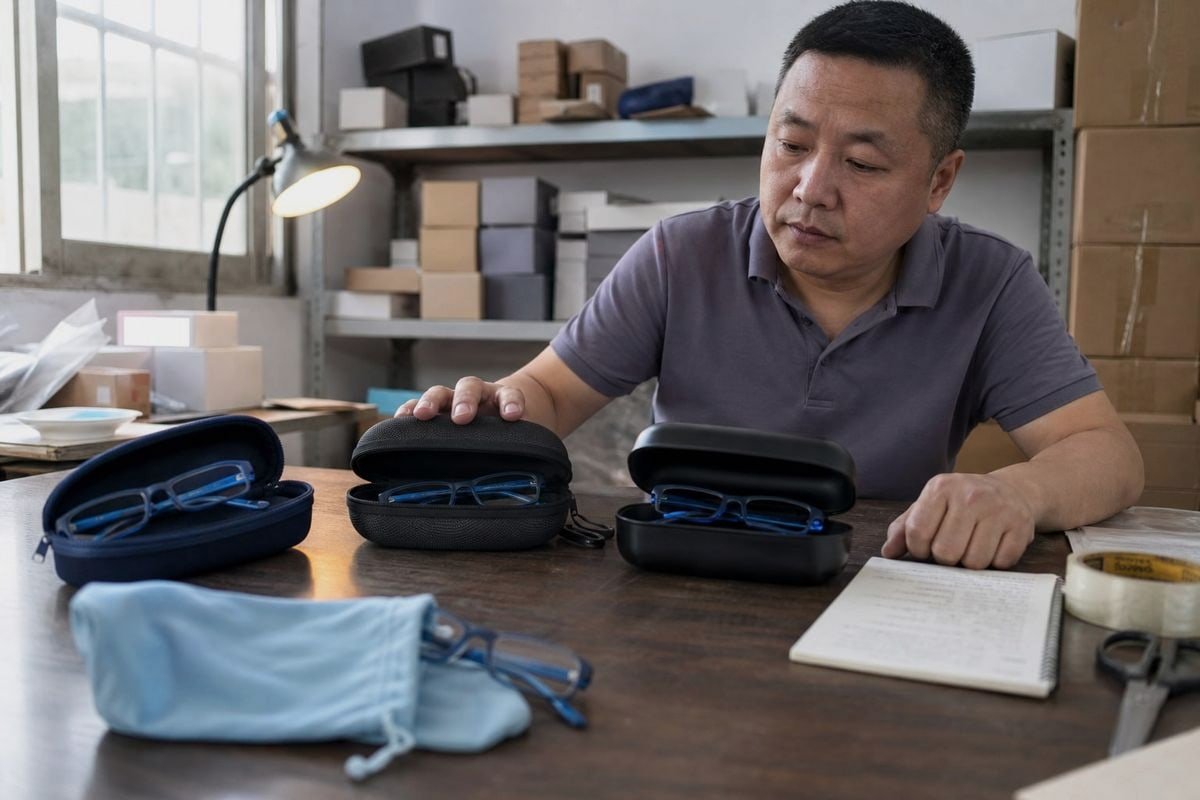
Here is how I walk buyers through the decision. First, define what the case must do. If it only needs to prevent scratches on the retail shelf, a soft microfiber pouch is enough. If it must survive international freight and protect the frame from crushing, you need rigid structure somewhere in the stack — either in the case or in the master carton insert.
Case options ranked by cost and protection
| Case type | Coût relatif | Scratch protection | Crush protection | Meilleure utilisation |
|---|---|---|---|---|
| Microfiber pouch | Le plus bas | Bon | Aucun | Bulk orders with foam tray cartons |
| Soft zip case | Bas | Bon | Weak | Child-friendly retail unboxing |
| EVA semi-hard case | Modéré | Très bon | Bon | Direct-to-consumer shipments |
| Clamshell hard case | Plus élevé | Très bon | Excellent | Premium lines, subscription boxes |
Some buyers worry that hard cases pose a safety risk when a child opens the package. That concern is fair. Child-focused packaging guidance favors soft cases, bright colors, and easy opening. Our compromise works well: use a child-safe soft case as the retail case, and let the master carton's protective foam inserts and dividers handle crush resistance. The child gets a friendly case. The freight gets rigid structure. Nobody pays for both twice.
Three more ways we help buyers control cost. Buy cases and eyewear together, so one factory assembles everything and you skip a separate supplier. Standardize one case across multiple styles from our 800-style catalog, which raises order volume per SKU. Finally, right-size the case; an oversized case needs extra filler and a bigger carton, and dimensional shipping fees add up fast.
What quality control checks should I request before my kids' eyewear leaves the factory?
Every export order in our Réalités du transit par mode 4 passes through a final inspection table before sealing. That step exists because one missed defect at origin becomes an expensive dispute at destination.
Request pre-shipment checks covering frame symmetry and hinge torque, lens surface film and coating inspection under bright light, drop and flex tests on sampled units, case fit verification, and a carton shake test confirming zero internal movement.
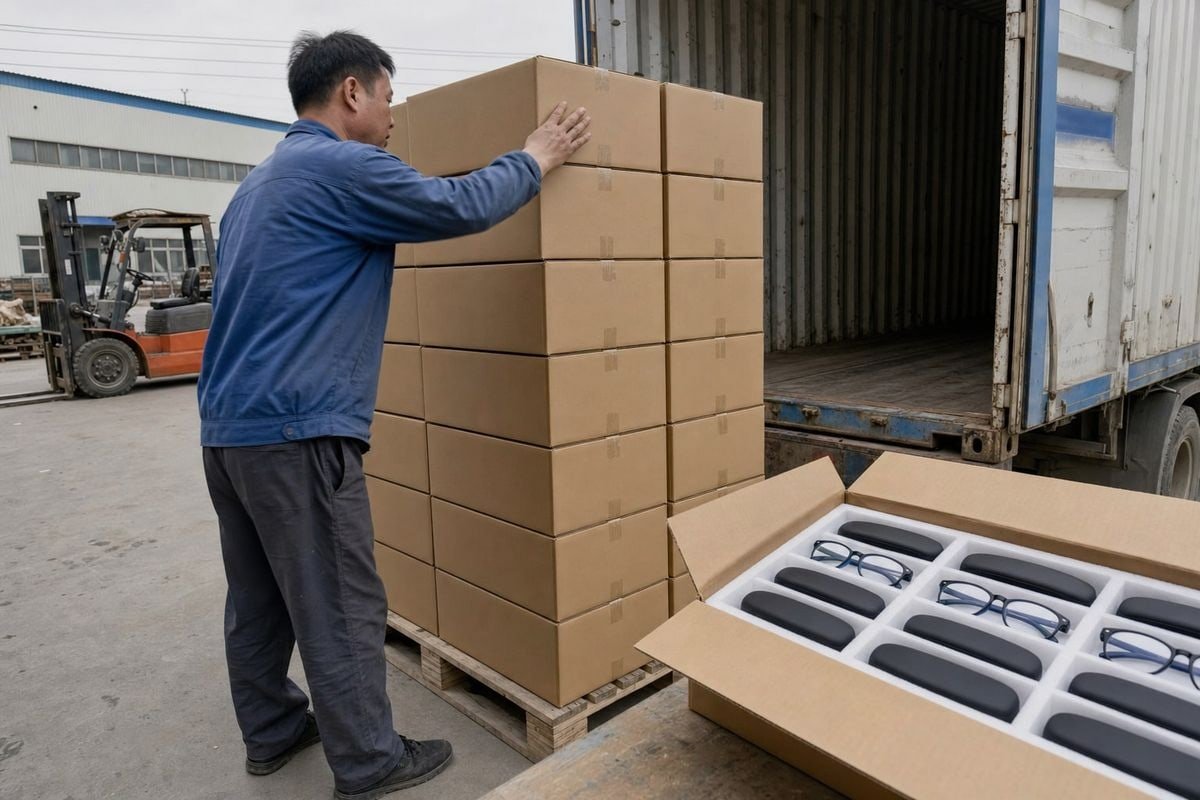
Good fulfillment quality control splits into three stages: product checks, packaging checks, and carton checks. Most buyers only ask about the first. The second and third are where transit damage is actually prevented.
Product-level checks
Ask your factory to sample units per AQL standards 5 and inspect each one for lens scratches under strong angled light, since micro-scratches hide under normal room lighting. Verify frame symmetry on a flat surface — both temples should touch simultaneously. Check hinge tension: temples should open and close smoothly without looseness. For flexible frames, request a twist-and-recover test to confirm the material returns to shape.
Packaging-level checks
Confirm the lens surface film or microfiber wrap is applied to every unit, not just the top layer of the carton. Verify the pair sits snugly in its case with no rattle. Check that any charms, cords, or accessories are packed separately, so they cannot scratch the lenses in transit.
Carton-level checks
A simple checklist we run on every order:
- Shake test — a sealed carton should make no sound when shaken.
- Compression check — the outer corrugated box should not flex under a firm hand press.
- Void inspection — foam or dividers must fill all empty space.
- Seal and label check — strong tape on all seams, fragile marking, correct shipping marks.
- Desiccant confirmation — silica gel packs included for humid sea routes.
Ask for photos or a short video of each stage. A reliable factory will send them without hesitation. We do this by default, because a documented pack-out protects both sides.
How do experienced manufacturers pack flexible TPEE and TR90 frames differently from rigid eyewear?
Fifteen years of working with flexible materials taught our team something counterintuitive: TR90 flexible frames and TPEE temples survive impacts that shatter acetate, yet they face one threat rigid frames barely notice — heat.
Flexible TPEE and TR90 frames need thermal protection more than impact protection. Experienced manufacturers avoid tight compression packing, add thermal-insulating liners for hot transit routes, use fitted trays that hold the frame's natural shape, and never heat-shrink film directly onto frames.
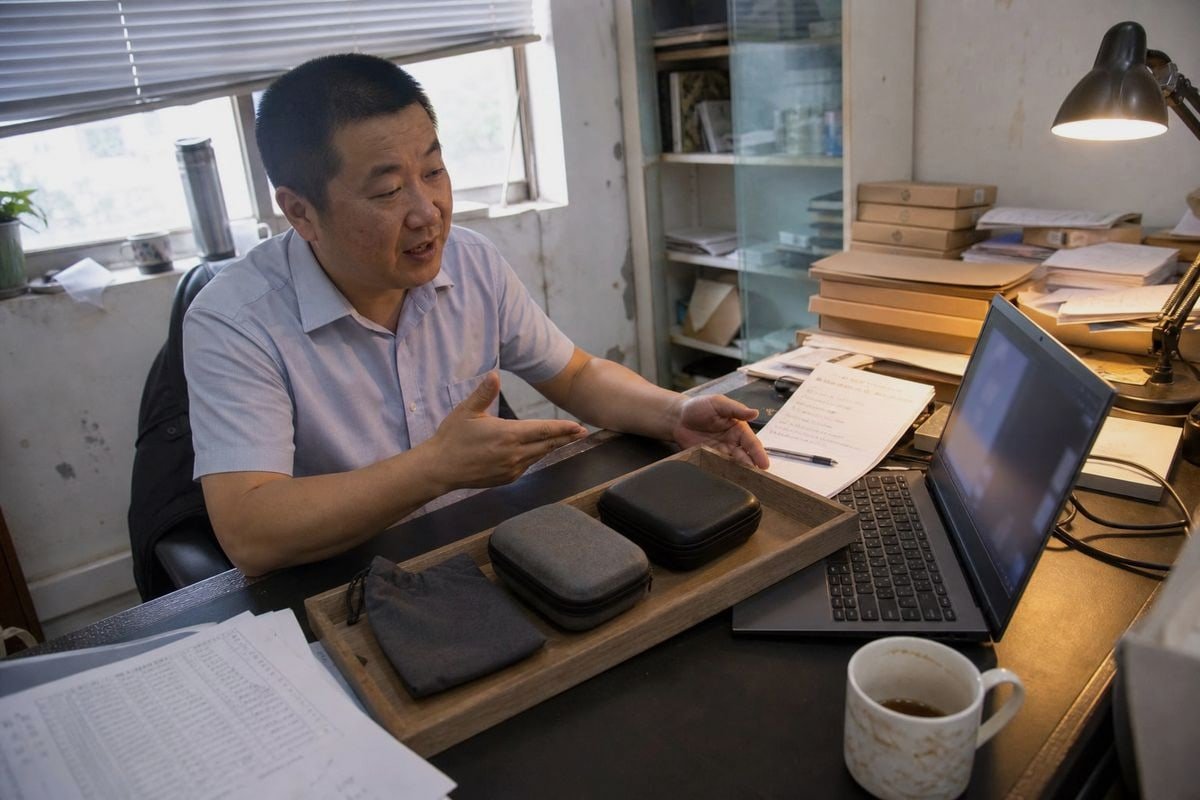
Thermoplastics like TR90 et TPEE 6 have memory. That memory is why they bounce back after a child twists them. But under sustained heat — a container crossing the equator, a delivery van in an Arizona summer — a flexible frame held in a bent position can take a permanent "heat-set" deformation. It cools in the wrong shape and stays there.
So the packing logic flips. With rigid acetate 7, the enemy is impact, and you cushion aggressively. With flexible frames, the enemy is constrained heat exposure, and you must let the frame rest in its natural geometry.
How our pack-out differs by material
| Packing factor | Rigid acetate frames | Flexible TPEE / TR90 frames |
|---|---|---|
| Main risk | Cracking, hinge breakage | Heat-set deformation, base-curve flattening |
| Ajustement de l'étui | Snug, firm cushioning | Fitted but never compressing the frame |
| Temple position | Folded flat, padded | Folded loosely, no pressure on flex zones |
| Hot-route extras | Norme | Thermal-insulating liners in master cartons |
| Shape support | Optionnel | Bridge stabilizers to hold the base curve |
Three specifics from our production floor. First, we insert custom-cut bridge stabilizers between the lenses and the case lid on wraparound and sport styles, so vertical stacking pressure cannot flatten the base curve. Second, we avoid tightly rolled wrapping; over-tight wrap stresses the frame exactly where heat could set it. Third, for plastic frames on high-vibration routes, anti-static packaging films help repel the fine abrasive dust that plastics attract, protecting both the frame finish and the lenses.
Shock absorption materials still matter — flexible frames carry screws, hinges, and coated lenses that dislike impacts. But the ranking of risks changes, and the packaging must change with it. When a supplier packs TR90 exactly like acetate, that is usually a sign they do not work with flexible materials often.
Conclusion
Damaged shipments destroy margins and trust. Layer your packaging, verify quality control before sealing, and pack flexible frames for heat, not just impact. Do that, and kids' eyewear arrives ready to sell.
Notes de bas de page
1. Authoritative overview of the standards and functions of packaging used for the transit of goods. ↩︎
2. Authoritative overview of polycarbonate’s impact resistance and durability for eyewear lenses. ↩︎
3. Comprehensive explanation of silica gel properties and its use as a desiccant for moisture control. ↩︎
4. Government resource explaining the 5S methodology for workplace organization and quality improvement. ↩︎
Plus d'articles que vous pourriez aimer
23 août 2026
Comment les lunettes pour enfants trop petites peuvent-elles être recyclées ou réutilisées ?
23 août 2026
Quelle est l'efficacité des matériaux biosourcés et recyclables dans les lunettes pour enfants ?
23 août 2026
Peut-on remplacer les verres après un changement de prescription pour les lunettes d'enfants ?
Vous recherchez un partenaire fiable en lunetterie pour enfants ?
Explorez plus de 800 styles prêts et un support OEM/ODM complet adapté à votre marque.
Contactez-nous English
  Español de México
  Deutsch
  Français
  日本語
日本語  العربية
  Português do Brasil