How Much Does No-Shelf-Display Packaging Increase Per-Unit Cost for Kids’ Sunglasses?
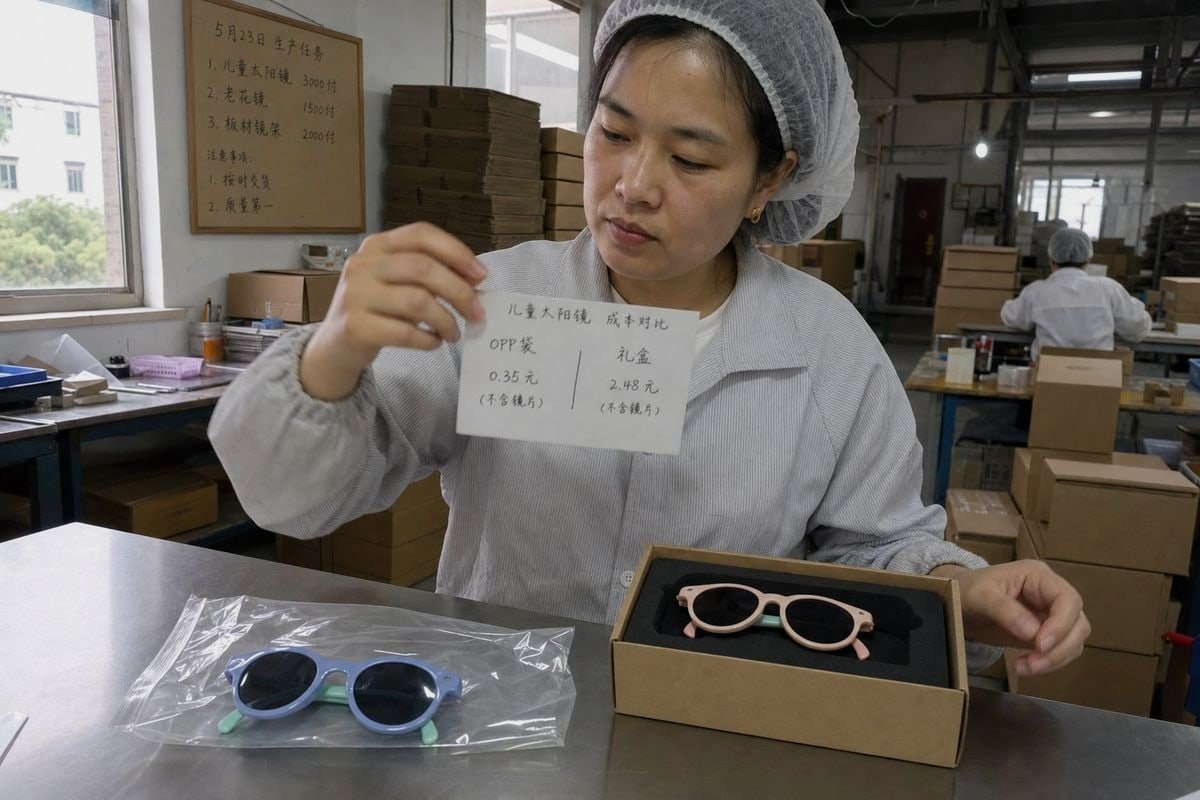
Buyers ask me about no-shelf-display packaging costs for kids’ sunglasses almost weekly. Guess wrong, and your margin quietly disappears. On our packing lines, we see exactly where that money goes.
No-shelf-display packaging typically increases per-unit cost for kids’ sunglasses by $0.15–$0.60, or roughly 10–45% over basic blister or polybag formats. The exact premium depends on order volume, material grade, print complexity, and whether protective inserts like pouches or foam cutouts are included.
That range is wide for a reason. Let me break down each factor so you can budget with confidence before you request quotes.
What factors determine how much extra I'll pay for no-shelf-display packaging on kids' sunglasses?
A buyer from Australia once sent me two packaging mockups that looked nearly identical. One quoted 40% higher. The difference sat entirely in board grade, print coverage, and assembly labor.
Five factors drive the premium: packaging material (rigid box vs. polybag), print coverage and finishing, manual assembly labor, protective inserts like microfiber pouches, and order volume. Material and labor typically account for 60–70% of the total no-shelf-display packaging cost increase.
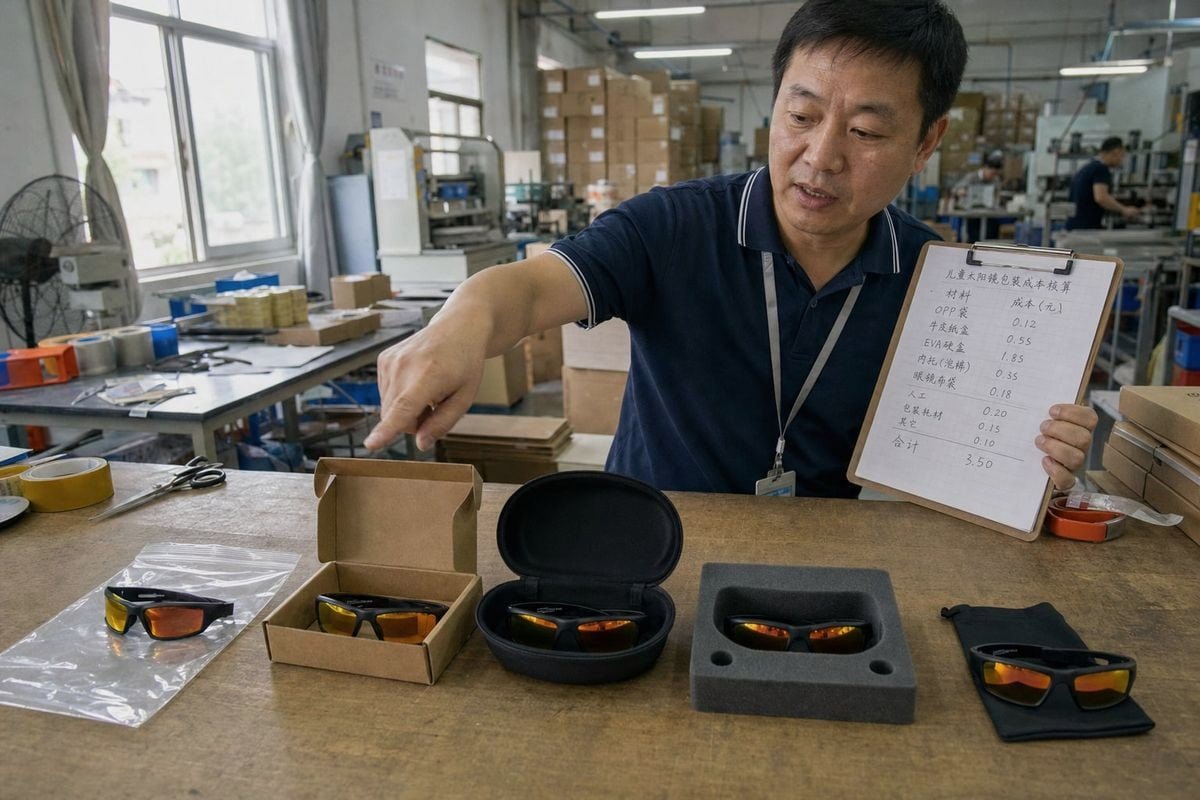
When we quote packaging for our TPEE and TR90 1 kids' frames, we build the price as a stack, not a single number. Understanding that stack helps you negotiate better.
The cost stack, layer by layer
Every no-shelf-display package starts with a base material. A plain OPP bag costs almost nothing. A rigid drawer box or an EVA hard case sits at the other extreme. Between them, you have folding cartons, kraft tuck boxes, and padded pouches.
| Cost Layer | Typical Add per Unit | What Drives It |
|---|---|---|
| Base material (bag, carton, box) | $0.03–$0.35 | Board grade, box style, size |
| Printing and finishing | $0.02–$0.15 | Color count, coverage, lamination |
| Protective insert | $0.03–$0.12 | Foam cutout, pouch, cleaning cloth |
| Assembly labor | $0.02–$0.08 | Hand-folding, inserting, sealing |
| Setup and tooling amortization | $0.01–$0.10 | Dies, plates, spread over run size |
Why kids' sunglasses are especially sensitive
Here is the nuance many buyers miss. Wholesale kids' sunglasses can sell for as little as $1.75–$2.00 per unit in promotional channels. On a product that cheap, even a $0.30 packaging add-on is a 15% cost jump. On a premium branded pair, the same $0.30 barely moves the needle. So the right question is not just "how much does packaging cost" but "what share of my coût rendu 2 can packaging absorb." In our experience supplying brands in 20+ countries, packaging usually lands between 8% and 20% of the ex-works price 3 for children's eyewear. Above 20%, we advise buyers to simplify the format or increase order volume.
How do minimum order quantities affect my per-unit packaging cost when I skip retail display packaging?
Last year, an importer asked us to quote the same custom kraft box at 500, 3,000, and 10,000 units. The per-unit price dropped by more than half across those three tiers.
MOQs dramatically shift per-unit packaging cost because setup fees, printing plates, and die-cutting tools are fixed. At 500 units, custom no-shelf-display packaging can add $0.50–$1.00 per unit; at 10,000 units, the same package often adds only $0.15–$0.25.
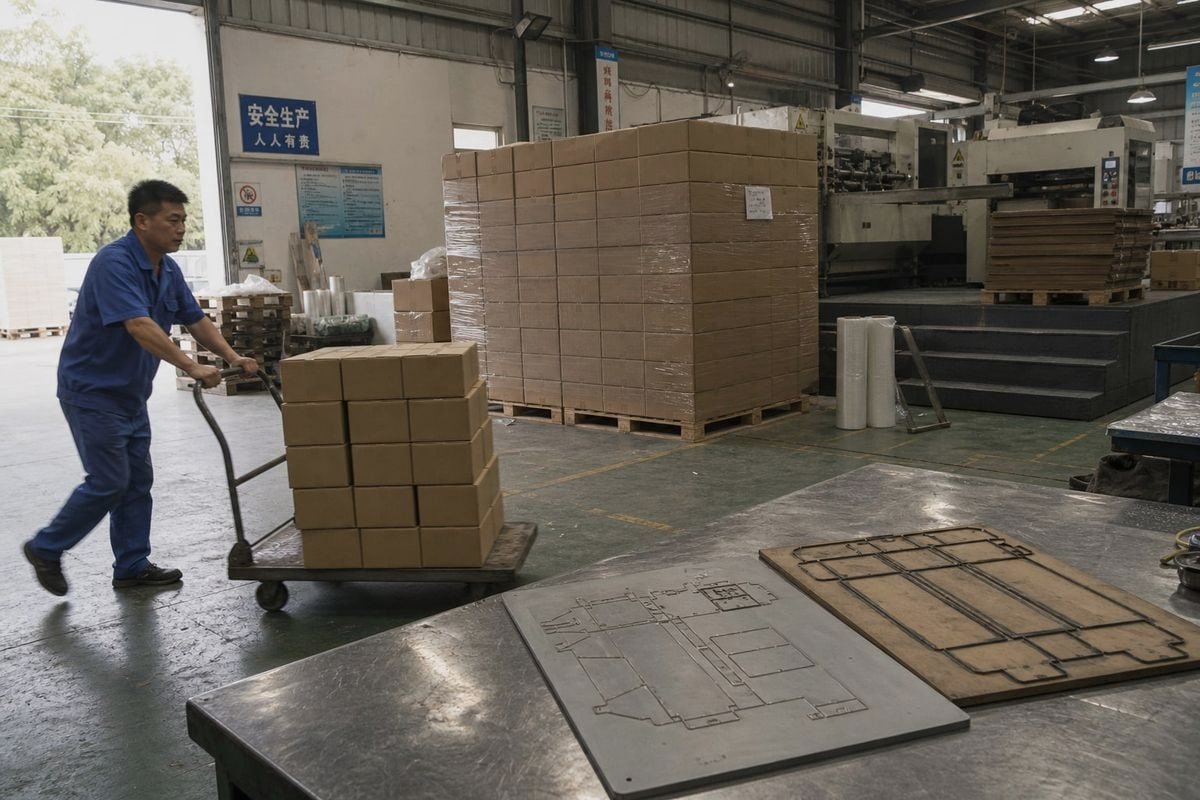
The economics here are simple but unforgiving. Custom packaging carries one-time costs. Printing plates, cutting dies, color proofing, and sample rounds must be paid whether you order 500 boxes or 50,000. Those fixed costs get divided across your run. Small runs carry the full weight.
A worked example
Assume a custom folding carton with a $300 tooling and setup fee, plus a $0.18 running cost per box.
| Order Quantity | Setup Cost per Unit | Running Cost | Total Packaging Cost per Unit |
|---|---|---|---|
| 500 units | $0.60 | $0.18 | $0.78 |
| 1,000 units | $0.30 | $0.18 | $0.48 |
| 3,000 units | $0.10 | $0.18 | $0.28 |
| 10,000 units | $0.03 | $0.18 | $0.21 |
The running cost barely changes. The setup amortization changes everything.
How we help buyers work around small MOQs
At our Taizhou factory, we keep around 800 existing styles precisely so new brands can test the market without heavy investment. The same logic applies to packaging. For first orders, we often suggest stock boxes with a custom printed sleeve or sticker. That approach cuts tooling costs to nearly zero while still looking branded. Once a buyer proves sell-through and reorders at 3,000+ units, fully custom packaging starts to make financial sense. We have watched several brands scale exactly this way over two or three seasons. Timing your packaging investment to your volume is one of the easiest margin wins available.
Can I reduce my packaging costs by choosing simpler materials without compromising product protection?
Protection is the one thing I refuse to compromise on, because our whole reputation rests on flexible, safe TPEE and TR90 frames arriving intact and staying safe for children.
Yes. Simpler materials like kraft folding cartons, single-color printing, and microfiber pouches instead of foam inserts can cut packaging cost by 20–40% while maintaining protection. Kids' sunglasses in flexible TPEE or TR90 tolerate lighter packaging better than rigid acetate frames.
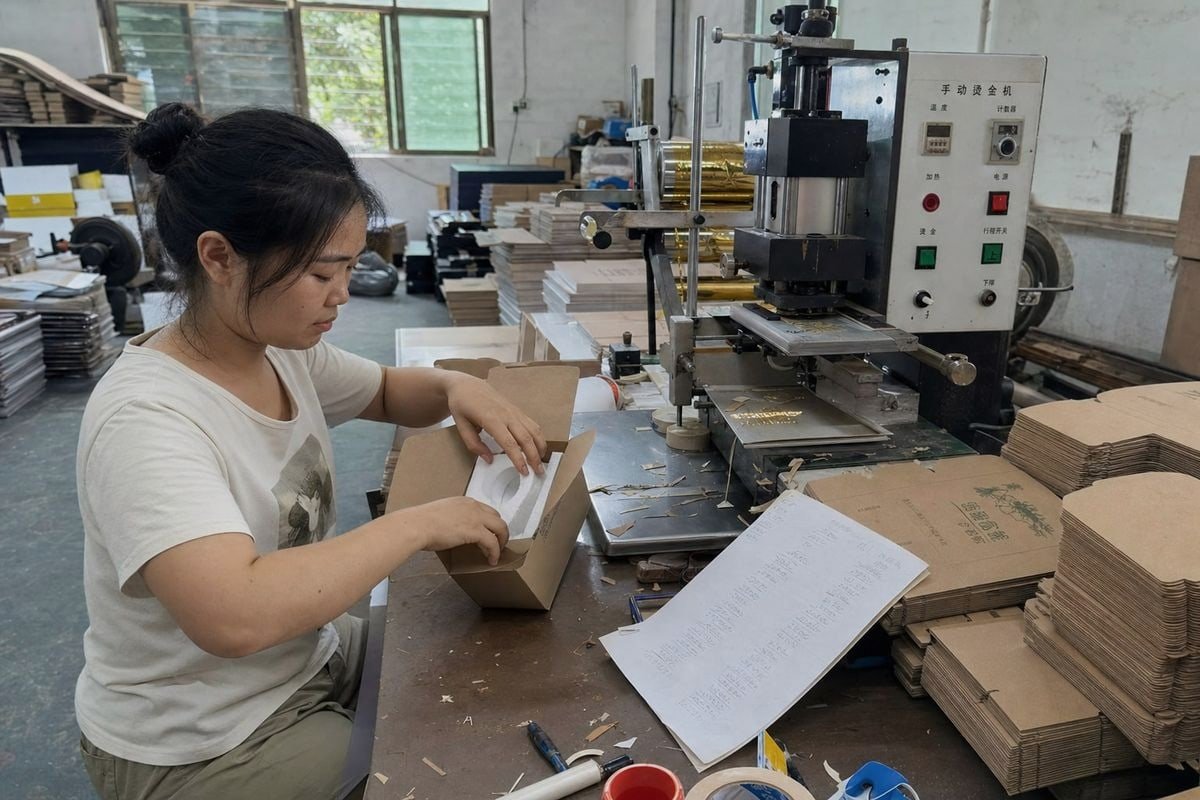
Here is an advantage that works in your favor. Flexible children's frames are inherently harder to break than rigid adult frames. A TR90 frame with TPEE temples can bend, twist, and spring back. That means the packaging's job shifts from crush protection toward scratch prevention and presentation. You can safely go lighter.
Where to simplify, and where not to
- Downgrade the box style first. A tuck-end folding carton protects nearly as well as a rigid box at a fraction of the cost.
- Cut print coverage, not print quality. One or two colors on kraft board looks intentional and premium. Full-bleed four-color printing with lamination is the expensive route.
- Swap foam cutouts for a microfiber pouch. The pouch prevents lens scratches, doubles as a usable accessory, and packs flatter.
- Never cut the lens-facing protection. A scratched UV400 or polarized lens 4 is a returned product. Keep at least a pouch or tissue wrap against the lens.
- Never cut required safety labeling. Warning text and compliance marks for children's products are non-negotiable and cost almost nothing anyway.
Material comparison at a glance
| Packaging Option | Relative Cost | Protection Level | Idéal pour |
|---|---|---|---|
| OPP bag only | Lowest | Basic scratch cover | Bulk fulfillment |
| Kraft tuck box + pouch | Low-mid | Good | E-commerce, boutiques |
| Printed carton + foam insert | Mid | Very good | Retail-ready branding |
| Rigid box or EVA case | Élevé | Excellent | Premium gift positioning |
When we run drop tests on our own packing formats, the kraft-box-plus-pouch combination consistently protects flexible kids' frames through normal courier handling. Spend on presentation only where your channel rewards it.
Is it worth paying more for no-shelf-display packaging if I'm selling directly through my own online store?
One of our European buyers put it perfectly during a sampling call: online, the unboxing is the shelf. Her reorder rate proved the point.
Usually yes. For direct-to-consumer online stores, no-shelf-display packaging is worth the premium because it improves unboxing experience, cuts shipping damage by an estimated 10–15%, and reinforces brand perception. Display features like hang tabs and blister windows add cost without any benefit online.
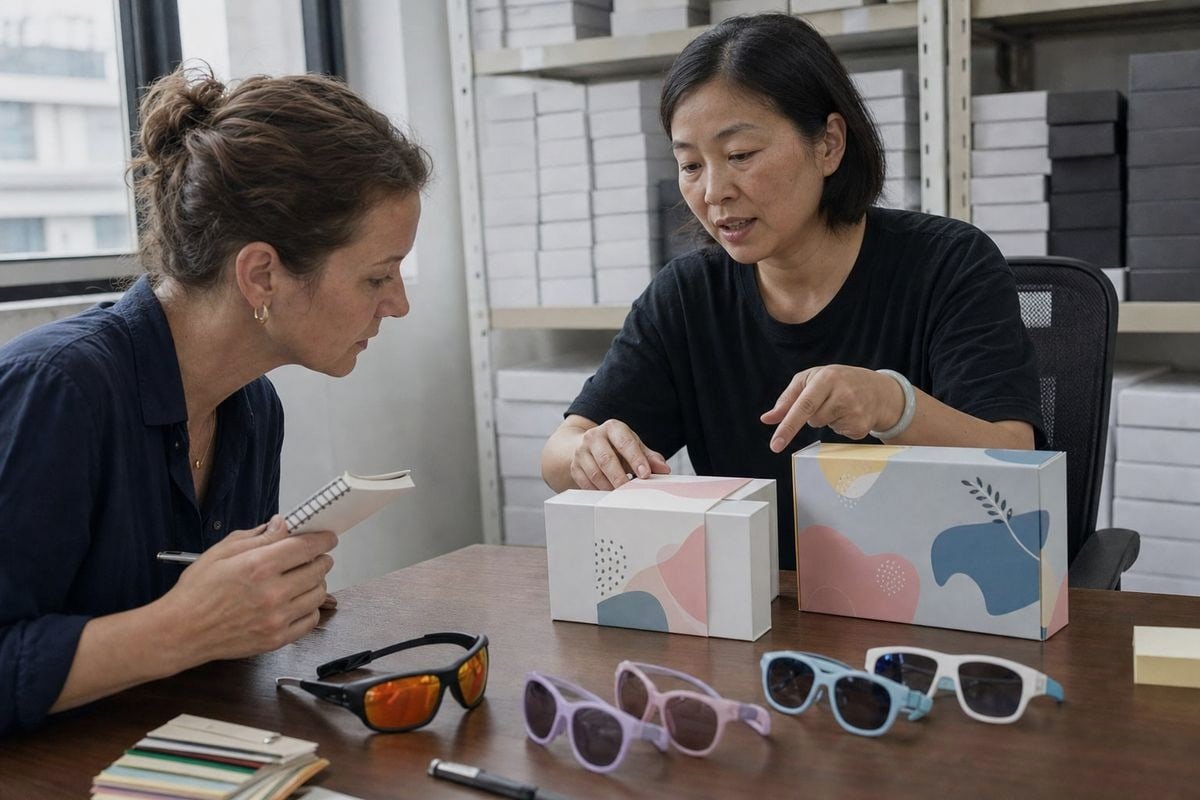
Think about what display packaging actually pays for. Hang tabs, die-cut windows, and shelf-ready trays exist to win attention in a physical aisle and reduce retailer labor. In your own online store, none of that applies. The customer already bought the product. Your packaging now has three different jobs: survive shipping, delight at opening, and encourage a repeat purchase or a social share.
The math often favors better boxes online
Damage and returns are where the premium pays for itself. A blister card is designed to hang, not to travel loose in a mixed parcel. A snug carton with a pouch travels better. If a sturdier package costs $0.30 more but prevents even a small percentage of damage claims on a $25 retail pair, it covers itself quickly. Refunds, reshipping, and lost customer trust cost far more than board and ink.
There is also a brand equity argument. Parents buying children's eyewear online judge safety and quality partly through packaging. A clean, well-printed box with clear UV400 labeling 5 and a soft pouch signals a careful brand. A loose polybag signals a commodity. Since our OEM/ODM support 6 already covers custom colors, logos, lenses, and packaging, we usually advise D2C buyers to invest the display-format savings into unboxing quality instead. You are not spending more overall. You are redirecting the same budget from the retailer's shelf to your customer's hands, where it now works hardest.
Conclusion
No-shelf-display packaging for kids' sunglasses typically adds $0.15–$0.60 per unit. Volume, materials, and channel decide whether that premium hurts margin or builds your brand. Budget it deliberately.
Notes de bas de page
1. Background on TR90 thermoplastic material used in flexible kids’ eyewear frames. ↩︎
2. Official trade resource explaining landed cost calculations relevant to import pricing. ↩︎
3. Government trade resource clarifying Incoterms like ex-works used in pricing. ↩︎
4. Explains polarization technology referenced for children’s sunglasses lenses. ↩︎
5. Explains UV400 protection standard referenced when discussing lens safety labeling on packaging. ↩︎
6. Defines OEM/ODM manufacturing model mentioned for custom eyewear production. ↩︎
Plus d'articles que vous pourriez aimer
1 août 2026
L'usine doit-elle gérer l'emballage et l'étiquetage des lunettes pour enfants, ou utiliser un fournisseur désigné ?
1 août 2026
Entrepôt propre vs. exécution directe par le fournisseur : lequel réduit les coûts de retour pour les marques de lunettes pour enfants ?
1 août 2026
Entrepôt direct au port ou staging outre-mer : lequel permet d'économiser le plus sur l'expédition des lunettes pour enfants ?
Vous recherchez un partenaire fiable en lunetterie pour enfants ?
Explorez plus de 800 styles prêts et un support OEM/ODM complet adapté à votre marque.
Contactez-nous English
  Español de México
  Deutsch
  Français
  日本語
日本語  العربية
  Português do Brasil