How to Include Quality Standards, Inspection, and Liability in Kids’ Sunglasses Contracts?
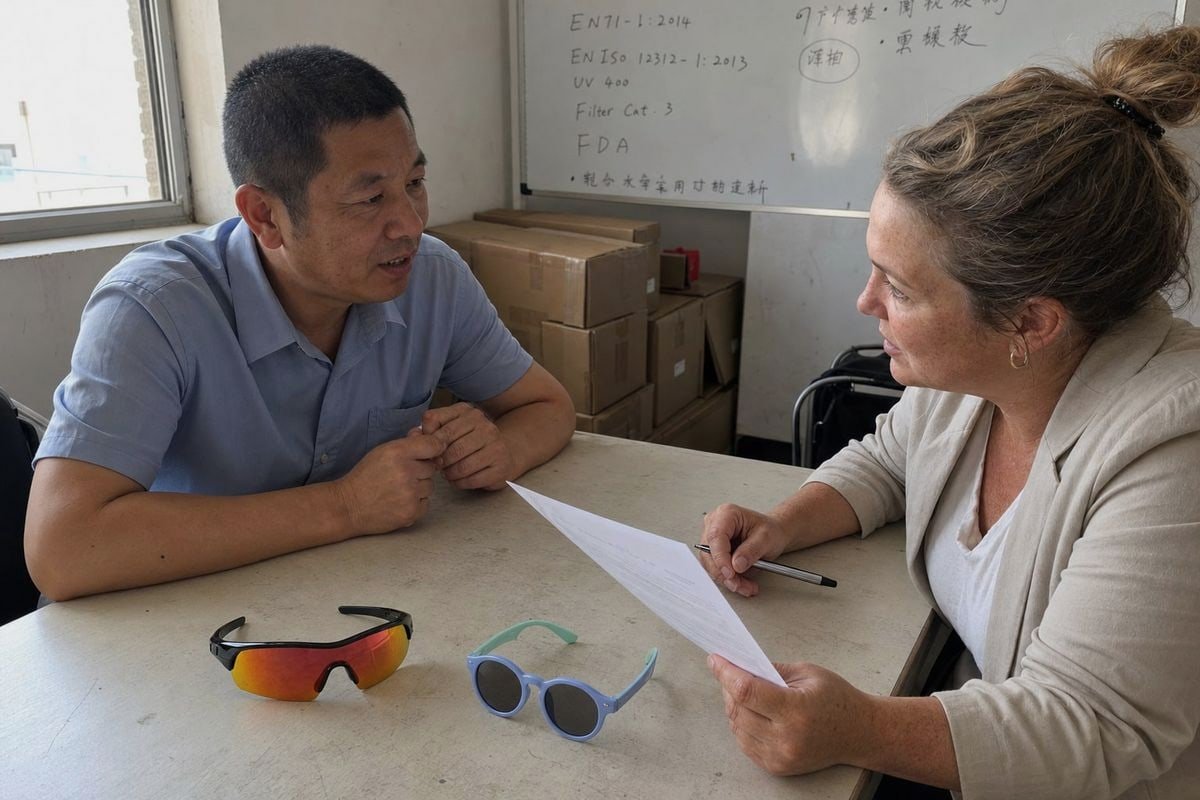
Quality standards, inspection, and liability in [kids’ sunglasses contracts](https://okayeyewear.com/how-write-clear-purchase-contract-sourcing-kids-sunglasses/) often get squeezed into one vague line. On our factory floor in Taizhou, I have seen what that vagueness costs buyers.
To include quality standards, inspection, and liability in kids’ sunglasses contracts, name the exact safety standards (ISO 12312-1, ANSI Z80.3, AS/NZS 1067.1), define AQL-based inspection checkpoints with third-party testing, and add supplier warranties, indemnification, recall obligations, and product liability insurance clauses.
Below, I will break each of these elements down. I will show you what to write, why it matters, and where buyers most often leave gaps.
What Quality Standards Should I Specify in My Kids' Sunglasses Manufacturing Contract?
A buyer from Australia once sent us a contract that simply said "sunglasses must be high quality and block UV." Our team asked her to rewrite it before we signed. Here is why.
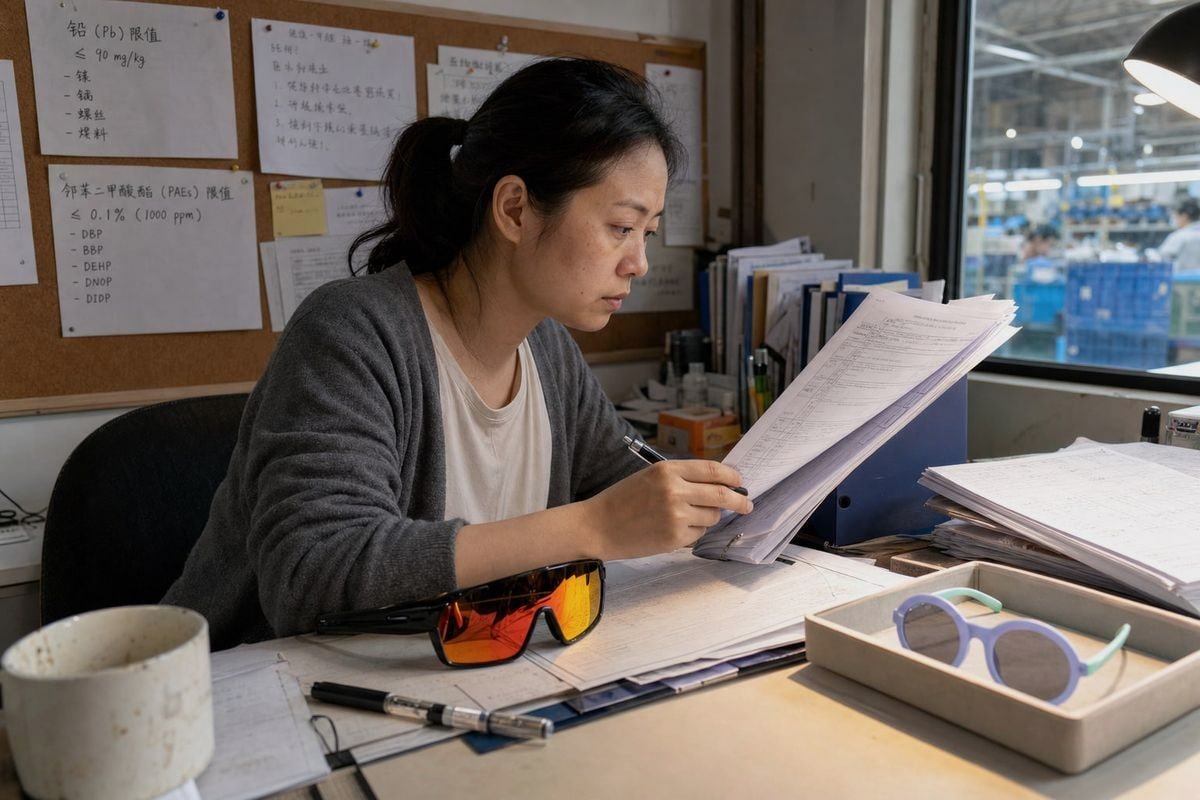
Your contract should specify 100% UVA/UVB (UV400) protection with lab-verified transmission limits, the market-specific standard (ISO 12312-1 for the EU, ANSI Z80.3 for the US, AS/NZS 1067.1 for Australia), shatter-resistant lens material, chemical limits for children's products, and numeric tolerances for each requirement.
Vague words like "good quality" are unenforceable. If a shipment arrives with lenses that only block 90% of UV, and your contract never defined "UV protection," you have no clear breach. That is why we push buyers to translate every safety claim into a measurable specification.
Start With the Safety-Critical Specs
Kids' sunglasses carry a core product promise: they protect a child's eyes. So the contract must define that promise in numbers. For the wraparound sport shields and the pastel round frames we produce, the safety specs are identical even though the styles differ.
At minimum, specify these five areas:
- UV performance. State "100% UVA/UVB protection" or "UV400 1," and require test reports showing transmission below the standard's limit. Remember, lens tint does not indicate UV blocking. A dark gray lens with no UV coating is worse than no sunglasses at all, because the pupil dilates behind it.
- Lens material and impact resistance. Require polycarbonate 2 or an equivalent shatter-resistant material. Never allow glass lenses for children. Our sport shield styles use single-piece polycarbonate lenses precisely because kids fall, throw things, and sit on their glasses.
- Frame material and flexibility. Name the material. We work mainly in TPEE and TR90 because they flex instead of snapping into sharp edges. Your contract should state the material and require it to match approved samples.
- Chemical compliance. For children's products, list limits on lead, phtalates 3, and heavy metals. US buyers should reference CPSIA obligations; EU buyers should reference REACH restrictions.
- Tint category and optical clarity. Specify the filter category and require uniform tint with no optical distortion.
Map Standards to Your Market
| Marché | Norme de base | Extra Children's Requirements |
|---|---|---|
| Union européenne | EN ISO 12312-1, Marquage CE 4ing | REACH chemical restrictions, toy-adjacent safety checks |
| États-Unis | ANSI Z80.3 | CPSIA lead/phthalate limits, tracking labels, testing documentation |
| Australie / Nouvelle-Zélande | AS/NZS 1067.1:2016 | Mandatory standard compliance; sunglasses are regulated products |
| Approuvé dans le monde entier | Often follows ISO 12312-1 | Buyer-specific chemical and labeling requirements |
One nuance I always flag: a CE mark alone is not a specification. Name the underlying standard in the contract. The mark is a claim; the standard is the proof.
How Do I Set Up Inspection Checkpoints With My Eyewear Manufacturer?
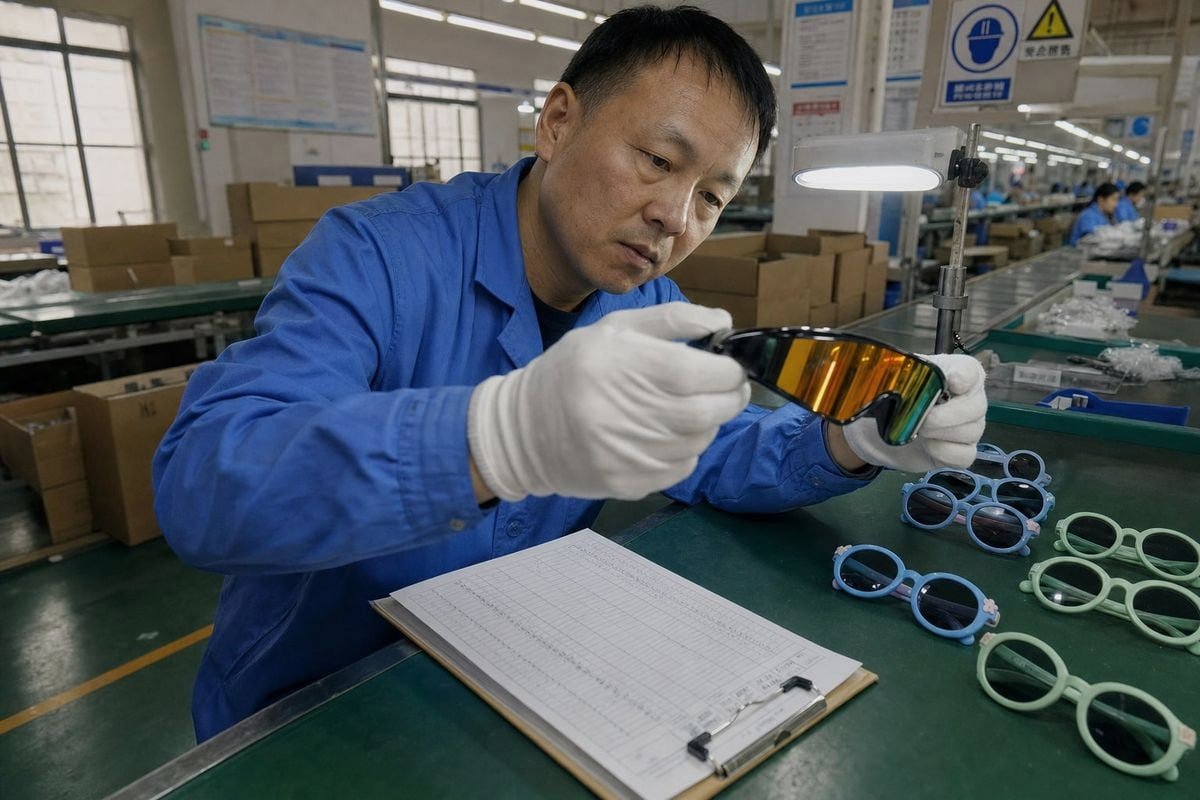
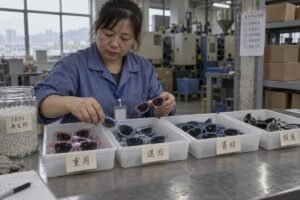
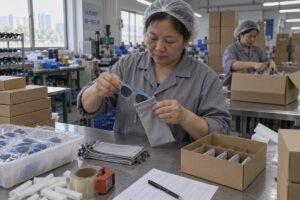
Every production run in our 5S-managed workshop passes through checkpoints we agreed with the buyer in advance. When those checkpoints live in the contract, disputes almost never happen. When they don't, everything becomes an argument.
Set four contractual checkpoints: pre-production sample approval, in-line inspection during assembly, final random inspection using AQL sampling per ANSI/ASQ Z1.4, and independent lab testing for UV, impact, and chemical safety. Make passing reports a condition of shipment release and payment.
The key idea is simple. Inspection should not be one event at the end. It should be a sequence of gates, each with a written pass/fail rule. Let me walk through how we structure this with experienced buyers.
The Four-Gate Inspection Framework
| Point de contrôle | Calendrier | What Is Checked | Contractual Trigger |
|---|---|---|---|
| Échantillon de pré-production | Avant la production de masse | Materials, colors, fit, lens specs, packaging mockups | Written buyer approval starts production |
| In-line inspection | 20–50% of production complete | Assembly quality, hinge screws, lens seating, coating consistency | Corrective action before continuing |
| Final random inspection | 100% produced, 80%+ packed | AQL sampling of cosmetic, functional, and labeling defects | Pass report required for shipment release |
| Third-party lab testing | Before or during production | UV transmission, impact resistance, lead, phthalates | Certificates delivered before payment |
Write AQL Levels Into the Contract
Do not just write "final inspection required." Define the sampling plan and defect tolerance. A common structure for children's eyewear looks like this:
- Critical defects (safety): AQL 0. Zero tolerance. Examples: sharp edges, cracked lenses, missing UV coating, loose small parts on a strap or hinge.
- Major defects: AQL 1.5 or 2.5. Examples: scratched lenses, misaligned temples, wrong tint gradient on a mirrored shield lens.
- Minor defects: AQL 4.0. Examples: slight packaging blemishes, faint mold marks on a temple tip.
Then name your approved inspection agencies — SGS 5, Bureau Veritas, Intertek, or your own QC team — and state who pays for the first inspection and who pays for re-inspection after a failure. In our experience, making the supplier pay for re-inspection after a failed check keeps everyone honest, including us.
Add Traceability
Require batch and lot certification for lenses. If a UV coating issue ever surfaces, lot traceability lets you recall one batch instead of an entire season's inventory. We laser-mark or label lots for buyers who ask, and I would encourage every children's brand to ask.
Who Should Be Liable If a Safety Defect Is Found After Shipment?
Years of exporting kids' eyewear to 20-plus countries have taught me one uncomfortable truth: liability questions only get answered fairly when they are answered before anything goes wrong.
The manufacturer should bear liability for defects traceable to production, materials, or non-compliance with contracted standards, including replacement, refunds, recall costs, and indemnification for injury claims. The buyer typically bears liability for design choices, labeling instructions, and market claims the buyer specified.
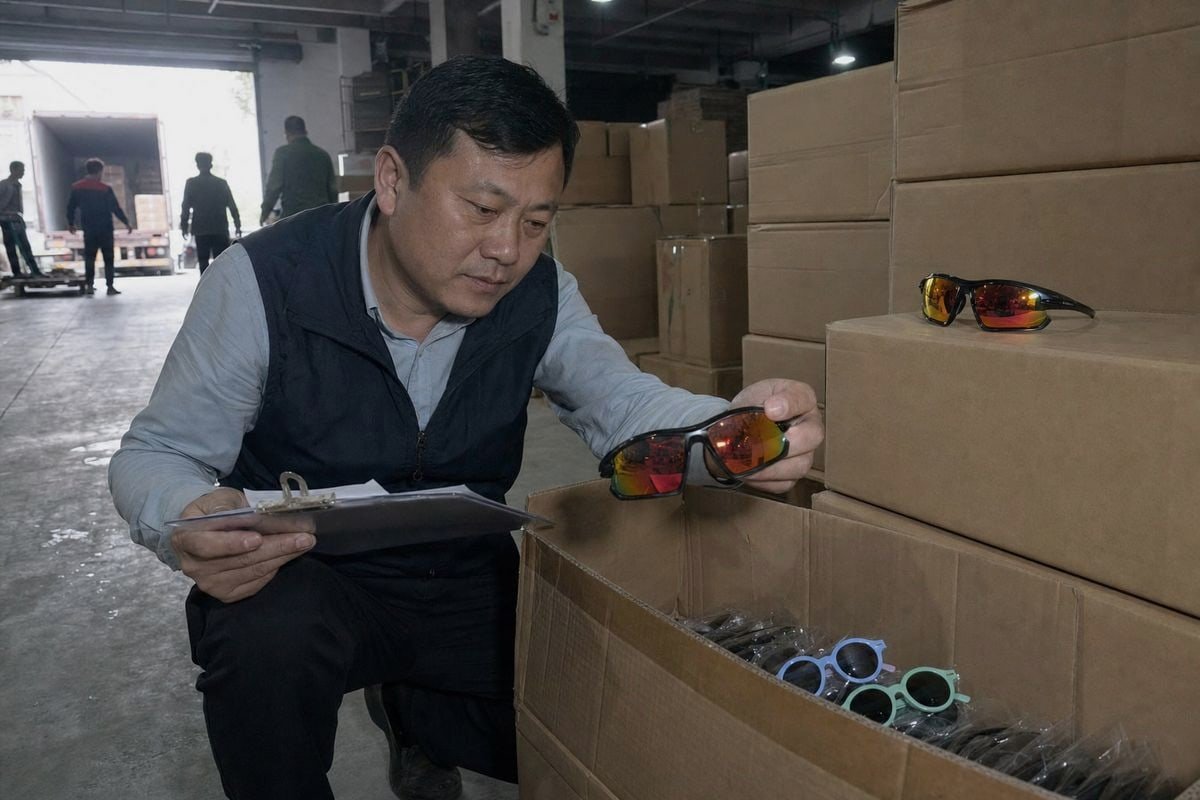
Passing inspection does not erase supplier responsibility. Your contract should say this explicitly. An inspection is a snapshot of a sample; a latent defect — say, a UV coating that degrades within months — can slip through. The warranty must survive acceptance.
Draw the Liability Line by Root Cause
The fairest way to allocate liability is by asking: who controlled the decision that caused the failure?
| Scénario de défaillance | Root Cause | Who Bears Liability |
|---|---|---|
| Lenses fail UV400 testing at retail | Wrong coating or material substitution | Fabricant |
| Lens shatters, child injured | Non-conforming lens material | Fabricant |
| Phthalates exceed limits in rubber temple tips | Uncontrolled raw material sourcing | Fabricant |
| Product recalled over a strap the buyer designed and specified | Buyer's design decision | Buyer, unless factory flagged the risk |
| Packaging claims "polarized" but buyer ordered non-polarized lenses | Buyer's artwork instruction | Buyer |
| Goods conform to spec but the spec itself violates local law | Buyer's spec, unless supplier warranted compliance | Depends on the compliance warranty |
That last row is why compliance warranties matter. If the supplier warrants that products "comply with AS/NZS 1067.1," the supplier owns that outcome even if the buyer's spec was silent. As a factory, we accept that warranty for standards we know and test against — and honest suppliers should.
Build a Graduated Remedy Ladder
Do not treat a scratched lens and a shattered lens the same way. Structure remedies by severity:
- Cosmetic defects above AQL: rework or discount, capped liability.
- Functional defects: replacement or refund of affected units, plus re-shipping costs.
- Safety-critical defects: full refund, recall cost coverage, and indemnification for third-party injury claims — carved out from any liability cap.
Graduated caps encourage strict QC on safety items while keeping minor disputes fast to resolve. Also require the supplier to carry une assurance responsabilité civile produit 7 with a stated minimum coverage, and ask for the certificate before your first purchase order, not after your first claim.
What Contract Clauses Protect My Brand From Non-Compliant Children's Eyewear?
When we onboard a new children's brand, I often review their draft agreement and find the same missing pieces. The gaps are predictable, so the fixes can be too.
Protect your brand with clauses covering supplier compliance warranties, documentation delivery before payment, third-party inspection rights, batch traceability, recall cooperation, indemnification, product liability insurance naming you as additional insured, continuous regulatory-update notification, and payment milestones tied to passed inspections.
Think of these clauses as layers of defense. Each one closes a specific gap between a marketing claim and a proven, documented fact.
The Nine Clauses I Would Never Skip
- Compliance warranty. The supplier warrants conformity with every named standard, absence of restricted substances, and consistency with approved samples — surviving inspection and acceptance.
- Documentation before payment. Test reports, declarations of conformity, and certificates must be delivered before final payment or shipment release. No documents, no funds.
- Inspection and audit rights. You may inspect the factory, appoint third-party agencies, and re-inspect after failures at the supplier's cost. Our workshop hosts buyer audits regularly; a factory that resists this clause is telling you something.
- Traceability. Batch and lot certification for lenses and frame materials, retained samples from each production run, and records kept for a defined number of years.
- Corrective action procedure. Automatic rework, replacement, or refund obligations when goods fail inspection — with defined timelines, so a failed shipment does not stall your launch season indefinitely.
- Recall cooperation. The supplier must support any recall, cover costs for defects it caused, and assist with regulatory notices in your market.
- Indemnification. The supplier indemnifies you against injury claims, regulatory penalties, and third-party claims arising from defects or non-compliance.
- Insurance. Product liability coverage with minimum limits, certificates on request, and you named as additional insured where possible.
- Continuous compliance. If ISO 12312-1, CPSIA rules, or AS/NZS requirements change, the supplier must notify you within a defined window and implement necessary changes.
Consumer Label vs. Contract Specification
A useful mental check: every claim on your retail packaging should map to a contract clause with evidence behind it. "UV400" on the hang tag should trace back to a transmission test report required by your agreement. "Flexible and kid-safe" should trace back to a named material spec and chemical test. If a claim has no contractual backing, either add the clause or remove the claim. Labels sell the product; contracts prove it.
Conclusion
A kids' sunglasses contract must prove safety, not just claim it. Name the standards, gate production with inspections, and allocate liability clearly — before the first order ships.
Notes de bas de page
1. CDC guidance on UV protection standards supports the UV400 requirement discussion. ↩︎
2. Explains the shatter-resistant plastic material required for safe children’s lenses. ↩︎
3. CDC factsheet on
Plus d'articles que vous pourriez aimer

Vous recherchez un partenaire fiable en lunetterie pour enfants ?
Explorez plus de 800 styles prêts et un support OEM/ODM complet adapté à votre marque.
Contactez-nous English
  Español de México
  Deutsch
  Français
  日本語
日本語  العربية
  Português do Brasil