How to Judge Injection Molding & Rubber Coating Quality in TR90 & TPEE Kids Optical Frames?
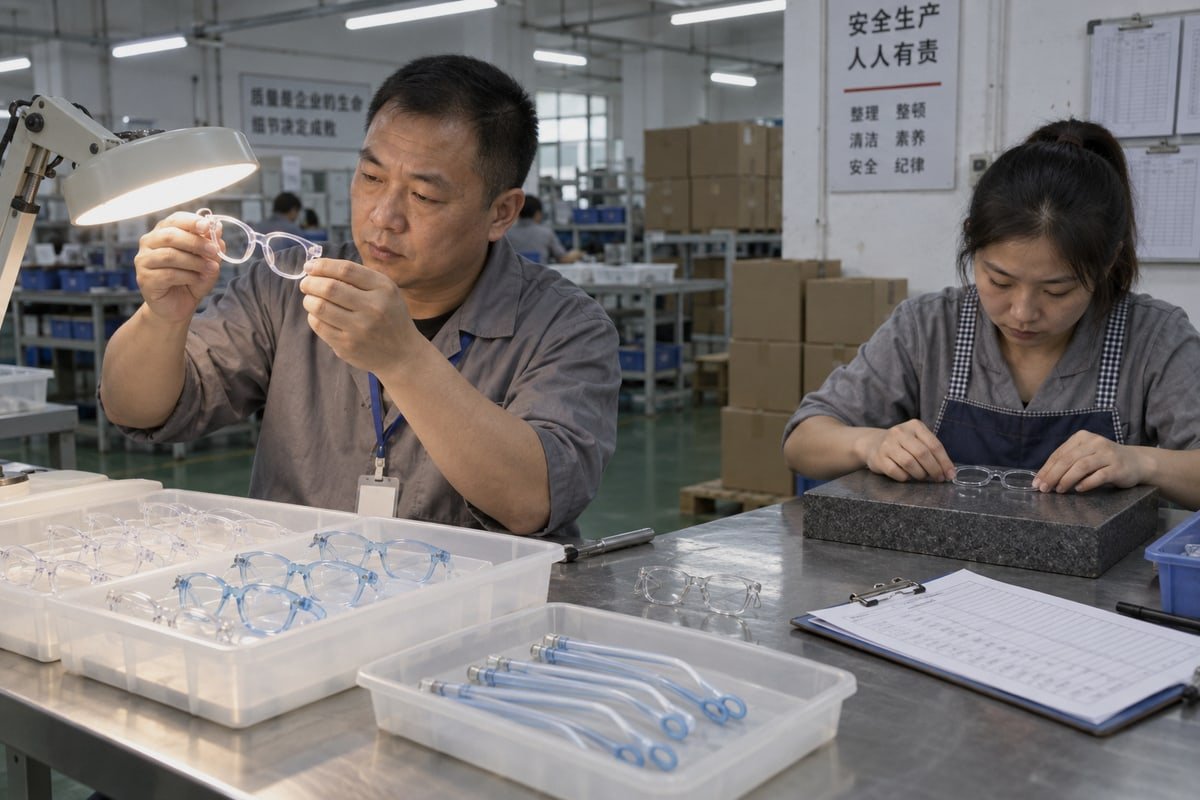
Many buyers judge injection molding and rubber coating quality in TR90 and TPEE kids optical frames by the resin name. On our line, the mold and finish decide far more.
Judge injection molding and rubber coating quality in TR90 and TPEE kids optical frames by checking symmetry, flatness, clean mold parting lines, absence of sink marks and flow marks, then testing coating adhesion, uniformity, and tackiness. Bend temples for shape memory and request MSDS, density, and adhesion test reports.
That is the short version. Below, I break it into four practical questions. Each one gives you checks you can do by hand, plus the tests and documents you should ask for before you commit to a bulk order.
What defects should I look for on the injection-molded TR90 frame front?
Last spring our QC team pulled a batch of crystal-clear TR90 fronts because three units showed faint silver streaks under the inspection lamp. Moisture in the resin was the cause.
Look for flash or burrs along mold parting lines, sink marks near the bridge and hinges, warping that stops the frame sitting flat, short shots in thin areas, flow marks, silver streaks, bubbles, black specks, and a visible gate vestige. Each defect signals a specific molding process fault.
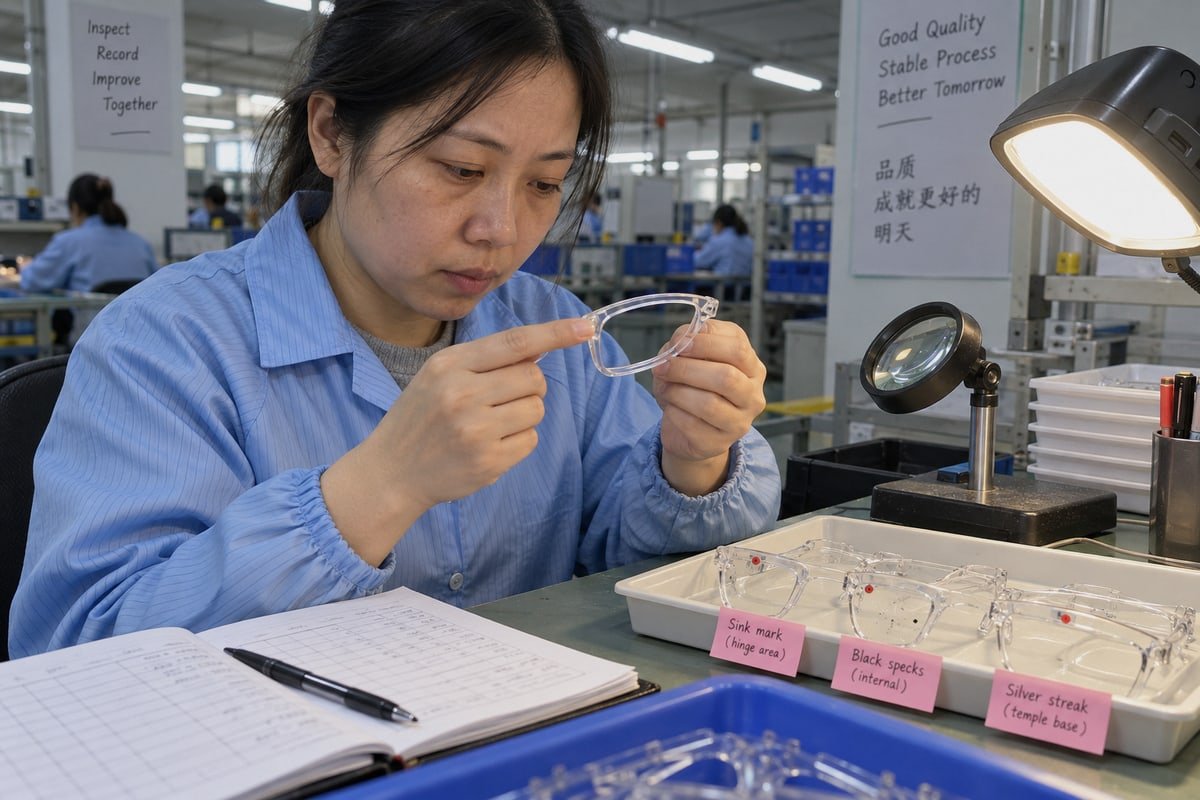
TR90 is a transparent polyamide. It sits in the same material family as Grilamid PA12, which is why it stays clear, light, and tough. Our crystal-clear fronts and our translucent light-blue fronts both use it. The resin itself is rarely the problem. The problem is what happens between the resin bag and the finished frame. Drying, mold condition, melt temperature, and packing pressure all leave marks you can see. So I inspect the front, not the datasheet.
Start with geometry, not gloss
Place the frame upside down on a flat table. All four contact points should touch. A rocking frame has warped. Warping usually comes from uneven cooling or uneven wall thickness. It hurts stabilité dimensionnelle 1, so the lenses will not seat evenly and the fit will drift over months. Then look at the frame from the front. The two lens shapes should match. The bridge should sit centered. Sight down each temple. Both should wrap at the same angle. Kids' faces are small, so a small drift in wrap angle becomes a large fit complaint.
Run your fingers along the mold parting lines
Every injection-molded frame has a seam processus de moulage par injection 2 where the two mold halves meet. On a good frame, that seam is nearly invisible and smooth to the touch. If you feel a ridge, that is flash. Flash means mold wear, weak clamping, or lazy finishing. On an adult frame, flash is a cosmetic issue. On a kids frame, it is a safety issue. A sharp burr near the nose or behind the ear can scratch skin.
Common surface finish defects and what they tell you
| Verre taillé trop petit, mauvaise insertion | Ce à quoi cela ressemble | Cause probable | Pourquoi c'est important pour les enfants |
|---|---|---|---|
| Sink marks | Shallow dents near hinges or bridge | Poor packing pressure or thick sections | Weak hinge area, early cracking |
| Short shot | Missing material at thin edges | Low melt temperature or poor venting | Incomplete rims, loose lenses |
| Flow marks | Wavy lines in the surface | Inconsistent injection speed or temperature | Uneven color across a batch |
| Silver streaks | Thin bright lines | Moisture in undried resin | Brittle spots, lower impact resistance |
| Black specks | Tiny dark dots inside clear material | Burnt resin or dirty barrel | Contamination, poor material control |
| Visible gate vestige | Rough nub on the surface | Gate placed on a visible face | Cosmetic flaw and stress point |
Hold the frame against strong light
Clear and translucent fronts hide nothing. Hold one up to a window or lamp. Look for internal bubbles, black carbon spots, or cloudy patches. Then find the gate vestige, which is where the melt entered the mold. On our tooling we place it behind the bridge or at a hidden temple face. If a supplier leaves it on the front face, they either saved money on tooling or did not think about the child's appearance.
How can I tell if the TPEE rubber coating is properly bonded to the frame?
A procurement manager from Australia once asked me why her previous supplier's temples turned sticky after one summer. Poor bonding and hydrolysis, not the child, caused it.
A properly bonded TPEE coating passes a cross-hatch tape test without lifting, shows no peeling at temple tips or bend points, feels grippy rather than sticky, and has even color with no pinholes. Flex the temple and rub the edge; any white bloom, edge lift, or tackiness means weak adhesion.
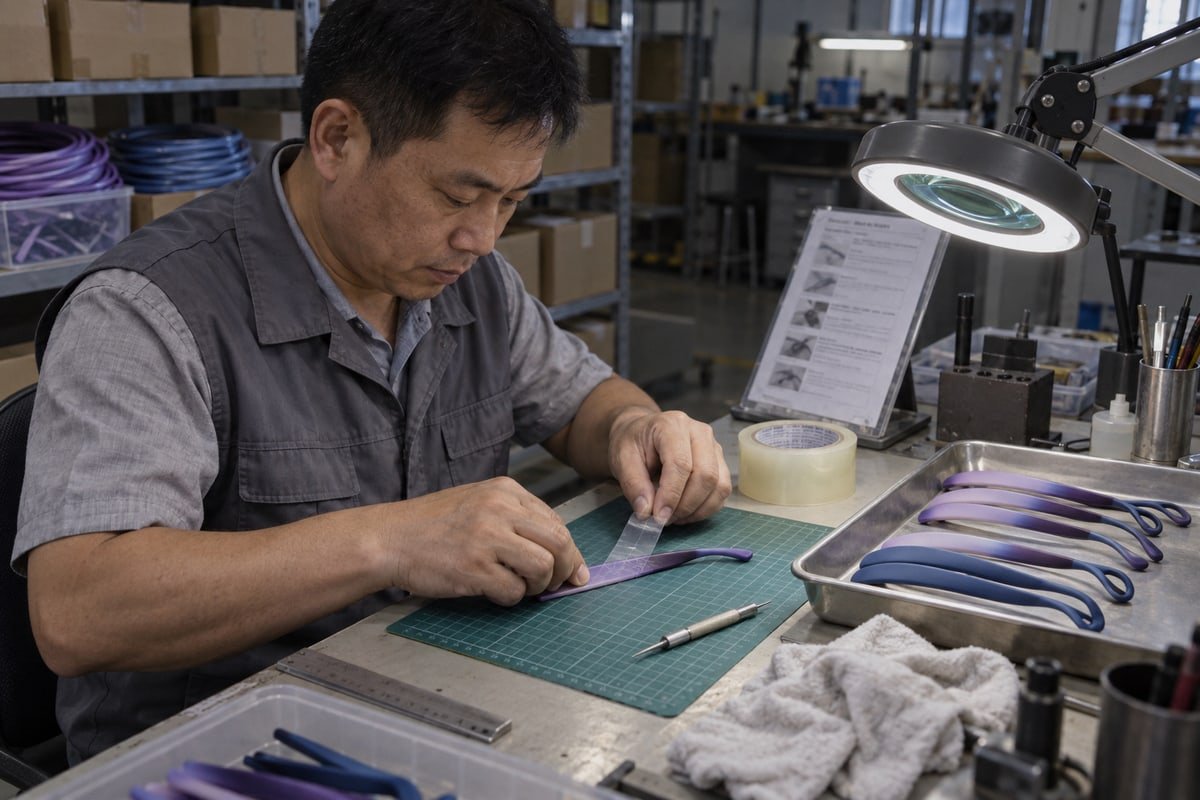
First, I want to clear up a common confusion. "Rubber coating" on a kids frame can mean two different things. One is a sprayed soft-touch layer 4 over a TR90 part. The other is a TPEE temple, temple tip, or nose contact area joined to the TR90 front through an overmolding process or double injection molding. TPEE belongs to the family of thermoplastic elastomers. It gives the grip and recovery that a hard polyamide cannot. Our gradient purple temples with looped ear hooks are TPEE. The matte blue temples with rubberized tips on our light-blue frame use the same approach. Both methods depend on adhesion strength between two materials, and both fail in the same visible ways.
Buyer objection: "If the TR90 is genuine, the coating does not matter"
I hear this often. I understand the logic, but I do not agree. The child never touches the resin. The child touches the coating. Grip on the ear, softness on the nose, and the feel in a parent's hand all come from the finish. A perfect TR90 front with a peeling temple still comes back as a return.
Buyer objection: "Soft-touch finishes just hide bad molding"
Some suppliers do use coating to mask flash or flow marks. That is a real risk. So I always ask for one uncoated shot alongside the finished sample. Inspect geometry and seams on the bare part first. Judge the coating second. Never let one hide the other.
Hands-on checks for coating bond and quality
| Vérifier | Comment faire | Signal de réussite | Signal d'échec |
|---|---|---|---|
| Adhérence par quadrillage | Score a small grid, press tape on, pull sharply | Grid stays intact | Squares lift with tape |
| Edge lift | Flex the temple and run a nail along the coating edge | Edge stays flush | Coating catches or curls |
| Uniformity | Rotate under a strong lamp | Even color and gloss on both sides | Pinholes, streaks, dust, pooling |
| Bloom check | Wipe the surface with a clean white cloth | Cloth stays clean | Waxy or powdery white residue |
| Tackiness | Hold in a warm, humid room for a few hours | Dry, grippy feel | Sticky or greasy feel |
Why blooming and tackiness matter more than they look
A white powdery bloom is plasticizer migrating out of low-grade elastomer. It can irritate skin and it means the material will keep degrading. Tackiness after humidity points to weak hydrolysis resistance. In warm markets like Australia or Southeast Asia, that frame will feel sticky within a season. Our temples go through humidity conditioning before we approve a new color, because a sample that feels fine in a dry office can behave very differently on a child's ear in summer.
What quality tests can I request to verify durability and flexibility before ordering?
Every time we tune temple flexibility, we weigh comfort against control. Too stiff hurts a child's ears; too soft lets the lenses drift out of alignment.
Request a temple flex and recovery test, cross-hatch coating adhesion test, environmental stress cracking test with simulated sweat, humidity tackiness test, drop or impact resistance check, and a resin density check around 1.14–1.15 g/cm³. Also ask for MSDS, BPA-free certification, and lens UV compliance to ANSI Z80.3 or ISO 12312-1.
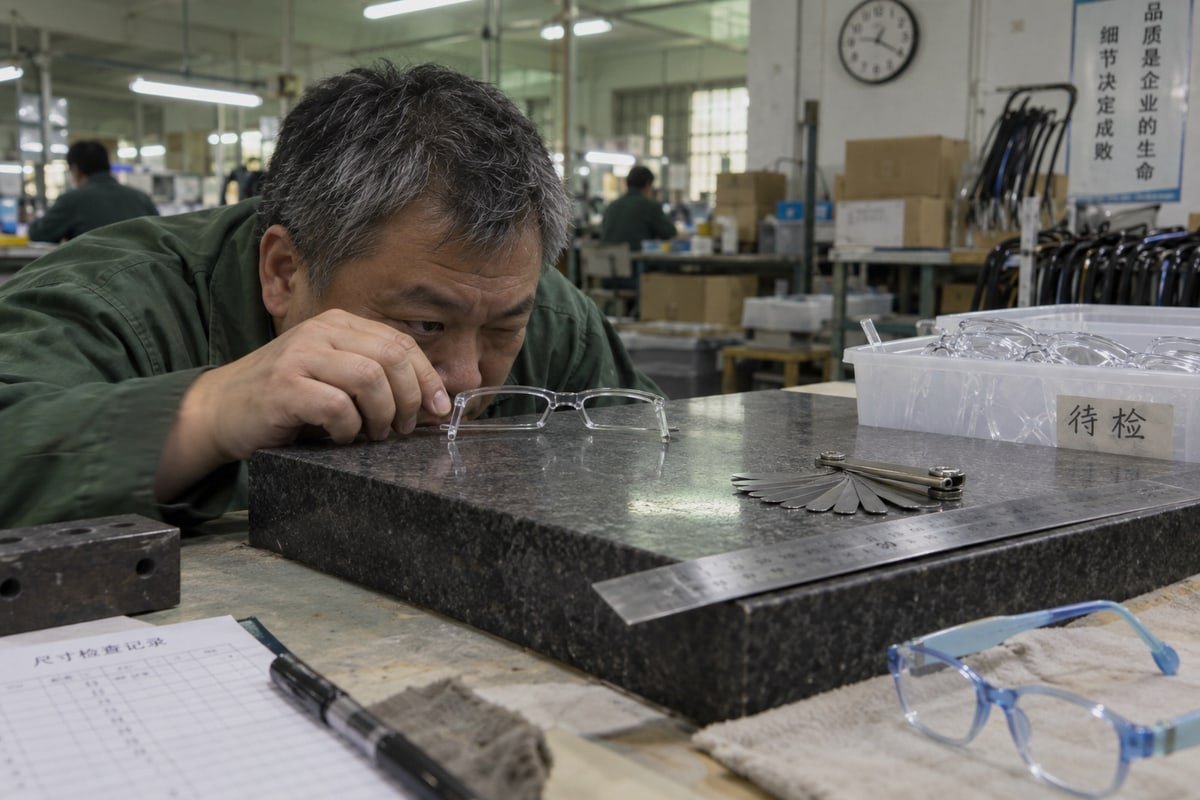
Flexibility is the headline feature of TR90 and TPEE kids frames. It is also the feature most often oversold. A very soft frame feels wonderful in a trade show booth. Then it fails to hold lens alignment on a child's face. So I look at flexibility as one part of a balanced set of tests. Here is what I ask for, and what each test actually proves.
Buyer objection: "More flexible means higher quality"
Not always. Flexibility without recovery is just softness. A frame should bend, then return to its original shape instantly, with no stress whitening at the flex points. If the temple stays slightly open, or if a pale line appears at the bend, the material or the wall thickness is wrong. For an optical frame, the front must stay stiff enough to keep the lens centers where the optician set them.
The test list I recommend for sample approval
| Test | Ce qu'il prouve | What to ask the supplier for |
|---|---|---|
| Temple flex and recovery | Shape memory and stress whitening | Photos or video of temples bent to limit and released |
| Adhérence par quadrillage | Coating bond strength | Grid photo after tape pull |
| Environmental stress cracking | Resistance to sweat and skin oils | Flexed sample exposed to simulated sweat, then checked for crazing |
| Humidity tackiness | Hydrolysis resistance of the soft-touch layer | Sample after warm humid conditioning |
| Drop or impact resistance | Frame survives real handling | Drop check on assembled frame with demo lenses |
| Resin density | Material authenticity | Reported value near 1.14–1.15 g/cm³ for genuine TR90 |
| Cyclage des charnières | Hinge stays aligned after repeated use | Open-close count and alignment check |
Documents that belong with the tests
Test photos tell you how a sample behaved. Documents tell you what the sample is made of. I ask for an MSDS for both the TR90 and the TPEE. I ask for BPA-free certification and any biocompatibility or harmful-substance reports the supplier can supply. For lenses, ANSI Z80.3 5 or ISO 12312-1 cover UV and optical clarity. Our own UV400 and polarized lens options go through this route, and we share the paperwork with buyers up front rather than on request.
A simple approval sequence
- Inspect the bare molded part for geometry and seams.
- Inspect the finished, coated part for adhesion and uniformity.
- Run flex, hinge, and drop checks on three units, not one.
- Condition one unit in humidity and one in simulated sweat.
- Match the documents to the actual resin used in the sample.
- Sign off only when all three units match each other.
Three units matter. One unit tells you what the supplier can do at their best. Three units start to tell you what they do on a normal day.
How do I choose a manufacturer with reliable injection molding and coating quality control?
Fifteen years of eyewear work taught our team one hard lesson: a perfect sample means nothing if bulk production drifts. Consistency is built before the first shot, not after.
Choose a manufacturer that runs its own molds and injection machines, controls resin drying, inspects in-process rather than only at final QC, and can show mold trial records, adhesion checks, and batch comparison samples. Prefer real factories with existing style libraries, documented materials, and full OEM/ODM support.

Injection molding and rubber coating quality in TR90 and TPEE kids optical frames is not decided at final inspection. By then, the frames already exist. It is decided at mold trial, at the resin dryer, and at the first color run of a new coating. So when I evaluate a partner, or when buyers evaluate us, the useful questions are about process, not about promises.
Buyer objection: "Coatings just add another way to fail"
That is a fair concern. A coating does add a bond line, and every bond line can fail. But the answer is process control, not avoiding the coating. Surface prep, matched materials, and a stable overmolding process turn that risk into a routine step. A factory that cannot explain how it controls adhesion should not be adding soft-touch finishes to children's frames at all.
Questions à poser à tout fournisseur
- Do you own the molds and run the injection machines in your own workshop?
- How do you dry TR90 before injection, and how do you check moisture?
- Where is the gate placed on this style, and why?
- Do you inspect during the run or only at the end?
- Can you show me three units from different points in the same batch?
- What surface prep happens before the soft-touch layer or the TPEE overmold?
- Which documents ship with the order by default?
Factory signals versus red flags
| Good signal | Indicateur rouge |
|---|---|
| Workshop with organized stations and clear process flow | Vague answers about where molding happens |
| Mold trial records and first-shot samples kept on file | Only glossy finished samples offered |
| Uncoated shot available on request | Refusal to show bare parts |
| Same-batch comparison units provided freely | One "golden sample" only |
| MSDS and material documents shared without prompting | Documents promised "later" |
Why a style library changes your risk
Here I will speak directly about how we work in Taizhou. Our workshop runs about 120 workers under 5S management, and we mold and finish in-house rather than trading. We keep roughly 800 existing styles, in TR90, TPEE, and TR90 fronts with TPEE temples. That library matters for quality, not only for speed. Every existing mold has already been trialed, corrected, and run in bulk. A new brand can launch on proven tooling, test the market, and avoid the defects that come with a fresh, untested mold. When a buyer wants custom colors, logos, lenses, or packaging, we build those on top of a mold we already trust. We ship to buyers in more than twenty countries, and the ones who stay with us are the ones who checked our process first and our price second.
Conclusion
Material names sell frames; molding and coating quality keep children wearing them. Inspect the seams, test the bond, request the documents, and choose a partner who controls both.
Vous souhaitez vous procurer les produits mentionnés dans cet article ? Voir les détails et demander un devis ici :
Notes de bas de page
1. Scientific explanation of dimensional stability and its importance in polymer engineering and molding. ↩︎
2. Authoritative technical overview of the manufacturing process and common defects. ↩︎
3. Engineering definition and principles of process control in manufacturing and quality management. ↩︎
4. Technical overview of soft-touch coating properties and application methods in industrial manufacturing. ↩︎
5. Official American National Standards Institute portal for eyewear safety and performance standards. ↩︎
Plus d'articles que vous pourriez aimer

28 octobre 2026
Quelles normes les montures optiques TR90 pour enfants doivent-elles respecter : GB/T 14214 ou ISO 12870 ?

27 octobre 2026
Comment les détaillants doivent-ils stocker les montures optiques TR90 pour enfants par âge et par tendances de genre ?
26 octobre 2026
Qu'est-ce que les parents privilégient dans les montures optiques TR90 pour enfants ?
Vous recherchez un partenaire fiable en lunetterie pour enfants ?
Explorez plus de 800 styles prêts et un support OEM/ODM complet adapté à votre marque.
Contactez-nous English
 Español de México
 Deutsch
 Français
 日本語
 العربية
 Português do Brasil