Como Julgar a Qualidade de Moldagem por Injeção e Revestimento de Borracha em Armações Ópticas Infantis TR90 e TPEE?
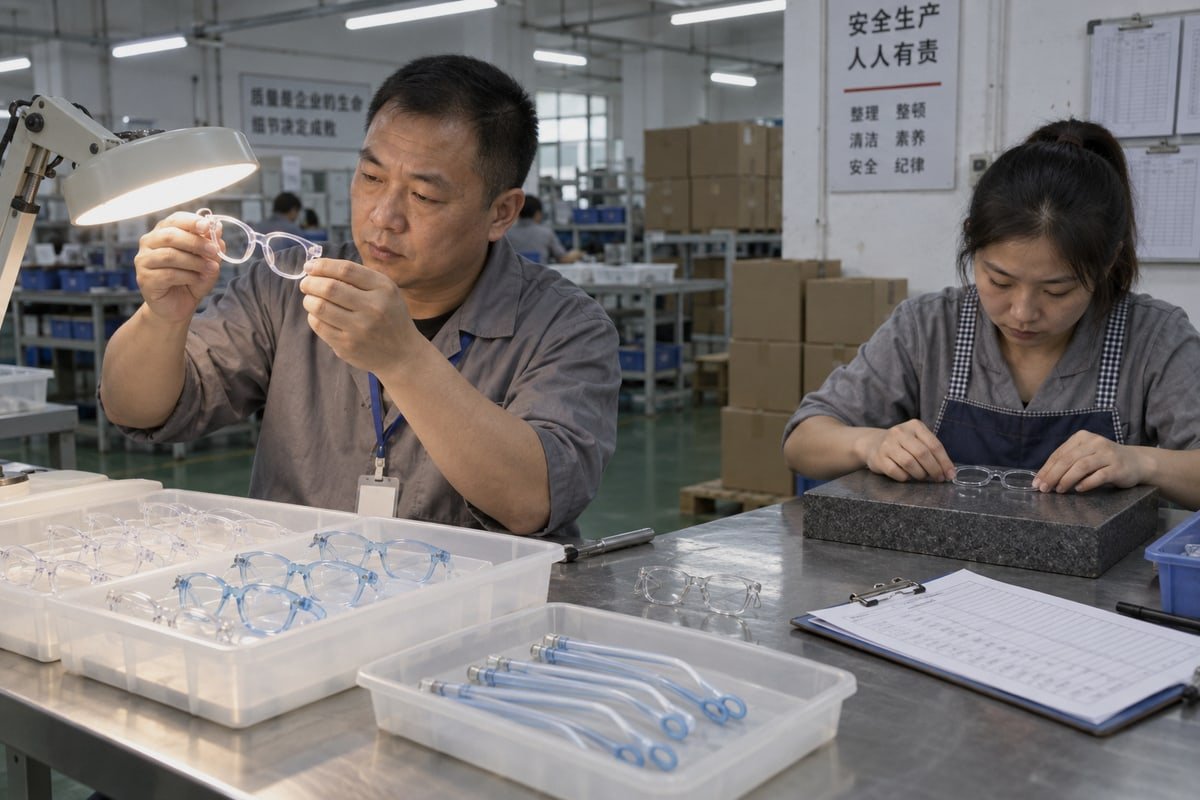
Muitos compradores julgam a qualidade de moldagem por injeção e revestimento de borracha em armações ópticas infantis TR90 e TPEE pelo nome da resina. Em nossa linha, o molde e o acabamento decidem muito mais.
Julgar a qualidade da moldagem por injeção e do revestimento de borracha em armações ópticas infantis de TR90 e TPEE verificando a simetria, planicidade, linhas de partição do molde limpas, ausência de marcas de afundamento e marcas de fluxo, em seguida, testando a adesão, uniformidade e pegajosidade do revestimento. Dobrar as hastes para memória de forma e solicitar relatórios de MSDS, densidade e teste de adesão.
Essa é a versão curta. Abaixo, eu a divido em quatro perguntas práticas. Cada uma oferece verificações que você pode fazer manualmente, além dos testes e documentos que você deve solicitar antes de se comprometer com um pedido em massa.
Que defeitos devo procurar na frente da armação moldada por injeção de TR90?
Na primavera passada, nossa equipe de CQ retirou um lote de frente TR90 cristalinas porque três unidades apresentaram finas listras prateadas sob a lâmpada de inspeção. A umidade na resina foi a causa.
Procure por rebarbas ou rebarbas ao longo das linhas de partição do molde, marcas de afundamento perto da ponte e dobradiças, empenamento que impede a moldura de assentar plana, tiros curtos em áreas finas, marcas de fluxo, estrias prateadas, bolhas, manchas pretas e um vestígio de portão visível. Cada defeito sinaliza uma falha específica do processo de moldagem.
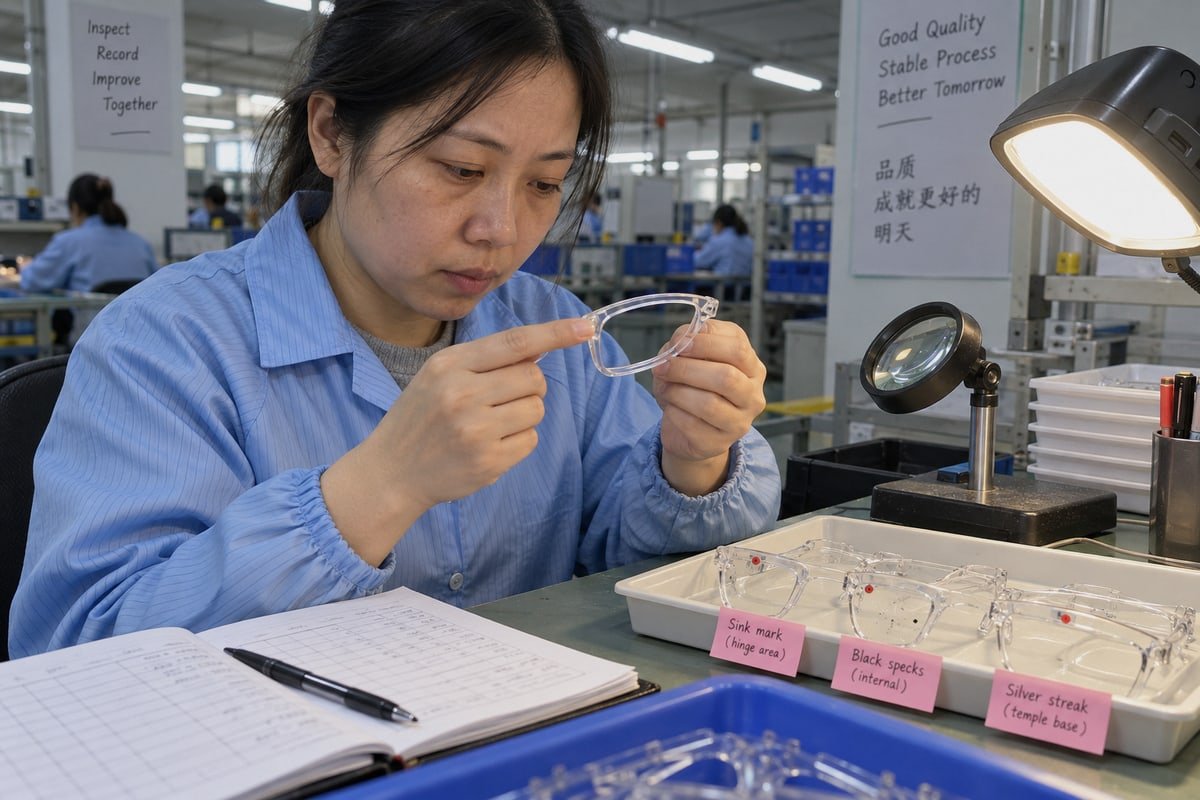
TR90 é uma poliamida transparente. Pertence à mesma família de materiais do Grilamid PA12, e é por isso que permanece transparente, leve e resistente. Nossas frente cristalinas e nossas frente azul-claras translúcidas o utilizam. A resina em si raramente é o problema. O problema é o que acontece entre o saco de resina e a armação acabada. Secagem, condição do molde, temperatura de fusão e pressão de empacotamento deixam marcas que você pode ver. Por isso, inspeciono a frente, não a folha de dados.
Comece pela geometria, não pelo brilho
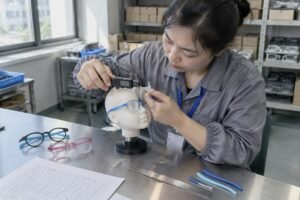
Coloque a armação de cabeça para baixo sobre uma mesa plana. Todos os quatro pontos de contato devem tocar. Uma armação bamba está empenada. O empenamento geralmente vem de resfriamento desigual ou espessura de parede desigual. Prejudica estabilidade dimensional 1, de modo que as lentes não se encaixarão uniformemente e o ajuste se desviará ao longo dos meses. Em seguida, olhe para a armação de frente. As duas formas das lentes devem corresponder. A ponte deve estar centralizada. Olhe ao longo de cada haste. Ambas devem curvar no mesmo ângulo. Os rostos das crianças são pequenos, então um pequeno desvio no ângulo de curvatura se torna uma grande reclamação de ajuste.
Passe os dedos ao longo das linhas de partição do molde
Toda armação moldada por injeção tem uma costura processo de moldagem por injeção 2 onde as duas metades do molde se encontram. Em uma armação boa, essa costura é quase invisível e lisa ao toque. Se você sentir uma rebarba, isso é rebarba. Rebarba significa desgaste do molde, fixação fraca ou acabamento preguiçoso. Em uma armação de adulto, a rebarba é um problema cosmético. Em uma armação infantil, é um problema de segurança. Uma rebarba afiada perto do nariz ou atrás da orelha pode arranhar a pele.
Defeitos comuns de acabamento de superfície e o que eles dizem a você
| Defeito | Como se parece | Causa provável | Por que é importante para crianças |
|---|---|---|---|
| Marcas de afundamento | Reentrâncias rasas perto das dobradiças ou da ponte | Pressão de empacotamento fraca ou seções espessas | Área de dobradiça fraca, rachaduras precoces |
| Injeção incompleta | Material faltando nas bordas finas | Baixa temperatura de fusão ou ventilação inadequada | Bordas incompletas, lentes soltas |
| Marcas de fluxo | Linhas onduladas na superfície | Velocidade ou temperatura de injeção inconsistente | Cor desigual em um lote |
| Listras prateadas | Linhas finas e brilhantes | Umidade em resina não seca | Pontos quebradiços, menor resistência ao impacto |
| Pontos pretos | Pequenos pontos escuros dentro do material transparente | Resina queimada ou barril sujo | Contaminação, controle de material inadequado |
| Vestígio de porta de injeção visível | Protuberância áspera na superfície | Porta de injeção colocada em uma face visível | Falha cosmética e ponto de estresse |
Segure a armação contra luz forte
Frente transparentes e translúcidas não escondem nada. Segure uma contra uma janela ou lâmpada. Procure por bolhas internas, pontos de carbono pretos ou manchas turvas. Em seguida, encontre o vestígio da porta de injeção, que é onde o material fundido entrou no molde. Em nossas ferramentas, colocamos atrás da ponte ou em uma face lateral oculta. Se um fornecedor o deixar na face frontal, ele economizou dinheiro em ferramentas ou não pensou na aparência da criança.
Como posso saber se o revestimento de borracha TPEE está devidamente aderido à estrutura?
Um gerente de compras da Austrália me perguntou uma vez por que as hastes de seu fornecedor anterior ficaram pegajosas após um verão. Ligação fraca e hidrólise, não a criança, causaram isso.
Um revestimento TPEE devidamente aderido passa num teste de fita de corte cruzado sem descolar, não mostra descamação nas pontas das hastes ou pontos de dobra, tem uma sensação aderente em vez de pegajosa e tem uma cor uniforme sem furos. Dobre a haste e esfregue a borda; qualquer esbranquiçamento, descolamento da borda ou pegajosidade significa adesão fraca.
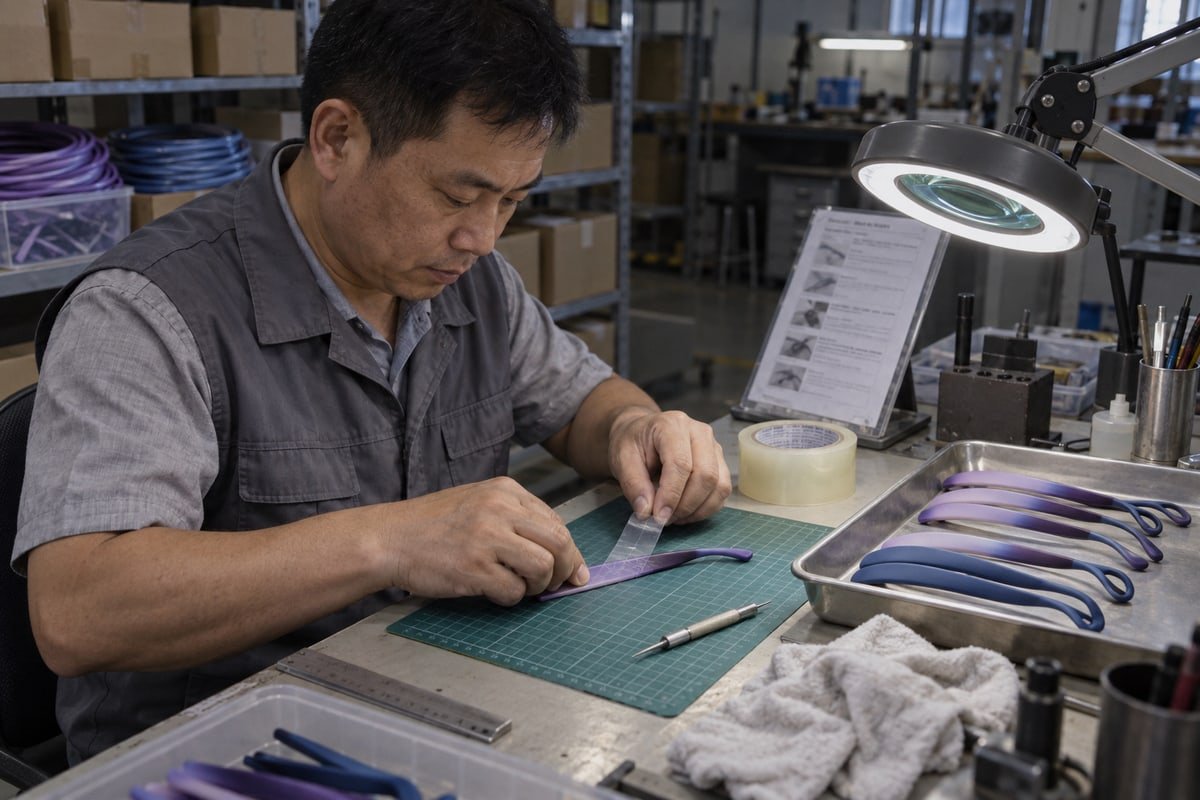
Primeiro, quero esclarecer uma confusão comum. "Revestimento de borracha" em uma armação infantil pode significar duas coisas diferentes. Uma é uma camada de toque suave pulverizada , 4 sobre uma peça TR90. A outra é uma haste TPEE, ponta de haste ou área de contato do nariz unida à frente TR90 através de um processo de sobremoldagem ou moldagem por injeção dupla. TPEE belongs to the family of thermoplastic elastomers. It gives the grip and recovery that a hard polyamide cannot. Our gradient purple temples with looped ear hooks are TPEE. The matte blue temples with rubberized tips on our light-blue frame use the same approach. Both methods depend on adhesion strength between two materials, and both fail in the same visible ways.
Buyer objection: "If the TR90 is genuine, the coating does not matter"
I hear this often. I understand the logic, but I do not agree. The child never touches the resin. The child touches the coating. Grip on the ear, softness on the nose, and the feel in a parent's hand all come from the finish. A perfect TR90 front with a peeling temple still comes back as a return.
Buyer objection: "Soft-touch finishes just hide bad molding"
Some suppliers do use coating to mask flash or flow marks. That is a real risk. So I always ask for one uncoated shot alongside the finished sample. Inspect geometry and seams on the bare part first. Judge the coating second. Never let one hide the other.
Hands-on checks for coating bond and quality
| Verifique | Como fazer isso. | Sinal de aprovação | Sinal de reprovação |
|---|---|---|---|
| Adesão por grade | Score a small grid, press tape on, pull sharply | Grid stays intact | Squares lift with tape |
| Edge lift | Flex the temple and run a nail along the coating edge | Edge stays flush | Coating catches or curls |
| Uniformity | Rotate under a strong lamp | Even color and gloss on both sides | Pinholes, streaks, dust, pooling |
| Bloom check | Wipe the surface with a clean white cloth | Cloth stays clean | Waxy or powdery white residue |
| Tackiness | Hold in a warm, humid room for a few hours | Dry, grippy feel | Sticky or greasy feel |
Why blooming and tackiness matter more than they look
A white powdery bloom is plasticizer migrating out of low-grade elastomer. It can irritate skin and it means the material will keep degrading. Tackiness after humidity points to weak hydrolysis resistance. In warm markets like Australia or Southeast Asia, that frame will feel sticky within a season. Our temples go through humidity conditioning before we approve a new color, because a sample that feels fine in a dry office can behave very differently on a child's ear in summer.
Que testes de qualidade posso solicitar para verificar durabilidade e flexibilidade antes de encomendar?
Every time we tune temple flexibility, we weigh comfort against control. Too stiff hurts a child's ears; too soft lets the lenses drift out of alignment.
Solicite um teste de flexão e recuperação de têmpora, teste de adesão de revestimento por reticulado, teste de rachaduras por estresse ambiental com suor simulado, teste de pegajosidade por umidade, verificação de resistência a quedas ou impactos e uma verificação de densidade de resina em torno de 1,14–1,15 g/cm³. Solicite também MSDS, certificação livre de BPA e conformidade de UV de lentes com ANSI Z80.3 ou ISO 12312-1.
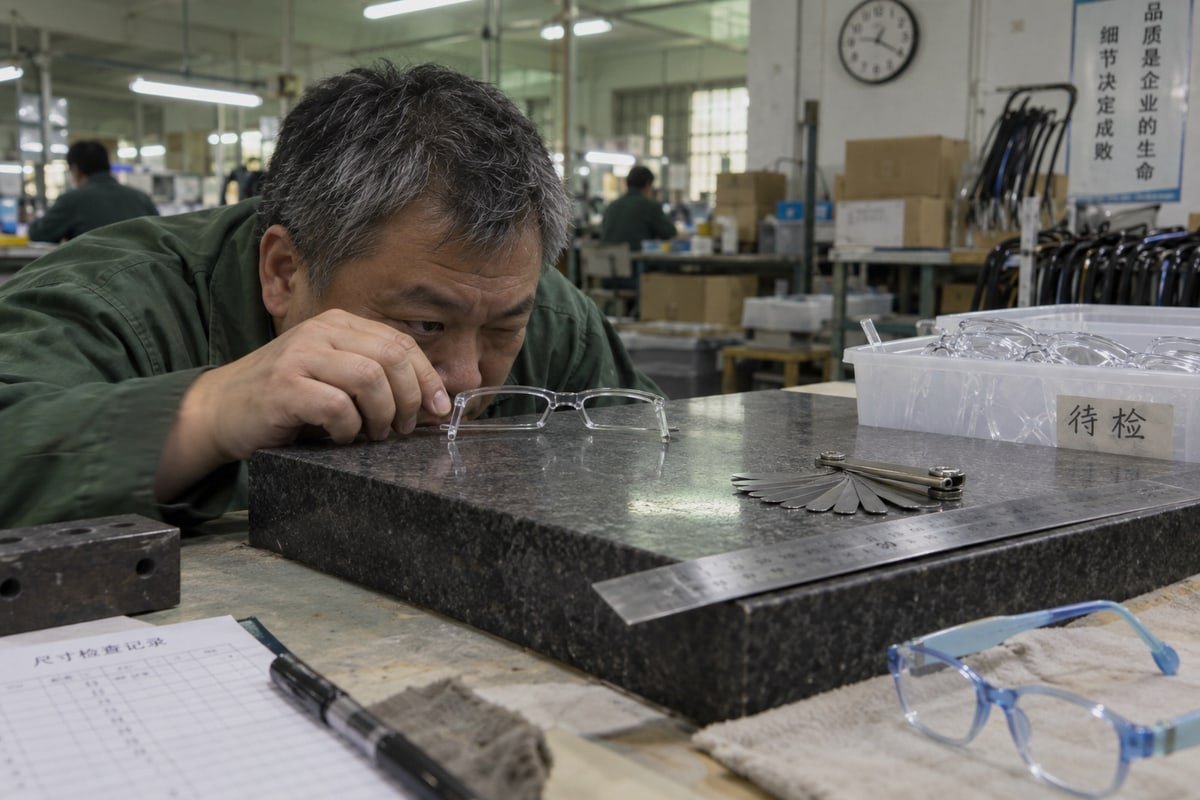
Flexibility is the headline feature of TR90 and TPEE kids frames. It is also the feature most often oversold. A very soft frame feels wonderful in a trade show booth. Then it fails to hold lens alignment on a child's face. So I look at flexibility as one part of a balanced set of tests. Here is what I ask for, and what each test actually proves.
Buyer objection: "More flexible means higher quality"
Not always. Flexibility without recovery is just softness. A frame should bend, then return to its original shape instantly, with no stress whitening at the flex points. If the temple stays slightly open, or if a pale line appears at the bend, the material or the wall thickness is wrong. For an optical frame, the front must stay stiff enough to keep the lens centers where the optician set them.
The test list I recommend for sample approval
| Teste | O que prova | What to ask the supplier for |
|---|---|---|
| Temple flex and recovery | Shape memory and stress whitening | Photos or video of temples bent to limit and released |
| Adesão por grade | Coating bond strength | Grid photo after tape pull |
| Environmental stress cracking | Resistance to sweat and skin oils | Flexed sample exposed to simulated sweat, then checked for crazing |
| Humidity tackiness | Hydrolysis resistance of the soft-touch layer | Sample after warm humid conditioning |
| Drop or impact resistance | Frame survives real handling | Drop check on assembled frame with demo lenses |
| Resin density | Material authenticity | Reported value near 1.14–1.15 g/cm³ for genuine TR90 |
| Ciclo de dobradiça | Hinge stays aligned after repeated use | Open-close count and alignment check |
Documents that belong with the tests
Test photos tell you how a sample behaved. Documents tell you what the sample is made of. I ask for an MSDS for both the TR90 and the TPEE. I ask for BPA-free certification and any biocompatibility or harmful-substance reports the supplier can supply. For lenses, ANSI Z80.3 5 or ISO 12312-1 cover UV and optical clarity. Our own UV400 and polarized lens options go through this route, and we share the paperwork with buyers up front rather than on request.
A simple approval sequence
- Inspect the bare molded part for geometry and seams.
- Inspect the finished, coated part for adhesion and uniformity.
- Run flex, hinge, and drop checks on three units, not one.
- Condition one unit in humidity and one in simulated sweat.
- Match the documents to the actual resin used in the sample.
- Sign off only when all three units match each other.
Three units matter. One unit tells you what the supplier can do at their best. Three units start to tell you what they do on a normal day.
Como escolho um fabricante com controle de qualidade confiável de moldagem por injeção e revestimento?
Fifteen years of eyewear work taught our team one hard lesson: a perfect sample means nothing if bulk production drifts. Consistency is built before the first shot, not after.
Escolha um fabricante que opere seus próprios moldes e máquinas de injeção, controle a secagem de resina, inspecione em processo em vez de apenas no controle de qualidade final, e possa apresentar registros de testes de moldes, verificações de adesão e amostras de comparação de lotes. Prefira fábricas reais com bibliotecas de estilo existentes, materiais documentados e suporte completo OEM/ODM.

Injection molding and rubber coating quality in TR90 and TPEE kids optical frames is not decided at final inspection. By then, the frames already exist. It is decided at mold trial, at the resin dryer, and at the first color run of a new coating. So when I evaluate a partner, or when buyers evaluate us, the useful questions are about process, not about promises.
Buyer objection: "Coatings just add another way to fail"
That is a fair concern. A coating does add a bond line, and every bond line can fail. But the answer is process control, not avoiding the coating. Surface prep, matched materials, and a stable overmolding process turn that risk into a routine step. A factory that cannot explain how it controls adhesion should not be adding soft-touch finishes to children's frames at all.
Perguntas que valem a pena fazer a qualquer fornecedor
- Do you own the molds and run the injection machines in your own workshop?
- How do you dry TR90 before injection, and how do you check moisture?
- Where is the gate placed on this style, and why?
- Do you inspect during the run or only at the end?
- Can you show me three units from different points in the same batch?
- What surface prep happens before the soft-touch layer or the TPEE overmold?
- Which documents ship with the order by default?
Factory signals versus red flags
| Good signal | Bandeira vermelha |
|---|---|
| Workshop with organized stations and clear process flow | Vague answers about where molding happens |
| Mold trial records and first-shot samples kept on file | Only glossy finished samples offered |
| Uncoated shot available on request | Refusal to show bare parts |
| Same-batch comparison units provided freely | One "golden sample" only |
| MSDS and material documents shared without prompting | Documents promised "later" |
Why a style library changes your risk
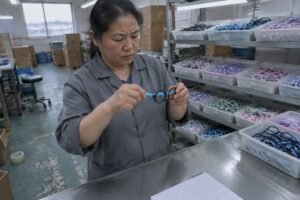
Here I will speak directly about how we work in Taizhou. Our workshop runs about 120 workers under 5S management, and we mold and finish in-house rather than trading. We keep roughly 800 existing styles, in TR90, TPEE, and TR90 fronts with TPEE temples. That library matters for quality, not only for speed. Every existing mold has already been trialed, corrected, and run in bulk. A new brand can launch on proven tooling, test the market, and avoid the defects that come with a fresh, untested mold. When a buyer wants custom colors, logos, lenses, or packaging, we build those on top of a mold we already trust. We ship to buyers in more than twenty countries, and the ones who stay with us are the ones who checked our process first and our price second.
Conclusão
Material names sell frames; molding and coating quality keep children wearing them. Inspect the seams, test the bond, request the documents, and choose a partner who controls both.
Interessado em adquirir os produtos mencionados neste artigo? Veja detalhes e solicite um orçamento aqui:
Notas de rodapé
1. Scientific explanation of dimensional stability and its importance in polymer engineering and molding. ↩︎
2. Authoritative technical overview of the manufacturing process and common defects. ↩︎
3. Engineering definition and principles of process control in manufacturing and quality management. ↩︎
4. Technical overview of soft-touch coating properties and application methods in industrial manufacturing. ↩︎
5. Official American National Standards Institute portal for eyewear safety and performance standards. ↩︎
Mais Artigos que Você Pode Gostar

27 de outubro de 2026
Como os varejistas devem estocar armações ópticas infantis TR90 por tendências de idade e gênero?
26 de outubro de 2026
O que os pais priorizam em armações ópticas infantis TR90?
25 de outubro de 2026
Como Escolher Armações Ópticas Infantis TR90 por Formato do Rosto e Ponte Nasal?
Procurando um Parceiro Confiável em Óculos Infantis?
Explore mais de 800 estilos prontos e suporte completo OEM/ODM adaptado à sua marca.
Entre em Contato English
 Español de México
 Deutsch
 Français
 日本語
 العربية
 Português do Brasil