Which TR90 Kids Sunglasses Hinge Is Best for Active Kids: Spring, Screwless, or Screw?
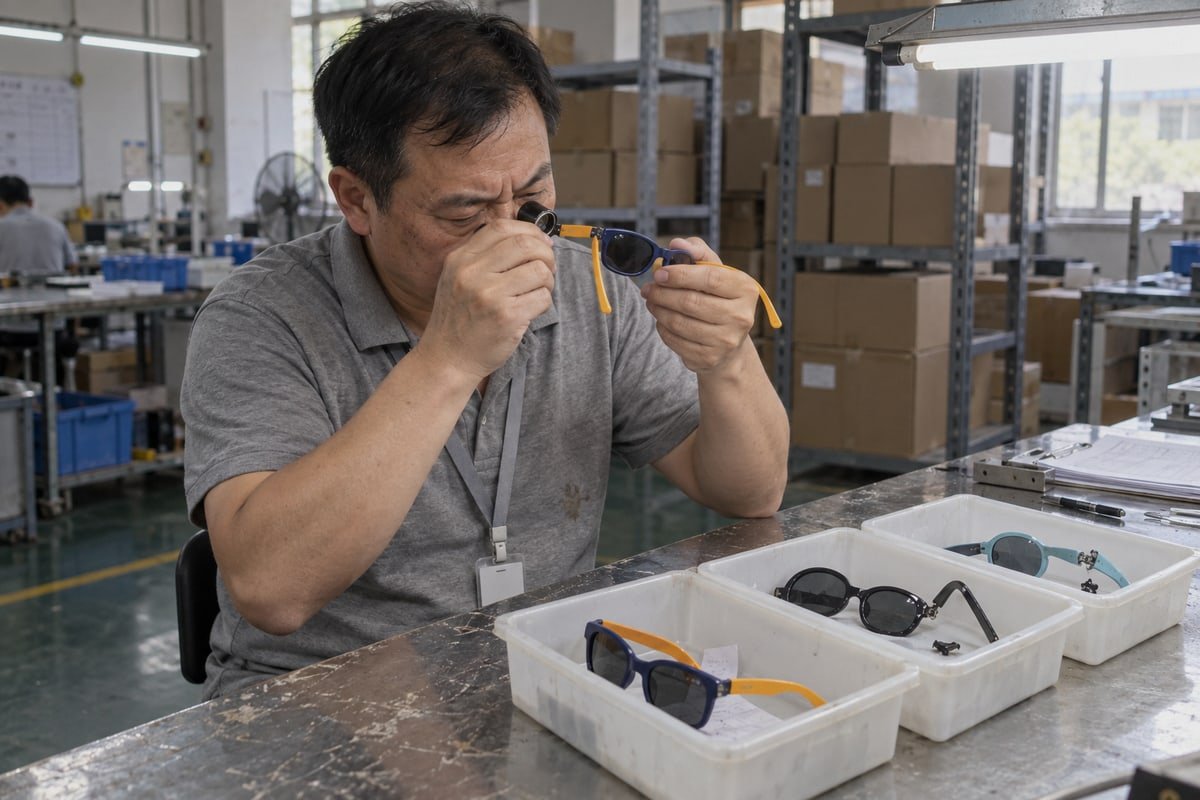
A TR90 kids sunglasses hinge fails long before the frame does. On our production line, most damaged samples we inspect show a stretched or lost hinge, not a cracked front.
For active kids, a TR90 frame with spring hinges is the best overall choice. Spring hinges flex past 90 degrees and snap back, surviving one-handed pulls. Screwless hinges are the strongest second option for cutting maintenance, while standard screw hinges suit older, calmer children.
The frame material gets most of the marketing attention. The hinge decides whether the sunglasses stay on, stay comfortable, and stay fixable. Below, I compare the three hinge types by durability, comfort, and maintenance. Then I give you a buying checklist and age-based recommendations you can take straight into a sampling request.
How do spring hinges compare to screwless designs for my kids' sunglasses line?
Every hinge decision is a trade-off between flex and simplicity. When we spec a TR90 style, we weigh how far the temple should bend against how many parts it adds.
Spring hinges use a metal cartridge that lets temples flex outward past 90 degrees and self-adjust for a snug fit. Screwless hinges use snap-fit polymer joints that remove the tiny screw, cut maintenance, and stay lighter, but they offer less outward flex.
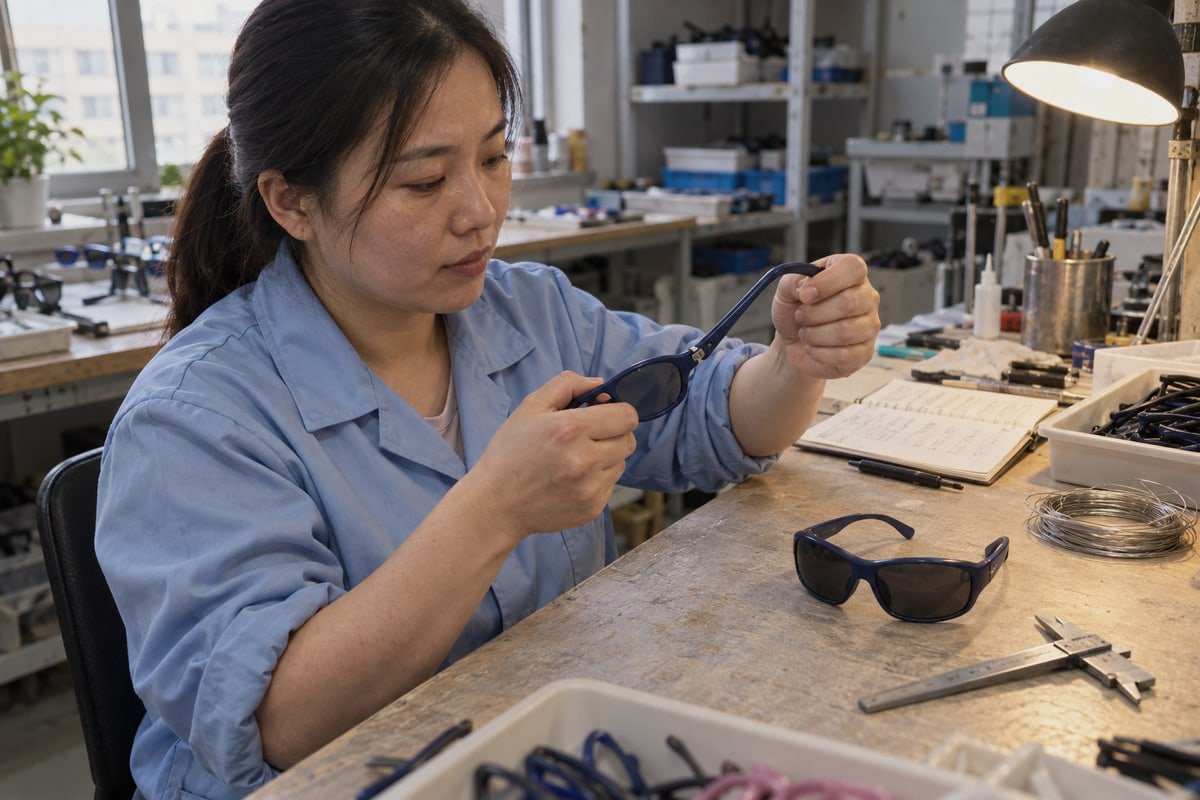
Here is the quick side-by-side view I share with buyers before we go into detail.
| Característica | Spring hinge | Screwless hinge |
|---|---|---|
| Outward flex | Opens past 90 degrees, often to about 180 degrees | Stops at the designed joint limit |
| Moving parts | Metal cartridge, internal spring, screw | Interlocking snap-fit polymer parts, no screw |
| Mantenimiento | Screw may need tightening over time | No screw to loosen, strip, or lose |
| Weight balance | Adds metal at each temple | Keeps all-polymer, lightweight balance |
| Repair path | Cartridge or screw can be replaced | Usually the whole temple is swapped |
| Mejor ajuste para | Daily active wear, sports lines | Low-maintenance lines, very young kids |
Flex range and self-adjusting fit
A standard barrel hinge opens to around 90 degrees and stops. A spring hinge keeps going. It flexes outward beyond the normal opening range and then pulls the temple back. This matters when a child yanks the sunglasses off with one hand. The temple bends instead of the frame cracking. The spring also applies gentle, even pressure to the sides of the head. That self-adjusting grip keeps the frame in place during running and jumping.
Screwless hinges work differently. The temple locks into a socket with a snap-fit mechanism. Flex comes mainly from the flexible temple arms and the TR90 memory polymer 1 itself, not from the hinge. Some high-end screwless designs act as a breakaway feature. Under extreme force, the temple pops out of its socket rather than snapping the frame.
Maintenance and lost hardware
The hinge screw is the most common part to vibrate loose or disappear during play. Two causes stand out. First, thermal expansion mismatch: metal screws and thermoplastic material 2 expand at different rates in the sun, so screws slowly back out. Second, vibration-induced fatigue from the constant micro-impacts of a child's gait. Snap-fit screwless hinges are immune to both. Buyers often raise a fair objection here: screwless designs give up easy repair. My answer is practical. You do not repair a screwless hinge; you replace the temple. So we recommend ordering spare temples with the first production run.
Weight and balance
An all-polymer screwless hinge preserves the ultra-light center of gravity of a TR90 frame. A metal spring cartridge adds weight at the temples and can make a frame slip during fast head turns. In our TR90-front-with-TPEE-temple builds, we keep cartridges compact so the frame never feels temple-heavy.
Which hinge type will hold up best to rough play and daily durability testing?
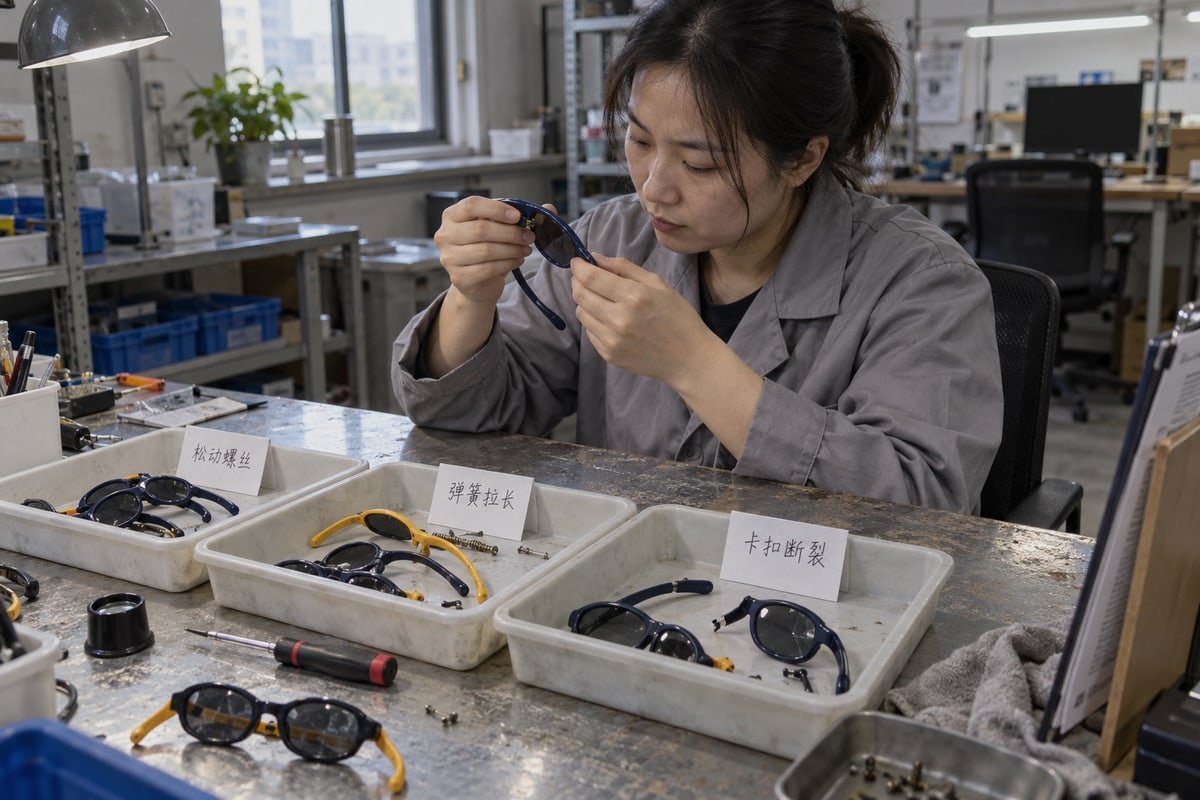
Our QC team keeps a small bin of frames that failed open-close testing. Most show a loosened screw hinge rather than a broken spring cartridge.
Spring hinges hold up best to rough play. They flex to about 180 degrees, absorb one-handed pulls, and some makers rate them for 50,000 open-close cycles. Screwless snap-fit hinges resist grit and vibration well, while screw hinges loosen fastest under daily active use.
Kids do not treat sunglasses the way adults do. They pull them off with one hand. They bend the temples outward to hang them on a shirt collar. They sit on them. They drop them in sand. They outgrow the fit and keep wearing them anyway. A TR90 kids sunglasses hinge has to survive all of that, every day, for at least one summer.
How we stress a hinge before it ships
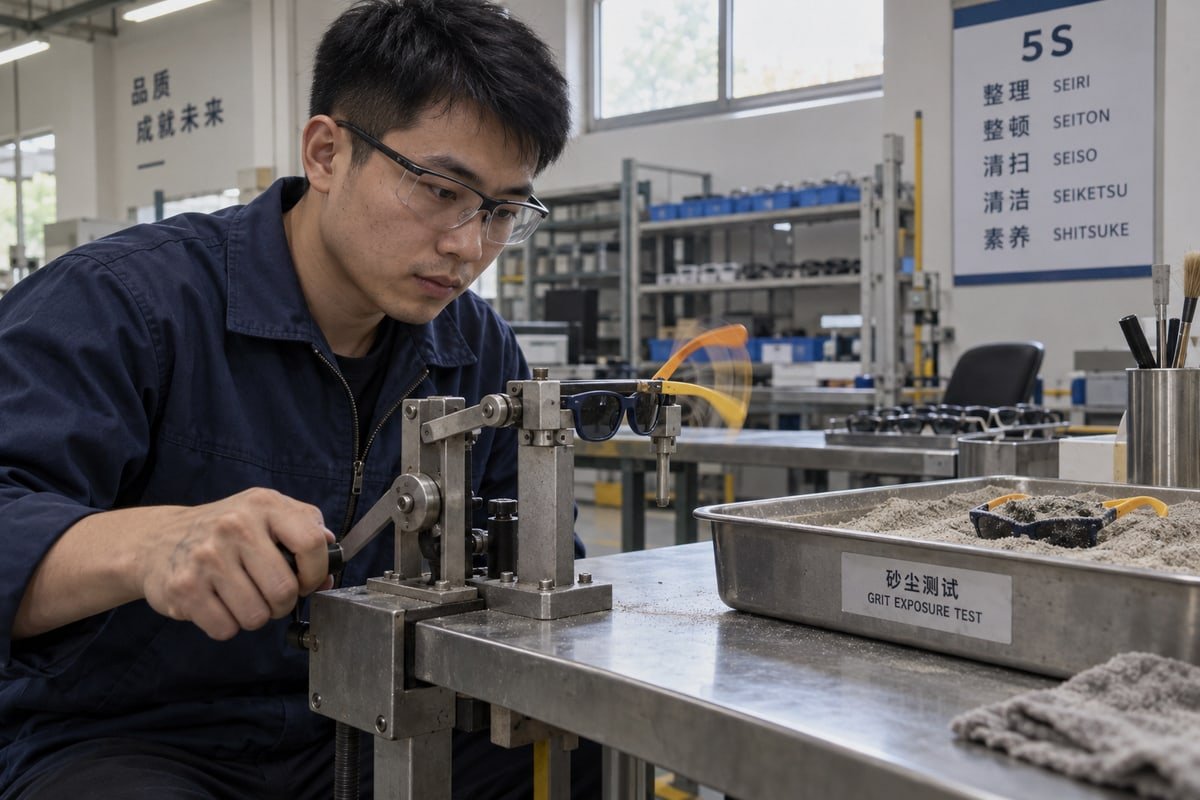
In our 5S-managed workshop, hinge testing follows a simple sequence. I describe it here so you know what to ask for from any supplier.
- Open-close cycling. The temple is opened and closed repeatedly to check for loosening, grinding, or loss of spring return.
- Outward temple pull. The temple is pushed past its normal stop to mimic a one-handed removal.
- Twist and sit-on simulation. The frame is twisted across the bridge to check whether the hinge area cracks or the memory polymer returns to shape.
- Grit exposure. Fine sand is worked into the hinge to check for seizing.
The TR90 front and TPEE temples give the frame its impact resistance. The hinge decides whether that flexibility is wasted.
Failure modes by hinge type
| Real-kid failure mode | Spring hinge | Screwless hinge | Screw hinge |
|---|---|---|---|
| One-handed pull past 90 degrees | Flexes and returns | May pop out, re-seats | Frame or hinge cracks |
| Sun heat, all-day wear | Screw may back out slowly | No screw, no issue | Screw backs out fastest |
| Playground sand and grit | Cartridge may need cleaning | Snap-fit resists seizing | Barrel can grind |
| Constant running vibration | Minor loosening over months | Immune to fatigue | Loosens within weeks |
| Sitting on the frame | Good recovery | Good recovery | Depends on hardware quality |
One honest caveat. Bisagras de resorte add complexity, and they can still fail if the frame is over-stressed again and again. The spring tires, and the return weakens. We manage this by pairing the cartridge with flexible temple arms, so the temple absorbs part of the load before the spring does. A screw hinge is not doomed either. With high-quality hardware and a good fit, it can serve an older, careful child. It is simply the least forgiving option for rough handling.
What should I ask my manufacturer about hinge safety for children's eyewear?
A procurement manager from Australia asked us only about lens UV ratings. Then her sample's temple pinched a tester's finger, and hinge safety jumped to the top of her list.
Ask your manufacturer how the hinge behaves under force, whether it pinches skin, which safety eyewear standards the frame is tested against, if the material is BPA-free and hypoallergenic, how screws are secured, and whether temples or hinges can be replaced after breakage.
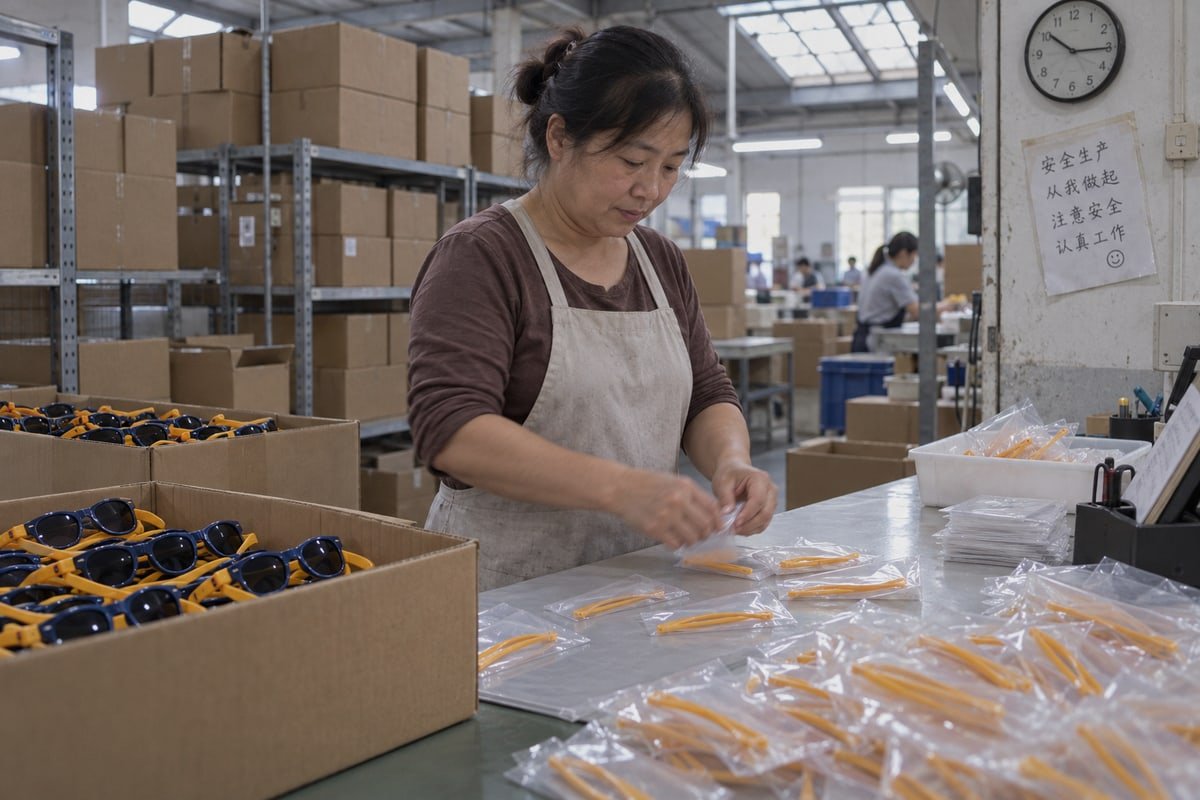
Parents buying kids' sunglasses care less about style and more about breakage, pinch risk, and repair. Your questions to the factory should follow the same priorities. Here is the list I encourage buyers to bring to every sampling call.
| Pregunta a hacer | Por qué importa | What a good answer sounds like |
|---|---|---|
| What happens when the temple is forced past its stop? | Reveals breakaway or snap behavior | Flexes and returns, or pops out and re-seats without sharp edges |
| Can the hinge pinch skin or catch hair? | Pinch points are a common complaint | Closed-gap design, rounded hinge housing |
| Which safety eyewear standards is this frame tested against? | Each market has its own rules | Test reports for your target market on request |
| Is the frame BPA-free, phthalate-free, and hypoallergenic? | Skin contact for hours a day | Declaraciones de materiales 3 and supplier certificates |
| How are hinge screws secured? | Loose screws are the top failure | Thread-locked, or no screw at all |
| Can temples or hinges be replaced? | Repair keeps the product in use | Spare temples available with the order |
Pinch and breakaway behavior
The white or silver hinge accent on our black oval kids' style is not decoration alone. That accent sits over a closed hinge gap. A closed gap means the temple cannot trap a fingertip when the child folds the frame. Ask to see the hinge in the fully closed position and check for any exposed spring or barrel edge.
Material safety beyond the hinge
The hinge sits inside the thermoplastic material of the frame. If the frame material is not BPA-free and hypoallergenic, the hinge type will not save you. TR90 is widely positioned as hypoallergenic and BPA-free, and kids' models are often marketed around 12 to 15 grams. Ask for the material declaration in writing, not as a verbal promise.
Repair and spare parts
Here is where the screwless objection returns. Screwless hinges remove the loose-screw problem, but they do trade away simple at-home repair with an optical screwdriver. The fix is a supply decision, not a design flaw. We ship spare temples for screwless lines when buyers ask. For screw hinges, we recommend a small screw pack in the retail box. Either way, the answer to "can this be fixed" should be yes.
How do I choose the right hinge type for my target age group and market?
One lesson took us years to learn: the perfect hinge for a four-year-old is the wrong hinge for a ten-year-old. Age changes grip, habits, and what parents forgive.
Match the hinge to age and activity. Choose spring or screwless hinges for ages 4 to 8 and any sports line. Choose spring hinges for daily wearers aged 7 to 12. Reserve screw hinges for older, careful children and fashion-led ranges where repairability matters.
TR90 is usually positioned for roughly ages 4 to 12, with some designs targeting 7 to 10. Inside that range, the right TR90 kids sunglasses hinge shifts as the child grows. Younger children pull harder and think less. Older children handle frames more carefully but wear them for sports. Your market adds another layer, because buyers in Europe, Japan, and Australia weigh safety, weight, and presentation differently.
Hinge choice by age band and activity
| Age band | Typical behavior | Recommended hinge | Frame notes |
|---|---|---|---|
| 4 to 6 | Grabs, chews, sits on frames | Screwless or spring | All-polymer build, soft nose pads, wrap-around design |
| 7 to 9 | Sports, one-handed removal | Spring | TR90 front, TPEE flexible temple arms, 180-degree flex |
| 10 to 12 | Daily wear, more careful | Spring or quality screw | Lightweight frame construction, polarized lenses optional |
| Fashion or gift lines | Occasional wear | Screw acceptable | Retro shapes, dual-tone colors, spare screw pack |
Reading your market
Buyers who visit our Taizhou factory from different countries ask different first questions. European brands lead with material declarations and safety eyewear standards. Japanese buyers focus on weight, finish, and packaging detail. Australian outdoor brands push hardest on lens coverage, UV400, and polarized lenses because of strong sun. None of these markets ask for the cheapest hinge. They ask for the hinge that will not generate a complaint.
What matters as much as the hinge
The hinge holds the frame together, but three other factors decide whether a child keeps the sunglasses on. First, fit. A frame that is too wide slips no matter how good the spring is. Second, lens coverage. A wrap-around design, like our matte navy sport style, blocks side light and stays put during movement. Third, temple grip. Rubberized or TPEE temple tips add hold without pinching.
Use this checklist when you review samples:
- Flexible temple arms that bend outward and return
- Soft nose pads that do not slide
- A lightweight frame construction, ideally in the 12 to 15 gram range for kids
- A strong, even hinge return with no sag
- No pinching at the temples when the frame is closed
- Age-appropriate width and bridge fit
With around 800 existing styles, you can test several hinge and shape combinations without heavy mold investment. Our navy front with yellow-orange temples, for example, can be sampled with a spring hinge for a sports line and a screwless hinge for a preschool line. Then you let the market tell you which hinge earns the repeat order.
Conclusión
Active kids destroy weak hinges fast. That costs you returns and trust. Choose TR90 with spring hinges first, screwless second, and let us help you sample both.
Interested in sourcing the products mentioned in this article? See details and request a quote here:
Notas al pie
1. Shape-memory polymers like TR90 allow eyewear frames to return to their original shape after deformation. ↩︎
2. Wikipedia explains the properties of thermoplastic materials like TR90 used in durable eyewear frames. ↩︎
3. ISO provides international standards for material declarations and safety requirements in the eyewear industry. ↩︎
Más artículos que te podrían gustar


¿Buscas un socio confiable en gafas para niños?
Explore más de 800 estilos listos y soporte OEM/ODM completo adaptado a su marca.
Ponte en contacto English
  Español de México
  Deutsch
  Français
  日本語
日本語  العربية
  Português do Brasil