What Overlooked Quality Details Should You Check in TR90 Kids’ Sunglasses?
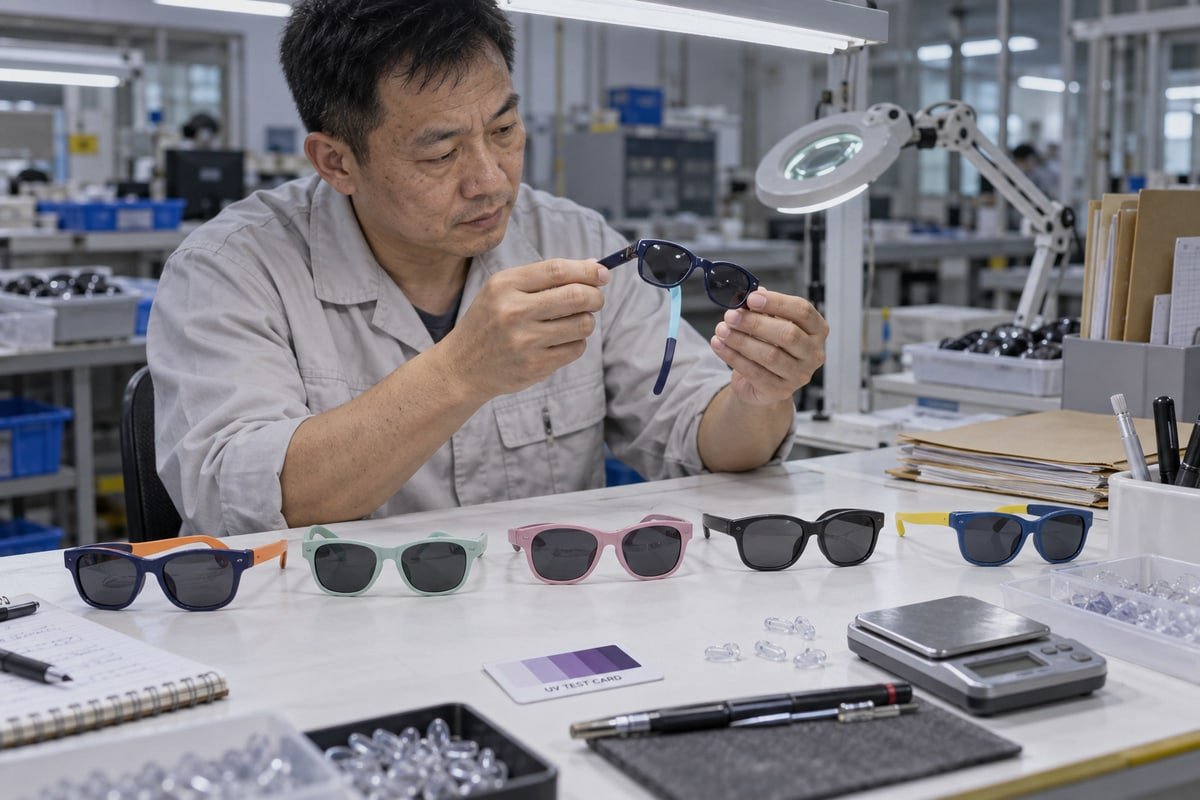
Every month, importers ask our Taizhou factory why their previous TR90 kids’ sunglasses failed within weeks. The frame was fine. The overlooked details were not. Here is what to check.
TR90 kids’ sunglasses should be checked for certified UV400 protection, impact-resistant polycarbonate or TAC lenses, one-piece or screwless hinges, flexible temple arms without stress whitening, odorless BPA-free material, child-sized bridge fit, soft silicone nose pads, and complete labeling with CE/EN ISO 12312-1 or ANSI Z80.3 compliance.
TR90 is a thermoplastic memory polymer. It is light, it bends, and it springs back. Those are real advantages. But a good material is only a starting point. The rest of this guide walks through the four areas where product quality quietly separates from material quality: certifications, [hinge](https://okayeyewear.com/which-tr90-kids-sunglasses-hinge-best-active-spring-screwless-screw/)s, lenses, and packaging.
What Material Certifications Should I Verify Before Trusting TR90 Kids' Sunglasses?
A procurement manager from Australia once sent us a competitor's frame that smelled like solvent. Her question was simple: which documents would have warned her before ordering?
Before trusting TR90 kids' sunglasses, verify material safety declarations for BPA-free, phthalate-free, latex-free, and nickel-free content, lens test reports proving UV400 protection, and compliance with CE / EN ISO 12312-1, ANSI Z80.3, or FDA requirements, plus children's product safety standards for your target market.

The word "TR90" on a spec sheet proves nothing by itself. The name describes a nylon co-polymer family. It does not describe purity, additives, or recycled content. So the first thing I tell buyers is to separate the marketing claim from the paperwork behind it.
Documents worth asking for
| Documento | What it should show | ¿Por qué es importante para los niños? |
|---|---|---|
| Declaración de seguridad de materiales | BPA-free material, phthalate-free, latex-free, nickel-free | Skin contact is constant; hypoallergenic frames reduce rash and irritation risk |
| Lens test report | UV400 protection, UVA y UVB 1 blocking | Tint alone does not block UV; only the report proves it |
| Sunglasses standard compliance | CE / EN ISO 12312-1 (Europe), ANSI Z80.3 standards (US), FDA drop-ball where applicable | Confirms optical quality and basic impact behavior |
| Children's product compliance | Regional kids' product rules for your market | Retailers and customs may ask for it before listing |
Three hands-on checks you can do without a lab
Paperwork is the foundation. Hands-on checks are the backup. We run these on our own production line, and any buyer can repeat them with a sample.
- Smell test. Genuine TR90 resin is virtually odorless. A sharp chemical or plastic smell points to low-grade material or unsafe additive contamination.
- Stress-whitening test. Bend the temple hard. High-grade TR90 stays the same color at the bend. Cheaper blends turn white along the stress line, which is an early sign of poor stress crack resistance.
- Cross-section color test. Scratch a hidden spot. True TR90 is colored throughout. Recycled or blended imitations often show a different core color under the surface coating.
Is TR90 right for every age?
One honest objection I hear is that TR90 is being sold as a universal answer. It is not. For ages 0 to 3, a softer TPEE frame is usually the better choice. TR90 fits children from about 3 to 12 and older. That is why our range includes both TPEE frames and TR90 frames with TPEE temples. The material should match the child, not the other way around.
How Can I Tell If the Hinges and Temples Will Hold Up to Rough Daily Wear?
On our flex-test bench, we bend temple arms outward past 90 degrees again and again. The weak hinges usually give up long before the frame material does.
Check that temples flex outward past 90 degrees and return without white stress marks, that the hinge is one-piece injection-molded or screwless rather than riveted, that spring or flex zones absorb sideways pulls, and that temple tips stay soft and firmly attached after repeated bending.
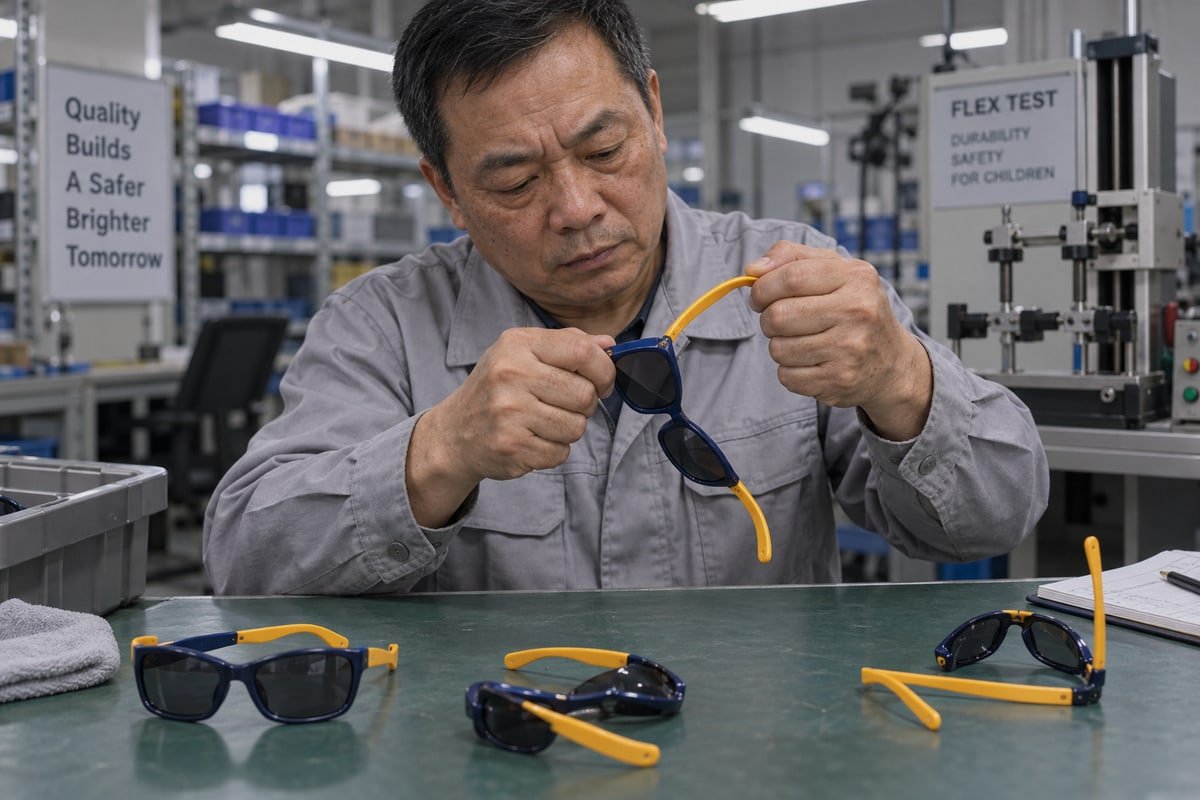
Children do not take sunglasses off with two hands. They grab one arm and yank. They sit on them. They stuff them into a backpack next to a water bottle. So the hinge and temple junction is where most kids' frames actually die. The frame material can be perfect and the product can still fail here.
A five-step hinge and temple check
- Open the temples flat and keep going. Good flexible temple arms swing well past 90 degrees and return to position. A hinge that stops hard at 90 degrees will snap on the first sideways pull.
- Look at the bend point. No white lines should appear. Whitening means the material is being damaged with every flex.
- Inspect the hinge-to-frame junction. One-piece injection-molded construction is the strongest. Rivets are the most common failure point in cheaper kids' frames because they loosen and tear out of the plastic.
- Twist the whole frame. The front should twist and recover without creaking. Creaking usually means a hairline crack is already forming.
- Press the temple tips and nose pads. They should feel soft, sit flush, and not peel at the edges.
Hinge types compared
| Tipo de bisagra | Typical failure | Idoneidad para niños activos |
|---|---|---|
| Riveted metal hinge | Rivet loosens, plastic cracks around it | Baja |
| Standard screw hinge | Screw backs out, temple falls off | Medium, needs regular tightening |
| Spring-loaded hinge | Spring fatigue if undersized | Good, absorbs outward pulls |
| Screwless hinges, one-piece molded | Rare, material fatigue only after long use | Best for rough daily wear |
Contact points matter as much as the hinge
A frame that stays on the face gets pulled less. Adjustable silicona and rubberized temple tips reduce slipping, so the child stops pushing the glasses back up every minute. On our matte navy sport style, the temples curve slightly inward at the ends for exactly this reason. We also pair TR90 fronts with TPEE temples for younger wearers. The softer temple bends before the hinge takes the load, and that combination has held up well in our export markets.
Why Does Lens Quality Matter More Than Frame Flexibility Alone?
Our quotations always come down to one trade-off: a cheap tinted lens or a tested UV400 polycarbonate lens. The price gap looks small. The safety gap is not.
Lens quality matters more because a flexible TR90 frame cannot protect a child's eyes; only impact-resistant polycarbonate or TAC lenses with verified UV400 protection block UVA and UVB rays and resist shattering, while dark tint or polarized lens technology alone reduces glare without guaranteeing UV safety.

Here is the uncomfortable truth about dark lenses. A dark lens opens the pupil. If that lens does not block UV, more harmful light reaches the back of the eye than with no sunglasses at all. So a stylish frame with an untested lens can be worse than nothing. This is the single most important point I raise with new brands.
UV protection and polarization are different things
Many product listings pair la tecnología de lentes polarizadas 2 with UV400. That is fine, but the two features do separate jobs. UV400 protection means the lens blocks longitudes de onda de hasta 400 nanómetros 3, covering both UVA and UVB. Polarization filters horizontal glare from water, roads, and sand. It makes vision more comfortable. It does not, by itself, make the lens safe. Always ask for the UV claim on its own.
Lens materials side by side
| Material de la lente | Resistencia al impacto | Peso | Excelente: se dobla 180° y se recupera |
|---|---|---|---|
| Lentes de policarbonato resistentes a impactos | Very high, shatter-resistant | Ligero | Sports, playground, everyday |
| TAC (tri-acetate cellulose) | Good, thin and flexible | Muy ligero | Polarized everyday and beach styles |
| Acrylic or PMMA | Low, can crack sharply | Ligero | Not recommended for active children |
Coatings, curvature, and coverage
Scratch resistance is the next overlooked item. A hard coat on the lens surface 4 keeps optics clear after months in a school bag. Fine scratches scatter light and cause squinting. Then there is coverage. A wrap-around frame design, like our sport style with the gradient gray lens, blocks light from the sides where flat frames leave a gap. For beach and snow use, that side coverage matters.
Finally, lens fit inside the frame deserves a look. Press the lens gently from the front. It should not pop out. It should also not rattle. A lens that pops out is a choking hazard for younger children and a lost-lens complaint for older ones. Consistent lens seating is one of the quality control steps 5 our workshop repeats on every batch, because it is cheap to check and expensive to get wrong.
What Packaging and Labeling Details Signal a Truly Retail-Ready Product?
Years ago we shipped a perfect batch in plain poly bags, and the brand's retail buyer rejected it on sight. That taught us packaging is part of product quality.
A retail-ready TR90 kids' sunglasses product shows a permanent UV400 and standard mark on the temple, a printed hangtag or box listing lens material, frame material, age range, and compliance statement, batch or lot traceability, a protective case or pouch, and consistent branding across every unit in the carton.
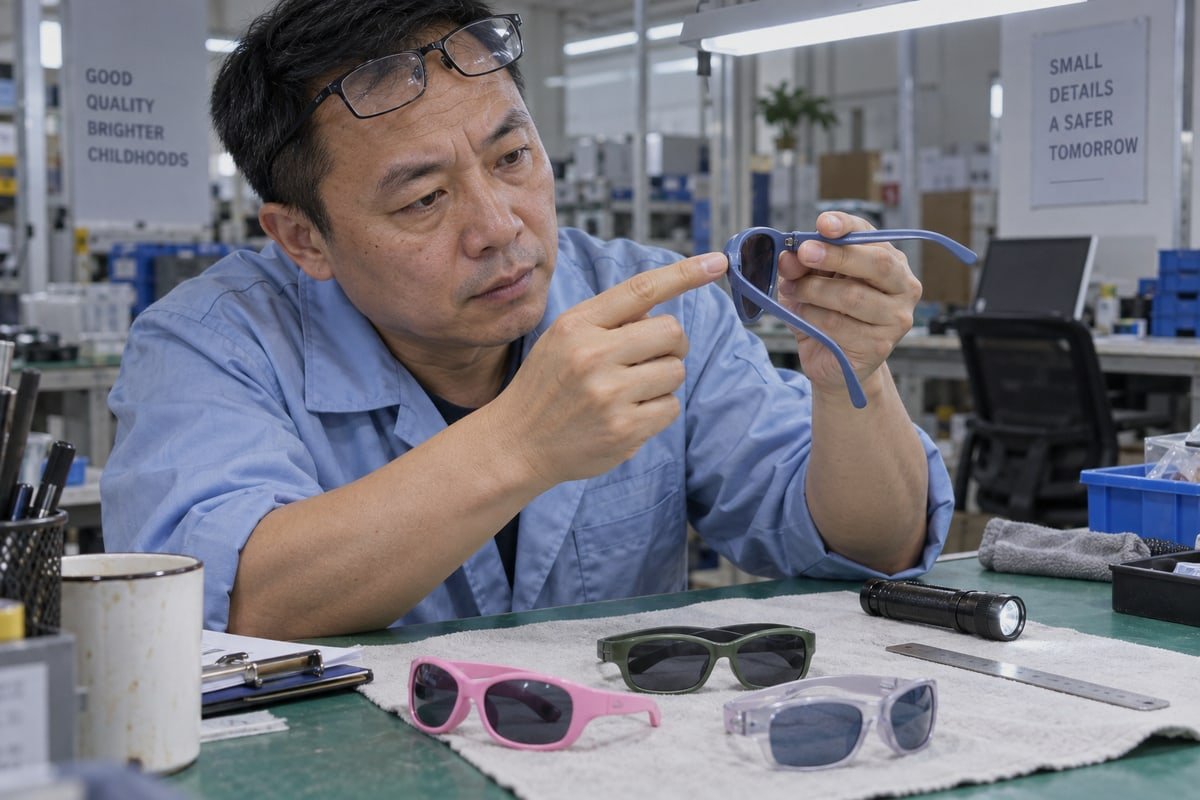
Packaging is where a parent decides whether a brand looks trustworthy. It is also where a retailer or customs officer decides whether the product can be sold at all. So I treat it as the last quality gate, not as an afterthought.
Permanent marks on the frame
Look at the inside of the temple near the hinge. Our navy and yellow-orange wayfarer style carries small etched text there. That text should state the model, the frame material, and the UV400 protection level. Printed ink wears off in a few weeks. Etched or molded text lasts the life of the frame. If the compliance claim only lives on a sticker, it is gone the first time the child peels it.
What the hangtag or box must carry
| Elemento | What it signals | Señal verde |
|---|---|---|
| Lens material and UV400 statement | Lens has been specified and tested | Vague "UV protection" with no number |
| Frame material and safety declarations | BPA-free, hypoallergenic frames, nickel-free hinges | No material named at all |
| Age range and size | Product was designed for a child's face, not scaled down | Adult-style sizing chart |
| Compliance mark and standard | CE / EN ISO 12312-1 or ANSI Z80.3 reference | Mark present but no standard cited |
| Batch or lot code | Traceability for recalls and quality follow-up | Identical, uncoded units |
| Care instructions | Brand thinks beyond the sale | Missing entirely |
Consistency across the whole order
Retail-ready also means every unit matches. Same color saturation, same lens tint, same logo placement, same case. One wrong hinge color in a carton of twelve gets the whole carton returned. This is why our 5S-managed workshop checks packing against a signed sample before sealing cartons.
For brands starting out, the practical route is to choose from our roughly 800 existing styles, then customize colors, logo, lens, case, and hangtag. That way you avoid a large mold investment, test the market with lower risk, and still put a fully branded, compliant product on the shelf. Reliable packaging support is a core part of full OEM and ODM service, and in my experience it is the detail buyers in Europe and Japan ask about second, right after lens safety.
Conclusión
TR90 is a strong start, but weak lenses, riveted hinges, missing certificates, or poor labeling still fail children. Check all four areas, and partner with a factory that does too.
Interested in sourcing the products mentioned in this article? See details and request a quote here:
Notas al pie
1. Authoritative source on UVA/UVB radiation risks supports UV400 lens protection claims. ↩︎
2. Technical overview of how polarized filters reduce glare in optical lenses. ↩︎
3. WHO fact sheet explaining the ultraviolet spectrum and its effects on health. ↩︎
4. Overview of protective coatings used to improve the durability of plastic lenses. ↩︎
5. ISO 9001 defines the quality management standard underlying consistent manufacturing QC checks. ↩︎
Más artículos que te podrían gustar


¿Buscas un socio confiable en gafas para niños?
Explore más de 800 estilos listos y soporte OEM/ODM completo adaptado a su marca.
Ponte en contacto English
  Español de México
  Deutsch
  Français
  日本語
日本語  العربية
  Português do Brasil