Spring Vs Regular Hinges: Which Lasts Longer for TR90/TPEE Kids Sunglasses?
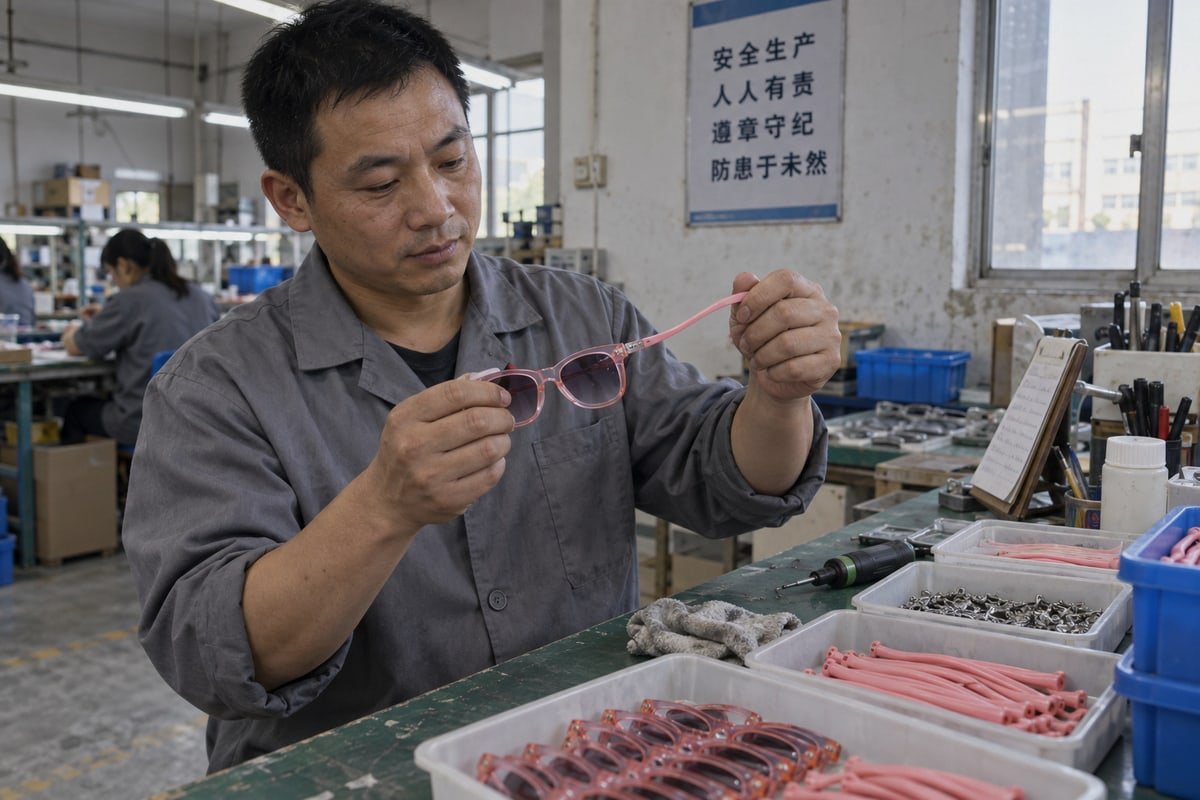
[Spring hinges vs regular hinges](https://okayeyewear.com/spring-hinges-vs-screw-free-ordinary-best-kids-sunglasses/) for TR90/TPEE kids sunglasses is the question buyers ask me most. Pick wrong, and returns pile up. Our Taizhou line has tested both for years.
Spring hinges usually last longer on TR90/TPEE kids sunglasses because they flex 10–15 degrees past the open position, absorbing one-handed pulls and drops. However, a well-built stainless steel regular hinge can outlast a cheap spring hinge, so hinge quality matters as much as hinge type.
That short answer hides a lot of detail. Below, I walk through what we see in daily wear, which tests to request, how hinges interact with soft TPEE temples, and which choice protects your return rate.
How do spring hinges compare to regular hinges in daily wear from my kids' customers?
A distributor in Australia once sent me a box of returned frames. Nearly every failure sat at the hinge, not the lens or the front. That box changed our advice.
In daily wear, spring hinges handle one-handed removal, wide heads, and rough play better because they flex outward instead of loading the screw joint. Regular barrel hinges are simpler and easier to repair, but they loosen and misalign faster under the same abuse from active children.

Here is the quick comparison I share with new brand buyers before we go deeper.
| Factor | Spring hinge | Regular barrel hinge |
|---|---|---|
| Outward flex | About 10–15 degrees past open | None; fixed pivot |
| Extracción con una sola mano | Absorbs the pull | Concentrates stress at the screw |
| Fit on wider heads | Self-adjusting, snug | Fixed; can feel tight or loose |
| Reparabilidad | Harder; internal coil and sleeve | Easy; one screw, one barrel |
| Sand and water exposure | Can trap debris | Fewer parts to clog |
| Costo de herramienta único | Ligeramente más alto | Más bajo |
How each mechanism works
A regular barrel hinge mechanism is a simple pivot. Two sets of metal loops interlock, and a screw runs through them. The temple opens to about 90 degrees and stops. Any force past that point goes straight into the screw and the plastic around it. On memory plastic frames 1 like TR90, that limit is real. The material bends, but the joint area can show stress whitening and then snap.
A spring hinge adds a small coil inside a metal sleeve. When a child yanks the temple outward, the coil compresses and lets the temple swing wider. Then it pulls the temple back. That extra travel is the whole advantage. Nothing else about the hinge is magic.
The kid-specific scenarios that matter
I think about five situations when I compare hinges for active kids sunglasses:
- One-handed removal, which happens dozens of times a day.
- Sleeping in the glasses on a car ride.
- Playground impact and drops onto concrete.
- Twisting the temples during play.
- Repeated opening and closing by curious hands.
Spring hinges win scenarios one, two, and four. Regular hinges hold their own in three and five, as long as the screw stays tight.
The objection: regular hinges are simpler and cheaper
Buyers often push back here. Yes, a regular hinge has fewer moving parts. Yes, it is cheaper. And yes, in sandy or wet conditions, fewer parts mean fewer things to clog. That view is fair for careful older kids or supervised wear. But the vendor-style lifespan estimates I have seen tell the practical story: a standard hinge lasts roughly 2–3 years in careful use, while a good spring hinge can survive 1–3 years of heavy use, or about 2–3 times longer in real-world conditions. Spring hinges also reduce loosening and misalignment during the first six months, which is when most first complaints arrive.
The catch is quality. Low-grade spring hinges can wear out in 6–9 months. A cheap coil is worse than a good barrel.
What durability tests should I request before choosing a hinge type for TR90/TPEE frames?
On our QC bench, we once opened and closed a sample temple until the barrel loosened. It took fewer cycles than the supplier's spec sheet promised. Spec sheets need checking.
Request a hinge cycle test, a temple pull and twist test, a screw torque and retention check, a drop test for impact resistance, and a salt spray or sweat corrosion test. For spring hinges, add a spring fatigue check past 5,000 flex cycles and a debris contamination test.
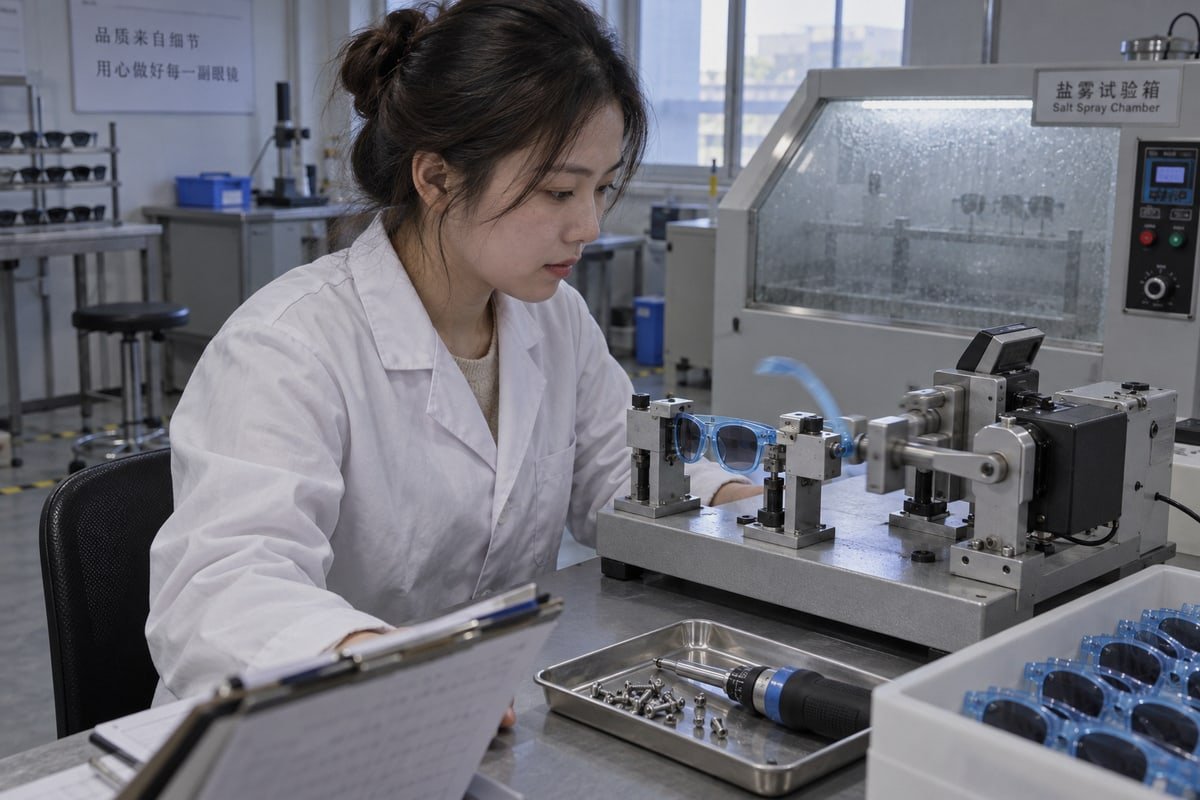
Eyewear durability testing for kids' frames is not complicated, but it must be specific to the hinge. A lens test tells you nothing about the joint. Here is the sequence I recommend when a buyer asks us to qualify a hinge for a TR90 front with TPEE temples.
Step-by-step hinge qualification
- Cycle the temples. Open and close each temple repeatedly and record when play, squeak, or looseness appears. For spring hinges, one claim you will see online is that the coil loses elasticity after about 5,000 flex cycles. I treat that number as a threshold to test against, not a guarantee.
- Pull and twist the temples. Spread the temples wider than a child's head and twist them. On a regular hinge, watch the plastic around the barrel for stress whitening. On a spring hinge, watch whether the coil returns the temple fully.
- Check screw torque and retention. Tighten to spec, cycle, then re-measure. Loosening within the first six months of simulated wear is the common complaint on regular hinges.
- Drop for impact resistance. Drop the frame lens-down and hinge-down onto a hard surface from a realistic height. Check whether the hinge bends, cracks, or stays true.
- Corrode it. Sweat, sunscreen, and salt water collect inside spring sleeves. A salt spray or sweat test shows whether the coil stiffens or seizes.
- Contaminate it. Pack sand into the hinge, cycle it, and see if it still moves. This is where simple barrel hinges sometimes outperform springs.
What each test tells you
| Prueba | Failure it catches | Hinge most at risk |
|---|---|---|
| Prueba de ciclo | Loosening, wobble, spring fatigue | Ambos |
| Pull and twist | Stress whitening, snapping at joint | Regular on TR90 |
| Screw retention | Screws backing out | Regular |
| Prueba de caída | Cracked barrels, bent sleeves | Ambos |
| Corrosion test | Stiffening, seizing, galvanic corrosion | Spring |
| Debris test | Clogged mechanism | Spring |
Do not confuse hinge tests with lens tests
El Marcado CE 2 you see on our polarized lens stickers relates to the lens and optical safety, not the hinge. UV400 protection is a lens property. Tensile strength 3 of the temple material is a material property. None of those replace a hinge test. When we develop a new style on our line, we run these hinge checks on pre-production samples before the buyer signs off on the final color and logo, because fixing a hinge after the mold is committed is expensive for everyone.
Can spring hinges affect the flexibility and safety benefits of TPEE temples?
Every time we pair a TR90 front with TPEE temples, we weigh the same trade-off: does adding a metal spring improve the hinge, or does it fight the temple's softness?
Spring hinges do not reduce TPEE temple flexibility, but they can add unnecessary weight and small metal parts to a temple that already bends safely. For toddlers, a screwless or integrated hinge on TPEE is often safer, while TR90 fronts with stiffer temples benefit most from springs.
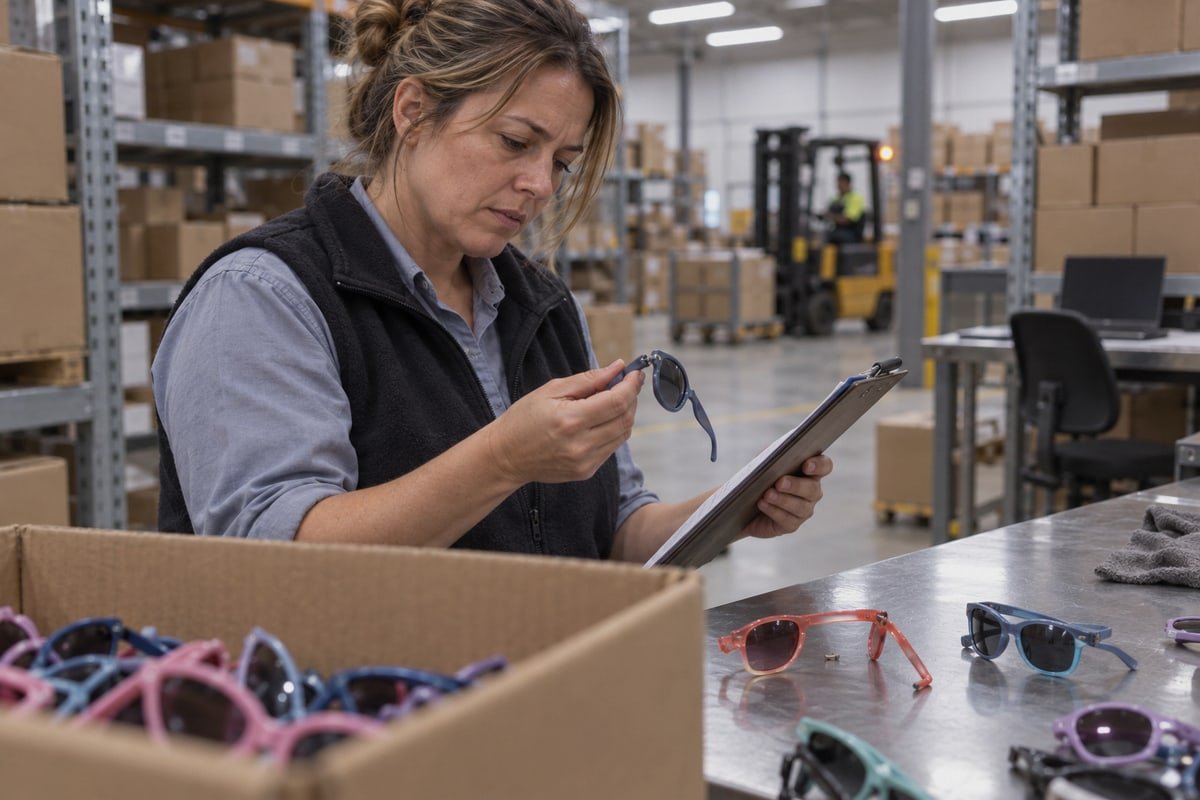
TPEE is a thermoplastic polyester elastomer. It is soft, rubbery, and returns to shape after bending. TR90 is a memory polymer that is flexible but noticeably stiffer. That difference drives the hinge decision more than most buyers expect. The temple arm flexibility of TPEE already does much of the work a spring hinge would do on a stiffer material.
Where the spring helps and where it does not
On our TR90 kids optical frames with TR90 temples, the temple resists outward force. The spring gives that stiff temple a safe path to flex. On a TR90 front with TPEE temples, the temple itself bends outward with the child's head. The spring still adds a little forgiveness at the pivot, but the gain is smaller. On a full TPEE frame, a mechanical spring often adds weight and metal for little benefit.
| Frame and temple combo | Recommended hinge | Razón |
|---|---|---|
| TR90 front, TR90 temples | Stainless steel spring hinge | Stiffer temple needs the outward flex |
| TR90 front, TPEE temples | Quality regular hinge or spring hinge | TPEE handles most of the flex; spring is a bonus |
| Full TPEE (toddler) | Screwless hinge design or living hinge | Removes small parts and metal fatigue |
The toddler safety angle
For toddler eyewear safety, fewer metal parts is a real advantage. A screwless hinge design molded into a TPEE frame eliminates the screw that can back out and the coil that can corrode. Living hinges molded directly into the elastomer avoid galvanic corrosion and the mechanical fatigue 4 that happens at metal-to-plastic friction points. That is a strong case, and for babies and toddlers I agree with it. TPEE is also valued as one of the materiales hipoalergénicos 5 for frames that sit against sensitive skin all day.
The objection: living hinges always outlast metal springs
Buyers sometimes take that argument too far. A living hinge is only as good as the elastomer around it, and it limits styling. The translucent gradient wayfarer fronts and glossy candy-color frames that sell well for older kids need a TR90 front to hold that crisp shape, and those fronts still need a metal hinge. There is also a safety trade-off in the other direction. Some argue that a regular hinge with a nylon screw acts as a controlled shear point in a hard impact, breaking cleanly, while a metal spring sleeve can bend into a sharp angle near the face. In our experience, a well-made stainless sleeve rarely bends that way, but it is another reason to test the drop scenario rather than assume.
Which hinge type will reduce my return rate and warranty claims over time?
The lesson I learned after fifteen years in eyewear is simple: returns rarely come from the hinge type on the spec sheet. They come from the hinge quality behind it.
Quality stainless steel spring hinges usually reduce return rates and warranty claims on TR90/TPEE kids sunglasses because they survive one-handed removal and rough play. Low-grade spring hinges wear out in six to nine months, so a well-made regular hinge beats a cheap spring hinge every time.
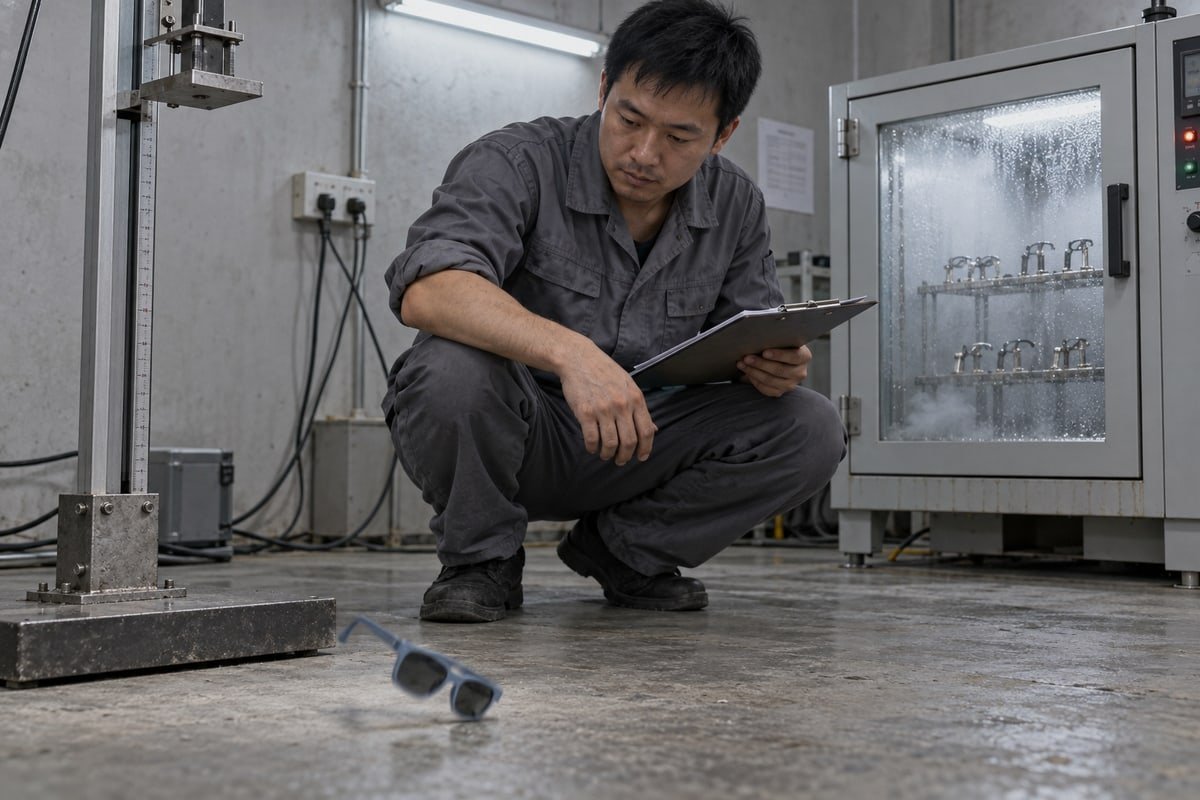
Warranty claims on kids' sunglasses tend to cluster around a few causes. Some are hinge-related and some are not. Sorting them out helps you decide where a spring hinge actually pays back its extra cost.
Where the claims come from
| Return cause | Hinge-related? | Hinge that helps most |
|---|---|---|
| Temple snapped at the joint after a pull | Sí | Spring hinge on TR90 |
| Loose, wobbly temple after a few months | Sí | Either, if stainless and well fitted |
| Hinge stiff or seized after beach use | Sí | Regular hinge, or sealed spring |
| Screw lost | Sí | Screwless hinge design on TPEE |
| Frame too tight or slips off | Partly | Spring hinge for self-adjusting fit |
| Lens scratched or popped out | No | Not a hinge issue |
The first row is the one that hurts brands most. Flexible frame technology in TR90 handles bending well, but the joint is still the limit. That is why a spring hinge on a TR90 front usually lowers the biggest single claim category.
Cost versus lifespan
Spring hinges raise the unit cost a little. Against that, weigh the cost of one return: shipping, replacement, and a parent who does not buy again. For most of our TR90 front styles, the extra hinge cost is small compared with the claim it prevents. For a promotional or lower-budget line, or for older and careful children, a quality regular hinge is perfectly adequate, easier to repair, and cheaper.
When regular hinges are still the right call
I still recommend regular hinges when:
- The product is a low-cost promotional giveaway with a short expected life.
- The child is older, supervised, or careful.
- The market involves heavy sand and salt water and the buyer prefers fewer parts to clog.
- Repairability by the parent or retailer is a selling point.
A product-page checklist for buyers
When a buyer chooses from our roughly 800 existing styles, I ask them to confirm five things before they lock a hinge: stainless steel hinge components, secure screw or screwless construction, temple material matched to the age group, verified hinge test results on the sample, and overall fit. Hinge type alone is never the last word. With full OEM/ODM support we can swap the hinge on an existing style, adjust colors and logos, and ship retail-ready packaging, so the buyer tests the market without a heavy mold investment.
Conclusión
Hinge failures drive kids sunglasses returns. Cheap springs make it worse. Choose a well-built stainless steel spring hinge on TR90, screwless TPEE for toddlers, and test before ordering.
Interested in sourcing the products mentioned in this article? See details and request a quote here:
Notas al pie
1. TR90 is a specialized polyamide (Nylon 12) widely used for its memory properties in flexible eyewear frames. ↩︎
2. Official European Commission resource detailing the safety and conformity requirements for products bearing the CE marking. ↩︎
3. ISO 527-1 is the international standard for determining the tensile properties and strength of plastic materials. ↩︎
4. Mechanical fatigue explains the structural damage that occurs when hinges are subjected to repeated cyclic loading. ↩︎
5. The FDA regulates the safety and biocompatibility of materials used in wearable devices and medical products. ↩︎
Más artículos que te podrían gustar

¿Buscas un socio confiable en gafas para niños?
Explore más de 800 estilos listos y soporte OEM/ODM completo adaptado a su marca.
Ponte en contacto English
  Español de México
  Deutsch
  Français
  日本語
日本語  العربية
  Português do Brasil