Can Kids Sunglasses Be Used for Swimming or Water Sports?
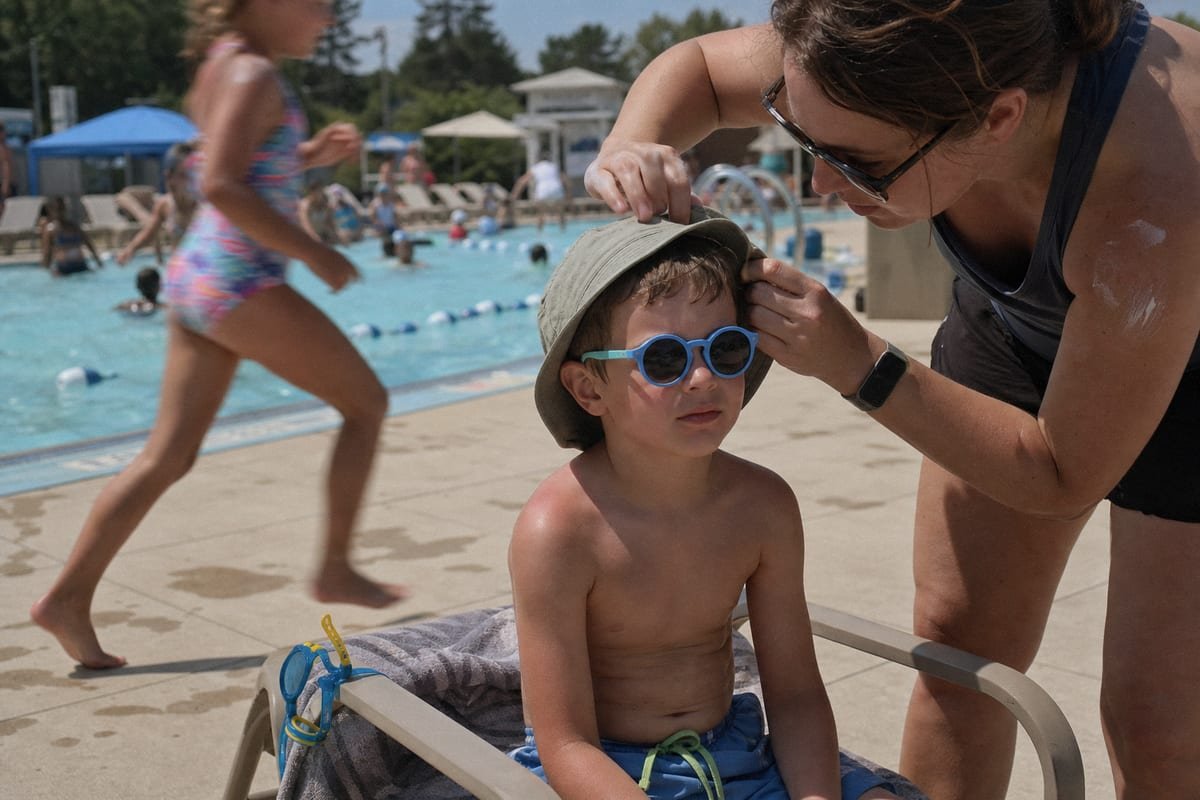
Every summer, buyers ask our factory whether kids sunglasses can be used for swimming or water sports. A wrong answer risks lost eyewear, unhappy parents, and product returns.
Kids sunglasses are made for sun protection around water, not in it. Standard pairs slip off, let water in, and lack a seal. For actual swimming, children need swimming goggles; sunglasses work only for poolside, beach, and boat-deck use, or in special water-ready designs.
That short answer hides useful detail. Let me break down the materials, retention systems, lens choices, and sourcing questions that matter for water-adjacent kids eyewear.
What materials make kids sunglasses safe for water sports?
During a material trial at our Taizhou workshop, we soaked TPEE and TR90 samples 1 in salt water for weeks. The results shaped how we now build water-ready kids sunglasses.
Water-safe kids sunglasses need impact-resistant polycarbonate lenses, flexible TPEE or TR90 frames that resist salt and chlorine, corrosion-proof hinges, and hydrophobic lens coatings. Some designs add lightweight floating frames so the sunglasses stay on the water surface if knocked off.
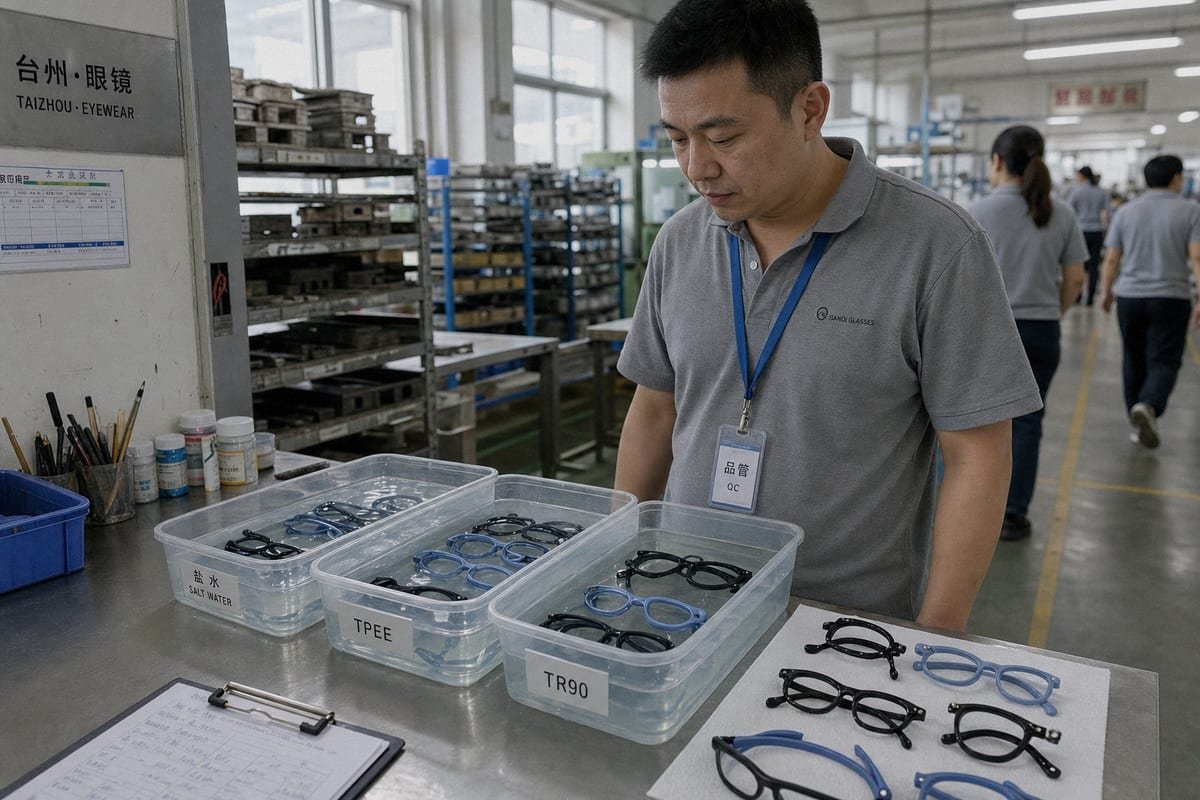
Material choice is the first place where regular kids sunglasses and water-ready eyewear separate. In our experience developing flexible frames for children's brands in Europe and Australia, three material zones matter: the lens, the frame, and the hardware.
The lens: impact resistance comes first
Children fall, collide, and take splashes to the face. Glass lenses are never acceptable for kids near water. Impact-resistant polycarbonate is the standard because it flexes instead of shattering. On top of that, a recubrimiento de lente hidrofóbico 2 helps water bead off instead of smearing. It also resists sunscreen oils and salt residue, which are the two biggest causes of blurred vision in beach eyewear.
The frame: flexibility and chemical resistance
Chlorine and salt water attack cheap plastics. They turn brittle, fade, and crack at the hinge. This is why we build most of our children's styles in TPEE and TR90. Both materials stay flexible, bounce back after twisting, and tolerate repeated wet-dry cycles far better than basic PC frames.
| Material zone | Water-ready choice | Por qué importa |
|---|---|---|
| Lente | Impact-resistant polycarbonate | Shatter-safe during play and collisions |
| Lens coating | Recubrimiento hidrofóbico | Sheds water, salt, and sunscreen oils |
| Marco | TPEE / TR90 | Flexible, chlorine- and salt-resistant |
| Bisagra | Plastic or marine-grade steel | Prevents rust and mechanical failure |
| Buoyancy | Lightweight floating frames | Easier recovery if dropped in deep water |
One more note. Even the best materials do not make sunglasses submersion-safe. They make them survivable around water, which is a different job.
How do I choose sunglasses that stay secure while my child swims?
A distributor in Queensland once told me half his customer complaints were about lost kids sunglasses at the beach. That conversation pushed us to rework our retention accessories.
Choose a wraparound style with rubberized temple grips, a snug child-specific fit, and an adjustable head strap in neoprene or silicone. These features keep sunglasses secure during splash play and boating. For actual swimming or diving, no retention system replaces properly sealed swimming goggles.
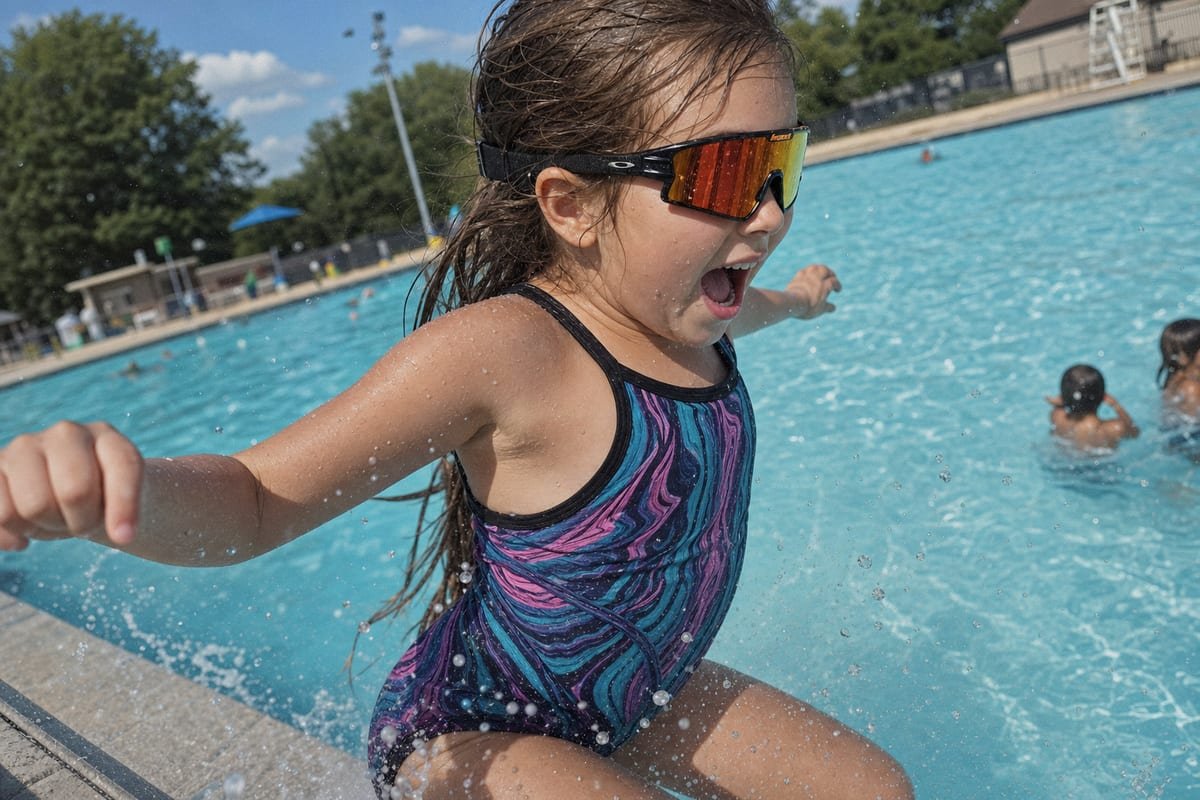
Retention is where physics defeats hope. When a child jumps into a pool, the water strips ordinary sunglasses off in an instant. So the honest first step is defining the activity level before choosing the retention system.
Match retention to the activity
Here is the practical ladder we recommend to our B2B buyers when they plan a water-themed collection:
- Lounging and beach play out of the water. A well-fitted flexible frame with grippy temple tips is enough.
- Boating, kayaking, and paddleboarding. Add an adjustable head strap in neoprene or silicone. It keeps eyewear attached through bumps and spray.
- Splash zones and shallow play. A wraparound style plus a strap can survive light splashing, though fogging is likely.
- Swimming, lessons, cannonballs, and diving. Switch to swimming goggles. Sunglasses do not seal, and they will let water flush across the eyes.
Fit details that actually hold
Fit matters more than accessories. On our production line, we size bridges and temple lengths specifically for toddler and child head shapes rather than shrinking adult frames. A frame that sits flush at the brow and hugs the temples resists movement far better than a loose fashion frame with a strap bolted on. Rubberized nose pads and temple ends add friction on wet skin. Floating frames are the final safety net: if the pair does come off in a lake or deep pool, it stays visible on the surface for easy recovery instead of sinking.
Are polarized or UV400 lenses better for kids near water?
We calibrate both lens types daily in our workshop, and buyers still mix them up. They solve different problems, and near water a child often needs both solved.
UV400 protection is non-negotiable because it blocks the UVA and UVB rays that damage children's eyes. Polarized lenses add comfort by cutting water surface glare. The best choice for kids near water is a polarized lens that also carries certified UV400 protection.

Think of these as two separate layers of defense. Protección UV400 is about health. Polarization is about vision quality. Confusing them leads to real risk, because a dark, glare-cutting lens without UV filtering can be worse than no lens at all — the pupil dilates behind the tint and lets more UV in.
Why children's eyes need UV400 first
Children's eyes are more vulnerable than adult eyes. Their young lenses allow more Radiación UV 3 to pass through to the retina, and a large share of lifetime sun exposure happens during childhood. Water makes this worse by reflecting sunlight upward, doubling the dose. Intense reflected UV can even cause queratitis actínica 4, a painful sunburn of the cornea 5, after a long unprotected day on bright water. That is why every lens we ship for children's collections is specified at UV400, whether tinted, mirrored, or polarized.
Where polarized lenses earn their place
Lentes polarizadas filter the horizontal light waves 6 that bounce off flat surfaces. On a lake or at the pool edge, that means far less squinting and better visibility into the water. For boating, fishing trips, and beach days, they are a genuine upgrade.
| Característica | Protección UV400 | Lentes polarizadas |
|---|---|---|
| Main job | Blocks UVA/UVB rays | Cuts water surface glare |
| Health impact | Protects retina and cornea | Reduces eye strain and squinting |
| ¿Requerido para niños? | Sí, siempre | Recommended near water |
| Works underwater? | Irrelevant when submerged | Irrelevant when submerged |
| Impacto de costo típico | Mínimo | Moderado |
One caveat: neither feature matters underwater. Once a child submerges, the priority shifts entirely to sealing, which is the job of goggles, some of which also carry tinted UV-rated lenses for outdoor pools.
What should I look for in a manufacturer for water-ready kids eyewear?
Fifteen years of building children's frames has taught our team one lesson: water-themed eyewear exposes weak suppliers fast, because corrosion, fading, and fit failures show up within one season.
Look for a factory with proven flexible-material expertise, certified UV400 and polarized lens options, corrosion-resistant hardware, child-specific sizing, and full OEM/ODM support. A broad existing style library also lets you launch a water-ready collection without heavy mold investment.
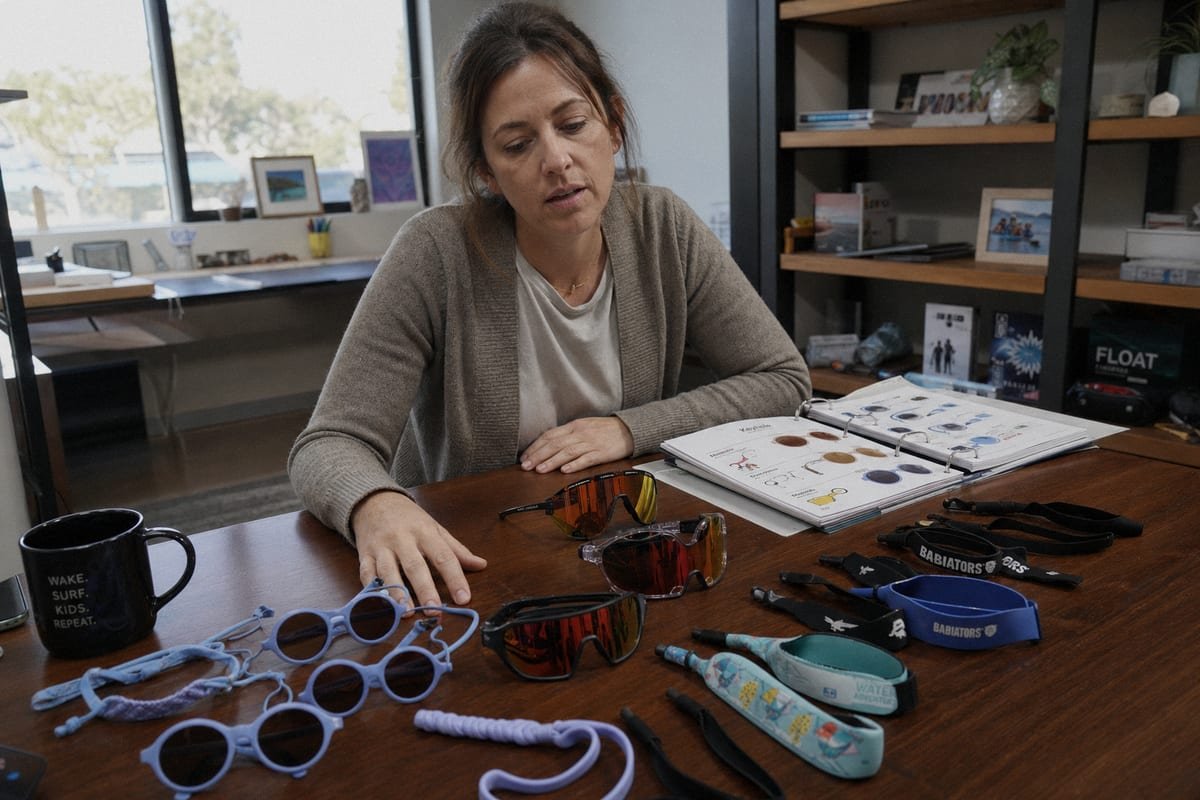
Sourcing water-adjacent kids eyewear is a different exercise from buying generic fashion sunglasses. The product lives in a harsh environment and sits on a child's face, so both durability and safety claims must hold up. Here is the checklist I would use if I were sitting on your side of the table.
Preguntas que separan fábricas de comerciantes
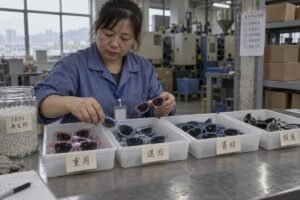
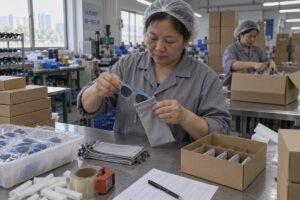
Ask where the frames are actually made and how many workers are on the line. Our own facility runs about 120 workers under 5S workshop management, and we encourage buyers to audit that directly. A trader cannot show you the injection machines, the lens-cutting stations, or the QC benches. A real factory can also explain its material sourcing for TPEE and TR90 and its tolerance standards for hinge assembly.
Capabilities that matter for water-ready lines
| Capability | Why it matters for water-ready kids eyewear |
|---|---|
| Flexible TPEE/TR90 expertise | Frames survive twisting, chlorine, and salt exposure |
| Opciones de lentes UV400 y polarizadas | Verified sun protection, reduced glare for water use |
| Corrosion-proof hinge options | No rust failures after beach seasons |
| ~800 existing styles | Test the market without new mold costs |
| OEM/ODM customization | Custom colors, logos, straps, and retail packaging |
| Consistent QC process | Fewer returns, safer products, protected brand reputation |
Low-risk ways to start
New brands rarely need custom molds on day one. Choosing from an existing style library — we maintain roughly 800 designs — lets you validate a beach or pool collection with modest order quantities. Then, once sell-through proves demand, you can invest in custom colorways, mirrored lens gradients 7, floating frames, or bundled straps and cases. Reliable manufacturers will also advise honestly on positioning: sunglasses for around the water, goggles for in it. If a supplier tells you regular kids sunglasses are fine for swimming laps, treat that as a red flag.
Conclusión
Kids sunglasses protect eyes around water; swimming goggles protect eyes in it. Specify UV400, polarized options, flexible frames, and secure retention — and partner with a factory that proves it.
Notas al pie
1. Wikipedia provides a technical overview of thermoplastic elastomers like TPEE used in durable, flexible consumer products. ↩︎
2. Industry leader Essilor explains the functional benefits of hydrophobic coatings for lens clarity and maintenance. ↩︎
3. The World Health Organization details the risks of UV radiation and the importance of eye protection. ↩︎
4. NIH MedlinePlus explains photokeratitis, backing the claim about UV-related corneal sunburn near water. ↩︎
5. The American Academy of Ophthalmology defines photokeratitis as a temporary but painful eye condition caused by UV exposure. ↩︎
6. Wikipedia explains the physics of wave polarization, which is the basis for glare-reducing polarized sunglass lenses. ↩︎
7. Wikipedia provides an overview of sunglass lens types, including mirrored and gradient finishes for specific light conditions. ↩︎
Más artículos que te podrían gustar

¿Buscas un socio confiable en gafas para niños?
Explore más de 800 estilos listos y soporte OEM/ODM completo adaptado a su marca.
Ponte en contacto English
  Español de México
  Deutsch
  Français
  日本語
日本語  العربية
  Português do Brasil