How Do You Verify TR90 Kids Sunglasses Meet Hazardous Substance Limits?
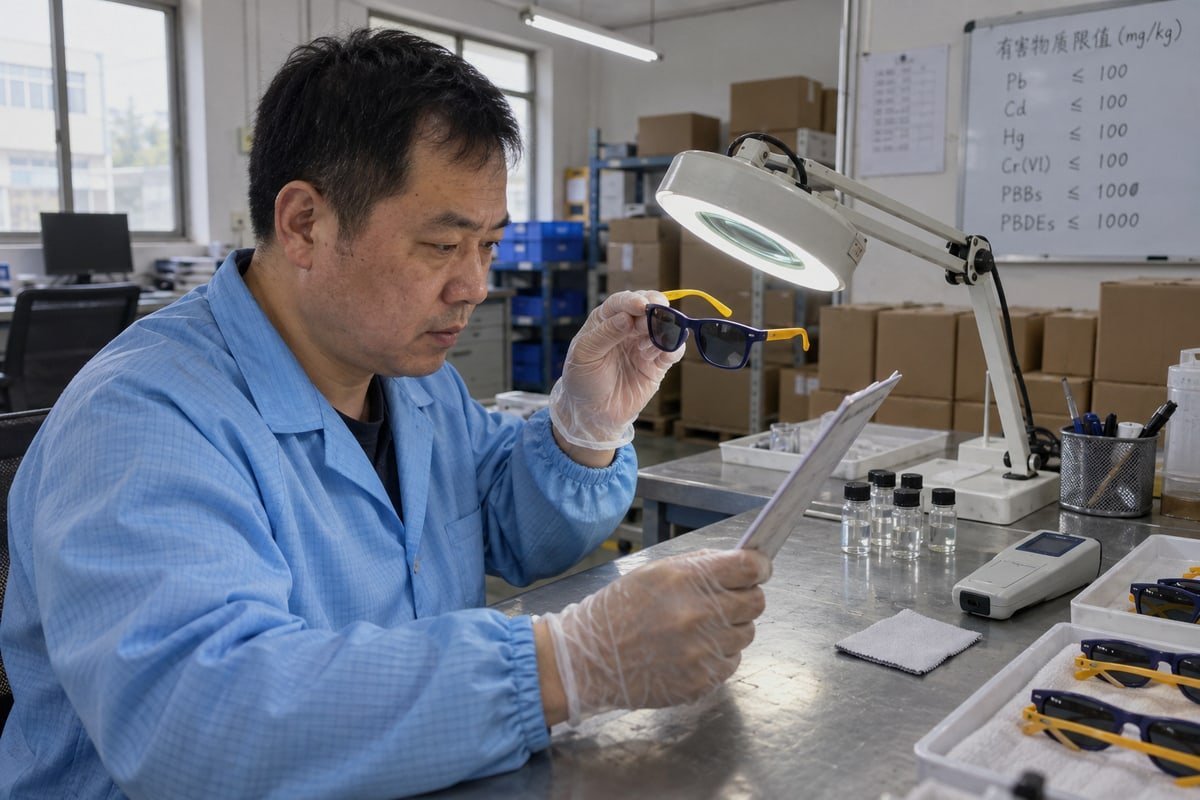
Many buyers assume TR90 kids sunglasses meet hazardous substance limits automatically. On our Taizhou production line, I’ve seen that assumption cause costly surprises. Verification is the only real fix.
To verify TR90 kids sunglasses meet hazardous substance limits, test the finished product at an ISO 17025-accredited lab against your target market’s rules, such as CPSIA lead and phthalate limits or REACH Annex XVII, then tie each batch-specific report to the exact style, colorway, and bill of materials.
TR90 is a good starting point. It is not final proof. Below, I walk through what to ask your supplier, which papers to collect, which lab reports matter for your country, and how to check every part of the product, not just the frame.
How can I confirm my TR90 sunglasses supplier tests for lead, cadmium, and phthalates?
Last year a procurement manager from Australia sent us a one-line email: "Do you test for lead?" Our reply ran three pages, because the real answer needs detail.
Confirm your supplier tests for lead, cadmium, and phthalates by requesting batch-specific third-party lab reports from an ISO 17025-accredited lab like SGS, TUV, or Intertek, showing lead under 100 ppm, phthalates under 1000 ppm, and cadmium under 75 mg/kg, matched to your exact style number.
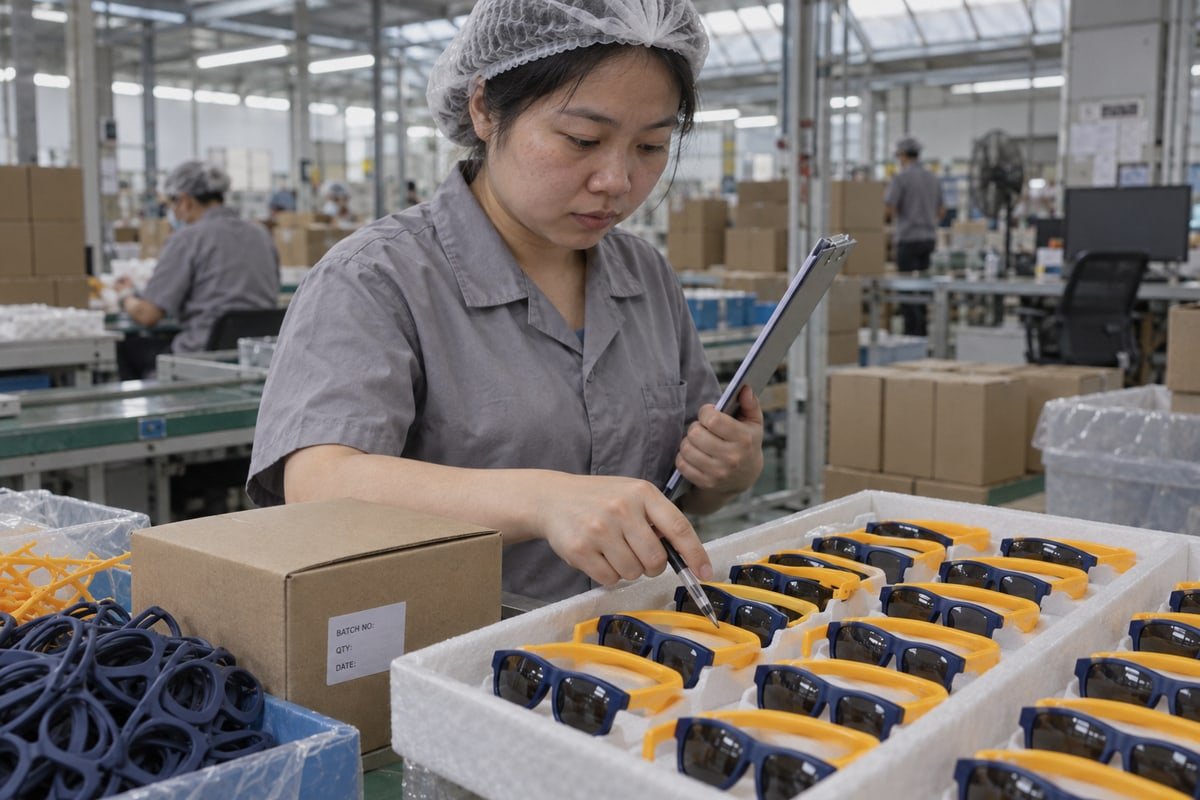
The word "test" hides a lot. A supplier can say yes and mean three very different things. They might mean the resin maker tested the raw pellets years ago. They might mean the factory ran a handheld XRF gun on one frame. Or they might mean they sent your production batch 1 to an accredited lab. Only the last one protects you.
Three questions that expose weak testing
I tell buyers to ask these in order. The answers tell you more than any brochure.
- Who did the test? You want Mercado de destino, not an in-house claim. Ask for the lab name and its ISO 17025 accreditation number.
- What exactly was tested? The report should name your style number, your colorway, and show sample photos. A generic "TR90 frame" report is not enough.
- When was it done? A report from two years ago on a different color does not cover this year's batch. Ask for batch-specific testing tied to your purchase order.
The substances and limits you should see on the report
| Sustancia | Common limit to check | Where it hides in kids sunglasses | Typical test approach |
|---|---|---|---|
| Plomo | Below 100 ppm (CPSIA) | Pigments, metal hinges, painted accents | ICP after acid digestion |
| Ftalatos | Below 1000 ppm each (CPSIA) | Soft nose pads, rubberized temple tips, soft-touch coatings | Solvent extraction, GC-MS |
| Cadmio | Below 75 mg/kg (China child eyewear rules; REACH also restricts) | Yellow, orange, and red pigments, plated hardware | ICP |
| Liberación de níquel | Below 0.5 μg/cm²/week for prolonged skin contact | Metal hinges, decorative rivets, screws | Sweat-simulated migration |
Notice the cadmium row. The bright yellow-orange temple on our dual-tone wayfarer style is a good example. Bright warm colors are exactly where cadmium pigments used to appear. So we treat every new masterbatch as a fresh chemical risk, even when the base polymer is the same Grilamid TR90 material we used last season.
Why batch-specific matters
Injection molding is repeatable, but the inputs are not always fixed. A regrind percentage can creep up. A masterbatch supplier can change a pigment. A subcontractor can switch a coating. That is why we keep the bill of materials frozen once a style is approved. If any input changes, we re-test. That habit is cheaper than a recall.
What certifications should I request to prove hazardous substance compliance?
Early in our export work, we learned that a "certificate" can mean many things. Some buyers accepted a resin datasheet as proof. That lesson shaped how we document today.
Request a Declaration of Conformity citing EN ISO 12312-1 and REACH Annex XVII for Europe, a Children's Product Certificate under CPSIA for the US, a Prop 65 review for California, plus the resin's Material Safety Data Sheet and Grilamid TR90 or equivalent trade name.

Certifications and test reports are not the same thing. A certification is a statement. A test report is evidence. You need both, and you need to know what each one actually covers. Here is how I explain the paperwork to new brand clients.
What each document proves and where it falls short
| Documento | Quién lo emite | Lo que prueba | What it does not prove |
|---|---|---|---|
| Declaración de Conformidad (DoC) | Manufacturer or importer | Legal commitment that the product meets named EU rules, including REACH compliance and EN ISO 12312-1 2 | It is a self-declaration; it must be backed by test data |
| Certificado de Producto Infantil (CPC) | Importer, based on lab data | CPSIA standards were tested by a CPSC-accepted lab | Only covers the US; only as good as the underlying report |
| Certificate of Compliance | Supplier or lab | Product or material meets a listed standard | Often generic unless it names your SKU and batch |
| Hoja de datos de seguridad del material | Resin maker | Composition and hazards of the raw polymer | Says nothing about coatings, pigments, or the finished frame |
| Prop 65 review | Lab or compliance consultant | Screening against the list of over 900 regulated chemicals | Not a certification; may still require a warning label |
The CE mark and the FDA question
For Europe, look for the CE mark engraved on the inner temple. On our frames it sits near the hinge, in the same small etched text area you see on the dual-tone wayfarer. The CE mark should point back to EN ISO 12312-1 for optical and impact safety. It does not by itself prove chemical safety, so pair it with REACH Annex XVII screening.
For the US, sunglasses are treated as Class I medical devices. Buyers often ask us about FDA registration. That registration relates to resistencia al impacto 3 and quality system basics, not chemical limits. CPSIA standards handle the chemical side for children's products.
Standards buyers request that may not apply
Some buyers ask for a RoHS directive certificate. RoHS covers electrical and electronic equipment, so it does not apply to plain sunglasses. Others ask for EN 71-3 safety standards or ASTM F963 requirements. Those are toy standards. They apply only if the sunglasses are marketed as a toy or bundled with one. I do not push back on these requests. I explain the scope, and if the buyer still wants the test for peace of mind, we arrange it.
A note on BPA-free certification: TR90 is a polyamide, so BPA is not part of its chemistry. A BPA-free claim on the resin is honest, but it is not a substitute for phthalate testing on the soft parts.
Which lab reports do I need before importing kids sunglasses into my country?
During a pre-shipment check on a dual-tone wayfarer, our QC team flagged that the yellow temple used a different masterbatch than the sample. We re-tested before shipping.
Before importing kids sunglasses, obtain batch-specific reports covering CPSIA lead and phthalate testing for the US, REACH Annex XVII and nickel release for the EU, EN ISO 12312-1 optical testing, and any Prop 65 or destination-specific chemical screening, all issued by an ISO 17025-accredited laboratory.

The right report depends on where the product will be sold. We ship to buyers in more than 20 countries, and the paperwork stack looks different for almost every one. Here is the map I use when a new client tells me their destination.
Reports by destination market
| Mercado | Chemical reports to collect | Optical and safety reports | Extra notes |
|---|---|---|---|
| Estados Unidos | CPSIA total lead, phthalates (each below 1000 ppm), lead in surface coatings | Prueba de impacto de caída de bola de la FDA | Add a Prop 65 review if selling in California |
| Unión Europea | REACH Annex XVII screening, SVHC screening, nickel release on metal parts | EN ISO 12312-1 | DoC must be on file with the importer |
| Australia and New Zealand | Buyers usually request CPSIA or REACH-style chemical reports | AS/NZS 1067 sunglass categories | Local retailers often set their own chemical policy |
| Japón | REACH-style screening is commonly requested by brands | JIS T 7333 | Brand-specific restricted substance lists are common |
| China | Lead, cadmium 75 mg/kg limit, nickel release 0.5 μg/cm²/week | National child eyewear rules | Useful even if not selling in China, since it is strict |
What a usable report must show
A report is only useful if a customs officer or retailer can match it to the goods. I check for these items before I send anything to a client.
- Style number and colorway that match the packing list.
- Sample photos of the actual tested product.
- Bill of materials revision number.
- Test date and lab accreditation number.
- The specific limits tested against, not just "pass."
- Signature and lab report number for tracing.
Keeping reports tied to the lot
We have started putting a unique QR code on some retail-ready packaging for clients who ask. It links to the lab results for that production lot. This is not required by law. But it answers the parent's question at the shelf, and it makes retailer audits faster. Blockchain-enabled tools go one step further, though most of our clients find a simple lot-linked report portal is enough.
One more point. Ask for the report before the goods ship, not after they land. A delay of one week at the lab is far cheaper than a container waiting at port.
How do I know if the lens and frame materials are truly free of harmful chemicals?
Every time we quote a matte rubberized finish or a mirrored lens, we weigh the look a brand wants against the extra chemical checks that finish demands. Both matter.
You know lens and frame materials are truly free of harmful chemicals only when component-level tests on the finished product, including coatings, inks, nose pads, temple tips, and metal hinges, pass lead and cadmium limits, phthalate testing, and REACH SVHC screening, with sweat-simulated migration confirming nothing leaches.
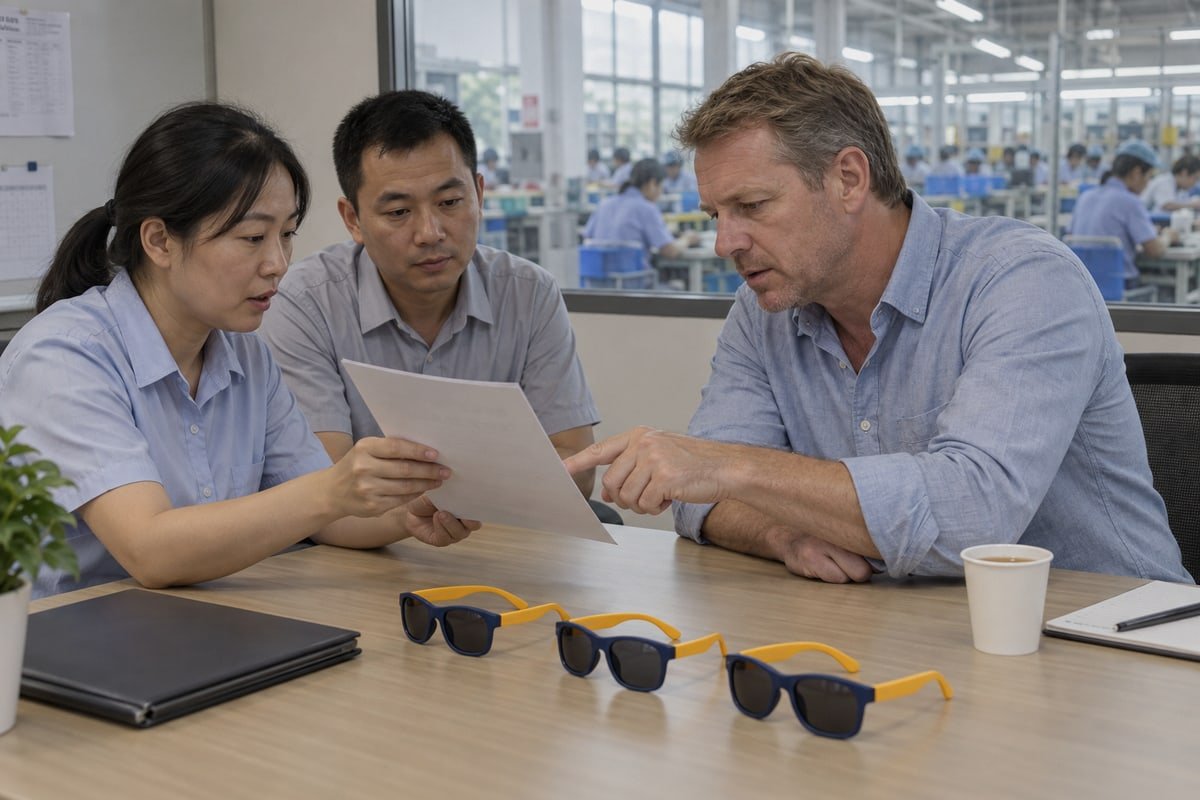
Here is the tension I hear from buyers. One side says TR90 is lightweight, flexible, hypoallergenic, and safe for kids, so why test more? The other side says the resin name is irrelevant, because real risk sits in additives, coatings, and supply-chain swaps. I think both are partly right, and the way to settle it is to break the product into parts.
Where chemicals actually hide
Take our three sample styles. The dual-tone wayfarer has two masterbatches and etched text. The matte navy sport frame has a soft-touch coating and gradient lenses. The glossy black oval has a metal accent at the hinge. Each part carries its own risk.
| Componente | Typical risk | What to test |
|---|---|---|
| TR90 frame body | Low if virgin Grilamid TR90 material; higher with regrind or unknown masterbatch | Lead, cadmium, SVHC screening |
| Soft-touch or rubberized coating | Phthalate plasticizers, solvents | Las pruebas de ftalatos |
| Tinted, gradient, or mirrored lenses | Dyes, metallic coatings | Lead, cadmium, SVHC |
| Printed logos and etched text fills | Pigments, heavy metals | Lead in surface coatings |
| Metal hinges, rivets, screws | Nickel, lead, cadmium | Nickel release, sweat migration |
| Nose pads and temple tips | Plasticizers | Las pruebas de ftalatos |
| Adhesives and packaging inks | Solvents, SVHC | REACH screening |
Sweat migration and NIAS
Kids wear sunglasses while running and sweating. Skin acidity can pull residual monomers or stabilizers out of a polymer over time. That is why sweat-simulated migration testing 4 matters, especially on parts that touch the face all day. Our TPEE temples are chosen for flexibility and comfort, and they get the same migration checks as the metal parts.
Non-intentionally added substances, or NIAS, are another quiet risk. If a molding shop also runs low-grade PVC or polycarbonate, cross-contamination can happen. Our workshop is 5S-managed, and we keep TR90 and TPEE lines separate. When a buyer audits us, this is one of the first things I show them.
A simple decision framework
Declarations alone are reasonable when the style is unchanged, virgin resin is confirmed, there are no soft coatings or metal trims, and a recent batch report already exists. Independent testing is necessary when any input changes, when the style has painted, plated, or rubberized parts, or when you enter a new market. With around 800 existing styles, we can often point buyers to a low-risk base design and then test only the customizations.
Conclusión
TR90 lowers risk but proves nothing alone. Freeze the bill of materials, collect real documents, test every batch at an accredited lab, and re-test after changes.
Interested in sourcing the products mentioned in this article? See details and request a quote here:
Notas al pie
1. Official ISO page for the laboratory testing standard required for valid production batch verification. ↩︎
2. International standard for sunglasses safety and optical requirements referenced for European market compliance. ↩︎
3. FDA guidance on medical device registration which includes impact resistance requirements for sunglasses. ↩︎
4. ECHA overview of REACH regulations which govern chemical migration limits in consumer products. ↩︎
Más artículos que te podrían gustar


¿Buscas un socio confiable en gafas para niños?
Explore más de 800 estilos listos y soporte OEM/ODM completo adaptado a su marca.
Ponte en contacto English
  Español de México
  Deutsch
  Français
  日本語
日本語  العربية
  Português do Brasil