How to Choose the Right Size of Kids’ Sunglasses by Age and Face Shape?
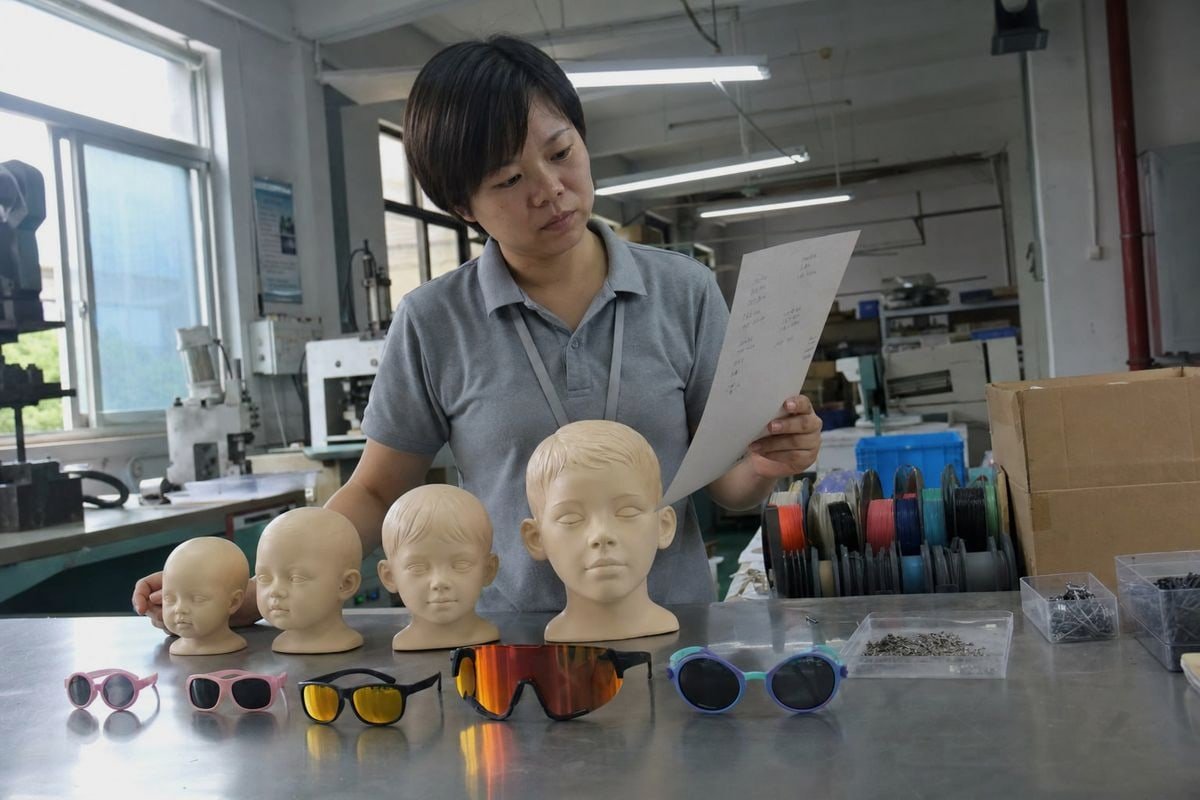
Choosing the right size of kids’ sunglasses sounds simple until a shipment gets returned UV400 lens quality 1. On our production line in Taizhou, I have seen brands lose whole seasons because their frames pinched toddlers or slid off school-age kids. Sunglasses that do not fit do not get worn — and unworn sunglasses protect nobody. The fix is a clear sizing method, and that is exactly what I will share here.
Choose the right size of kids’ sunglasses by starting with an age band, then confirming with real measurements: face width at the temples, nose bridge fit, and temple length. Lens widths typically run from 35 mm for babies to 52 mm for teens, refined by face shape.
Age charts are a starting point, not the final answer. In this guide, I will walk you through measurement steps, age-by-age sizing data, fit checks, and why size range matters when you source frames for your brand.
How do I measure my child's face for the right sunglasses fit?
Fifteen years of building children's frames in TPEE and TR90 2 taught our team one thing early: two four-year-olds can have completely different face widths. That is why we always tell buyers to measure first and trust age labels second.
Measure the face at its widest point near the temples using a soft tape or ruler, then add 5–10 mm to estimate frame width. Also measure the nose bridge where the frame rests, and the distance from the ear hinge point to behind the ear for temple length.
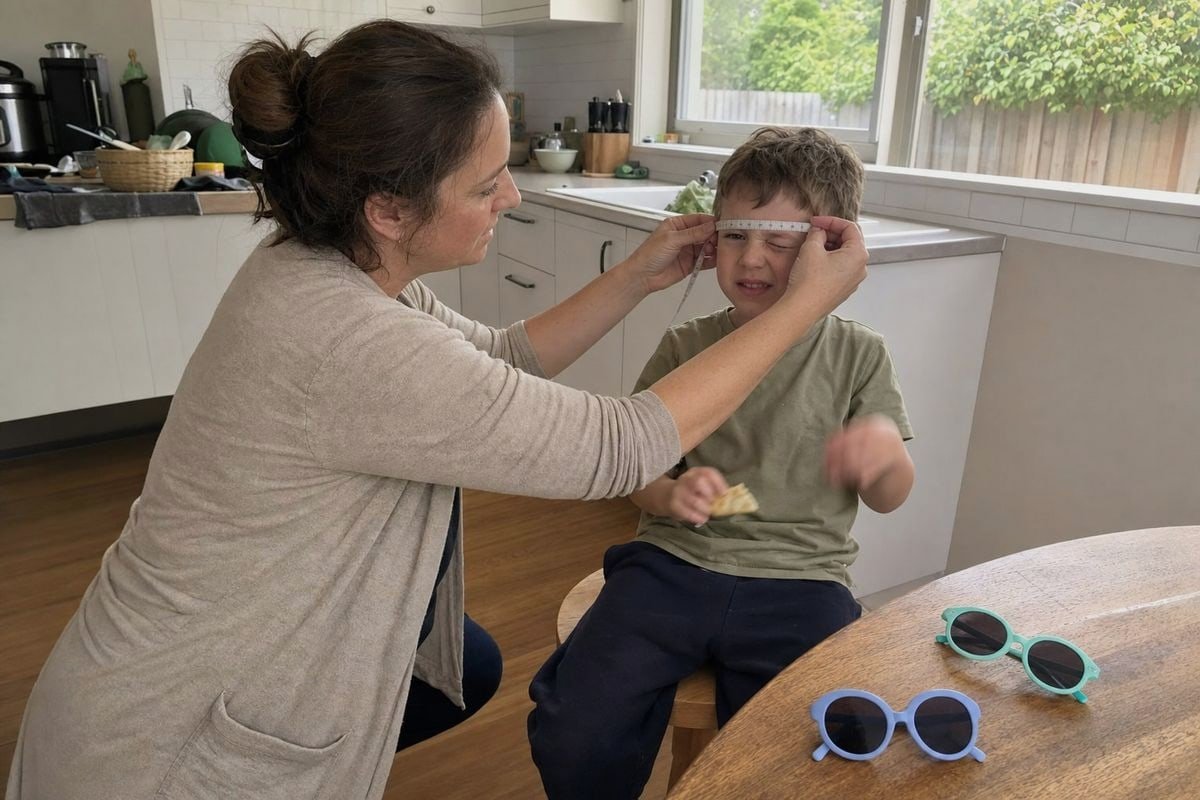
Measuring a child's face takes about two minutes, and it removes most of the guesswork. I recommend doing it while the child sits still — a small snack helps, as any parent knows. Here is the process our team uses when we help brands define size specs for their target market.
Step-by-step measurement method
- Ancho de la cara. Hold a soft measuring tape flat across the face, from one temple to the other, at the widest point. Write down the number in millimeters.
- Add an allowance. If the child does not currently wear glasses, add about 5–10 mm to that width. The frame should sit slightly wider than the face so it never squeezes the temples.
- Bridge width. Look at where the sunglasses will rest on the nose. Young children have small, flat bridges, so measure the width of the nose at that resting point. A frame with a low, cushioned bridge works best here.
- Longitud de la patilla. Measure from the outer corner of the eye area (roughly where the hinge sits) back to the point just behind the ear. This tells you how long the temple arms need to be.
What each measurement controls
| Medida | What it controls | Por qué importa para los niños |
|---|---|---|
| Face width (temple to temple) | Overall frame width | Too narrow pinches; too wide slides off |
| Ancho del puente | How the frame sits on the nose | Small bridges cause constant slipping |
| Longitud de la patilla | Grip behind the ears | Short temples press; long temples wobble |
If the child already wears glasses that fit well, there is a shortcut. Simply measure the width of the existing frame and match your sunglasses to it. In our sample rooms, we keep head-form models across age bands for exactly this reason — real dimensions beat labels every time.
What sunglasses sizes work best for each age group, from toddlers to teens?
When buyers from Europe and Australia visit our factory, the first document they ask for is our size chart by age band. We built ours from years of tooling frames for babies through teens, and the progression is surprisingly consistent.
Kids' sunglasses sizes progress by age: babies need about 35–37 mm lens width, toddlers 37–42 mm, preschoolers 43–45 mm, school-age kids 45–47 mm, and preteens or teens 47–52 mm. Frame width grows from roughly 90 mm to 140 mm across those bands.
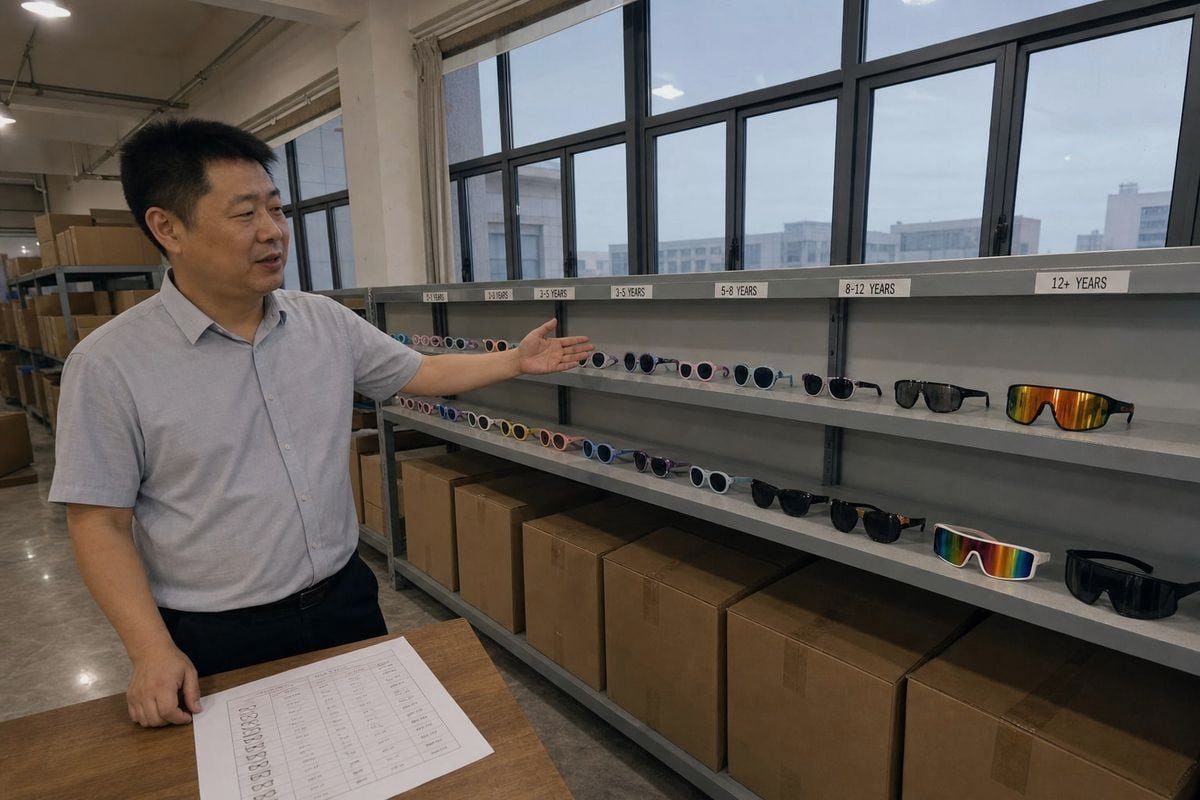
Age bands are useful because they narrow your options fast. But remember: they describe averages, not your specific child or your specific target market. Here is the full breakdown we use when advising brands on which of our roughly 800 existing styles fit their age range.
Age-by-age sizing chart
| Grupo de edad | Ancho de lente | Ancho de montura | Longitud de la patilla |
|---|---|---|---|
| 0–1 años | 35–37 mm | 90–100 mm | 110–120 mm |
| 1–2.5 años | 37–38 mm | 95–108 mm | 115–125 mm |
| 5–4 años | 40–42 mm | 105–115 mm | 120–130 mm |
| 4–7 años | 43–45 mm | 110–120 mm | 125–135 mm |
| 7–10 años | 45–47 mm | 120–130 mm | 135–145 mm |
| 10–16 años | 47–52 mm | 125–140 mm | 140–155 mm |
How face shape refines the choice
Once the size band is right, face shape helps you fine-tune style and retention:
- Round faces look balanced with slightly angular or rectangular frames, like the shield and wraparound sport styles we produce for active older kids.
- Angular or square faces suit softer, rounded frames — think retro circular lenses, which we often mold in flexible two-tone TPEE for younger children.
- Oval faces fit almost any frame shape, making them the easiest to style.
- Heart-shaped faces pair well with frames that are wider at the bottom.
For children, shape is a secondary refinement. Coverage and comfort always come first. A perfectly stylish frame that leaves gaps above the brow or at the sides is not doing its job of blocking luz UV 3.
How can I tell if kids' sunglasses fit correctly and stay comfortable during play?
A distributor once sent us a video of his own daughter shaking her head with one of our TR90 wraparound samples on — his personal drop test. She giggled, the frame stayed put, and he placed the order. That is the standard I hold every fit check to.
Kids' sunglasses fit correctly when they sit snugly without pinching, do not slide when the child looks down, cover the eyes from eyebrow to cheekbone with no side gaps, rest comfortably on the nose bridge, and leave no pressure marks after extended wear.
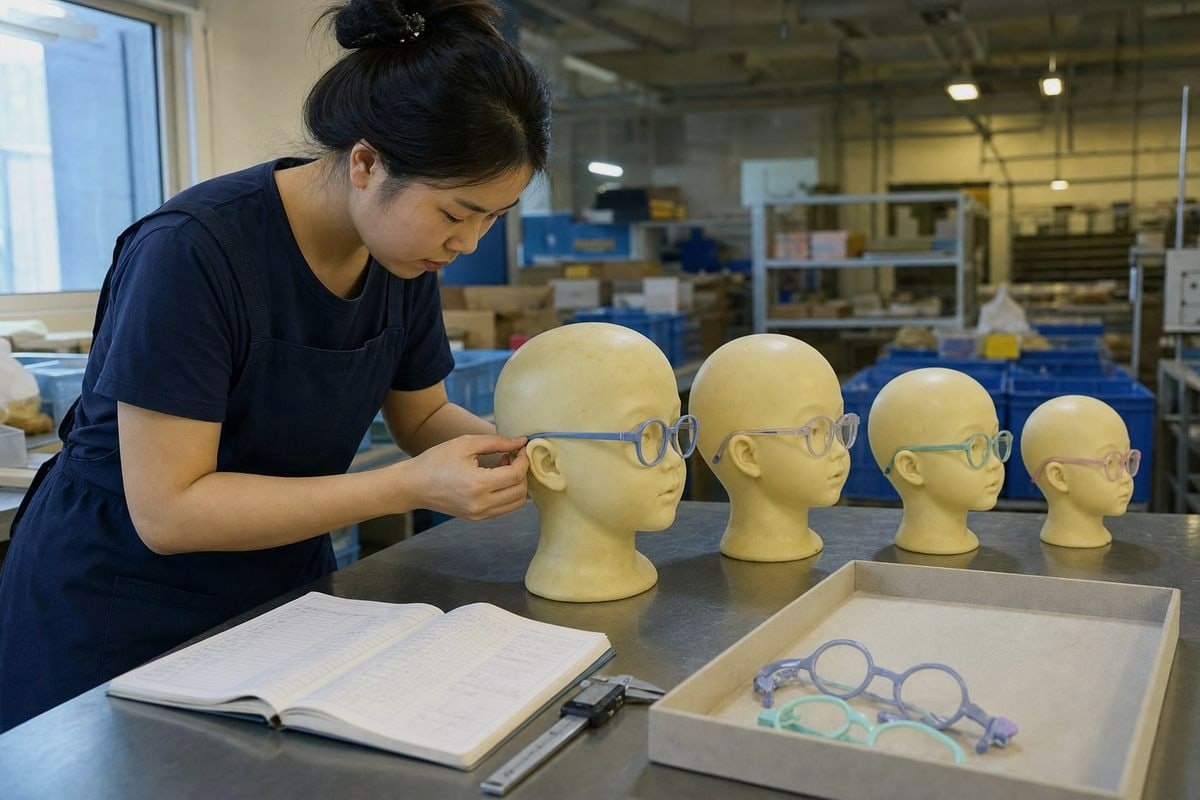
Fit is not a single check — it is a short series of quick tests any parent or QC inspector can run. In our 5S-managed workshop, we perform similar checks on head forms before samples ship, but the real proof always comes on a moving, playing child.
The five-point fit checklist
| Fit check | How to test it | Pass condition |
|---|---|---|
| Snugness | Look at the temples and sides | Secure hold, no squeezing or red marks |
| Slide test | Ask the child to look straight down | Frame stays in place on the nose |
| Cobertura | Check eyebrow-to-cheekbone shielding | Lenses cover the full eye area, no big side gaps |
| Bridge rest | Watch the frame at the nose | Sits level, does not tip or slip |
| Resistencia | Have the child wear them for 20–30 minutes | No marks behind ears or on the nose afterward |
Why the coverage check beats width alone
The eyebrow-to-cheekbone check is the strongest single indicator of a good fit. A frame can match the face width perfectly yet still sit too low or too high, leaving the eyes exposed to UV from above or the sides. Children's pupils 4 let in more light than adults' pupils, so gaps matter more than they would on an adult frame.
Material plays a huge role in passing these tests. Rigid frames fail the snugness test as soon as a child's head grows a few millimeters. Flexible materials like TPEE and TR90 bend with movement and growth, which is why we build our children's lines around them. A frame that flexes outward without snapping also survives being sat on, stuffed into backpacks, and yanked off mid-tantrum — all normal events in a kids' product's life.
Why does working with a factory offering multiple sizes and fits matter for my brand?
One lesson from fifteen years of OEM work stands out: brands that launch with a single "kids' size" almost always come back within a year asking for more. Parents shop by their child's actual age, and one frame cannot serve a one-year-old and a ten-year-old.
A factory offering multiple sizes and fits lets your brand cover every age band accurately, reduce returns from poor fit, launch faster using existing tooling, and build a coherent size ladder — all without investing in new molds for each frame dimension.
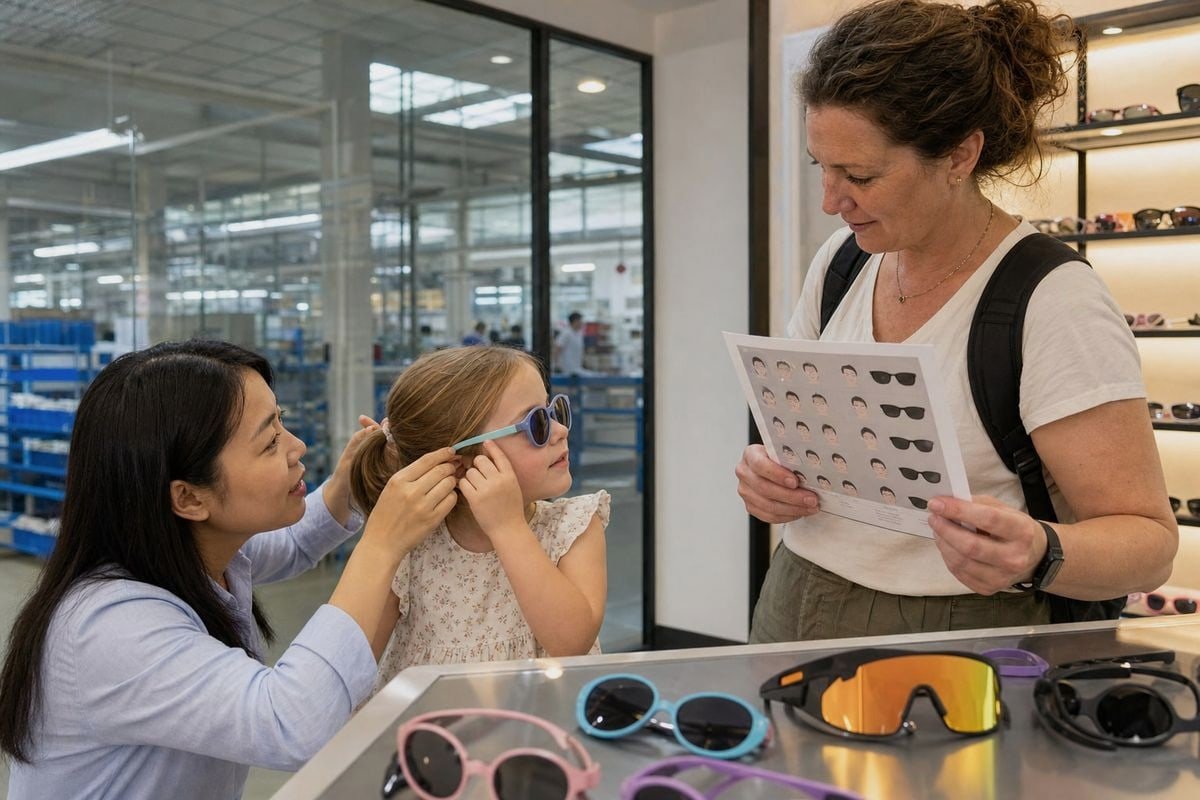
Sizing depth is a supply-chain decision 5 as much as a design decision. Let me break down why it changes your commercial outcome.
Lower risk at launch
Opening a new mold for each size is expensive and slow. When a factory already holds a broad catalog — we maintain around 800 existing styles across baby, toddler, kids, and youth dimensions — a new brand can pick a graduated size range off the shelf. You test the market with real products, learn which age bands sell in your region, and only invest in custom tooling once demand is proven. I have watched importers in Japan and Europe use exactly this path to go from first inquiry to retail shelf within one season.
Fewer returns and better reviews
Fit complaints are the top reason children's sunglasses come back. A factory that understands bridge height for toddlers, temple flex for preschoolers, and width progression for preteens engineers those problems out before production. That expertise shows up later as fewer one-star reviews mentioning "kept falling off."
A coherent brand size ladder
Serious kids' brands sell a journey: baby size, toddler size, kids size, youth size. When one manufacturing partner produces all of them, the materials, UV400 6 lens quality, hinge feel, and color language stay consistent across the ladder. Parents who trust your toddler frame will buy your youth frame three years later. Add full OEM/ODM 7 support — custom colors, logos, lens options, and retail-ready packaging — and the size range becomes a real brand asset, not just a spec sheet. That consistency is hard to achieve when sizes are cobbled together from multiple suppliers with different tolerances and quality standards.
Conclusión
Ill-fitting sunglasses get abandoned, leaving young eyes unprotected. The answer is simple: start with age bands, confirm with measurements, run the fit checklist, and partner with a factory that sizes for every stage.
Notas al pie
1. Ophthalmology authority verifies UV400 lens standards referenced for children’s sunglasses safety. ↩︎
2. Wikipedia entry on nylon materials clarifies TR90’s polymer composition referenced for flexible frames. ↩︎
3. WHO explains UV radiation risks, supporting the article’s emphasis on eye protection coverage. ↩︎
4. NIH resource on eye anatomy supports claim about children’s pupils and light exposure. ↩︎
5. WTO resource on supply chain and trade relevant to factory sourcing strategy discussion. ↩︎
6. Background reference explaining UV400 lens standards mentioned as part of brand consistency. ↩︎
7. Defines OEM/ODM manufacturing model referenced for brand customization services. ↩︎
Más artículos que te podrían gustar



¿Buscas un socio confiable en gafas para niños?
Explore más de 800 estilos listos y soporte OEM/ODM completo adaptado a su marca.
Ponte en contacto English
  Español de México
  Deutsch
  Français
  日本語
日本語  العربية
  Português do Brasil