¿Cómo se comparan las monturas ópticas infantiles TR90-TPEE con las de silicona y acetato?
Un puente roto, un niño llorando, una solicitud de reembolso. Nuestra fábrica escucha esa cadena semanalmente. Elegir TR90-TPEE para niños monturas ópticas 1 por encima del acetato puede romperlo antes de que empiece.
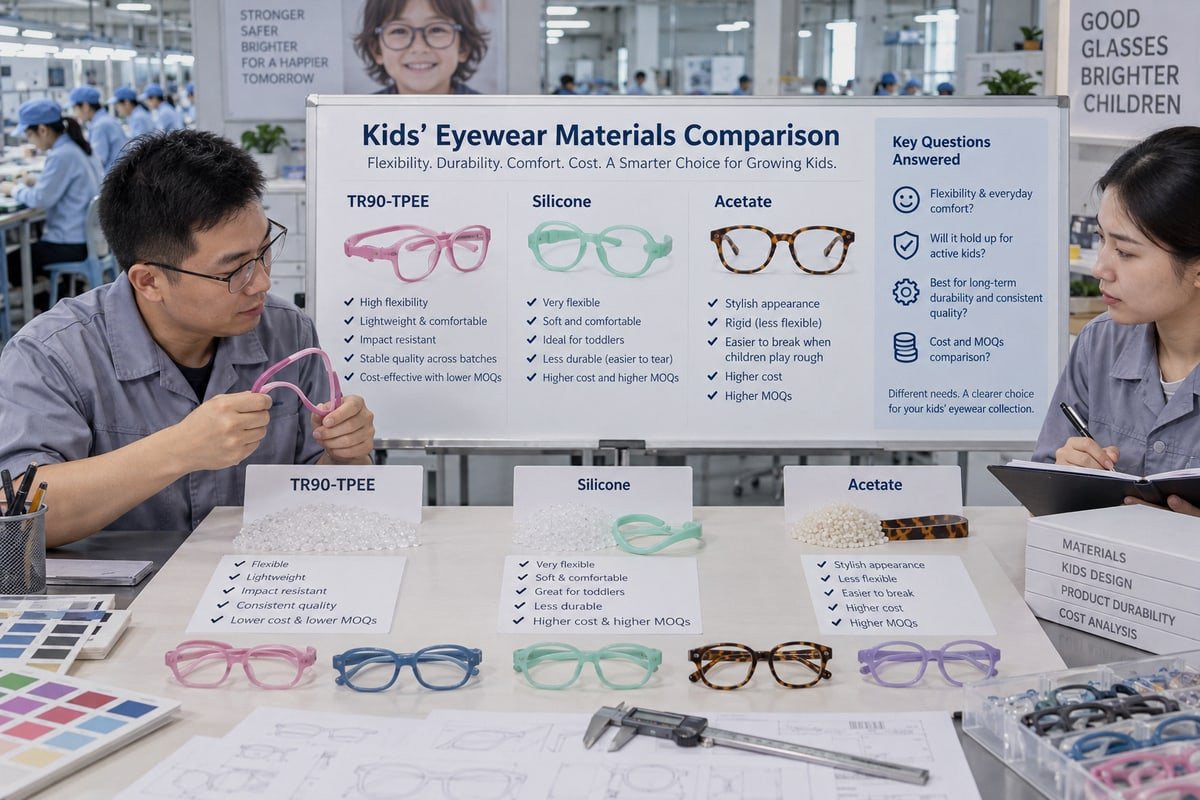
Las monturas ópticas TR90-TPEE para niños son más ligeras, más flexibles y más resistentes a los impactos que el acetato, y más estables en su forma que la silicona. Los frentes de TR90 pesan aproximadamente 15-20 g frente a los 25-35 g del acetato, mientras que las patillas de TPEE añaden una comodidad suave y similar al caucho. El acetato gana en profundidad de color; la silicona gana solo en suavidad.
Esa es la versión corta. La versión larga importa más cuando estás construyendo una línea, no comprando un par. A continuación, analizo las cuatro preguntas que los compradores nos hacen con más frecuencia. Cada una compara los tres materiales en un punto específico: comodidad, juego brusco, consistencia de lotes y costo de abastecimiento.
¿Cómo se compara el TR90-TPEE con las monturas de silicona en cuanto a flexibilidad y comodidad diaria para la colección de mis hijos?
Un comprador de Australia nos pidió el año pasado que cotizáramos monturas de silicona. Cuando abrimos sus fotos de referencia, todas eran TPEE.
Las monturas TR90-TPEE igualan al silicona en suavidad en los puntos de contacto, pero conservan mejor su forma. Las patillas de TPEE se flexionan como goma contra la oreja, la parte frontal de TR90 mantiene las lentes alineadas y la montura terminada pesa entre 15 y 20 g. El silicona es más suave pero se deforma, por lo que es más adecuado para bebés que para niños en edad escolar.
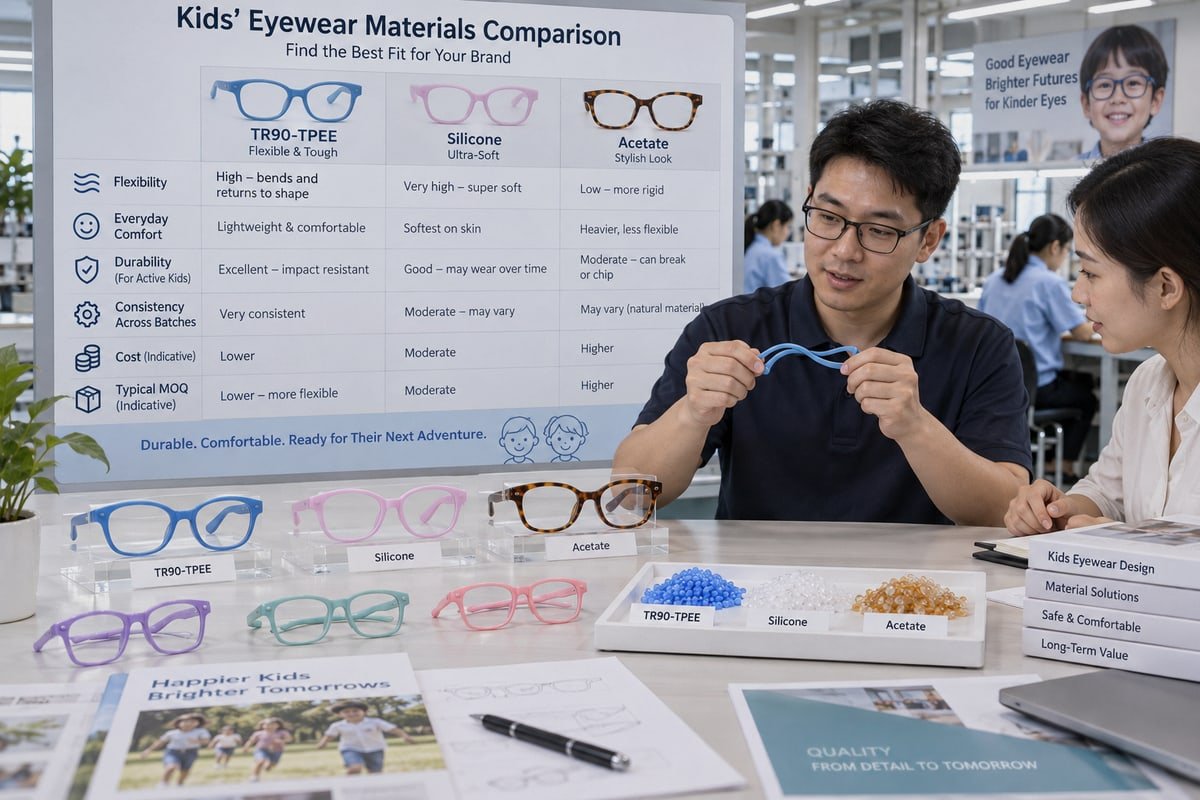
La confusión de ese comprador es común y vale la pena aclararla primero. En el mercado de gafas para niños, la palabra 'silicona" se usa a menudo de forma laxa. Muchos vendedores se refieren a cualquier montura suave, gomosa y flexible. La comparación técnicamente correcta para monturas ópticas es TR90 frente a TPEE frente a acetato. La silicona verdadera es una química diferente y se comporta de manera diferente.
Una rápida comparación de flexibilidad y comodidad
| Característica | Frente de TR90 + varillas de TPEE | Montura de silicona verdadera | Acetato (como referencia) |
|---|---|---|---|
| Peso terminado | Aproximadamente 15-20 g | Ligero, pero varía según el grosor | Aproximadamente 25-35 g |
| Suavidad de la varilla | Gomosa, elástica | Muy suave, poca recuperación elástica | Rígido, ajustado a mano |
| Estabilidad de la forma | Alta (parte frontal TR90) | Baja a media | Alta |
| Retención de la lente | Ranura fiable | Puede aflojarse con el tiempo | Ranura fiable |
| Banda de edad típica | 6-12+ (TR90), 0-5 (principalmente TPEE) | 0–3 | 8+ y adolescentes |
| Partes metálicas | Opcional; diseño de bisagra sin tornillos disponible | Normalmente ninguna | Tornillos y bisagras |
Donde la silicona realmente pertenece
La silicona merece crédito por lo que hace bien. Es uno de los materiales más hipoalergénicos en gafas. No tiene tornillos, ni metal, ni bordes duros. Por eso es la opción preferida para bebés y niños pequeños con puentes nasales subdesarrollados. Las monturas de silicona a menudo usan un puente integrado y una varilla envolvente o una correa para la cabeza, porque el material por sí solo no puede sujetarse a la cara.
Pero esa misma suavidad es el límite. Una parte frontal de silicona no sujeta una lente graduada tan firmemente como una parte frontal de TR90. Puede deformarse en climas cálidos. También se siente menos como "gafas de verdad", lo que los niños mayores notan rápidamente.
Cómo las propiedades de plástico con memoria TR90 cambian la sensación
TR90 es un Termoplástico desarrollado en Suiza 2 con propiedades de plástico con memoria. Se dobla más de 90 grados y vuelve a su forma original. Las pruebas de la industria lo sitúan en más de 5.000 ciclos de flexión y resistencia al calor alrededor de 120 °C. En nuestra línea de producción, lo usamos para la parte frontal, donde la alineación de la lente es lo más importante.
El TPEE se usa en las varillas. Es aún más suave que el TR90, con una sensación al tacto similar a la goma. Mire el estilo degradado púrpura translúcido en nuestro catálogo: la parte frontal transparente es TR90, las varillas son TPEE y las puntas terminan en ganchos para las orejas. Pequeños puntos perforados a lo largo de las varillas añaden flexibilidad adicional sin añadir peso. La versión azul claro utiliza varillas TPEE opacas mate con puntas recubiertas de goma. Ambas brindan al niño flexibilidad y comodidad en las orejas y la nariz, además de una parte frontal que se mantiene recta.
Detalles amigables con la piel que importan para el uso durante todo el día
La comodidad no es solo suavidad. También es lo que el material hace durante ocho horas en la cara de un niño. Nuestras mezclas TR90-TPEE 3 están formuladas para ser de grado alimenticio y libres de BPA, porque los niños pequeños muerden las puntas de las varillas. El material resiste los aceites de la piel y el sudor, por lo que la superficie permanece lisa en lugar de volverse pegajosa. Estos componentes amigables con la piel son una gran razón por la que los padres mantienen las gafas puestas en el niño, y una gran razón por la que las ópticas vuelven a pedir.
¿Soportarán mejor las monturas TR90-TPEE que las monturas de acetato para niños activos que juegan bruscamente?
En nuestro banco de pruebas de flexión, torcemos cada varilla TR90 de muestra más allá de los 90 grados y la vemos volver a su posición. El acetato no sobrevive a esa prueba.
Sí. Las monturas TR90-TPEE resisten mejor que el acetato en niños activos porque el TR90 se dobla más de 90° y vuelve a su forma, sobrevive a más de 5.000 ciclos de flexión y resiste el calor hasta aproximadamente 120 °C. El acetato es más pesado, más quebradizo, se rompe con el frío y puede dejar bordes afilados al romperse.
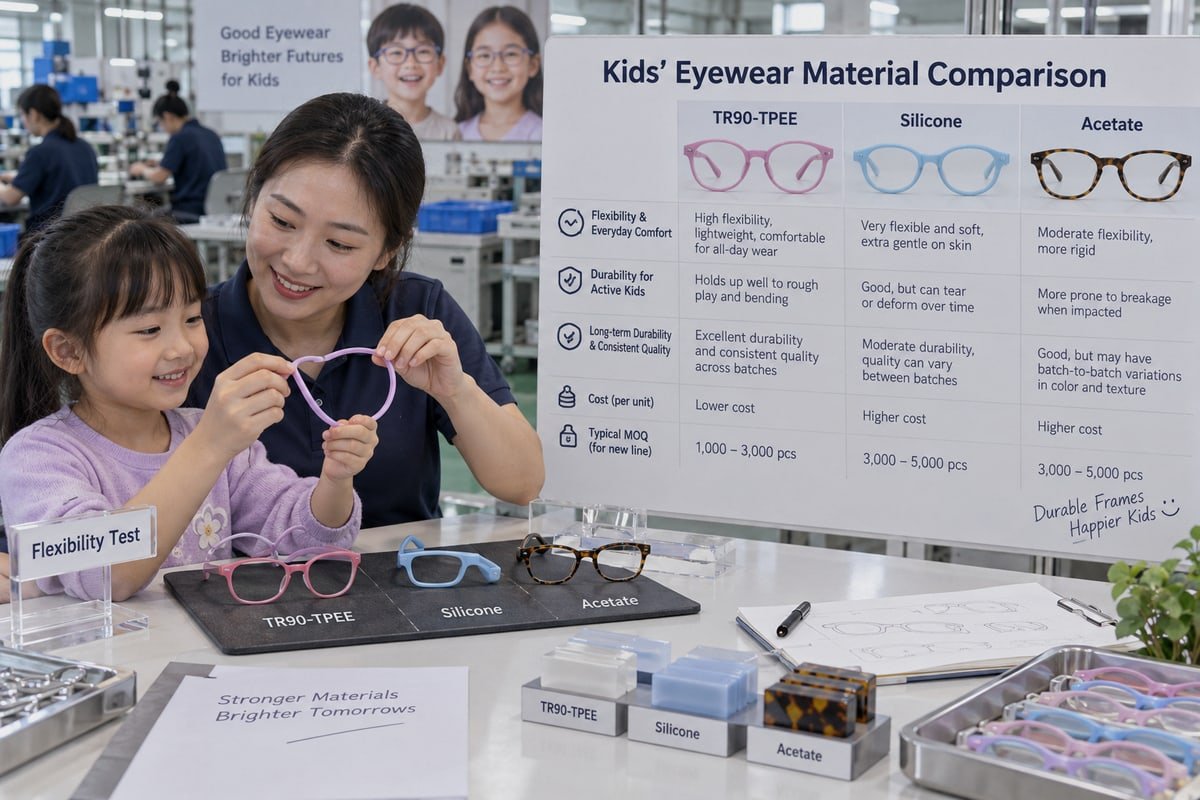
Permítanme ser justo con el acetato primero. Es un material hermoso. Tiene un color profundo y en capas y un aspecto pulido y de primera calidad que el TR90 no puede copiar por completo. Muchas marcas infantiles de moda lo eligen por esa razón. La pregunta no es si el acetato es malo. La pregunta es qué sucede cuando un niño de siete años se sienta sobre él.
Six ways children break glasses
Rough play is not one event. It is a list of repeated small abuses. Here is how each material handles them.
- Caídas sobre concreto. TR90 absorbs the impact and flexes. Acetate can crack at the bridge or lens rim.
- Torcer las patillas. TR90 and TPEE return to shape. Acetate holds a permanent bend or snaps at the hinge.
- Tugging by a sibling. TPEE temples stretch and recover. Acetate temples transfer the force to the screw and hinge.
- Chewing the tips. Food-grade, BPA-free TPEE handles this. Acetate can chip.
- Cold weather. TPEE keeps its flexibility and resistencia al impacto 4 in sub-zero temperatures. Acetate becomes brittle and snaps more easily.
- Sweat, sunscreen, and sun. TR90 and TPEE resist skin oils and UV. Acetate contains plasticizers that migrate out over time, causing the "whitening" you see on old frames.
Frame durability in numbers
| Propiedad | TR90-TPEE | Acetato |
|---|---|---|
| Recuperación de la flexión | Past 90°, returns to shape | Limited; permanent set or fracture |
| Flex cycle testing | 5,000+ cycles reported | Not designed for repeated flexing |
| Resistencia al calor | About 120°C | Softens and deforms at lower heat |
| Rendimiento en frío | Stays flexible below zero | Brittle, prone to snapping |
| Aging | Resists oils, sweat, UV | Whitening and plasticizer loss |
| Comportamiento de rotura | Bends or tears, no sharp shards | Can fracture into sharp edges |
The premium objection, and why it does not hold
The objection I hear from brand owners is simple: acetate feels more premium, so it must be built better. The resistencia a la tracción 5 of acetate is real, but strength is not the same as toughness. A material can be strong and still brittle. Our engineers found this out early. Weight and stiffness feel like quality in the hand, but on a playground they become liabilities. A heavier frame swings harder when it falls and pushes harder on the nose. That extra weight also causes the "nose-slide" effect, which is worse with thick myopia-control lenses. The lower density of TR90-TPEE lets us mold a thicker, more robust rim to hold those heavy lenses without the frame sliding down.
Safety when a frame does fail
Every frame will eventually meet a force it cannot handle. What matters then is the failure mode. Acetate can crack into sharp edges near the eye. TR90 and TPEE bend, tear, or separate cleanly. On our toddler styles we go one step further with a screwless hinge design, so there is no metal part to press into the face on impact. This is also what most eyewear safety standards for children push toward: fewer rigid parts, no sharp fragments, and predictable behavior under load.
¿Qué material debería elegir si la prioridad de mi marca es la durabilidad a largo plazo y la calidad constante en los lotes de producción?
Every new style forces a trade-off I weigh carefully: softer material feels nicer in hand, but too soft and the lens groove loses its grip.
Elija TR90 para la parte frontal y TPEE para las patillas. Ambos son termoplásticos moldeados por inyección, por lo que el color, el grosor de la pared y el ajuste de las bisagras se mantienen consistentes de un lote a otro. El acetato se corta y pule a mano, lo que añade variación y blanqueamiento con el tiempo; la silicona pura puede ceder y perder la retención de la lente.
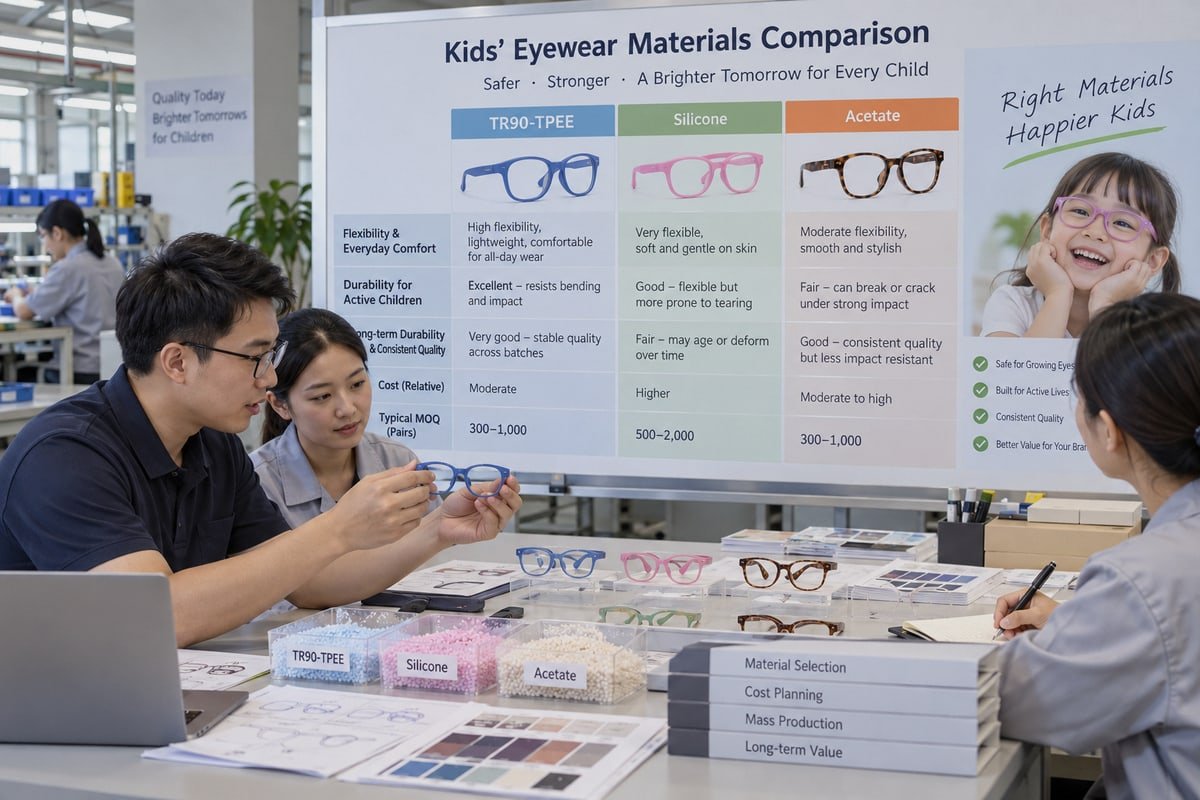
Batch consistency is a process question before it is a material question. But the material decides how easy the process is to control. That is why I push most brand buyers toward the hybrid TR90-TPEE build when they tell me consistency is the priority.
Why injection molding makes consistency easier
TR90 and TPEE are both molded. The mold sets the geometry. The resin lot sets the color. The machine parameters set the density and surface. Once those three are locked, frame 1 and frame 5,000 come out the same. Acetate works differently. Sheets are cut, tumbled, and polished by hand. Skilled workers do great work, but every hand step is a small chance for variation in thickness, gloss, and temple angle.
How we keep TR90-TPEE kids optical frames the same every run
Here is the sequence our 5S-managed workshop follows on a repeat order. I share it because buyers often assume "molded" means "no QC needed." It does not.
- Incoming resin check. We confirm the TR90 and TPEE lot numbers and color masterbatch against the approved sample.
- Mold inspection. Vent, gate, and cavity surfaces are cleaned and checked before the first shot.
- First-article approval. The first frames off the machine are compared to the golden sample for color, dimensions, and surface.
- Flex and recovery check. Temples are bent past 90 degrees and must return without whitening or set.
- Lens retention check. Demo lenses are pressed and removed to confirm the groove holds and the front stays square.
- Hinge and tip check. Adjustable temple tips and hinges are cycled to confirm smooth movement and no play.
- Final visual and packing. Logos, colors, and packaging are matched to the buyer's spec before boxing.
The counterargument: is more flexible always better?
No, and this is the trade-off I mentioned above. A frame can be too soft. When the front flexes too much, the lens can pop, the pupil center shifts, and the prescription no longer sits where the optician set it. That is a real problem for kids in myopia-control lenses. It is why we do not mold the front from TPEE for school-age styles. TR90 gives the front structure. TPEE gives the temples give. That split is the whole point of the hybrid design.
Long-term durability by material
| Factor | TR90-TPEE | Acetato | Silicona |
|---|---|---|---|
| Batch color control | Masterbatch, repeatable | Sheet variation possible | Repeatable but limited palette |
| Dimensional control | Mold-locked | Hand finishing | Mold-locked, but soft |
| Aging over 2–3 years | Resists oils, sweat, UV | Whitening, plasticizer migration | Can yellow, attracts dust |
| Prescription alignment | Estable | Estable | Débil |
| Reciclabilidad | 100% recyclable thermoplastic | Often non-biodegradable plasticizers | Difficult to reprocess |
That last row matters more each year. Brands in Europe and Japan increasingly ask about economía circular 6 fit. TR90 and TPEE are recyclable thermoplastics. Silicone is hard to reprocess. Acetate often carries plasticizers that complicate recycling. If your brand story includes environmentally friendly materials, the hybrid build supports it honestly.
¿Cómo se comparan los costos y las MOQ de TR90-TPEE con los de silicona y acetato cuando estoy buscando una nueva línea de gafas para niños?
Fifteen years of quoting kids' eyewear taught me one lesson: the mold, not the resin, decides whether a new line is affordable.
Los armazones TR90-TPEE suelen costar menos por unidad que los de acetato y tienen MOQ más bajos, porque se moldean por inyección en lugar de acabarse a mano. El acetato necesita más mano de obra y se sitúa en puntos de precio premium. Las herramientas de silicona son similares a las de TPEE. Elegir entre moldes existentes reduce el MOQ y elimina el coste inicial de las herramientas.
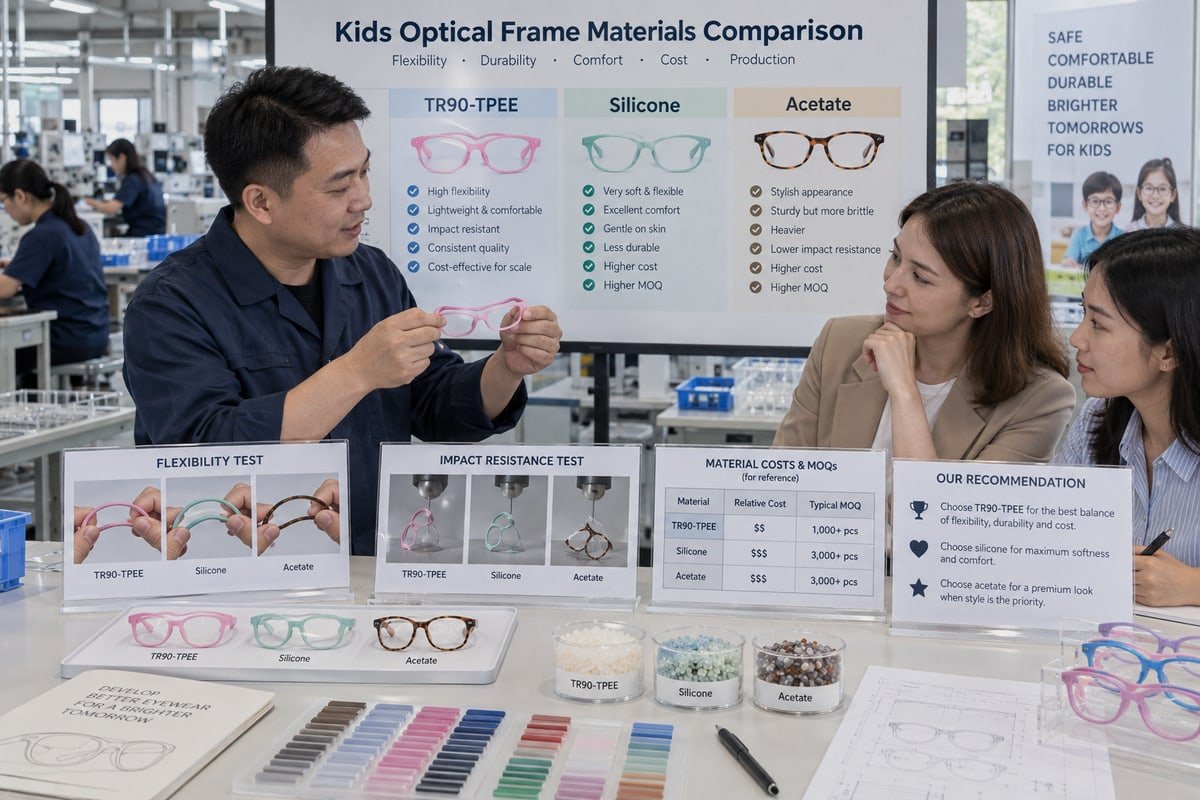
When a new brand founder sends me a budget, I usually split it into three buckets before we talk price per pair. The buckets are tooling, unit cost, and everything after the frame ships. Material changes all three, but not in the way most people expect.
Cost structure by material
| Factor de costo | TR90-TPEE | Acetato | Silicona |
|---|---|---|---|
| Herramientas | Steel mold per front and temple; shared across colors | Little tooling, but cutting patterns and hand labor | Mold per style, similar to TPEE |
| Mano de obra unitaria | Low; molded, trimmed, assembled | High; cut, tumble, polish, fit | Baja a media |
| Cambios de color | Easy via masterbatch | Requires new sheet stock | Easy via pigment |
| Typical positioning | Value-durable, sport, everyday school | Premium fashion | Infant and toddler niche |
| MOQ driver | Amortización del molde | Labor scheduling and sheet minimums | Amortización del molde |
| Returns and breakage | Baja | Higher on active kids | Low, but limited to young ages |
The mold question, and how to skip it
A new TR90-TPEE style needs a mold for the front and a mold for the temples. That is a real upfront cost, and it is what pushes MOQs up when everything is custom. The way around it is to start from existing tooling. Our catalog holds roughly 800 existing styles across TPEE and TR90. A brand can pick a front, pick a temple, and change the color, logo, lens, and packaging without paying for new steel. That lets an importer or a baby-product brand test a market with a smaller first order and lower risk. The two styles I described earlier, the clear front with purple-gradient temples and the light-blue front with matte-blue temples, are both existing molds. Different colorways, same tooling.
What custom OEM/ODM work actually adds
Customization does not have to mean a new mold. In our experience with brands across 20+ countries, the changes that build a brand are mostly surface-level from a tooling point of view:
- Custom colors through masterbatch, including translucent and gradient effects.
- Ubicación del logotipo by pad print, laser, or molded inset on the temple.
- Opciones de lentes such as UV400 or polarized for the sun range, or demo lenses for optical fronts.
- Embalaje y accesorios like cases, cloths, straps, and retail-ready hang cards.
Each of these adds a modest cost per unit. None of them force you into a large MOQ the way a new mold does.
The cost acetate hides
Acetate quotes look higher on paper and often are. But the bigger gap shows up after delivery. An active-kid line in acetate sees more breakage, more warranty claims, and more one-star reviews from parents. A TR90-TPEE line with lightweight construction, adjustable temple tips, and food-grade materials sees fewer of all three. When I help a buyer build a landed-cost sheet, I tell them to add a line for expected returns. That line usually flips the decision.
A simple age guide for planning a line
| Banda de edad | Recommended build | Por qué |
|---|---|---|
| 0–3 | TPEE-heavy, screwless, integrated bridge or strap | Softest, no metal, safest failure mode |
| 3–5 | TPEE frame or TR90 front with TPEE temples | Balance of softness and shape |
| 6–12 | montura frontal de TR90 con patillas de TPEE | Holds prescription, survives school and sport |
| 12+ style-first | Acetate or TR90 in fashion colorways | Premium look matters more, play is gentler |
Conclusión
Broken frames cost brands trust. TR90-TPEE kids optical frames give the durability, comfort, and batch consistency active children need. Acetate suits fashion. Silicone suits infants.
¿Interesado en obtener los productos mencionados en este artículo? Ver detalles y solicitar un presupuesto aquí:
Notas al pie
1. WHO resource on visual impairment, relevant to the use of specialized corrective lenses. ↩︎
2. Official manufacturer site for the TR90 material (Grilamid TR), detailing its properties. ↩︎
3. FDA overview of BPA safety and regulations in consumer products. ↩︎
4. DuPont’s official page for Hytrel, the primary commercial TPEE used in flexible applications. ↩︎
5. Comprehensive overview of cellulose acetate’s chemical properties and its history in eyewear. ↩︎
6. Official European Commission page explaining circular economy principles and sustainability. ↩︎
Más artículos que te podrían gustar

28 de octubre de 2026
¿Qué normas deben cumplir las monturas ópticas TR90 para niños: GB/T 14214 vs ISO 12870?

27 de octubre de 2026
¿Cómo deben los minoristas almacenar monturas ópticas infantiles TR90 por tendencias de edad y género?
26 de octubre de 2026
¿Qué priorizan los padres en las monturas ópticas TR90 para niños?
¿Buscas un socio confiable en gafas para niños?
Explore más de 800 estilos listos y soporte OEM/ODM completo adaptado a su marca.
Ponte en contacto English
 Español de México
 Deutsch
 Français
 日本語
 العربية
 Português do Brasil