What Does UV400 Protection Mean for Kids’ Sunglasses?
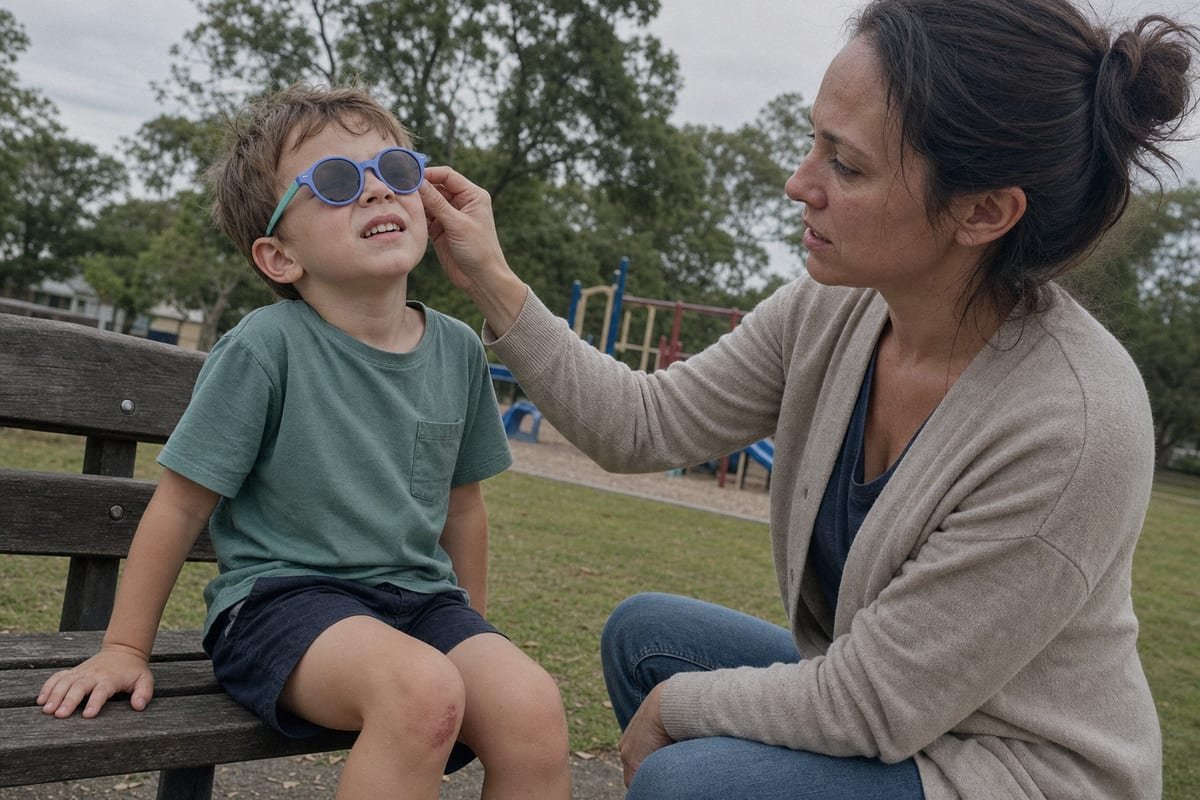
Every week, buyers ask me about UV400 protection for kids’ sunglasses early cataract formation 1. Many worry they might import lenses that look dark but quietly fail to protect children’s eyes.
UV400 protection means the lenses block ultraviolet light up to the 400 nanometer wavelength, covering 100% of both UVA and UVB rays. For kids’ sunglasses, UV400 is the essential safety standard, because a child’s developing eyes admit far more UV radiation than adult eyes.
That is the short answer. But if you are building a children’s eyewear line, you need more detail. Let me walk you through what the label really guarantees, how to verify it, and what it means for your order.
What Exactly Does the UV400 Rating Guarantee for My Kids' Eyewear Line?
During a product development call last spring, a buyer from Australia asked me a simple question: is UV400 about the tint or the lens material? It was a great question, and our lab answer surprised her.
The UV400 rating guarantees that lenses filter all ultraviolet radiation up to 400 nanometers, capturing the complete UVA and UVB spectrum. It is a health-protection standard tied to the lens material and coating, not to how dark, mirrored, or polarized the lens appears.
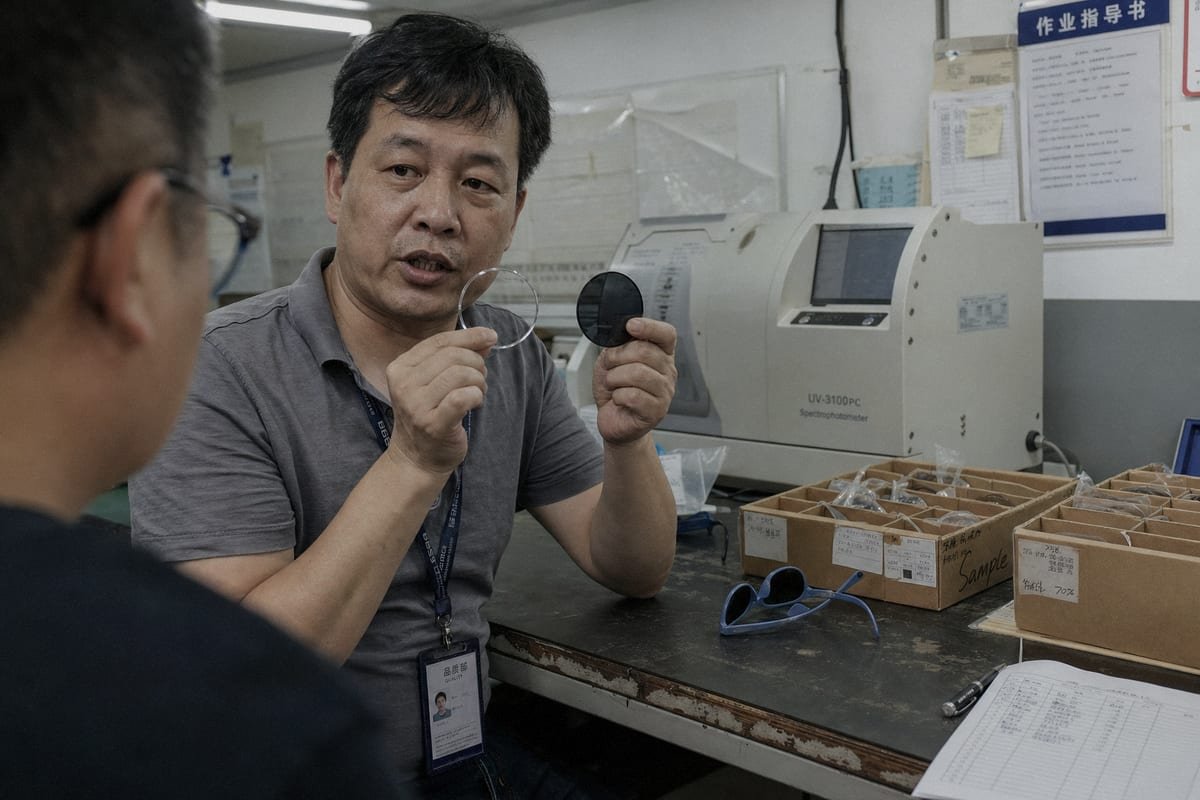
UV radiation spans roughly 100 to 400 nanometers. UVB sits at about 280 to 315 nm, and UVA runs from about 315 to 400 nm. A UV400 lens is engineered to block everything up to that 400 nanometer wavelength ceiling. That is why the industry treats UV400 as full-spectrum consumer protection.
Here is the point I stress with every new buyer: UV400 describes protection, not appearance. In our workshop, we produce clear optical lenses that block UV completely, and we have tested dark novelty lenses from other sources that barely block anything. Darkness controls brightness. UV blocking happens at the molecular level, through the lens material itself or an applied treatment.
UV400 vs. Polarized vs. Tinted — What Each Actually Does
Parents and even some retailers confuse these three terms. Your product pages should separate them clearly.
| Merkmal | Was es tut | Is It UV Protection? |
|---|---|---|
| UV400 | Blocks UVA and UVB rays up to 400 nm | Yes — the core safety standard |
| Polarisierte Gläser | Cut reflected glare from water, roads, and snow | Nein – nur Komfortmerkmal |
| Dunkle Tönung | Reduziert die sichtbare Helligkeit | No — appearance only |
| Spiegelbeschichtung | Reflects visible light, adds style | No — cosmetic feature |
Why "Up to 400 nm" Matters
Some regional standards only require blocking up to 380 nm. That leaves a small band of UVA unfiltered. It sounds minor, but children spend years outdoors, and exposure is cumulative. This is why we build all our kids' lenses — including our polarisierte Linsenoptionen — to the full UV400 level, and why we recommend buyers reference standards like ANSI Z80.3 2 in their quality documents. A lens rated to 380 nm is good. A lens rated to 400 nm is complete. For a children's brand, complete is the only defensible position.
How Can I Verify That My Supplier's UV400 Lenses Truly Block Harmful Rays?
Fifteen years in eyewear has taught our team one hard lesson: never accept a UV claim on faith. Early on, we tested competitor samples that a trader had labeled UV400. Several failed at 385 nm.
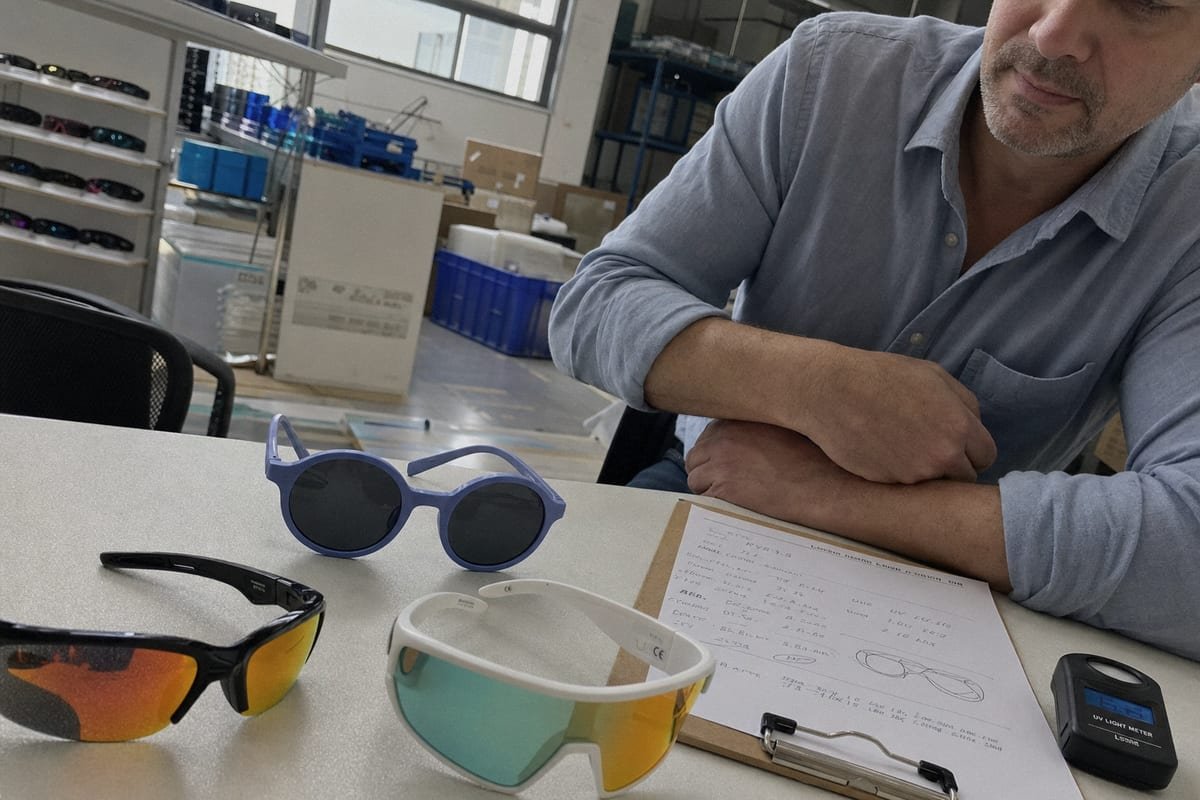
Verify UV400 claims by requesting third-party lab test reports, spectrophotometer transmission curves showing zero transmission below 400 nm, and compliance certificates for your market. Reputable factories also welcome pre-shipment inspections and can demonstrate lens testing with a UV meter on-site.
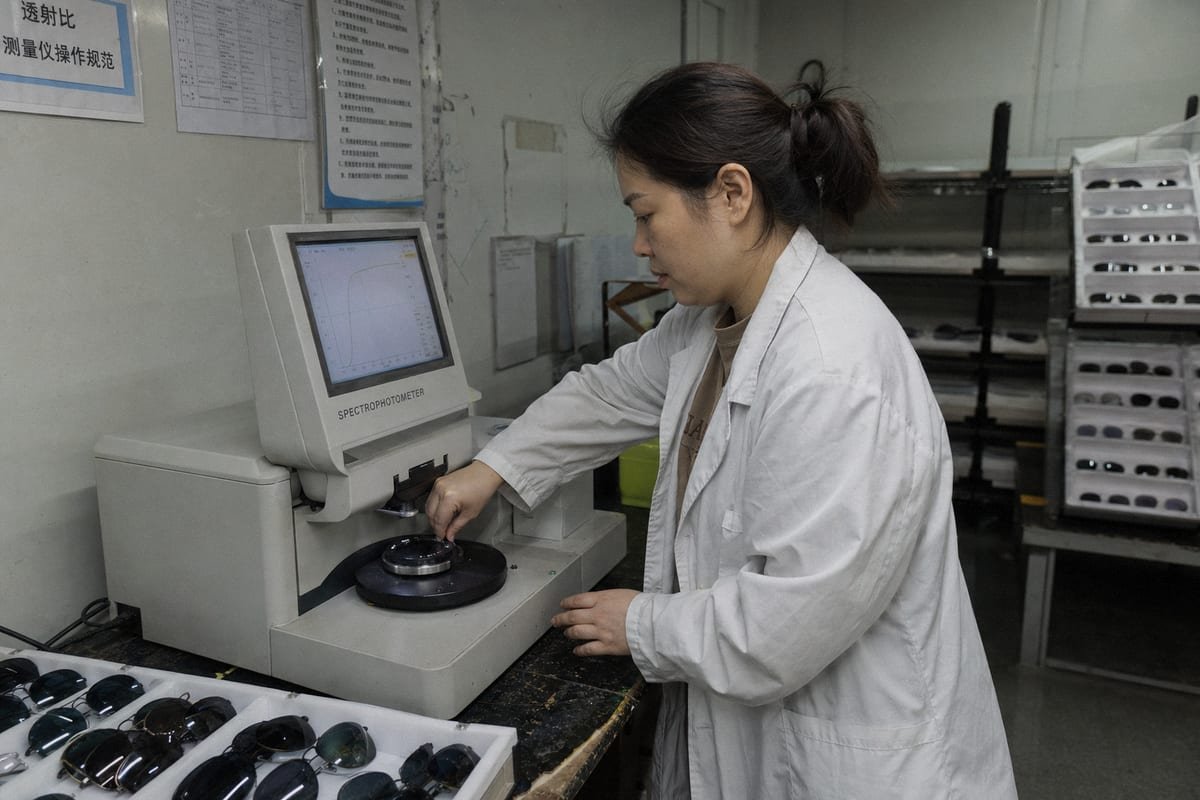
You cannot see UV protection with your eyes. That is exactly why verification matters so much in B2B sourcing. A cheap tinted lens 3 and a genuine UV400 lens look identical on a product photo. The difference only shows up in testing — and in a child's long-term ocular sun safety.
A Practical Verification Checklist for Buyers
Here is the process we recommend to every importer and brand we work with:
- Ask for the transmission curve. A spectrophotometer report should show near-zero UV transmission across 280–400 nm. If a supplier cannot produce one, walk away.
- Request market-specific compliance documents. In the US, reference ANSI Z80.3 standards. In Europe, check for CE marking and EN ISO 12312-1 test reports. Australia and New Zealand use AS/NZS 1067.
- Test incoming samples independently. A third-party lab test on pre-production samples costs little compared to a recall.
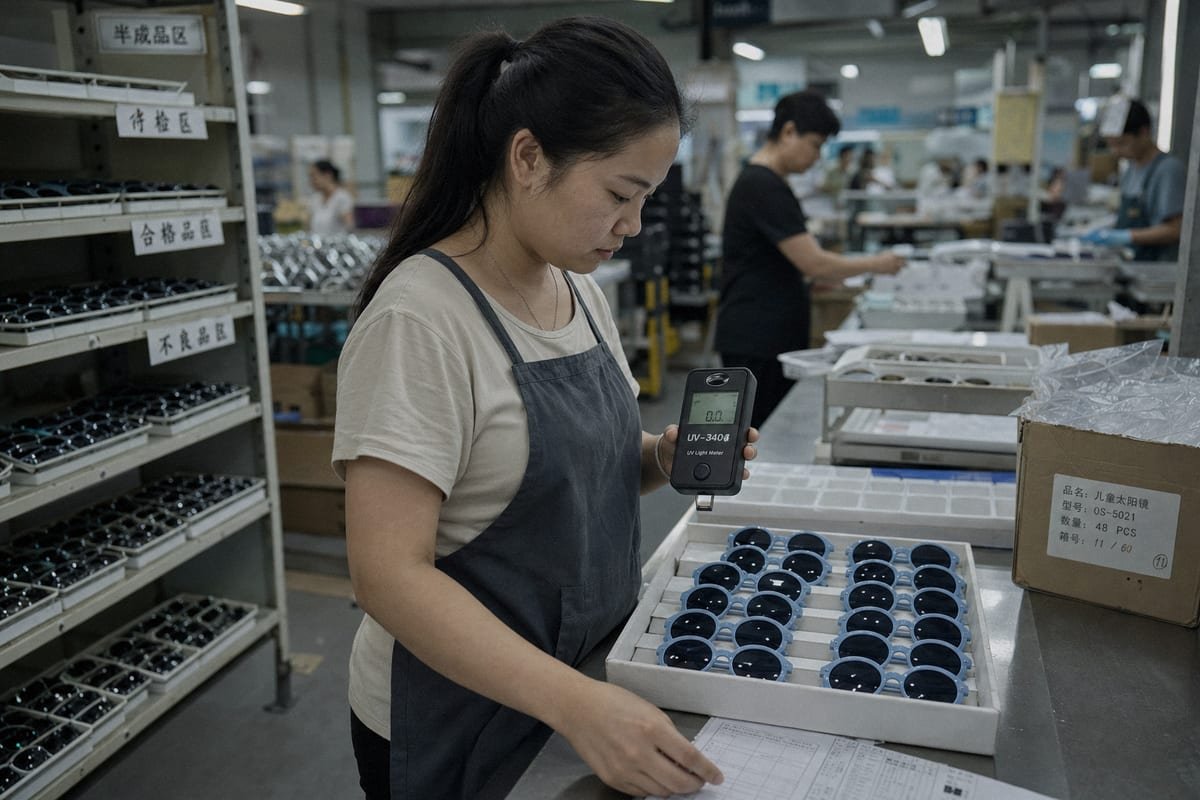
- Use a UV light meter for spot checks. In our QC room, we run quick UV meter checks on lens batches before assembly. Ask your supplier to show this step on a video call.
- Audit consistency, not just one sample. One golden sample proves nothing. Batch-level testing proves a process.
Red Flags That Suggest Weak UV Claims
| Warnsignal | Warum es wichtig ist |
|---|---|
| No test report available | The supplier likely never tested the lenses |
| "UV protection" with no number | Vague wording often hides 380 nm or lower blocking |
| Preis weit unter dem Marktdurchschnitt | UV-treated polycarbonate lens 4es have a real cost floor |
| Trader cannot name the lens factory | No traceability means no accountability |
When buyers visit our 5S-managed workshop in Taizhou, we show them the testing station first. In my experience exporting to 20+ countries, the buyers who ask the hardest verification questions build the strongest brands. Documentation is not bureaucracy. It is your legal and reputational shield when a parent asks whether your product truly protects their child.
Why Is UV400 Protection So Critical for Young Children's Developing Eyes?
One trade-off we refuse to make in our factory is protection versus comfort — because with children, if sunglasses feel bad, they come off, and the protection disappears with them.
Children's eyes are more vulnerable to UV damage because their pupils are larger and their crystalline lenses are clearer, letting more radiation reach the retina. Since UV damage is cumulative and much of lifetime exposure occurs before age 18, UV400 protection is critical during childhood.
Pediatric eye health specialists agree on the biology here. A young child's ist klarer als die eines Erwachsenen, sodass im Kindesalter deutlich mehr UV-Strahlung auf die Netzhaut trifft. Okulare Sonnenschäden sind kumulativ – Katarakte, Pterygium und Netzhautveränderungen lassen sich auf lebenslange Exposition zurückführen, die in den frühesten Jahren beginnt. Deshalb verwenden wir standardmäßig UV400-Linsen für unser gesamtes Kindersortiment, auch für CE-konforme Bestellungen, bei denen 380 nm rechtlich ausreichen würden. 5 has not yet developed the natural yellowing that filters some UV in adults. Their pupils are larger and constrict more slowly when moving from shade into bright light. The result is simple and sobering: more UVA and UVB radiation reaches the internal structures of a child's eye than an adult's under identical sunlight.
Cumulative Exposure Starts Early
UV damage to the eye does not reset. It accumulates over a lifetime, and a significant portion of total lifetime exposure happens before age 18. Long-term risks linked to unprotected exposure include Netzhautschäden 6, early cataract formation, and growths on the eye's surface. None of these appear overnight, which is exactly why parents underestimate the risk — and why your brand messaging can genuinely educate.
Protection Only Works If Kids Wear It
This is where design meets health. In developing our TPEE and TR90 frames, we learned that comfort drives compliance. Key factors we engineer for:
- Lightweight, flexible materials so frames do not pinch active kids during play.
- Wrap-around frames that reduce peripheral leakage, where UV sneaks in from the sides and top.
- Schlagfestigkeit through polycarbonate lenses, because kids fall, throw, and sit on their glasses.
- Snug, soft-touch temple grips that stay put during running and cycling.
There are practical performance benefits too. Consistent UV400 wear reduces the squint reflex in bright environments, which eases eye strain 7 during outdoor play. Filtering the blue haze at the edge of the UV spectrum also helps children see contrast and judge depth more accurately outdoors. For a kids' outdoor or sports brand, these are honest, meaningful selling points — protection first, better vision as the bonus.
Does UV400 Protection Affect the Cost or Quality of My Sunglasses Order?
A procurement manager from Japan once challenged our quote, pointing to a supplier offering kids' sunglasses at nearly half the price. We tested that supplier's sample together. The lenses stopped blocking at 375 nm.
Genuine UV400 protection adds only a modest amount to lens cost, typically a small fraction of the unit price. It does not reduce optical quality; in fact, verified UV400 lenses usually indicate a higher-quality supplier with proper materials, testing equipment, and quality control.
Let me be direct about the economics, because this is where many new brands make their biggest mistake. The raw cost difference between an untreated tinted lens and a true UV400 polycarbonate lens is small at factory scale. When a quote seems impossibly cheap, the savings almost never come from clever efficiency. They come from skipped UV treatment, skipped testing, brittle recycled plastics, or all three.
Where the Cost Actually Sits
| Kostenfaktor | Impact on Unit Price | Impact on Child Safety |
|---|---|---|
| UV400 lens treatment | Niedrig | Critical — the core protection |
| Polycarbonate lens material | Niedrig bis moderat | High — impact resistance for active kids |
| TR90/TPEE flexible frames | Mäßig | High — comfort drives daily wear |
| Batch UV testing and QC | Niedrig | High — guarantees consistency |
| Einzelhandelsfertige Verpackung | Mäßig | Indirect — builds parent trust |
Quality Is a System, Not a Sticker
In our production line, UV400 is not an add-on. It is a specification checked at incoming lens inspection, during assembly, and at pre-shipment QC. Suppliers who take UV blocking seriously tend to take everything seriously — hinge durability, frame flexibility, coating adhesion. The reverse is also true.
For brands testing the market, there is a smarter path than cutting lens quality. We maintain around 800 existing styles, from pastel round frames for toddlers to wrap-around sport shields with mirrored gradient lenses. Choosing from existing molds avoids heavy tooling investment, so you can allocate budget to what parents actually judge you on: verified protection, comfortable materials, and professional packaging. Full OEM/ODM support — custom colors, logos, lens options, and branded packaging — layers on top of that proven base. In fifteen years, I have never seen a children's brand regret paying for real UV400. I have seen several regret not doing so.
Schlussfolgerung
UV400 protection blocks all UVA and UVB rays up to 400 nanometers — the non-negotiable standard for children’s developing eyes. Verify it with test data, pair it with comfortable wrap-around frames, and your kids' eyewear line earns lasting parent trust.
Fußnoten
1. Government health resource linking ultraviolet radiation exposure to the development of cataracts. ↩︎
2. Reliable overview of the American national standard for nonprescription sunglasses and fashion eyewear. ↩︎
3. Expert medical advice explaining the difference between lens tint and actual UV protection. ↩︎
4. Technical details on polycarbonate, the standard material for impact-resistant and UV-blocking eyewear. ↩︎
5. Technical overview of the eye’s crystalline lens and its role in filtering light. ↩︎
6. Professional medical guidance on how UV exposure can lead to long-term retinal damage in children. ↩︎
7. Authoritative medical source explaining the causes and symptoms of eye strain from bright light. ↩︎
Weitere Artikel, die Ihnen gefallen könnten



Auf der Suche nach einem zuverlässigen Partner für Kinderbrillen?
Entdecken Sie über 800 sofort verfügbare Modelle und umfassenden OEM/ODM-Support, der auf Ihre Marke zugeschnitten ist.
Kontakt aufnehmen English
  Español de México
  Deutsch
  Français
  日本語
日本語  العربية
  Português do Brasil