What Role Do Kids’ Sunglasses Play in Ski Trips and Snow Scenarios?
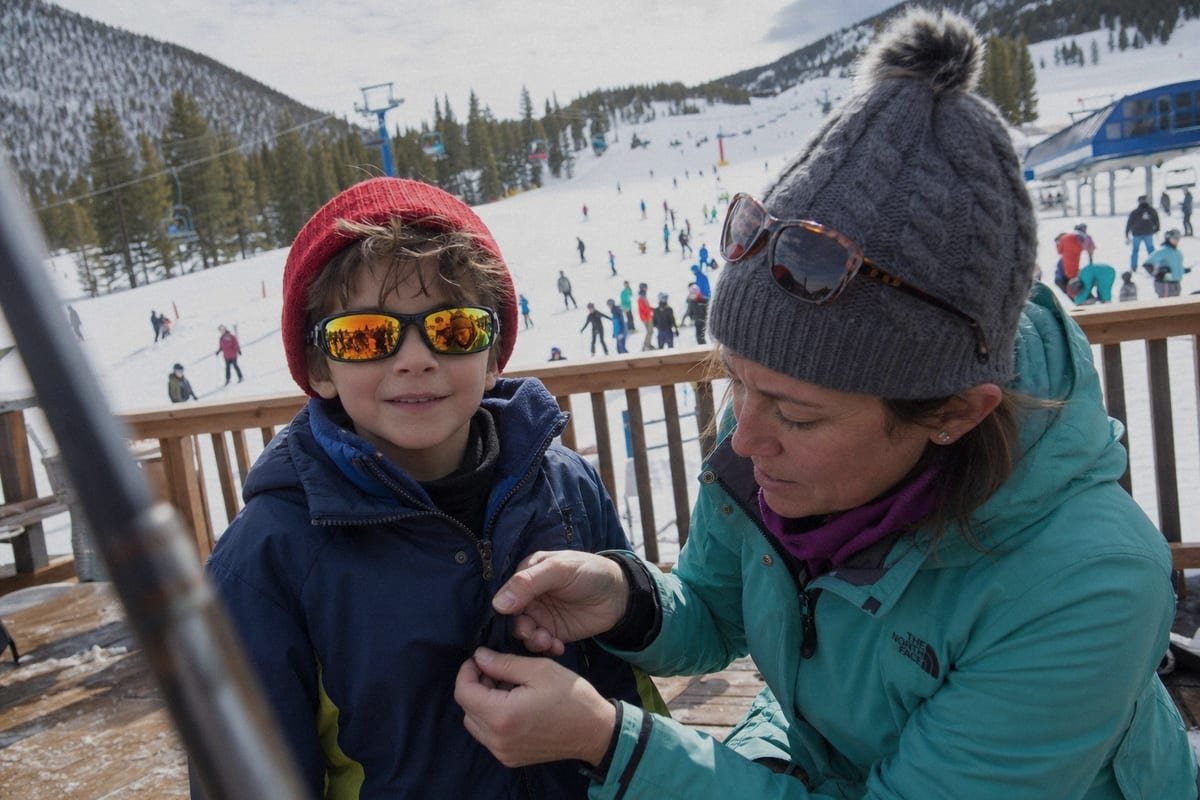
Every winter, buyers ask our factory the same question about kids’ sunglasses for ski trips: are they enough for snow? Many parents get this wrong, and children pay the price.
Kids’ sunglasses play a protective role on ski trips by blocking 100% UVA/UVB rays and cutting intense snow glare during walking, sledding, and casual snow play. For high-speed skiing, goggles remain safer, but well-fitted, wraparound sunglasses handle low-intensity snow scenarios very well.
Snow doubles a child’s UV exposure. That fact shapes every decision below. Let me walk you through what actually matters when you choose or develop snow-ready eyewear for children.
What Sunglasses Features Do My Kids Need for Snow Glare and UV Protection?
A buyer from Japan once sent us a returned pair of budget sunglasses. The lenses were dark but had no UV filter. That combination is more dangerous than wearing nothing at all.
Kids need sunglasses with full UV400 protection, category 3 or category 4 lenses for bright snow, impact-resistant polycarbonate lenses, and wraparound frames that block reflected light from below and the sides. Polarized lenses add glare reduction on ice and packed snow.

Snow is one of the harshest light environments a child's eyes 1 will ever face. Fresh snow reflects up to 80% of UV radiation. This is called the albedo effect. Light hits the eyes twice: once from the sky, and once bouncing up from the ground. On top of that, high altitude UV exposure 2 increases roughly 10% for every 1,000 feet of elevation. A ski resort at 6,000 feet is a very different environment from a beach at sea level.
Children's eyes are also more vulnerable than adult eyes. Their lenses are clearer, so more UV reaches the retina. UV damage is cumulative over a lifetime. Protection during childhood snow trips directly lowers the risk of cataracts and Makuladegeneration 3 decades later. Unprotected exposure can also cause photokeratitis, better known as snow blindness. It is essentially a sunburn on the cornea, and it is painful.
The Feature Checklist That Actually Matters
When we develop snow-ready styles for our clients, we work from a clear priority list:
| Merkmal | Why It Matters in Snow | Was zu spezifizieren ist |
|---|---|---|
| UV400-Schutz | Blocks 100% of UVA/UVB, including reflected rays | Non-negotiable baseline |
| Kategorie 0–4 klar angegeben | Controls Visible Light Transmission (VLT) | Category 3 for bright days; category 4 lenses for glacier-level glare |
| Polarisierte Gläser | Cuts horizontal glare off ice and packed snow | Strongly recommended for snow scenarios |
| Polycarbonat-Gläser | Impact resistance against falls and flying ice | Standard for all children's eyewear |
| Wraparound frames | Blocks side and bottom light entry | Essential for reflective environments |
Understanding Visible Light Transmission
VLT tells you how much light passes through the lens. A category 3 lens allows roughly 8–18% of light through, which suits most sunny snow days. Category 4 lenses drop below 8% and suit extreme glare, though they are too dark for driving or dim conditions. In our sampling process, we always confirm the VLT rating with the buyer before mass production, because snow use demands darker lenses than everyday summer styles.
Snow also reflects a high amount of HEV blue light 4, which can strain young retinas and even disrupt sleep after a long day outside. A quality tinted lens reduces this load naturally.
How Can I Choose Sunglasses That Stay Secure on My Child's Face During Ski Trips?
Fit failures are the top complaint we hear from kids' brands entering the winter category. A pair that slips down a cold, runny nose gets shoved into a pocket. Then it protects nothing.
Choose sunglasses with flexible, grippy frame materials like TPEE, rubberized temple tips, a snug wraparound shape sized to the child's face width, and optional elastic head straps. Secure fit keeps lenses in position during sledding, walking, and active snow play.
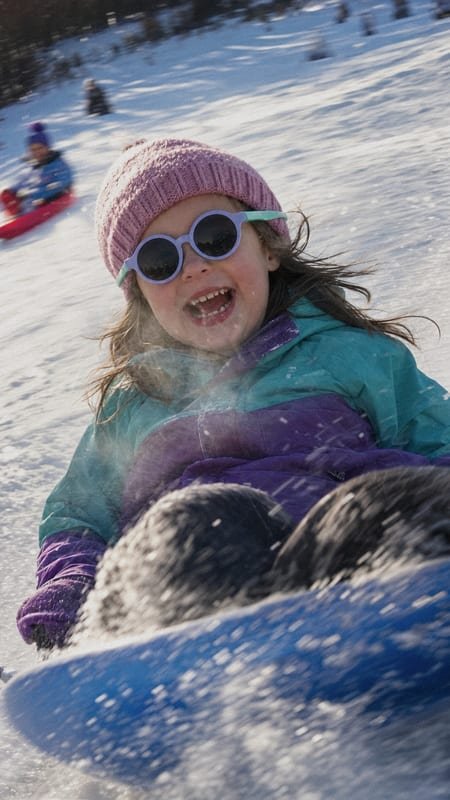
Cold weather changes how eyewear behaves on a face. Skin contracts slightly. Kids wear beanies and hoods that push against temple arms. Noses run, so frames slide. And gloves make constant readjustment frustrating for a child. Fit is not a comfort detail in snow scenarios. It is a safety function.
The Four Fit Factors We Test For
- Material grip in cold conditions. Standard hard plastics get slippery and stiff below freezing. Flexible materials 5 like TPEE keep a soft, rubberized surface texture that grips skin even when wet with melted snow. One of our two-tone round styles uses this soft-touch matte finish exactly for this reason: toddlers cannot easily shake it loose.
- Temple pressure balance. Temples that are too tight cause headaches under a hat. Temples that are too loose slide with every head movement. We calibrate temple flex during sampling so the frame holds through active play without pinching.
- Correct sizing by age band. A frame designed for a seven-year-old will slide off a three-year-old immediately. Lens width, bridge width, and temple length all need to match the age group your brand targets.
- Strap compatibility. For toddlers and sledding-age children, an elastic strap accessory turns sunglasses into near-goggle security. We supply these as add-ons for many clients, packaged retail-ready.
Fit Recommendations by Snow Activity
| Activity | Recommended Fit Solution | Extra Consideration |
|---|---|---|
| Walking in the resort village | Standard flexible frame, snug temples | Comfort under a beanie |
| Sledding and snow play | Wraparound frames plus elastic strap | Impact resistance for tumbles |
| Beginner slope lessons | Sport shield style or goggles | Helmet compatibility |
| Après-ski and travel days | Lightweight everyday frame | Easy on-off with gloves |
Sunglasses also offer one underrated fit advantage over goggles: ventilation. Goggles can overheat a young child's face during low-intensity play. Well-fitted sunglasses shield the eyes from cold-induced tearing caused by dry mountain wind while letting the face breathe.
Are Polarized or TR90 Frames Better for My Kids' Winter Sports Eyewear Line?
This question comes up in almost every product development call we host, and it reveals a common confusion. Polarization and TR90 solve two completely different problems.
Polarized refers to the lens; TR90 refers to the frame. They are complementary, not competing. The strongest winter sports eyewear combines polarized UV400 lenses for glare control with TR90 or TPEE frames for cold-weather flexibility and impact resistance.
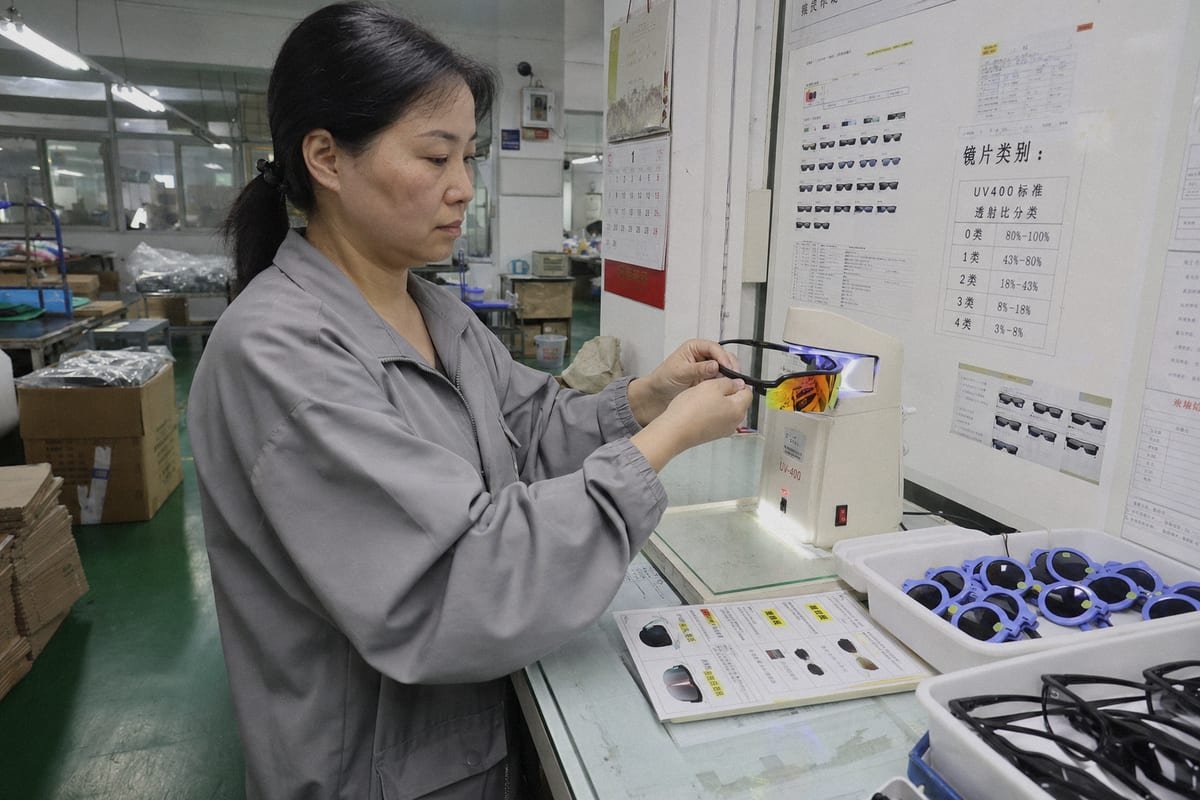
Let me break the comparison down clearly, because getting this right shapes your entire product spec sheet.
| Attribute | Polarized Lenses | TR90-Fassungen |
|---|---|---|
| Was es ist | A lens filter technology | A nylon-based frame material |
| Main benefit | Blocks horizontal glare off ice and snow | Lightweight, flexible, hard to snap |
| Snow relevance | Eliminates blinding reflections | Survives cold, drops, and twisting |
| UV role | Must still be paired with UV400 coating | None; UV protection is a lens property |
| Kostenwirkung | Raises lens cost moderately | Raises frame cost versus basic PC |
Why the Lens Choice Matters in Snow
Polarized lenses are the gold standard for snow glare because reflected light off ice and packed snow is largely horizontal. The polarizing filter 6 blocks that specific wave orientation. The result is dramatically better contrast and less squinting. One important nuance: polarization reduces glare, but it does not replace UV protection. Always specify both together. Mirrored coatings, like the orange-to-gold gradient lens on our sport shield style, add another layer of brightness reduction and give the product strong shelf appeal.
Why the Frame Material Matters in Cold
Cheap plastic frames turn brittle in sub-zero temperatures. A brittle frame snaps on impact, and broken edges near a child's eye are a serious hazard. TR90 stays flexible in the cold. Our engineers often go one step further and pair TR90 fronts with TPEE temples. TPEE is a thermoplastisches Polyesterelastomer 7 that keeps its elasticity in freezing conditions, so the frame bends and returns rather than cracking. After fifteen years of building children's eyewear in these materials, we consider cold-weather flexibility a core safety spec, not a premium upgrade.
For a winter line, the practical answer is simple: spec polarized polycarbonate lenses inside TR90 or TR90-plus-TPEE frames. You get glare control, impact resistance, and cold flexibility in one product.
What Should I Look for in a Manufacturer to Develop a Durable Snow Sunglasses Collection?
A procurement manager from Australia once told me her previous supplier passed samples but failed in bulk. That gap between sample and mass production is where snow collections live or die.
Look for a factory with proven flexible-material expertise in TPEE and TR90, verified UV400 and impact testing, an existing style library to reduce mold investment, full OEM/ODM support for lenses and packaging, and documented quality control across production batches.
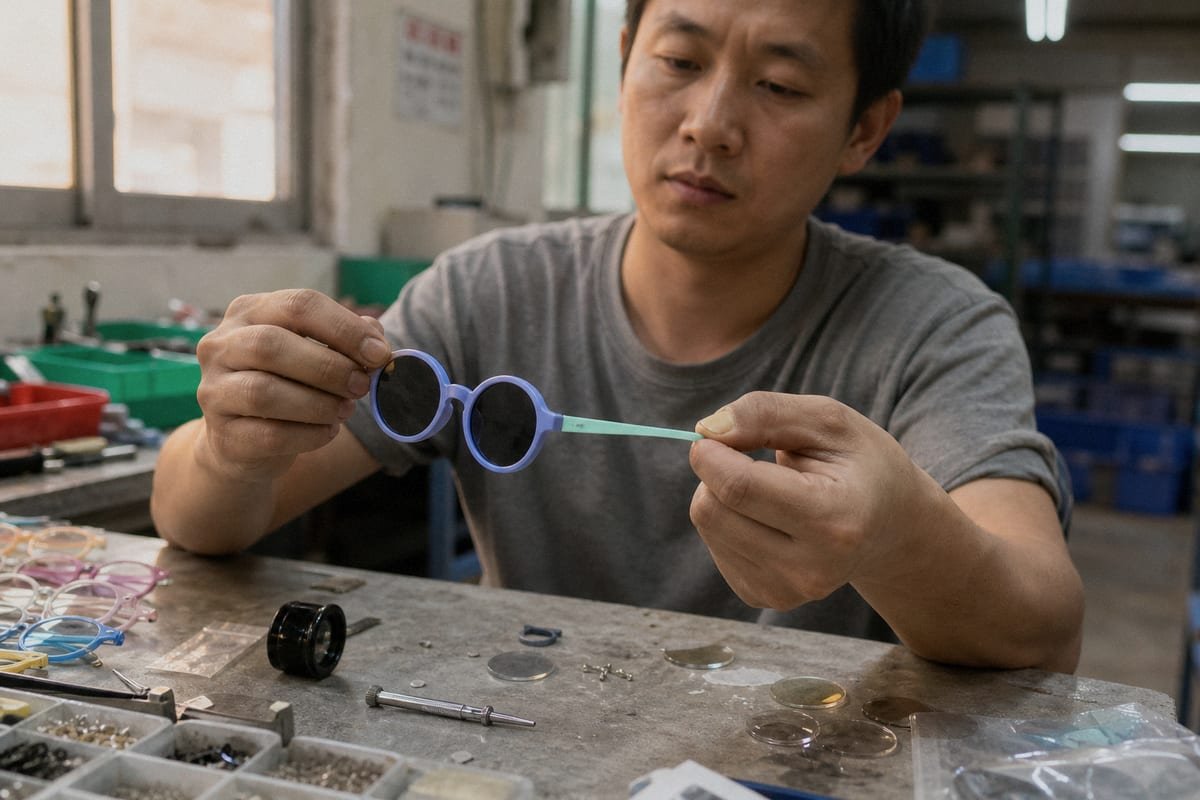
Snow eyewear is less forgiving than summer eyewear. Cold makes weak materials fail. Glare exposes poor lens quality instantly. So your manufacturer selection carries more weight in this category than almost any other kids' accessory.
A Practical Evaluation Sequence
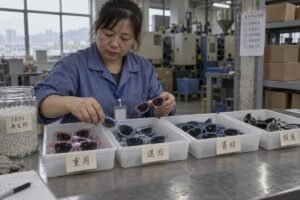
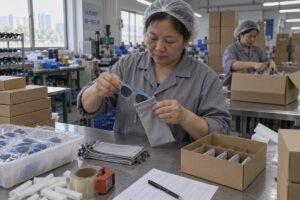
- Verify they are a real factory, not a trader. Ask for workshop photos, worker counts, and process documentation. Our own facility in Taizhou runs about 120 workers under 5S-Management 8, and we encourage buyers to audit exactly these things. A trader cannot control cold-weather material tolerances; a factory can.
- Test material claims, not just accept them. Request cold-flex samples. Bend the temples after chilling them. Genuine TR90 and TPEEE-blend frames return to shape; imitation materials whiten at the stress point or crack.
- Demand lens documentation. UV400 protection and impact resistance should be testable and repeatable batch to batch, not just true on the golden sample. Ask how lens VLT and polarization film alignment are checked during production.
- Check the existing style library. Launching a snow collection with all-new molds is expensive and slow. A factory with a deep catalog — we maintain roughly 800 existing styles — lets you test the winter market with lower risk, then invest in custom molds once sales data justifies it.
- Bewertung der OEM/ODM-Tiefe. Snow collections need more than a logo print. Custom lens tints, mirror coatings, strap accessories, cases, and retail-ready packaging all shape sell-through. Confirm the factory handles the full package, not just the frame.
- Evaluate communication and lead-time reliability. Winter is a hard seasonal deadline. Stock that arrives in February misses the season entirely. Ask for realistic production calendars and how the factory handles delays.
Sample Versus Bulk: Where Quality Gaps Hide
The most common failure points we see when auditing competitor products are hinge screws loosening in cold weather, lens coatings that delaminate, and frame colors that fade unevenly. A serious partner will show you how each of these is controlled on the line, station by station. In our workshop, hinge torque and lens fit are checked as separate QC steps precisely because snow-market buyers cannot afford field failures.
Schlussfolgerung
Snow punishes unprotected young eyes. Match sunglasses to calm snow play, goggles to fast slopes, and build every winter product on UV400, polarization, flexible frames, and a reliable factory partner.
Fußnoten
1. Authoritative guidance from the American Academy of Ophthalmology on protecting children’s vision from solar radiation. ↩︎
2. WHO resource explaining how UV radiation intensity increases with altitude and environmental reflection. ↩︎
3. National Eye Institute documentation on long-term retinal damage and age-related macular degeneration risks. ↩︎
4. Technical overview of high-energy visible light and its effects on ocular health. ↩︎
5. Authoritative Wikipedia entry explaining the properties and flexibility of thermoplastic elastomers used in eyewear frames. ↩︎
6. Authoritative medical source from the American Academy of Ophthalmology explaining how polarized filters reduce glare. ↩︎
7. Detailed material science background on TPEE and its performance characteristics in extreme temperatures. ↩︎
8. Explanation of the 5S workplace organization method used in high-quality manufacturing facilities. ↩︎
Weitere Artikel, die Ihnen gefallen könnten

Auf der Suche nach einem zuverlässigen Partner für Kinderbrillen?
Entdecken Sie über 800 sofort verfügbare Modelle und umfassenden OEM/ODM-Support, der auf Ihre Marke zugeschnitten ist.
Kontakt aufnehmen English
  Español de México
  Deutsch
  Français
  日本語
日本語  العربية
  Português do Brasil