What Packaging Info Do Parents Check First for TR90 & TPEE Kids Sunglasses?
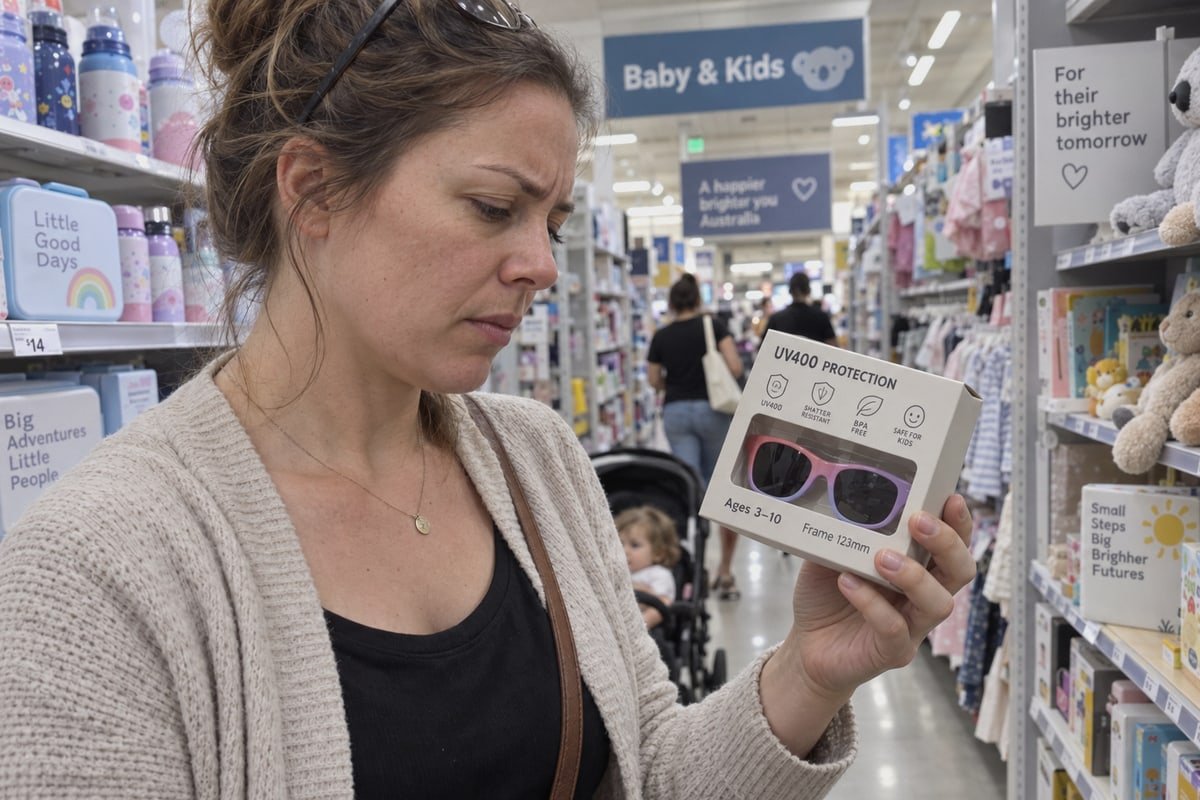
Packaging info for TR90 & TPEE kids sunglasses gets a thirty-second parent scan. Miss one label, the sale is gone. Our Taizhou line taught us which labels win.
Parents check UV400 protection first on TR90 & TPEE kids sunglasses packaging, then material safety marks such as BPA-free, phthalate-free, CPSIA, EN71, or CE, and then the age range and frame size. Polarized lenses, flexibility claims, and eco-friendly packaging come after these three core checks.
That order matters. Parents are not reading your box the way a marketer would. They want three answers fast: Will it protect? Is it safe to wear or chew? Will it fit? The sections below walk through each answer, and how to print it so a parent finds it without searching.
What packaging information do I need to reassure parents about safety certifications?
A buyer from Australia once asked us to add three compliance lines to a hang tag. Her reason was simple. Retail staff kept getting the same safety questions from parents.
Packaging should state UV400 protection (100% UVA/UVB, blocking up to 400 nm), BPA-free and phthalate-free material claims, and the compliance marks your market expects: CPSIA and ASTM F963 for the US, EN71 and CE marking for Europe, plus FDA or ISO language where applicable.
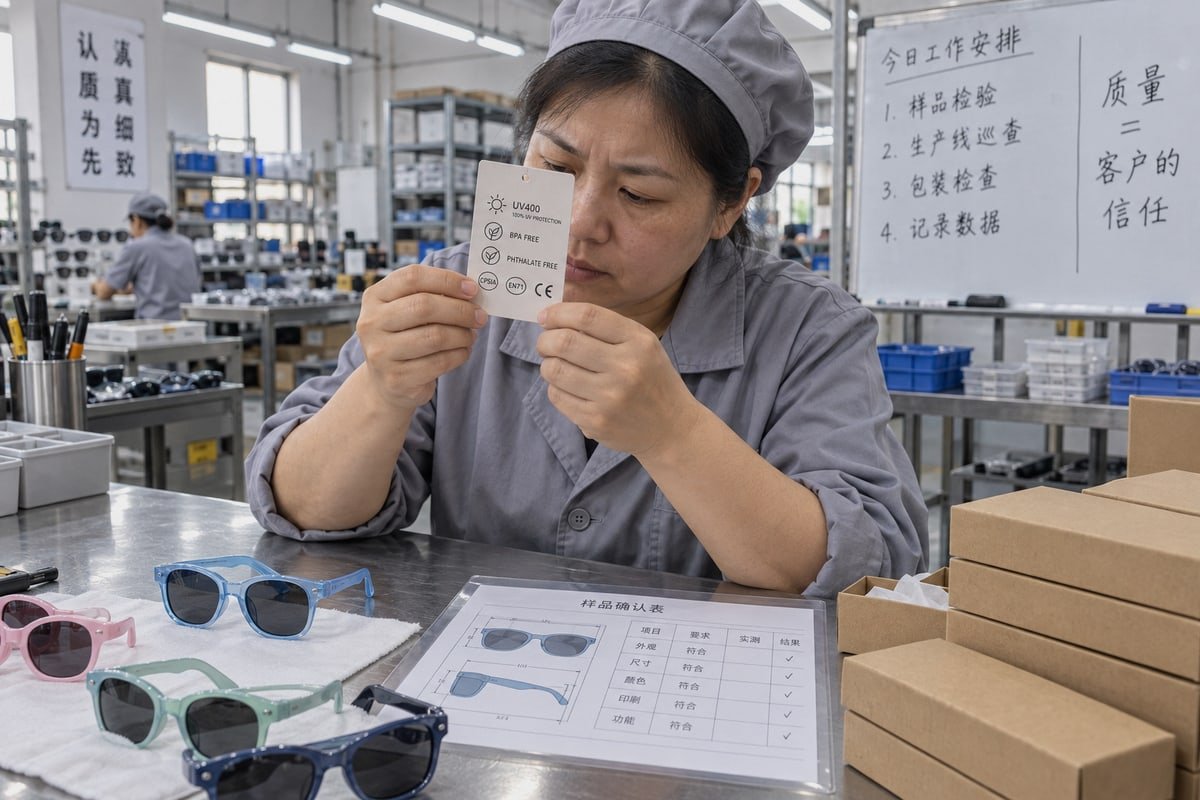
The safety block is the part of the box a parent reads first. So I treat it as the headline, not the fine print. When we build retail-ready packaging for a customer, we ask one question before anything else: which market is this going to? The answer decides which marks go on the front.
The three questions behind every label
Parents rarely know the standard numbers. They know the questions. Each label on the box should answer one of them.
| Elternfrage | Label that answers it | Where to print it |
|---|---|---|
| Does it block UV rays? | UV400 / 100% UVA-UVB, up to 400 nm | Front panel, largest safety claim |
| Is it safe to wear or chew? | BPA-free, phthalate-free, food-grade, non-toxic | Front or side, near the material name |
| Does it meet a real standard? | CPSIA, ASTM F963 (US); EN71, CE (EU); FDA, ISO where applicable | Back panel badge row |
UV400 protection is the anchor. Some wholesale listings phrase it as 99.9% UV blocking up to 400 nm, and that wording works well because it gives a number parents can trust. Put it first and make it bigger than everything else.
Wear claims and chew claims are different
Older kids wear sunglasses. Toddlers chew them. That is why BPA-free certification language 1 and phthalate-free labeling sit right next to the material name on TPEE styles. "Food-grade" is a strong extra line for the 0–3 range because it speaks directly to a parent watching a baby gnaw on a temple. For any age, a note on hypoallergenic frame materials reassures parents of children with sensitive skin.
Back every mark with a report
Here is a buyer objection I hear often: "Can we just print the badges?" No. A CE mark carries CE-Kennzeichnungsanforderungen 2 behind it, and CPSIA or EN71 claims imply test reports. We help brands arrange the testing their target market needs before the artwork is approved. A badge without a report is a liability, not a trust signal.
Where polarization fits
Some brands push polarized lens technology as the top feature. Parents do value it for glare at the beach or on the sports field. But polarization does not block UV by itself. Print UV400 first, and treat "Polarized" as the second claim, the way the small lens sticker on our sky-blue translucent frame shows "Polarized" alongside a CE mark.
How can I clearly display material details like TR90 and TPEE on my packaging?
During a bend test on our 5S workshop floor, a TPEE temple folded flat and sprang back. That moment is what parents need to picture when they read the box.
Name the material plainly on the front panel, pair it with one benefit and one age band, and support it with a short icon row. For example: TPEE, soft and chew-safe, ages 0–3; TR90, lightweight and impact-resistant, ages 3–12+; frame weight under 20 g.
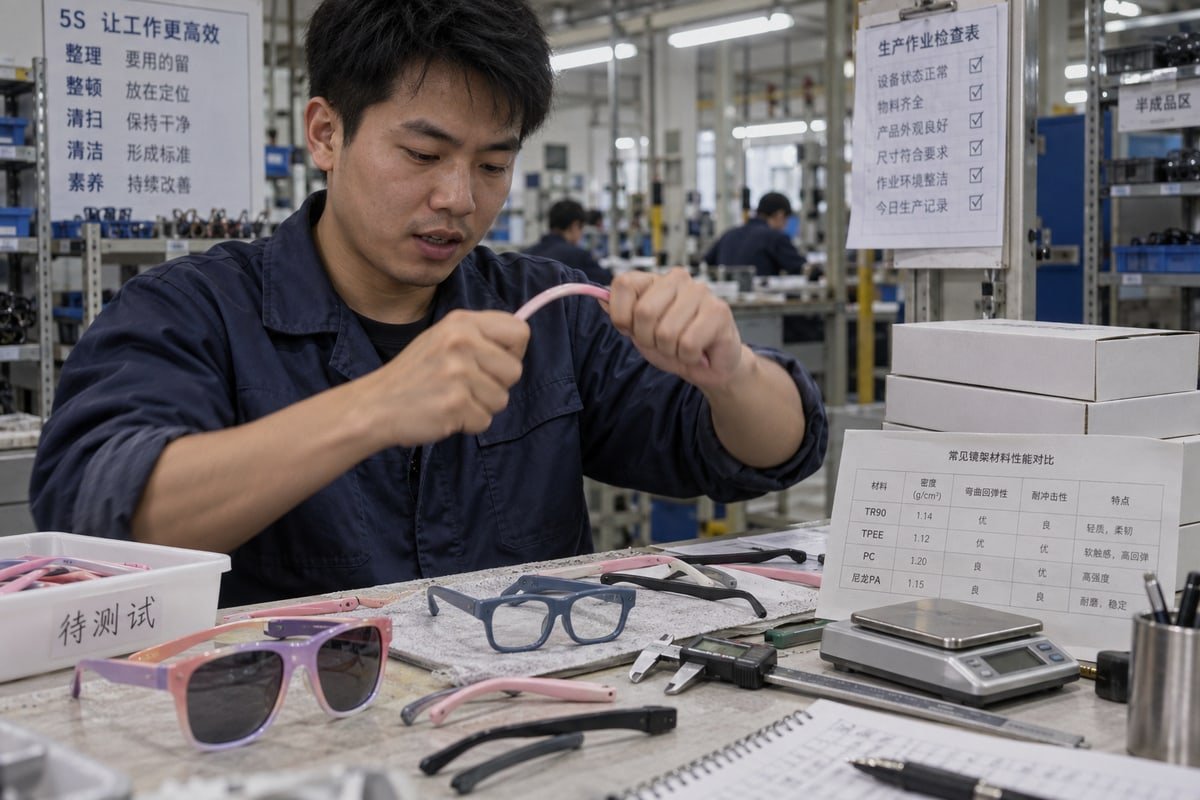
Parents do not know what TR90 or TPEE stands for. They do know what "soft" and "won't snap" mean. So the job of the packaging is to translate. I have found that the clearest boxes use three lines: the material name, one plain-English benefit, and one age range. Everything else can go on the back.
TR90 vs TPEE: what the box should say
| TPEE | TR90 | |
|---|---|---|
| Beste Verwendung | Soft, rubbery, very flexible | Firm but bendable, lightweight |
| Best age band | 0–3 (babies and toddlers) | 3–12+ (active older kids) |
| Front-panel benefit line | "Soft and chew-safe" | "Bends, doesn't break" |
| Supporting claims | Food-grade, BPA-free, phthalate-free | Impact-resistant, under 20 g |
| Typical lens pairing | UV400 tinted | UV400 or polarized |
These two materials are both kid-friendly, but they are not the same thing. A common buyer objection is: "Can we use one material and one box for all ages?" You can, but you lose the age-specific message parents now expect. TPEE is presented as the softer, toddler-first choice. TR90 is the broader performance plastic for older kids. Make that split obvious on the box instead of leaving parents to guess.
The hybrid option
Many of our styles use a TR90 front with TPEE temples. The front holds its shape and protects shatterproof safety lenses. The temples stay soft against the ears. On the box, I describe this as "TR90 frame, soft TPEE arms 3" and add the age band. Parents understand it instantly.
"Unbreakable" needs a partner
"Unbreakable," "bendable," and "shatter-resistant" are attractive words. But they invite doubt if they stand alone. Pair them with Schlagfestigkeitsstandards 4 language and a short note on what was tested: bend and spring-back, hinge cycles, lens impact. Practical guides still tell parents to check hinges and edges, so tell them you did too.
Two details that quietly build confidence
First, print the frame weight in grams. "Under 20 g" makes the feather-light claim concrete. Second, add a thermal stability 5 line, such as "won't warp in a hot car." Parents who have pulled a twisted pair off a dashboard will notice it.
What sizing and age guidance should I include so parents choose the right fit?
Printing four measurements on a box costs space. Leaving them off costs returns. We weigh that trade-off every time we lay out a retail-ready package for a customer.
Include a clear age band (for example 0–3, 3–6, 6–12), the frame width, bridge width, and temple length in millimetres, and a head-circumference or face-width guide. Add a simple fit icon showing wraparound coverage and strap compatibility so parents can match the frame to their child in seconds.
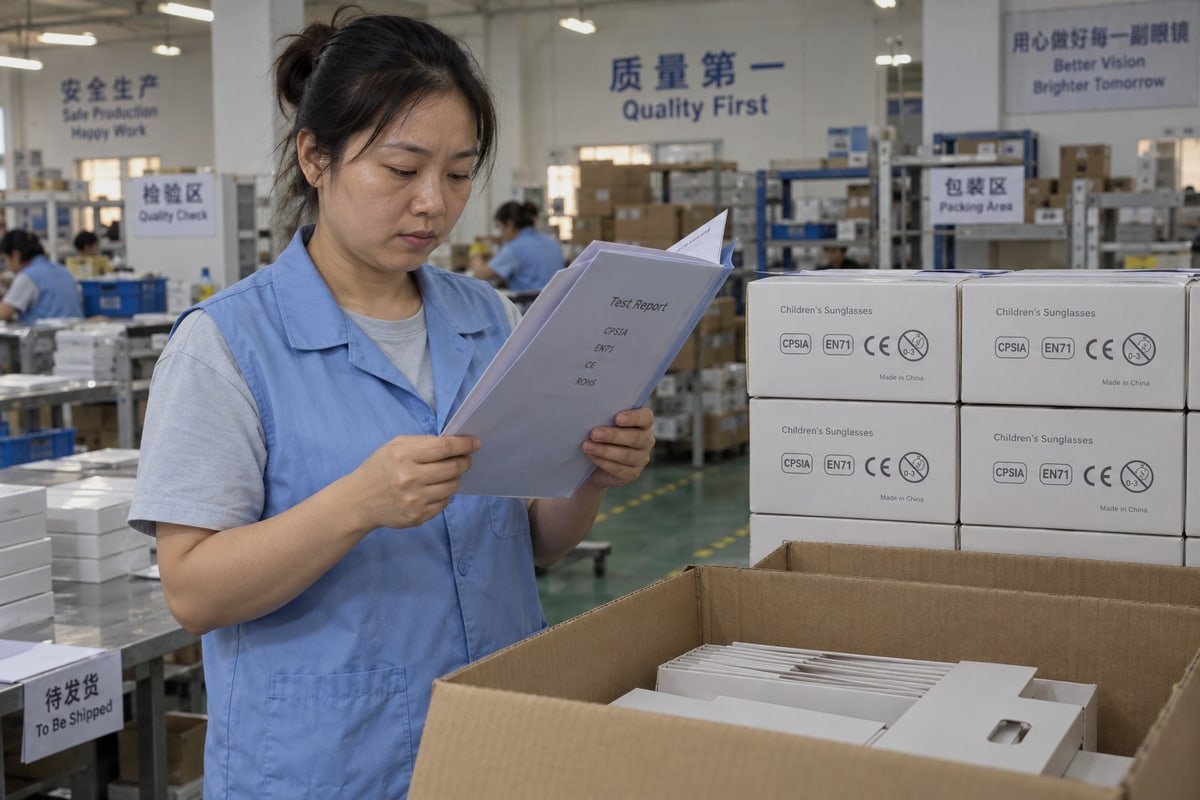
Fit is the third question, and it is the one most likely to cause a return. A parent buying online cannot try the frame on the child. A parent in a store often cannot open the box. So the packaging has to do the fitting for them. I have seen good products fail simply because the box said "kids" with no age band.
Build the size panel in four steps
- Lead with the age band. Print it on the front, near the material name. Age is the first filter parents apply.
- Add the three frame numbers. Frame width, bridge width, and temple length in millimetres. Put them on the side or back with a small line drawing.
- Give a body measurement. Head circumference or face width lets a parent measure a child at home and compare.
- Show the fit features. Icons for soft nose pads, flexible temples, wraparound coverage, and retention strap compatibility.
Match age band to material and comfort cue
| Altersband | Empfohlenes Material | What to print | Comfort cue to highlight |
|---|---|---|---|
| 0–3 | TPEE | "Soft, chew-safe, strap-ready" | Retention strap, no hard edges |
| 3–6 | TR90 mit TPEE-Bügeln | "Lightweight, bendable" | Soft nose pads, spring-back arms |
| 6–12+ | TR90 | "Impact-resistant, under 20 g" | Wraparound coverage, sport fit |
This table is a template. The exact millimetre values come from the style you choose. With around 800 existing styles in our range, a brand can pick a toddler frame and a school-age frame from the same family and print two size panels without paying for new molds.
Why the numbers reduce doubt
A frame width tells a parent whether the lenses will sit on the cheeks or float above them. A temple length tells them whether the arms will reach behind the ears. These sound like small details. But the chunky slate-blue frame in our range looks very different on a four-year-old and an eight-year-old, and the numbers explain why. Clear sizing also protects your reviews, because a "too big" one-star review is really a packaging failure.
A note on visual proof
If the box has a product window or photo, show the frame on a child of the target age, not on a flat white background alone. Parents compare that image to their own child before they read a single number.
Which packaging features help parents trust my brand at first glance?
One lesson from fifteen years of eyewear work: a box that looks careful makes the product feel safe. Sloppy print undoes even a perfect UV400 lens.
Parents trust packaging that shows a clean front panel with UV400 protection, a compliance badge row, a visible age band, a real product window or photo, a protective case or pouch, and recyclable packaging symbols. Consistent print quality and a brand contact line reinforce that trust at first glance.

Trust at first glance is not one feature. It is the sum of small signals that all point the same way. When I review a customer's artwork before it goes to print, I check the front panel from arm's length. If I cannot find the UV400 claim, the age band, and one safety mark in three seconds, the layout goes back for revision.
The thirty-second parent checklist
This is what a parent is scanning for, in the order they usually find it. Use it to audit your own box.
- UV400 or 100% UVA/UVB on the front, in large type.
- Material name with a plain benefit: TPEE soft, TR90 lightweight.
- Age band next to the material.
- BPA-free, phthalate-free, and food-grade lines for toddler styles.
- A badge row: CPSIA, ASTM F963, EN71, CE, FDA compliant plastics, or ISO, as the market requires.
- Polarized status, second to UV, as a glare-reduction benefit.
- Frame weight in grams and a thermal stability note.
- Size numbers and a fit icon on the side or back.
- A protective case, pouch, or strap included and stated.
- Recycling symbols and a brand contact line.
Signals that are educational, not loud
Retail packaging is becoming more educational. Icons, short benefit statements, and age recommendations reduce decision friction. Big slogans do the opposite. "Ultra safe" means nothing. "UV400, EN71 tested, ages 3–6" means everything. Optical safety standards, printed by name, beat adjectives every time.
Eco-friendly packaging is real, but it comes second
Recyclable cartons and minimal plastic are showing up more often, and eco-conscious parents notice them. Component-specific recycling symbols and circularity instructions are worth adding. But in the parent decision process they sit below the safety and fit checks. Print them, and print them honestly, but do not let them push UV400 off the front.
Consistency is the quiet trust signal
The same badge row, the same icon set, and the same age-band style across a whole range tells a parent the brand is organized. Full OEM/ODM support means a brand can carry its logo, its colours, its lens choice, and its packaging system across every style it picks. Even the lens sticker matters: the pink gradient wayfarer in our range ships with a small "Polarized" sticker and a cloud logo on the lens, and that tiny detail reads as finished, not generic.
Schlussfolgerung
Parents scan for protection, safety, and fit before style. Miss those and the box fails. Print them clearly, back them with reports, and let our 800 styles carry the rest.
Interested in sourcing the products mentioned in this article? See details and request a quote here:
Fußnoten
1. FDA resources regarding the safety and regulation of Bisphenol A (BPA) in consumer products and food contact materials. ↩︎
2. Official European Commission guidance on the legal requirements and application of the CE mark for product compliance. ↩︎
3. Wikipedia page for thermoplastic elastomers, the category of flexible, rubber-like materials used for durable children’s eyewear components. ↩︎
4. FDA regulatory resources for medical devices, covering safety requirements like impact resistance for sunglass lenses. ↩︎
5. The ISO homepage provides access to international standards for material testing, including thermal stability and durability for plastics. ↩︎
Weitere Artikel, die Ihnen gefallen könnten


Auf der Suche nach einem zuverlässigen Partner für Kinderbrillen?
Entdecken Sie über 800 sofort verfügbare Modelle und umfassenden OEM/ODM-Support, der auf Ihre Marke zugeschnitten ist.
Kontakt aufnehmen English
  Español de México
  Deutsch
  Français
  日本語
日本語  العربية
  Português do Brasil