What Mouth-Contact Safety Standards Must TPEE Kids Sunglasses Materials Meet?
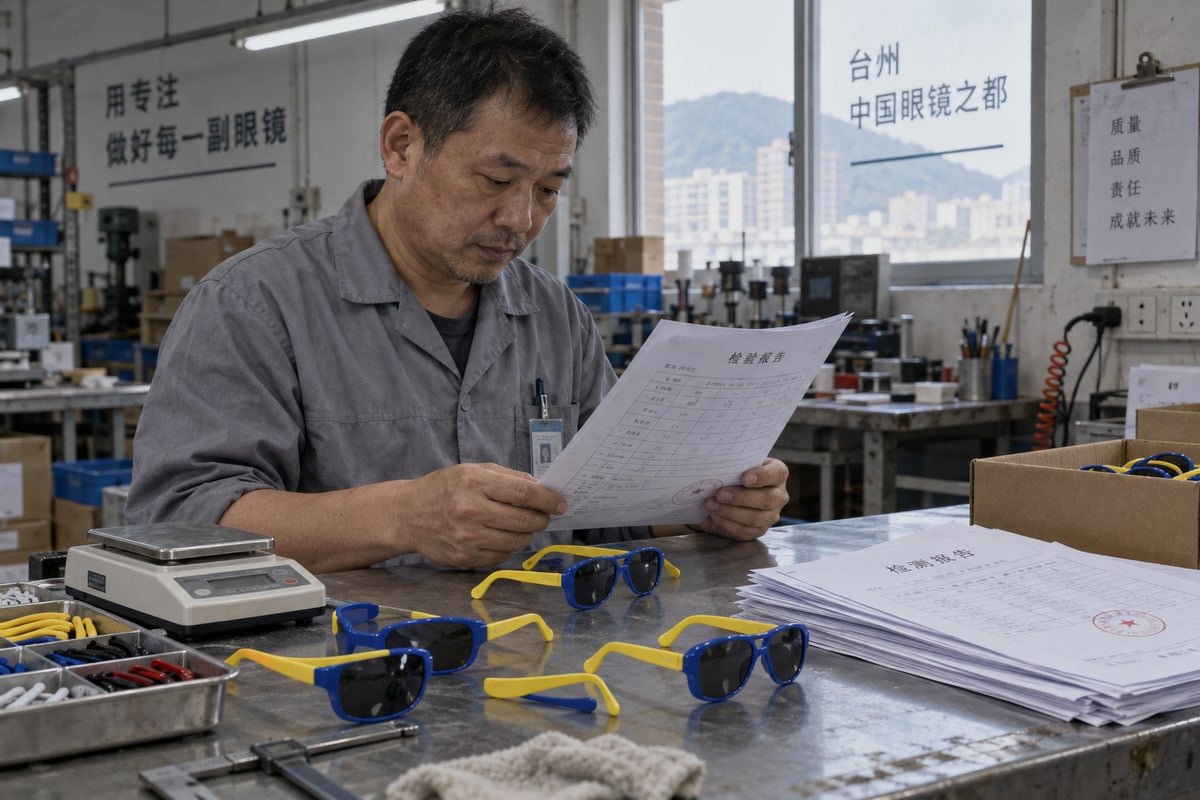
Toddlers chew temple tips. Untested frames can leach chemicals into saliva. So on our production line, I put mouth-contact safety standards for TPEE kids sunglasses materials before color or style.
Mouth-contact safety standards for TPEE kids sunglasses materials combine children’s chemical rules and eyewear rules: CPSIA lead and phthalate limits, EN 71-3 migration limits, ASTM F963 mechanical and chemical safety, REACH SVHC screening, BPA-free verification, and small-parts choking checks, plus ANSI Z80.3 lens performance.
That answer is short. The reality behind it is not. There is no single “mouth-safe” stamp for sunglasses REACH-Verordnung 1. Instead, safety comes from stacking several standards on top of each other. Below, I walk through which certificates to request, how to verify them, which tests apply to flexible materials, and why price should never win this argument.
What safety certifications should I ask my TPEE sunglasses supplier to provide?
A procurement manager from Australia once emailed us a one-line question: "Send me your certificates." I asked which ones. She paused. That pause is where most sourcing mistakes begin.
Ask your TPEE sunglasses supplier for third-party reports covering CPSIA certification for lead and phthalates, EN 71-3 compliance, ASTM F963 standards, REACH SVHC screening, BPA-free certification, and ANSI Z80.3 or EN ISO 12312-1 lens results, plus a Children's Product Certificate and small-parts test.
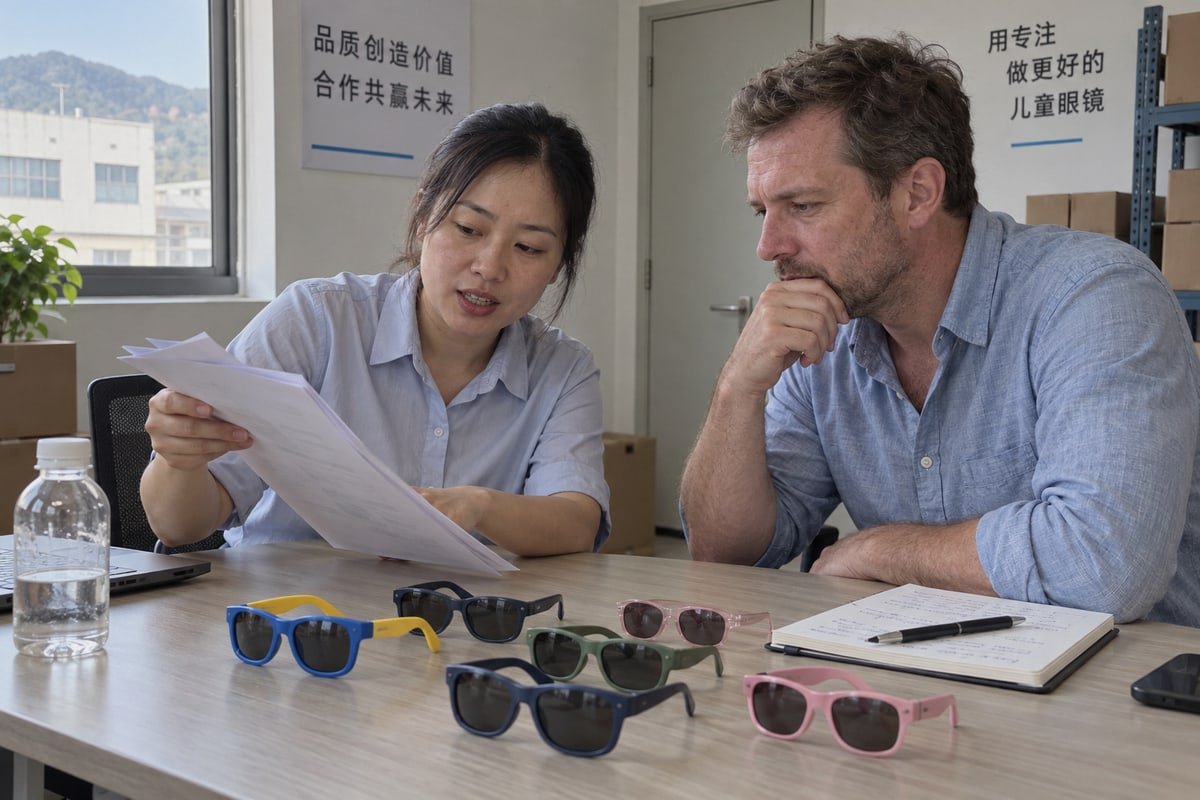
The document checklist I send to every new buyer
When a brand starts working with us, I send a short list. It is not long. But every line covers a different risk, so skipping one leaves a gap.
| Zu beantragende Dokumentation | Was es tatsächlich beweist | Which parts it should cover |
|---|---|---|
| CPSIA test report plus Children's Product Certificate | Lead in substrate and surface coatings; phthalate content limits met | Every accessible part, including paint and ink |
| EN 71-3 migration report | Migration of 19 toxic elements stays under limits | Temples, temple tips, nose area, inserts |
| ASTM F963 report | Mechanical safety, flammability, and chemical limits | The complete assembled frame |
| REACH SVHC screening | No listed Substances of Very High Concern above threshold | Full formulation, all colors |
| BPA-free lab data | No bisphenol A detected or leaching | Resin, coatings, adhesives |
| ANSI Z80.3 or EN ISO 12312-1 lens report | UV transmission and impact resistance | Lenses only |
| Small-parts and use-and-abuse test | Nothing detaches into a choking-size piece | Hinges, tips, decorative parts |
Why an engraved CE mark is not proof
Look at the lavender cat-eye frame in our range. It carries a small CE marking on the inner temple. Buyers sometimes treat that engraving as the certificate. It is not. CE is a declaration by the maker. The lab report behind it is what protects your brand. Always ask for the report, and check the date and the lab name.
Match every report to your actual bill of materials
Here is a detail many buyers miss. A report is only valid for the exact material it tested. Take our royal blue frame with yellow temple arms. That is two colorants and two components. If the report only lists "blue TPEE," the yellow arms are not covered. So when you receive documents, compare them line by line against the colors, coatings, and accessories in your order. In our experience exporting to Europe and Japan, this one check catches more problems than any other.
How do I verify that TPEE material is truly safe for my children's product line?
Last year our QC team rejected a batch of yellow temple arms. The base resin was fine. The masterbatch was not. Same polymer name, different result.
Verify TPEE safety by testing the finished part, not the resin name: request migration testing on colored components, confirm food-grade TPEE or FDA 21 CFR resin grades, check heavy metal restrictions and phthalate content limits, and run pull and torque tests on hinges and temple tips.

Start with the resin, but never stop there
TPEE, or thermoplastic polyester elastomer, is popular in children's eyewear for good reasons. It bends without snapping. It springs back to shape. It feels soft against a toddler's nose and ears. Many resin suppliers offer grades with FDA 21 CFR food-contact compliance, and that is a strong starting point. But a sunglasses frame is not raw resin. It is resin plus pigment, plus a gloss finish, plus a hinge, plus maybe a printed logo. Each addition can introduce lead, cadmium, phthalates, or other restricted substances. So the finished part must be tested, not the pellet.
A five-step verification process I use
- Get the resin datasheet. Confirm the grade, the supplier, and whether it is marketed as food-grade TPEE. This proves the base is a non-toxic elastomer.
- List every accessible component. Temples, temple tips, nose bridge, hinge screws, decorative inserts, and any coating.
- Send finished parts to a third-party lab. Fragen Sie nach migration testing to EN 71-3 2, plus CPSIA lead and phthalate analysis on each color.
- Run mechanical checks. Pull the temples, twist the hinges, and drop the frame. Nothing should release a small part.
- Repeat on production, not just samples. A golden sample tells you what is possible. A production-lot test tells you what you shipped.
Which parts get mouthed the most
| Frame area | How a toddler interacts with it | Main hazard to check |
|---|---|---|
| Bügelenden | Chewed and sucked for long periods | Heavy metal migration, dye transfer, BPA |
| Bügel | Bitten, bent, twisted | Fatigue cracking, sharp edges, micro-shedding |
| Nasenrücken | Licked, pressed on skin | Allergens, plasticizers, coating wear |
| Hinge and screws | Pulled and pried | Small-parts detachment, nickel exposure |
| Logos and inserts | Picked at and gnawed | Ink migration, adhesive residue, detachment |
Some buyers push back here. They tell me their supplier already says "BPA-free and non-toxic," so surely that is enough. I understand the logic. But a slogan is not a lab result. On our own line, we treat those phrases as claims to be proven, and we treat every new color as a new material until the report arrives.
What testing standards apply to flexible eyewear materials like TPEE and TR90?
Softer TPEE feels kinder on a toddler's nose. Stiffer TR90 holds lenses more securely. We weigh that balance in every frame-plus-temple combination, and the test plan changes with it.
Flexible eyewear materials like TPEE and TR90 are tested under CPSIA and ASTM F963 in the US, EN 71-3 and REACH regulation in Europe, plus ANSI Z80.3 or EN ISO 12312-1 for lenses. Advanced programs add ISO 10993 biocompatibility, DIN 53160 saliva colorfastness, and PFAS screening.
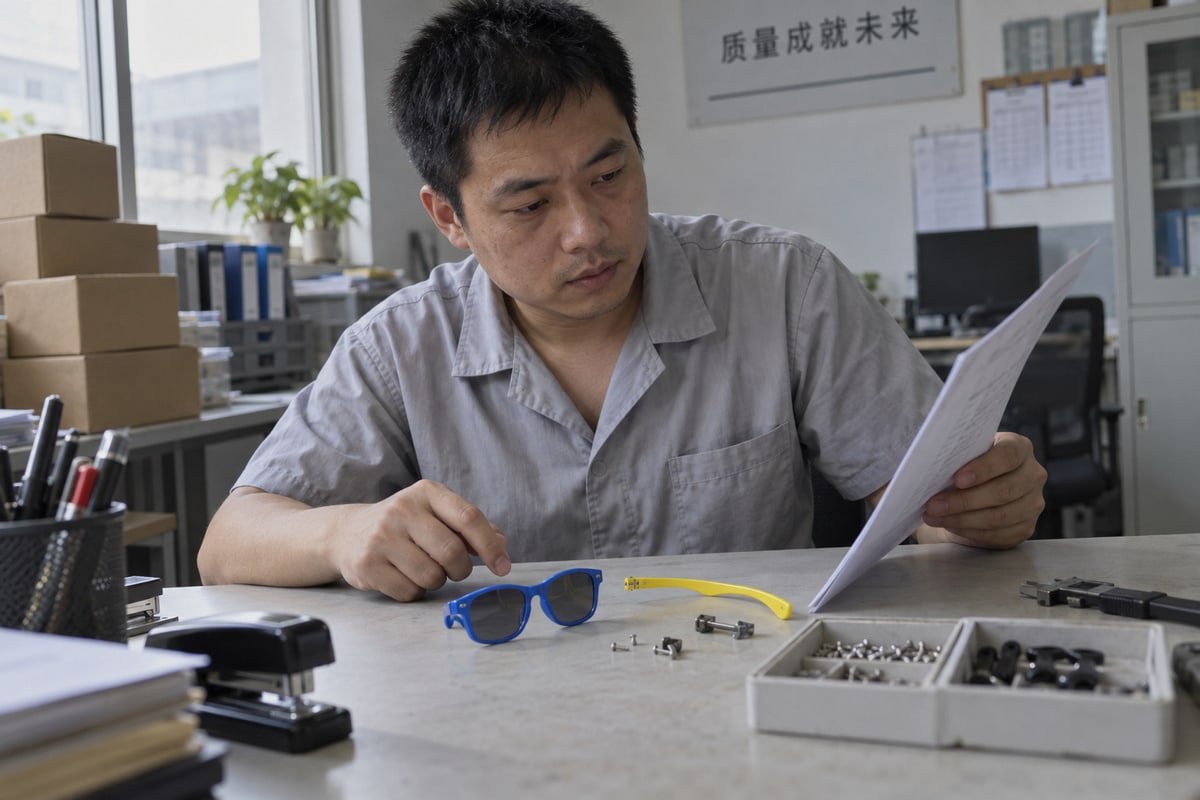
Three families of standards, one product
Kids' sunglasses sit where three rulebooks overlap. Each was written for a different product. None was written specifically for a chewable frame. So I find it easiest to compare them side by side.
| Standard family | Written for | What it demands | Why it matters for TPEE kids sunglasses |
|---|---|---|---|
| Eyewear-safe (ANSI Z80.3, EN ISO 12312-1, FDA impact rule) | Sunglasses and spectacles | UV filtering, optical quality, impact-resistant lenses, non-flammable frames | Covers vision and breakage, but says little about chemicals in the mouth |
| Toy-safe (ASTM F963, EN 71-3, CPSIA) | Products children play with | Heavy metal restrictions, phthalate content limits, small-parts rules, flammability | Directly addresses mouthing, chewing, and choking |
| Food-safe logic (EU food-contact framework, FDA 21 CFR) | Materials touching food | Inertness and low migration under simulated contact conditions | A useful benchmark for temple tips that spend hours in a mouth |
The objection I hear most often
"Sunglasses are eyewear, not toys. Why should I pay for toy testing?" That is the industry-typical view, and it is not wrong on paper. Regulators classify sunglasses as eyewear. The lens rules under ANSI Z80.3 are what a customs officer will look for first. But the conservative view has a stronger point. For a two-year-old, normal use includes mouthing. If normal use includes mouthing, then the material should meet the same chemical bar as a teether. My practical answer is the middle ground: keep eyewear standards for the lenses and the whole frame, then test the soft accessible parts, especially TPEE temples and tips, against the harshest plausible exposure. That means EN 71-3 compliance for 19 migrating elements and CPSIA certification for lead and phthalates, at minimum.
Where the newer tests fit
The EU food-contact framework uses migration testing under simulated conditions, including elevated-temperature accelerated testing to model long contact. Eyewear is not automatically a food-contact product, but that logic is a smart way to stress a temple tip. On top of that, forward-looking brands now ask for ISO 10993 cytotoxicity and oral mucosa irritation results, DIN 53160 colorfastness to saliva and perspiration so pigment does not transfer during chewing, mechanical chew-test simulations for micro-plastic shedding and fatigue, and PFAS-free verification. TR90 and TPEE behave differently under fatigue, so when we pair a TR90 front with TPEE temples, the flex point at the hinge gets extra attention.
Why does material safety matter more than price when sourcing kids' sunglasses?
Fifteen years of making children's frames taught me one hard lesson. The cheapest quote never includes the cost of a recall, which always dwarfs the cost of testing.
Material safety matters more than price because children mouth sunglasses during normal use, and unverified non-toxic claims can hide lead, phthalates, or BPA risks. One failed inspection, recall, or injury erases years of margin, while proper testing costs a fraction of one lost order.
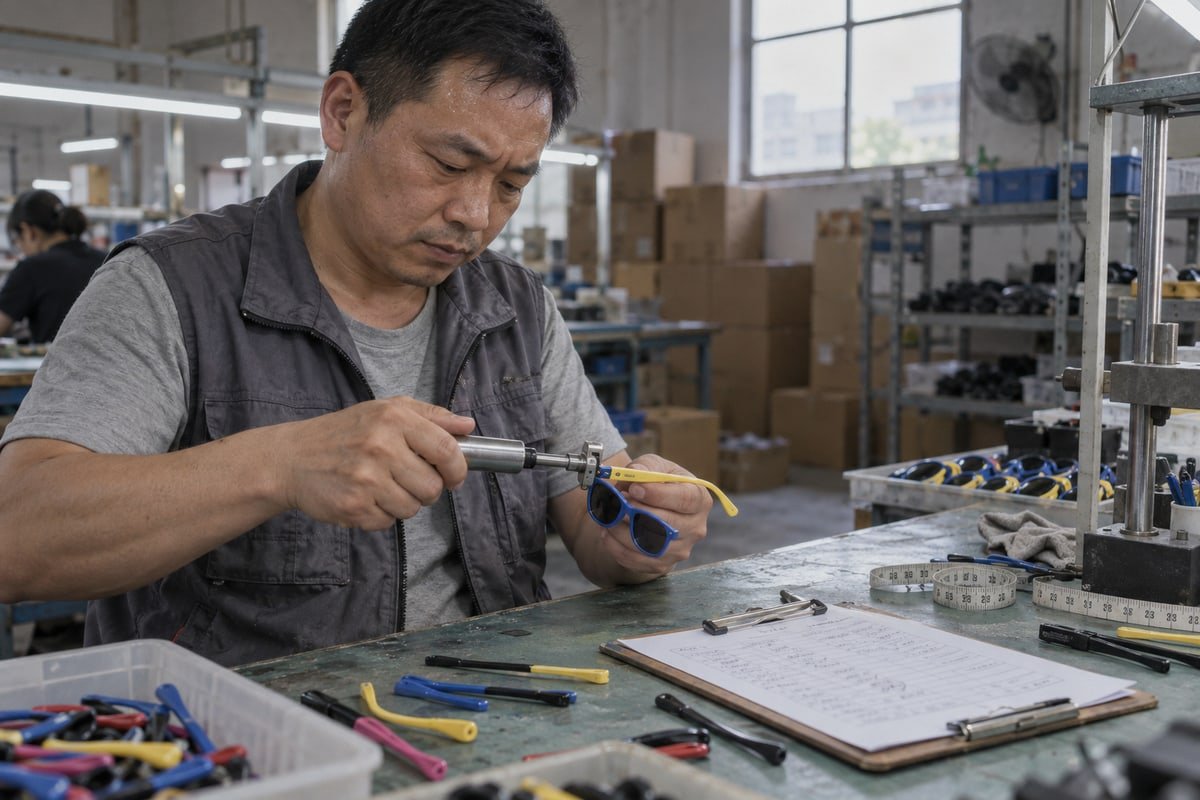
Where low-price frames usually cut corners
A cheap children's frame looks the same in a product photo. The blush-pink round style in our range and a copy from an unknown workshop can share a silhouette. The difference lives in the parts you cannot see.
| Where cost is cut | What it saves per frame | What it can cost your brand later |
|---|---|---|
| Recycled or off-spec resin | A few cents | Failed heavy metal restrictions, brittle temples, customs holds |
| Cheap masterbatch pigments | A few cents | Cadmium or lead in migration testing, dye transfer to saliva |
| No per-color lab testing | The lab fee | Retailer delisting when a spot check fails |
| Thin hinge pins | A fraction of a cent | Small-parts detachment, choking hazard, product recall |
| No production-lot testing | The lab fee | Shipping a batch that differs from the approved sample |
The real cost equation
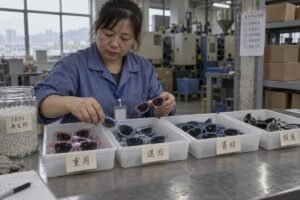
When I quote a kids' brand, I price the frame and the testing together. Some buyers compare that number to a bare frame price and see a gap. But that gap is the safety program. In our factory, the 5S workshop discipline and in-line QC exist so that what we test is what we ship. That consistency is what a brand in Europe or Japan is actually paying for, not the polymer alone.
How to keep safety and budget on the same side
Here is the approach I recommend to founders and product managers:
- Reduce mold risk, not test risk. Choosing from an existing library of styles, like the roughly 800 we maintain, avoids heavy tooling costs. That frees budget for proper lab work.
- Specify materials in the purchase order. Name the TPEE and TR90 grades, the colorant source, and the required reports. Vague orders get vague materials.
- Require reports per color and per lot. Not per style. Not per year.
- Ask for REACH regulation screening even for non-EU markets. It is a low-cost way to catch restricted plasticizers early.
- Use OEM/ODM support wisely. Custom logos, packaging, and lens options are valuable, but every added ink or accessory must enter the test plan.
Price still matters. I never tell buyers otherwise. But safety sets the floor, and price is negotiated above that floor, never below it.
Schlussfolgerung
Toddlers will chew your frames. Untested TPEE can fail them. Demand stacked CPSIA, EN 71-3, ASTM F963, and lens reports, and safety follows.
Interested in sourcing the products mentioned in this article? See details and request a quote here:
Fußnoten
1. ECHA’s primary explanation of the REACH regulation for chemical safety in the EU. ↩︎
2. European Commission resource on toy safety standards, including chemical migration requirements. ↩︎
Weitere Artikel, die Ihnen gefallen könnten


Auf der Suche nach einem zuverlässigen Partner für Kinderbrillen?
Entdecken Sie über 800 sofort verfügbare Modelle und umfassenden OEM/ODM-Support, der auf Ihre Marke zugeschnitten ist.
Kontakt aufnehmen English
  Español de México
  Deutsch
  Français
  日本語
日本語  العربية
  Português do Brasil