How to Read “48□16-120” Size Markings on TR90 Kids Sunglasses Temples?
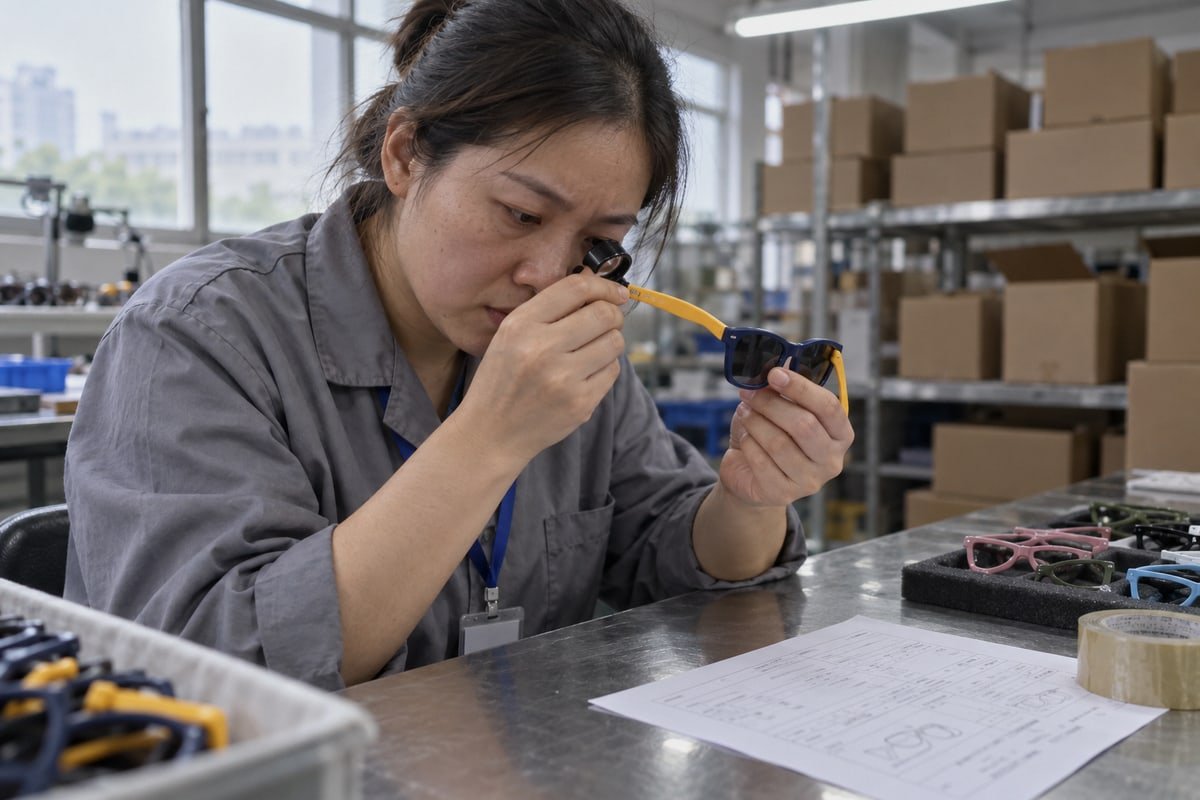
Every week a buyer asks our Taizhou team what 48□16-120 size markings on TR90 kids sunglasses mean. Guess wrong, and a whole shipment fits the wrong age group.
48□16-120 size markings on TR90 kids sunglasses read as three millimeter measurements: 48 mm lens width, 16 mm bridge distance, and 120 mm temple arm length. The square is the boxing-system symbol. Together they describe frame size for roughly ages 4 to 8, not the model number.
That is the short version. The long version matters more when you are placing a purchase order for thousands of units. Below, I break down each number, show how the codes map to age groups, explain why soft TPEE temples are marked differently, and give you a fit checklist that goes beyond the printed code.
What Do the Three Numbers in "48□16-120" Actually Mean for My Kids Sunglasses Order?
Our QC team once pulled a carton because the temple marking read 48□16-125 while the spec sheet said 120. Five millimeters sounds tiny. On a child's ear, it is not.
The three numbers are millimeter measurements. 48 is the lens width across one lens at its widest point. 16 is the bridge distance between the two lenses. 120 is the temple arm length from hinge to tip. The □ symbol shows the boxing measurement system was used.
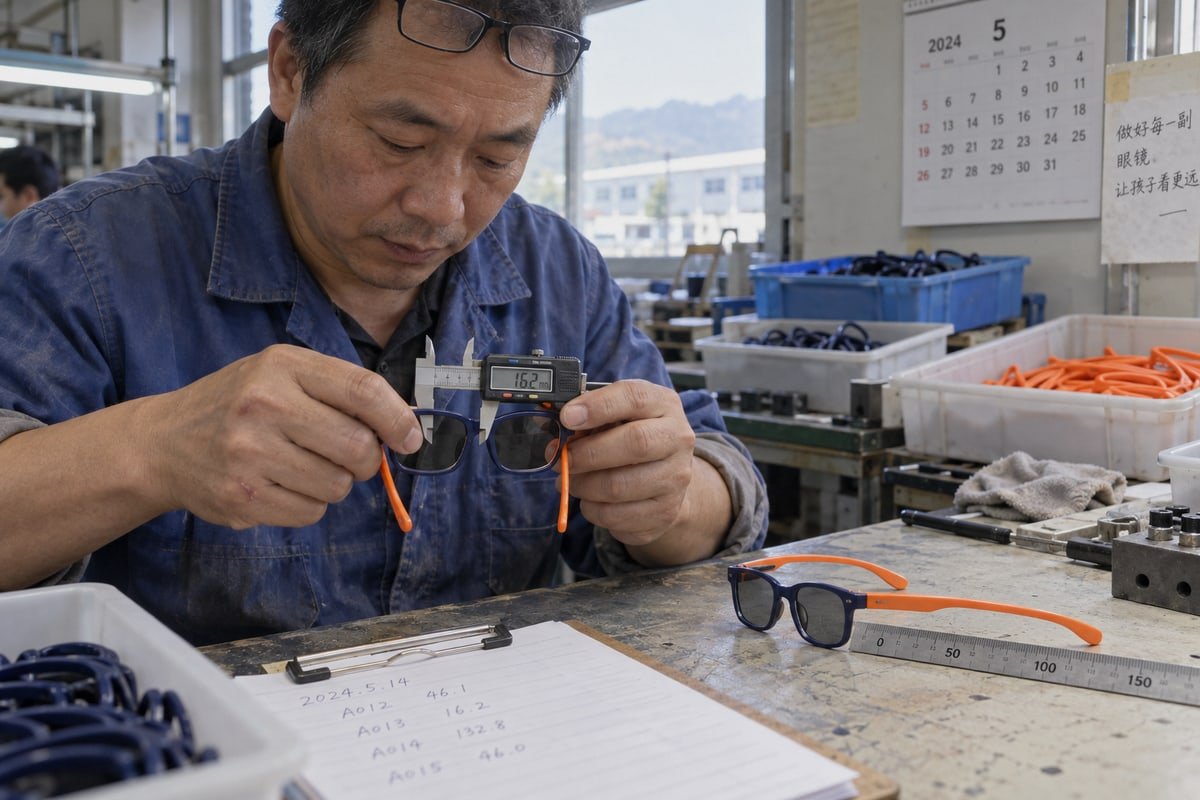
Eyewear sizing looks cryptic, but it follows one simple rule. The three numbers always appear in the same order: lens, bridge, temple. All three are millimeter measurements. Once you know that, you can read any frame in seconds.
The Three Measurements at a Glance
| Position | Nummer | Name | Test | Warum es für Kinder wichtig ist |
|---|---|---|---|---|
| First | 48 | Glasbreite 1 (eye size measurement) | Horizontal width of one lens at its widest point | Controls how much of the eye area the lens covers |
| Mittlere | 16 | Bridge distance | Shortest distance between lenses, where the frame sits on the nose | Too wide and the frame slides; too narrow and it pinches |
| Last | 120 | Bügellänge 2 | From the hinge screw to the end of the temple tip | Decides whether the arm reaches and hooks behind the ear |
What the Square Symbol Tells You
The □ between 48 and 16 is not decoration. It is the Boxingsystem 3 mark. In the boxing system, the lens is measured inside an imaginary rectangle drawn around its edges. The width of that box is the lens width. Some brands use a dash instead of a square. Some just use a space. The meaning stays the same. On our own molds we use the square because optical shops recognise it instantly.
What the Code Does Not Tell You
Here is the point that trips up many buyers. The code does not give total frame width. A rough estimate is 2 × lens width + bridge distance. For 48□16-120 that gives about 112 mm. But the real front width depends on the rim thickness and the frame curve. A wraparound sport front, like our matte navy style with gradient lenses, wraps tighter than a flat wayfarer. Same code, different feel.
One more misunderstanding. Some buyers treat 48□16-120 as the model number. It is not. On our frames the model code and color code sit on the other temple or on the inner front. The size code is only the size code.
How Do I Match TR90 Temple Size Codes to the Right Age Group for My Children's Collection?
A procurement manager in Australia once sent us a single size code and asked for a full toddler-to-junior range. One code covers one age band, not a collection.
Match TR90 temple size codes by lens width and temple arm length together. Codes near 40□16-120 suit toddlers, 48□16-120 typically fits ages 4 to 8, and 48–52 mm lenses with 125–135 mm temples suit older kids and juniors. Always confirm against a brand frame fit guide.

Age is a proxy. Head size is what actually matters. Still, most retail frame fit guides group kids eyewear dimensions into age bands because that is how parents shop. The table below reflects the ranges we see in TR90 catalogs and children's sizing charts. Treat it as a starting point, not a rule.
Typical Size Codes by Age Band
| Altersgruppe | Typische Glasbreite | Typical Bridge | Typische Bügellänge | Example Code |
|---|---|---|---|---|
| Baby / toddler (1–3) | 38–42 mm | 14–16 mm | 115–120 mm | 40□16-120 |
| Young kids (4–8) | 44–48 mm | 15–17 mm | 120–125 mm | 48□16-120 |
| Older kids / junior (8–12) | 48–52 mm | 16–18 mm | 125–135 mm | 50□17-130 |
| Teen / small adult | 52 mm and up | 17–19 mm | 135–140 mm | 53□18-138 |
Notice the overlap. A 48 mm lens width appears in both the young kids band and the junior band. The temple arm length separates them. A 48 mm lens with a 120 mm temple leans young. The same lens with a 130 mm temple leans junior. That is why you should never pick a frame by the first number alone.
A Simple Process for Building a Range
- Decide your target age bands first. Most of our brand clients pick two or three.
- Assign one core size code to each band using the table above.
- Pull styles from an existing catalog that already carry those codes. Our library of around 800 existing styles lets buyers cover toddler through junior without paying for new molds.
- Order samples in each size and test them on real children in your market.
- Lock the codes into your spec sheet before mass production, so QC can check the temple marking against it.
Why Optical Frame Sizing Differs Slightly
Optical frame sizing for children is often a touch more conservative than sunglass sizing. Prescription lenses need the pupil centered in the lens. Sunglasses have more freedom. So a TR90 kids optical frame might be 46□16-120 while the matching sunglass style is 48□16-120. Both target the same child. Keep this in mind if your collection includes both.
Why Does My Supplier Print Different Size Markings on TPEE Temples Versus Rigid Frames?
Pairing a TR90 front with TPEE temples forces one trade-off every time: the soft temple bends easily, but that same softness changes how and where we can mark it.
Suppliers mark TPEE temples differently because the soft thermoplastic material properties resist crisp pad printing, so sizes are usually molded in or moved to the inner frame front. Rigid TR90 frames accept laser or print marks directly. The measurements stay the same; only the placement and method change.

Buyers sometimes worry when two frames from the same factory carry markings in different places or in different styles. In our workshop that is normal, and the reason is the material itself.
Two Materials, Two Marking Methods
| Merkmal | Rigid TR90 Frame or Temple | Soft TPEE Temple |
|---|---|---|
| Materialverhalten | Flexible but holds shape; smooth glossy or matte surface | Rubber-like, very soft, high stretch |
| Best marking method | Laser etching or pad printing on the inner temple | Raised or recessed text molded into the tool |
| Typical marking location | Inner left temple near the hinge | Inner temple near the hinge, or moved to the inner frame front |
| Durability of mark | Good; laser marks resist wear | Excellent when molded; printed ink can rub off |
| Temple length convention | Measured hinge to tip along the arm | Measured hinge to tip with the arm laid flat |
What TR90 Actually Is
TR90 is a Swiss-developed thermoplastic. It is light, it flexes, and it springs back. Those thermoplastic material properties 4 are why it dominates children's eyewear. A useful detail for buyers: TR90 has shape memory. The 16 mm bridge distance on a 48□16-120 frame is meant to hold its tension over years of use, so the frame does not stretch out and slide down the nose. TR90 is a material, though, not a size. Two suppliers can both quote TR90 and ship frames that fit very differently.
Why We Mix TR90 Fronts With TPEE Temples
TPEE is even softer than TR90. On our TR90-front, TPEE-temple styles, the arm can bend nearly flat without cracking. flexible TPEE temples 5 That is a safety win for active kids. But soft TPEE does not take pad printing well. Ink sits on the surface and wears off. So we mold the size code into the tool. You will see it as small raised or recessed text on the inner arm near the hinge, exactly like the etched text on our navy front with yellow-orange temples. When the temple is very thin, we move the marking to the inner front instead.
How to Read Temple Length on a Soft Temple
One practical note. A TPEE temple curves more behind the ear than a rigid one. We measure the 120 mm temple arm length with the arm laid flat, from hinge to tip. Some suppliers measure along the curve. Ask which method your supplier uses. Otherwise two 120 mm temples may not match.
Can I Rely on These Size Codes Alone to Ensure a Safe, Comfortable Fit for Kids?
Fifteen years of building children's frames taught me a hard lesson: two frames with identical 48□16-120 codes can fit the same child completely differently.
No. Size codes give kids eyewear dimensions, not fit. Frame curvature, bridge shape, vertex distance, and temple contour bend all change comfort. Use the code to shortlist sizes, then verify with a physical sample, an existing well-fitting pair, or a supplier frame fit guide.
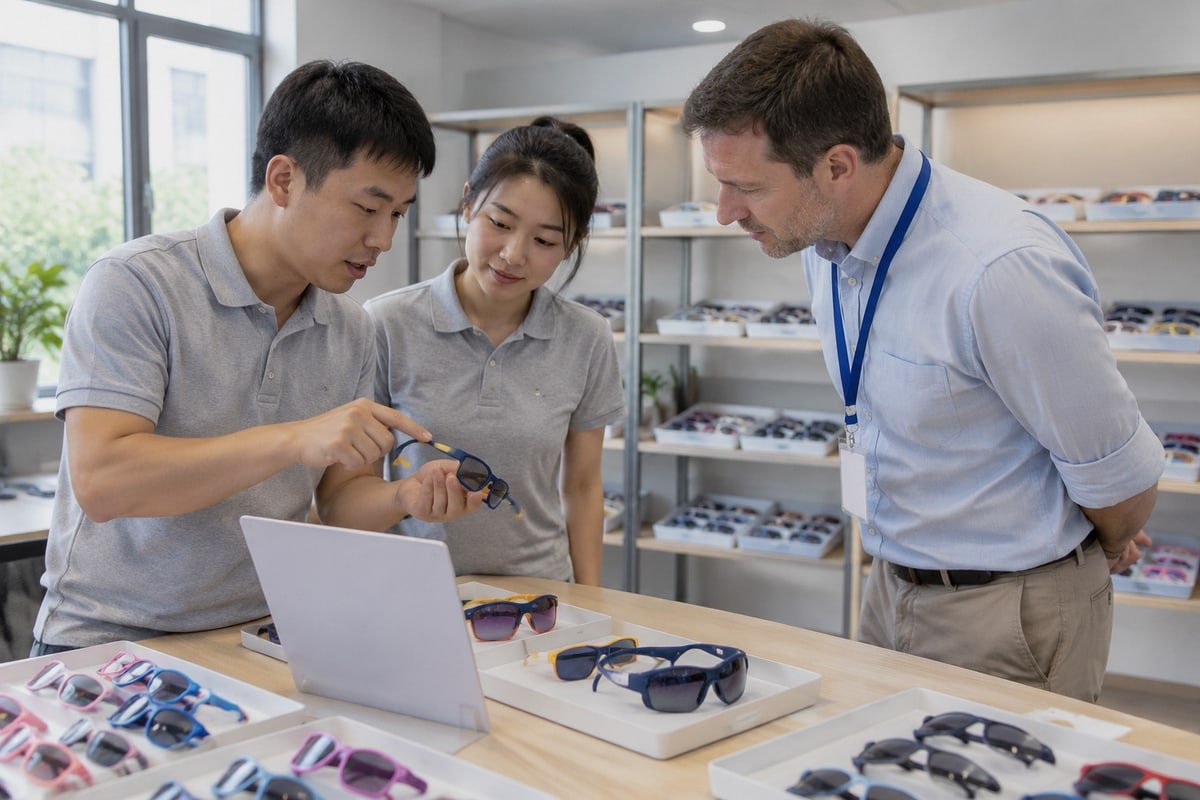
Some sizing guides claim the three numbers are enough to choose a frame. For adults, that is close to true. For children, it is not. Kids have flatter nose bridges, rounder cheeks, and heads that grow between order and delivery. So the code is your filter, not your final decision.
Objection: TR90 Is Flexible, So Fit Takes Care of Itself
I hear this often. Sellers stress that TR90 is light and nearly unbreakable. Both claims are fair. But flexibility does not make a wrong-sized frame fit. A 48□16-120 frame that is too wide will still slide. A temple that is too short will still fall off. Material comfort and dimensional fit are separate questions. Good children's eyewear needs both.
Details the Code Cannot Capture
Temple contour bend. TR90 has a slicker surface than acetate. Many designers compensate with a stronger bend behind the ear so the frame stays put during play. Two 120 mm temples with different bends grip very differently.
Scheitelabstand. A 48 mm lens width is chosen partly so the lens sits close to the eye. That blocks peripheral UV. But if the bridge is too deep, the lenses drift forward. If it is too shallow, eyelashes brush the lens. Neither shows up in the code.
Bridge shape. Two frames can share a 16 mm distance between lenses yet have very different nose pad angles. Our oval glossy black style uses a low-profile bridge for compact faces. A keyhole bridge with the same number would sit higher.
A Practical Fit Checklist
- Temples rest on the ears without pressing red marks after ten minutes.
- The bridge sits flat on the nose and does not slide when the child looks down.
- Lenses do not touch the cheeks when the child smiles.
- Eyelashes do not brush the inside of the lens.
- The frame front does not extend past the sides of the face.
- The child can shake their head without the frame moving.
Compare Against a Known Pair
The fastest real-world check is comparison. Take a pair that already fits well, read its temple, and compare each number. Then order a sample of the new style and test both on the same child. Some brands now feed these millimeter measurements into AR try-on apps as a baseline for a 3D facial map. That is a helpful screening tool. It still does not replace a physical sample on a real face.
Schlussfolgerung
Misreading 48□16-120 wastes molds, margin, and trust. Read the three millimeter measurements, match them to an age band, then confirm fit with samples. Our team can help.
Interested in sourcing the products mentioned in this article? See details and request a quote here:
Fußnoten
1. The FDA regulates sunglasses as medical devices and provides standards for lens and frame safety. ↩︎
2. Wikipedia provides a comprehensive overview of standard eyeglass frame components and sizing terminology. ↩︎
3. ISO is the international body that standardizes the boxing system for measuring spectacle frames. ↩︎
4. NIST provides technical data and standards for the physical properties of thermoplastic materials used in manufacturing. ↩︎
5. Authoritative Wikipedia entry explaining the flexible properties of thermoplastic elastomers like TPEE. ↩︎
Weitere Artikel, die Ihnen gefallen könnten



Auf der Suche nach einem zuverlässigen Partner für Kinderbrillen?
Entdecken Sie über 800 sofort verfügbare Modelle und umfassenden OEM/ODM-Support, der auf Ihre Marke zugeschnitten ist.
Kontakt aufnehmen English
  Español de México
  Deutsch
  Français
  日本語
日本語  العربية
  Português do Brasil