How to Test Export Packaging for Kids Optical Frames Against Drops and Compression?
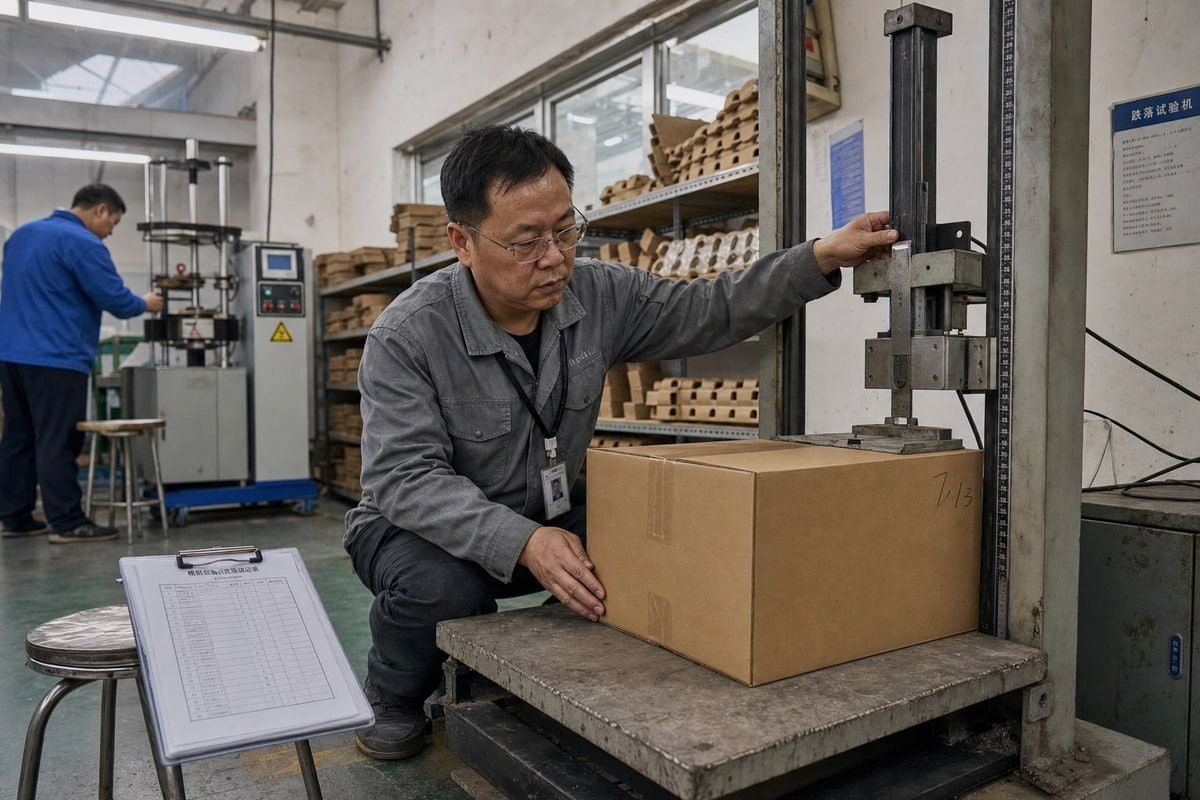
Export packaging for kids optical frames fails more often than buyers expect. On our production line in Taizhou, we have seen one crushed carton ruin an entire launch shipment.
To test export packaging for kids optical frames, run free-fall drop tests per ASTM D5276 on faces, edges, and corners, plus compression tests per ASTM D642 simulating stack loads. Test the complete packed shipping unit, pre-condition samples, and set pass/fail criteria before testing.
That is the short answer. Now let me walk you through how we actually do this before any container leaves our factory, step by step.
What packaging tests should I run before shipping kids optical frames overseas?
A buyer from Australia once asked me why we test packed cartons instead of empty ones. My answer: an empty box tells you nothing about how frames survive real transit.
Before shipping kids optical frames overseas, run four tests: free-fall drop testing (ASTM D5276), compression testing (ASTM D642), vibration testing, and environmental pre-conditioning. Always test the complete shipping unit — frames, inserts, retail boxes, and master carton packed exactly as they will ship.
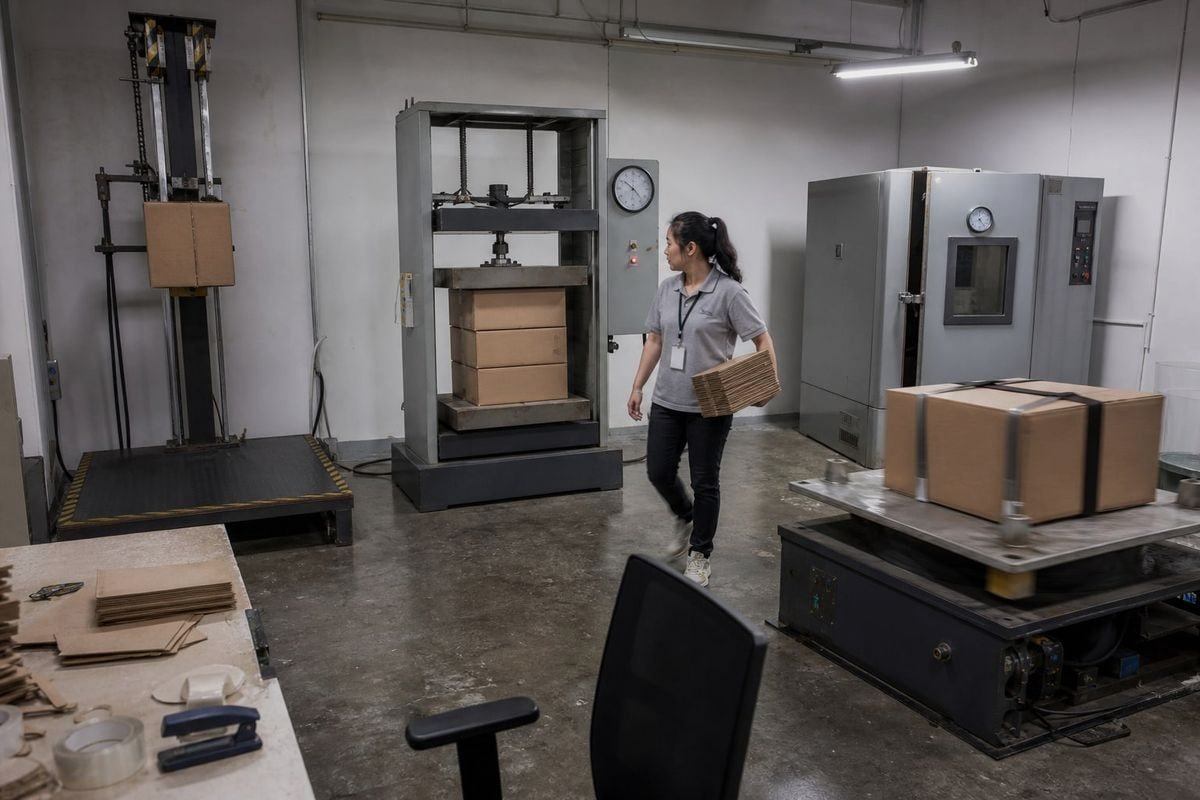
The biggest mistake I see is treating packaging as a single item. It is not. It is a system. The frame, the microfiber pouch, the insert tray, the retail box, the divider, and the outer corrugated carton 1 all work together. If you test only one layer, you miss how the layers interact under stress.
The core test plan
We follow a distribution-simulation approach, similar in spirit to ISTA testing standards 2 und ASTM D4169 3. That framework asks a simple question: what hazards will this package actually face on its route? Then it builds tests around those hazards, not around guesswork.
| Zwei Methoden dominieren. Der Stahlwolltest reibt ein standardisiertes Pad unter festem Druck für eine festgelegte Anzahl von Zyklen über die Beschichtung und bewertet dann die Kratzer. Der Bayer-Abriebtest schüttelt die Linse in abrasivem Medium und vergleicht die Zunahme der Trübung mit einer unbeschichteten Referenz. Bayer liefert ein numerisches Verhältnis, das den Vergleich der Abriebfestigkeitsniveaus zwischen den Lieferanten vereinfacht. | What it simulates | Common standard |
|---|---|---|
| Free-fall drop | Manual handling, loading shocks | ASTM D5276 4 |
| Compression | Warehouse stacking, pallet loads | ASTM D642 / ISO 12048 5 |
| Vibration testing | Truck and ocean transit motion | ASTM / ISTA protocols |
| Pre-conditioning | Humidity and temperature exposure | ASTM conditioning practice |
Why vibration and conditioning matter
Drops and compression get the headlines. But continuous vibration during transit causes rubbing, lens scratches, and loosened hinges even without a single drop. Humidity weakens corrugated box strength before compression even starts. So we condition samples first, then test. In our experience exporting to 20+ countries, a carton that passes when dry can buckle after 72 hours in ocean-freight humidity.
For kids' frames specifically, add one more consideration. TR90 and TPEE frames 6 are flexible by design, which is great for child safety. But flexibility means the internal structure, not the frame, must carry any sustained load. Your test plan needs to confirm that.
How do I know if my packaging can survive drops during long-distance shipping?
During a QC review last year, our team dropped a packed master carton on its corner and watched an insert tray collapse inward. The face drops had all passed. The corner told the real story.
Your packaging survives drops if the complete packed unit passes controlled free-fall drops onto a rigid surface — on faces, edges, and corners — with frames remaining undamaged and wearable. Use ASTM D5276 orientation tolerances, fresh replicate samples, and drop heights based on package weight.
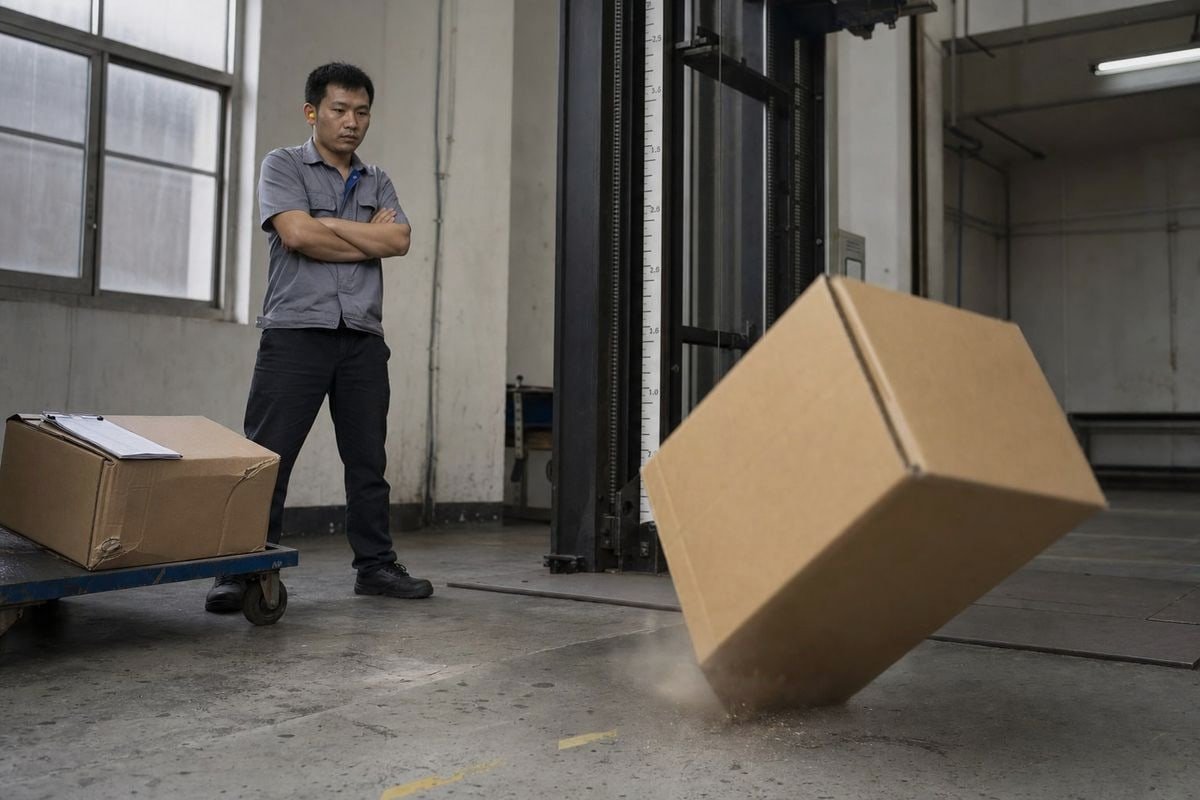
Drop testing looks simple, but the details decide whether your results mean anything. Here is the process we use before approving any new eyewear packaging design for export.
The drop test procedure, step by step
- Pack the shipping unit exactly as it will ship — frames, pouches, retail boxes, dividers, desiccant, tape, everything.
- Pre-condition samples if the route involves humidity or temperature swings.
- Set the drop height from a recognized table based on gross package weight.
- Drop onto a rigid, flat, non-resilient surface. A soft floor absorbs energy and gives you false passes.
- Run the full orientation sequence: bottom face, edges, corners, then remaining faces.
- Control orientation carefully. ASTM D5276 requires face drops to strike within about 2 degrees of flat, with tighter positional controls for edges and corners.
- Avoid secondary impacts. ISTA warns that tip-over after a drop can distort results — a real risk with lightweight eyewear cartons that rebound.
- Repeat with fresh samples. ISTA guidance says three successful replicate tests improve assurance, and five or more are better.
What each drop orientation reveals
Each drop type exposes a different weakness. A face drop checks broad-panel stiffness and cushioning. An edge drop stresses seams, fold lines, and closures. A corner drop is usually the most severe, because it concentrates all the impact energy at the package's weakest geometry. Small, lightweight kids' frames can also shift inside the carton mid-fall, changing how the impact lands. That is why snug internal fit matters as much as carton grade for fragile goods handling.
After each drop, open the package. Inspect the frames, not just the box. Check hinges, lens seating, and coatings. Package integrity and product integrity are two different pass/fail questions, and you need answers to both.
What compression standards should I follow to protect optical frames in bulk cartons?
One trade-off we weigh constantly at our factory: a heavier flute grade adds corrugated box strength but also adds freight weight across thousands of units. Compression testing is how we settle that debate with data instead of opinions.
Follow ASTM D642 for compression strength testing and ISO 12048 for stacking simulation, within an ASTM D4169 distribution plan. Test the packed carton under a load representing your real stack height plus a safety factor, with a dwell time, and verify frames stay unwarped.
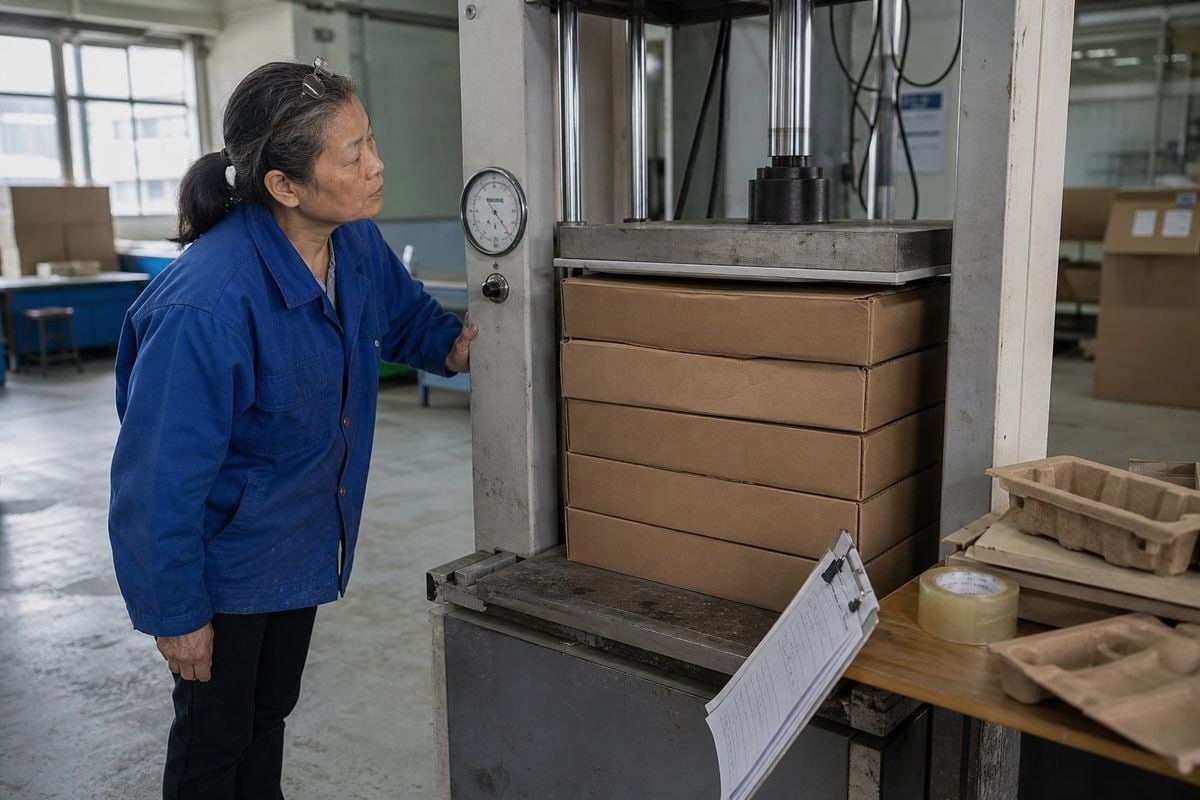
Think of compression as the squash test. Your carton sits at the bottom of a pallet stack in a humid warehouse for weeks. Can it keep its shape? And more importantly, can it keep the load off the frames inside?
Static versus dynamic compression
Static compression applies a fixed load over time, simulating warehouse stacking. Dynamic compression applies increasing force until failure, telling you the carton's maximum strength. You need both numbers. The maximum strength tells you your margin. The static dwell test tells you what happens over real storage time, when humidity and creep slowly weaken the board.
| Compression factor | What to define | Why it matters for kids' frames |
|---|---|---|
| Stack height | Cartons per pallet stack on your route | Sets the minimum load your bottom carton carries |
| Sicherheitsfaktor | Multiplier for humidity, time, misalignment | Ocean freight humidity can cut board strength sharply |
| Dwell time | Hours or days under sustained load | Reveals slow buckling and insert creep |
| Load path | Where force travels inside the carton | Flexible TR90/TPEE frames must never bear the load |
Why flexible kids' frames need special attention
Here is the point many buyers miss. TR90 and TPEE are wonderful materials for children — flexible, safe, hard to snap. But under sustained pressure, a flexible temple can take a permanent set and warp. So our eyewear packaging design principle is simple: the insert and carton structure carry the compression load, and the frame floats protected inside. After every compression test, we open sample retail boxes and check temples against a flat reference surface. If any frame shows warping, the internal structure failed, even if the outer carton looks fine.
Failure modes to record: crushed corners, seam splits, panel buckling, tray collapse, divider tearing, product shift, bent temples, and pressure marks on lenses. Documenting these turns a pass/fail event into design feedback.
How can I balance protective packaging with cost when importing children's eyewear?
A European buyer once sent us a competitor's sample carton that was practically armor-plated. It protected beautifully. It also added meaningful cost and warehouse bulk to every shipment. Overbuilding is a failure mode too — just a quieter one.
Balance protection and cost by testing to your actual distribution channel, not the worst imaginable hazard. Validate the pack under drop, compression, and vibration first, then remove material in small steps and retest. Set clear damage-acceptance criteria so you stop optimizing at the right point.
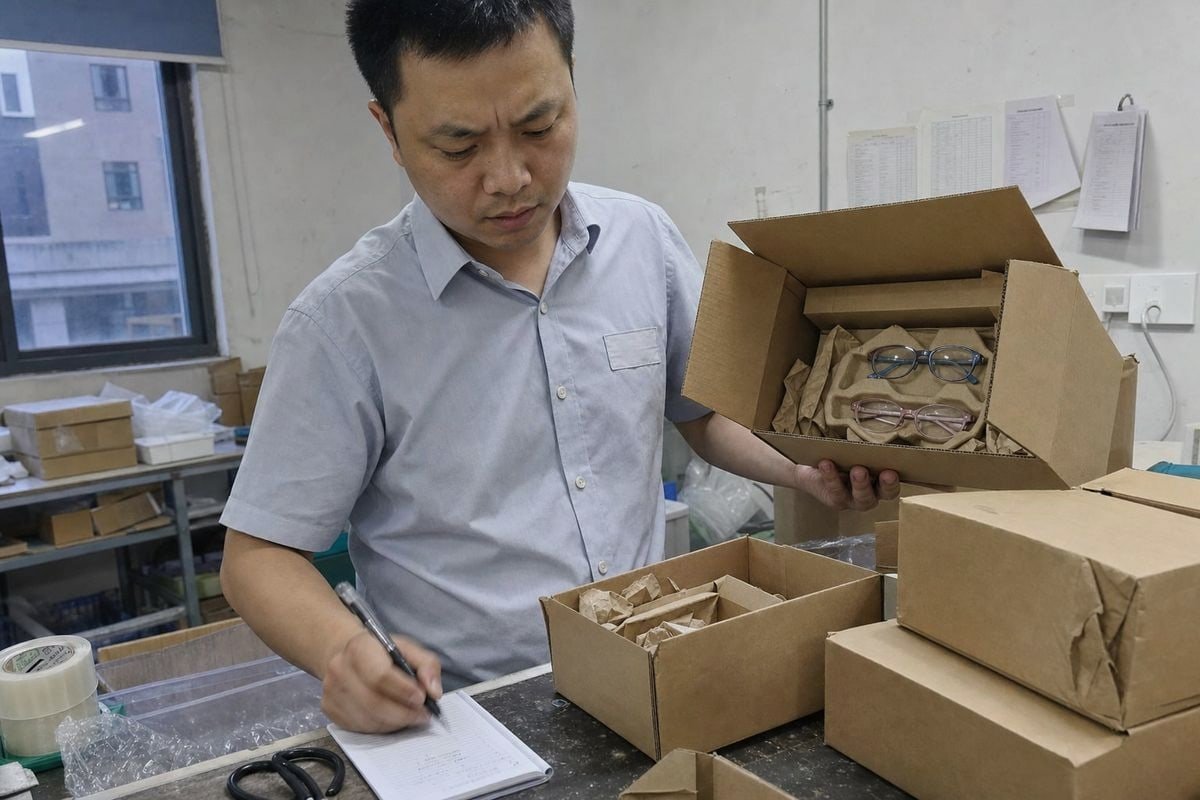
Two opposing camps exist among the buyers we work with. One camp chases the lowest-cost carton that passes a basic drop test. That approach misses stacking damage, vibration wear, and route-specific risks, and the savings evaporate in returns and replacement shipments. The other camp overbuilds everything. That protects well, but it inflates freight cost, material use, and warehouse space. Both camps are optimizing the wrong variable.
The validated-then-optimized approach
The balanced path works like this. First, define your route: air, ocean, truck, or mixed mode. Ocean freight means longer compression dwell and higher humidity. Air freight means more handling drops. Then validate a pack that passes with margin. Only after that, optimize downward — thinner flute, smaller carton, lighter insert — retesting at each step until you find the edge, then step back.
| Ansatz | Anschaffungskosten | Versteckte Kosten | Sie handhaben |
|---|---|---|---|
| Minimal pack, basic drop test only | Niedrigste | Transit damage, returns, brand harm | Almost no one |
| Overbuilt pack | Höchste | Freight, materials, warehouse space | Very high-value goods |
| Channel-validated, then optimized | Mäßig | Testing time upfront | Most kids' eyewear brands |
Acceptance criteria stop the guesswork
Set pass/fail criteria before testing, and tie them to your market. For kids optical frames, we typically use: frames remain undamaged and wearable, lenses stay seated and uncracked, hinges open and close normally, no exposed sharp edges, the retail pack stays closed and presentable, and the outer carton remains serviceable. A premium optical channel may demand cosmetic perfection on the retail box. A bulk distributor may accept minor carton scuffing as long as every frame is perfect. Neither is wrong — but you must decide before the test, not after.
One more lever: because we hold around 800 existing styles with proven packaging configurations, new brands can often skip a full development cycle and start from a pack that has already survived real export lanes. That is often the cheapest shipping damage prevention there is. Protective packaging materials also intersect with export packaging regulations for children's products, so sustainable material swaps should be retested for both performance and compliance, not assumed equivalent.
Schlussfolgerung
Damaged frames destroy launches and trust. One untested carton can undo months of work. Validate the full shipping unit under drop, compression, and vibration — then ship with confidence.
Fußnoten
1. Provides a comprehensive guide on corrugated boxes, their composition, and uses in packaging. ↩︎
2. Official website of the International Safe Transit Association, detailing their packaging standards. ↩︎
3. Official ASTM International page for performance testing of shipping containers and systems. ↩︎
4. Official ASTM International page detailing the standard for free-fall drop testing. ↩︎
5. Official ISO International page detailing the standard for compression and stacking tests. ↩︎
6. Compares TR90 and TPEE materials for kids’ sunglasses frames, discussing their properties and benefits. ↩︎
Weitere Artikel, die Ihnen gefallen könnten

August 2026
Überprüfung von Lieferanten für Kinder-Optikrahmen: Interne oder externe Inspektion?
August 2026
Wie stellt man sicher, dass Kinder-Optikrahmen-Giveaways frei von Erstickungsgefahren sind?

August 2026
Vor-Ort- vs. Drittanbieter-Audits: Wie unterscheiden sie sich in der Abdeckung für Lieferanten von Kinderbrillen?
Auf der Suche nach einem zuverlässigen Partner für Kinderbrillen?
Entdecken Sie über 800 sofort verfügbare Modelle und umfassenden OEM/ODM-Support, der auf Ihre Marke zugeschnitten ist.
Kontakt aufnehmen English
  Español de México
  Deutsch
  Français
  日本語
日本語  العربية
  Português do Brasil