How to Request Material Test Reports From Kids Optical Frames Suppliers?

Requesting material test reports from kids optical frames suppliers sounds simple — until a vague “we have compliance” reply leaves your shipment stuck at customs and your launch date slipping. On our production line in Taizhou, I have watched buyers lose whole seasons over missing paperwork. The fix is knowing exactly what to ask for, and when.
Request the full test report PDF from your kids optical frames supplier, showing the exact SKU tested, the standard applied (CPSIA, REACH, EN 14139, or ASTM F803), the accredited third-party lab name, the test date, and the batch reference — before you place your order, not after shipment.
That one-sentence answer hides a lot of detail. Below, I break down which documents matter, how to spot fakes, which standards apply to TR90 and TPEE 1, and the right timing for every request.
What Material Test Reports Should I Ask My Kids Optical Frames Supplier For?
A buyer from Australia once emailed me asking for "the safety certificate" for a TR90 frame. I sent back a list of six different documents — because there is no single certificate that covers everything.
Ask for four document types: a raw material test report for the frame resin, a finished product test report against your market's standard, component-level certificates for hinges and nose pads, and a Certificate of Conformity or CPSIA compliance certificate for customs clearance.

Buyers often confuse three very different documents, so let me separate them clearly. A material test report covers the raw resin or component — for example, TR90 material safety data showing the polymer is free of restricted chemicals. A product test report covers the finished frame as assembled, including coatings, screws, and temple tips. A certificate or compliance file bundles those reports into a legal declaration, such as a Kinderproduktzertifikat for the US market.
The Core Documents to Request
Here is the checklist I recommend to every brand we work with:
| Dokument | Was es abdeckt | Why You Need It |
|---|---|---|
| Raw material test report | TR90 or TPEE resin composition, BPA-free certification | Confirms the base polymer is safe for children |
| Finished product report | Lead and phthalates testing, chemical migration | The assembled frame can differ from raw resin |
| Component certificates | Hinges, screws, nose pads, silicone parts | Small metal parts need nickel-free testing |
| Coating report | Paint, anti-scratch or anti-fog treatments | Pigments and coatings often introduce heavy metals |
| Certificate of Conformity / CPC | Legal declaration tied to lab reports | Required by customs in the US and EU |
Why Component-Level Detail Matters
At our factory, the frame front, the TPEE temple, the silicone ear hook, and the metal screw may all come from different material batches. A report that only names "plastic frame" tells you very little. Ask your supplier to state the scope of testing: frame material, hinges, nose pads, temple tips, coatings, and screws. For custom-dyed colorways, request pigment-specific testing too. In our experience, heavy metals are far more likely to enter through colorants than through the certified base resin. One report per colorway family is a reasonable ask; one report for the whole catalog is not.
How Do I Verify That a Supplier's Test Reports Are Genuine and Up to Date?
Early in my export career, a client forwarded me a competitor's report to review. The lab name was real, but the tested model was a different frame entirely. That taught me to check documents line by line.
Verify a test report by matching the tested SKU and photos to your actual frames, confirming the lab is CPSC-accepted or ISO 17025 accredited, checking the report date against your production run, and contacting the lab directly to authenticate the report number.

Never accept a report at face value, even from a supplier you like. Verification is not about distrust — it is about traceability. A genuine report from a third-party lab testing facility 2 such as SGS, Intertek, Bureau Veritas, or TÜV will include a unique report number that the lab can confirm on request. Most major labs offer online verification portals for exactly this reason.
A Five-Step Verification Routine
- Match the model. The report must name the exact SKU or model number you are buying. Check the high-resolution photos inside the report against your physical sample and colorway.
- Check the lab credentials. Look for CPSC acceptance for US-bound goods or ISO 17025 accreditation 3. An unknown lab with no visible credentials is a red flag.
- Check the date. A report from four years ago may predate the current resin batch, the current pigment supplier, or updated REACH regulation standards 4.
- Confirm exact match vs. similar model. Ask the supplier in writing: is this report for this exact frame, or a similar construction? Get the answer by email, not just verbally.
- Trace the batch. Compare sample or batch identifiers in the report against your purchase documents where possible.
Common Red Flags
Watch for these warning signs. A claim of compliance with no PDF attached. A screenshot instead of a full document. A report where key fields are cropped or unreadable. A report covering a different material — for example, acetate results offered for a TR90 order. And vague multi-region language like "meets all international standards" without naming a single actual standard. When we share reports with buyers, we always send the complete PDF plus a short confirmation email stating that the tested item matches the offered SKU or the same material family. Ask your supplier to do the same.
Which Safety Standards Should I Check When Reviewing TR90 or TPEE Frame Test Reports?
One trade-off we discuss with almost every new brand is testing scope versus budget. Testing every colorway against every standard gets expensive fast, so knowing which standards your market actually requires saves real money.
For the US, check CPSIA lead and phthalates limits, ASTM F803 for sports styles, and 16 CFR 1109 component testing. For Europe, check REACH Annex XVII and EN 14139 ophthalmic optics. For all markets, verify nickel-free and BPA-free results.
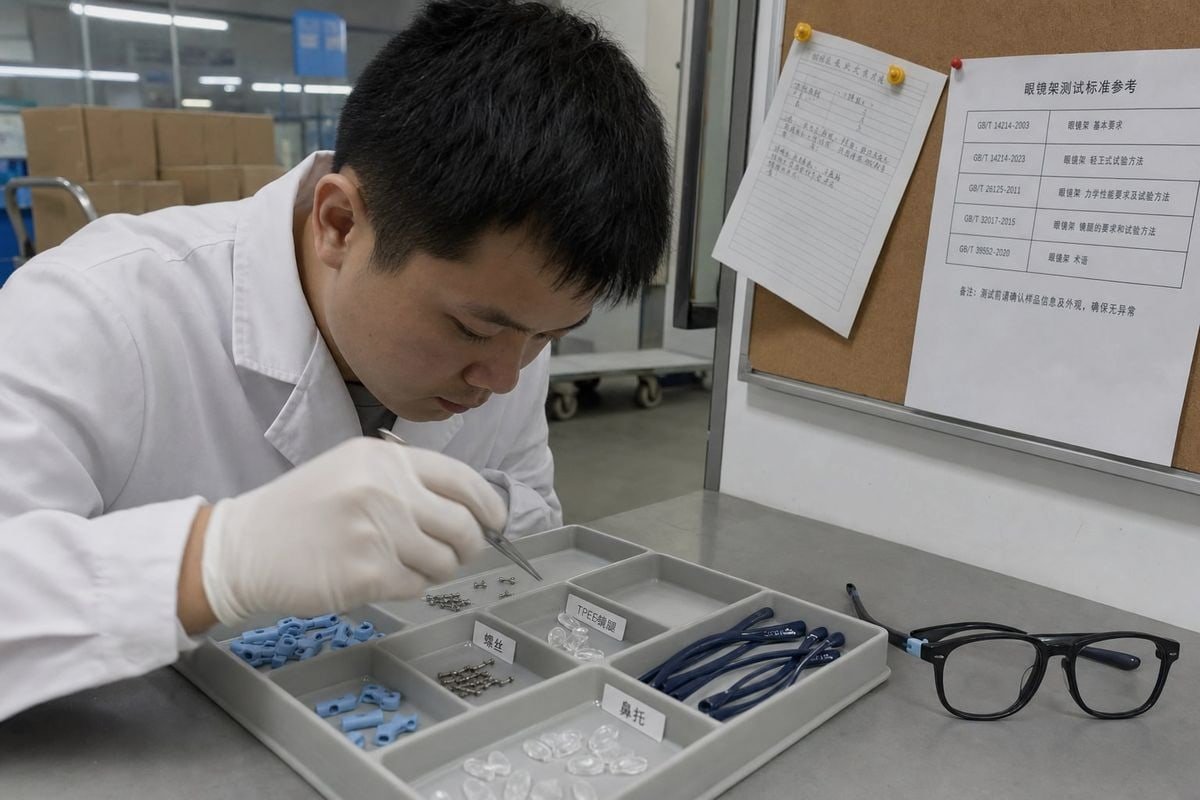
TR90 and TPEE are both excellent flexible materials for children's faces — that is exactly why we built our product line around them. But "flexible and comfortable" does not automatically mean "compliant." The standards below are the ones that appear most often in our buyers' documentation requests.
Standards by Market
| Markt | Key Standards | What They Test |
|---|---|---|
| Vereinigte Staaten | CPSIA, 16 CFR 1109 5, ASTM F803 | Total lead, phthalates, component part testing, impact for sports eyewear |
| Europäische Union | REACH Annex XVII, EN 14139 | Restricted chemicals, ophthalmic optics requirements for finished spectacles |
| Global / general | Nickel release, BPA-free certification | Metal hinge and wire-core safety, plastic additive safety |
Points Buyers Often Miss
First, the Component Part Testing Rule under 16 CFR 1109 can lower your costs. If your supplier certifies the shared TR90 or TPEE raw material once, that certification can support multiple frame styles built from the same resin. We use this approach across our catalog of roughly 800 existing styles, so buyers testing the market do not pay for redundant lab work.
Second, do not skip internal components. A metal wire core inside a plastic temple still needs nickel-free testing, because outer layers wear down over years of daily use by an active child.
Third, be careful with emerging chemical rules. PFAS-free confirmation for anti-fog or anti-scratch coatings is increasingly requested by European and Australian buyers, and it is easier to address before production than after.
Finally, a note on scope: optical frames sold as prescription eyewear may also touch FDA medical device registration 6 requirements in the US, depending on how the product is marketed. If you sell frames with demo lenses for later prescription fitting, ask your regulatory advisor where your product sits. And if a supplier claims bio-acetate or eco-friendly content, ask for an ASTM D6866 report to verify the renewable percentage rather than accepting the marketing claim.
When in My Sourcing Process Should I Request These Test Reports From My Supplier?
A lesson I learned the hard way: a European importer once asked us for REACH documents after their goods had already sailed. Everything worked out, but the stress was avoidable. Timing is half of compliance.
Request test reports at three points: during the RFQ stage to screen suppliers, before paying the deposit to confirm the exact SKU is covered, and during mass production to test samples from the actual production batch rather than golden samples.

Documentation should follow your sourcing timeline, not chase it. Buyers are shifting from asking "Can you make it?" to asking "Can you prove it meets the rules?" — and the proof needs to arrive before money moves, not after.
The Request Timeline
| Sourcing Stage | Was zu beantragen ist | Why This Timing |
|---|---|---|
| RFQ / supplier screening | Existing CPSIA and REACH reports for similar frames | Filters out suppliers with no compliance history |
| Sample evaluation | Exact-match reports for your chosen SKU and colorway | Confirms the specific frame is covered before commitment |
| Before deposit | Written confirmation that reports match your order | Locks accountability into the transaction |
| Massenproduktion | New third-party testing on production-batch samples | Golden samples do not prove batch consistency |
| Pre-shipment | CPSIA compliance certificate or CPC, final QC report | Customs and Border Protection expects these documents |
Plan for Lead Times and Costs
Lab reports are not instant. In typical workflows, a new test report can take around twelve working days, so build that into your production schedule. Some suppliers also charge document retrieval fees or require report requests at the time of purchase — ask about costs upfront so there are no surprises.
What If the Supplier Has No Report?
You still have options. Ask for a report on a similar frame from the same material family. Request in-house quality control inspection data 7 as an interim reference. For meaningful order volumes, commission a new third-party test on your actual production sample — we regularly support this for private-label buyers. And if compliance is critical to your market and the supplier resists every option, treat that as your answer. Some suppliers cite customer-specific confidentiality or NDA terms, and sometimes that is legitimate. But for children's products, the burden of proof sits with the supplier before the order — a partner unwilling to meet that burden is signaling how the rest of the relationship will go.
Schlussfolgerung
Missing paperwork can stall a children's eyewear launch for months. The solution is simple discipline: request exact-match reports early, verify the lab, and test production batches — every single time.
Fußnoten
1. Background on the thermoplastic elastomer materials commonly used in kids’ eyewear frames. ↩︎
2. Wikipedia page defining third-party and independent testing organizations. ↩︎
3. ISO’s own standard page defines the lab accreditation credential buyers should verify. ↩︎
4. ECHA’s official REACH page explains the EU chemical restriction rules referenced here. ↩︎
5. Official US federal regulation text for children’s product component testing requirements. ↩︎
6. Current official FDA guidance page for medical device registration and listing. ↩︎
7. General background on quality control processes referenced as an interim compliance reference. ↩︎
Weitere Artikel, die Ihnen gefallen könnten

August 2026
Bio-Based vs Regular Cellulose Acetate: What's the Difference for Kids' Frames?

August 2026
How Recyclable Are Kids' Optical Frame Materials, and What Eco-Friendly Alternatives Exist?

August 2026
Bleichen Kinderbrillengestelle im Lager aus oder altern sie, und wie kontrolliert man die Lagerbedingungen?
Auf der Suche nach einem zuverlässigen Partner für Kinderbrillen?
Entdecken Sie über 800 sofort verfügbare Modelle und umfassenden OEM/ODM-Support, der auf Ihre Marke zugeschnitten ist.
Kontakt aufnehmen English
  Español de México
  Deutsch
  Français
  日本語
日本語  العربية
  Português do Brasil