How Effective Is “Blue Light Protection” in TR90 Kids Sunglasses?
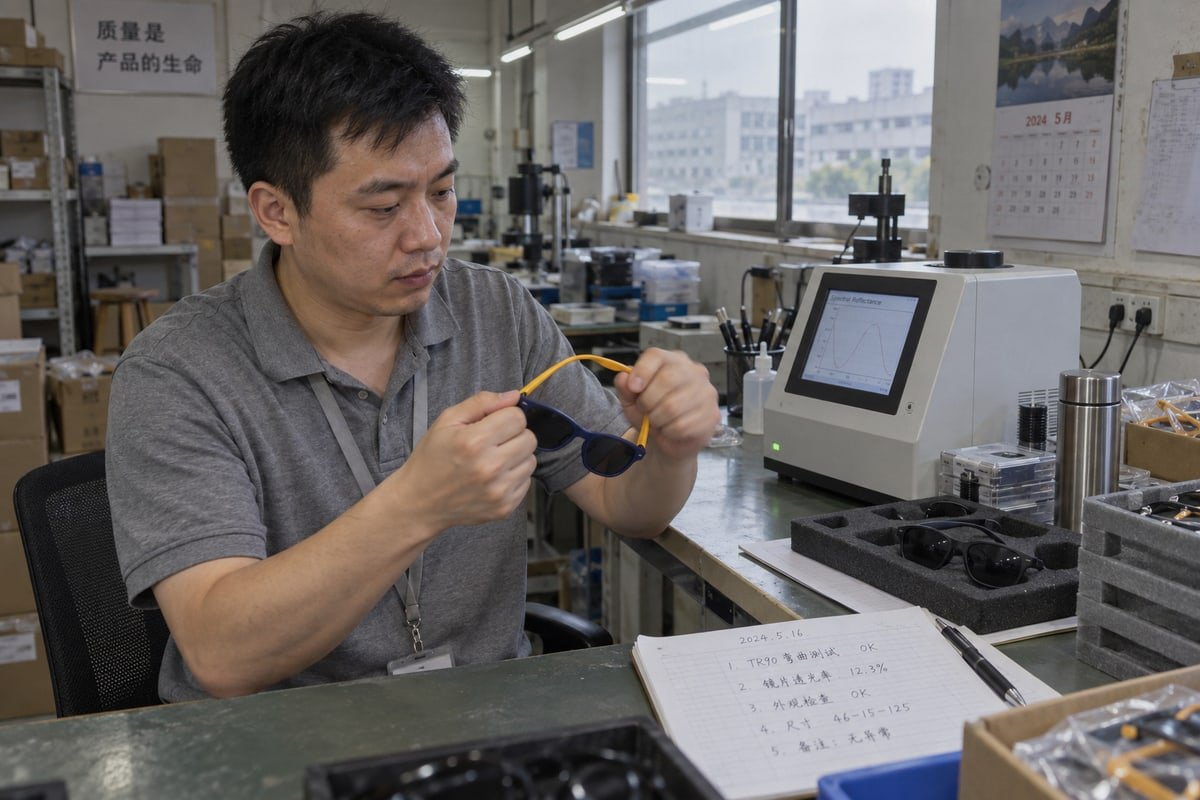
Buyers ask me about [blue light protection](https://okayeyewear.com/blue-light-blocking-kids-sunglasses-actually-benefit-children-do/) in TR90 kids sunglasses every week. Many worry the claim is hype. On our production line, the answer depends entirely on the lens spec.
Blue light protection in TR90 kids sunglasses is only modestly effective. TR90 is a frame material and blocks nothing; the lens does the work. Outdoors, UV400 protection matters far more. Blue light filtering mainly helps with screen comfort and limiting evening melatonin suppression, not sun safety.
That short answer hides a lot of detail. Below, I break the question into four parts. First, does the lens actually do anything for a child’s eyes? Second, should you build it into your line? Third, what paperwork proves the claim? Fourth, how do you sell it without misleading parents? I will use what we see on our own factory floor in Taizhou, plus the current research, to keep the advice practical.
How Do I Know If Blue Light Lenses Actually Work for Children's Eyes?
Our QC team once compared a supplier's clear blue light sample against a plain lens under a spectrometer. The difference was smaller than the label suggested.
You know blue light lenses work when the supplier provides a measured transmittance curve, not a slogan. Clear lenses usually filter 30–50% of blue light; amber lenses block 90–99%. Real benefits are limited to digital eye strain relief and sleep, not preventing damage.

I want to start with the frame, because this is where confusion begins. TR90 is a Swiss-developed thermoplastic. It has "memory" properties, so it bends and returns to shape. That is why we use it so widely for active kids. But flexible thermoplastic frames 1 have nothing to do with light. Every optical claim on blue light protection in TR90 kids sunglasses belongs to the lens alone.
What the evidence says about pediatric eye health
Das American Academy of Ophthalmology 2 maintains that digital screens do not emit enough blue light to cause retinal damage or permanent vision loss in children. So the biggest fear parents carry is not supported by pediatric eye health guidance. The dry eyes and headaches kids report after tablets are usually computer vision syndrome. Reduced blink rates and fixed focus cause them, not the light spectrum itself.
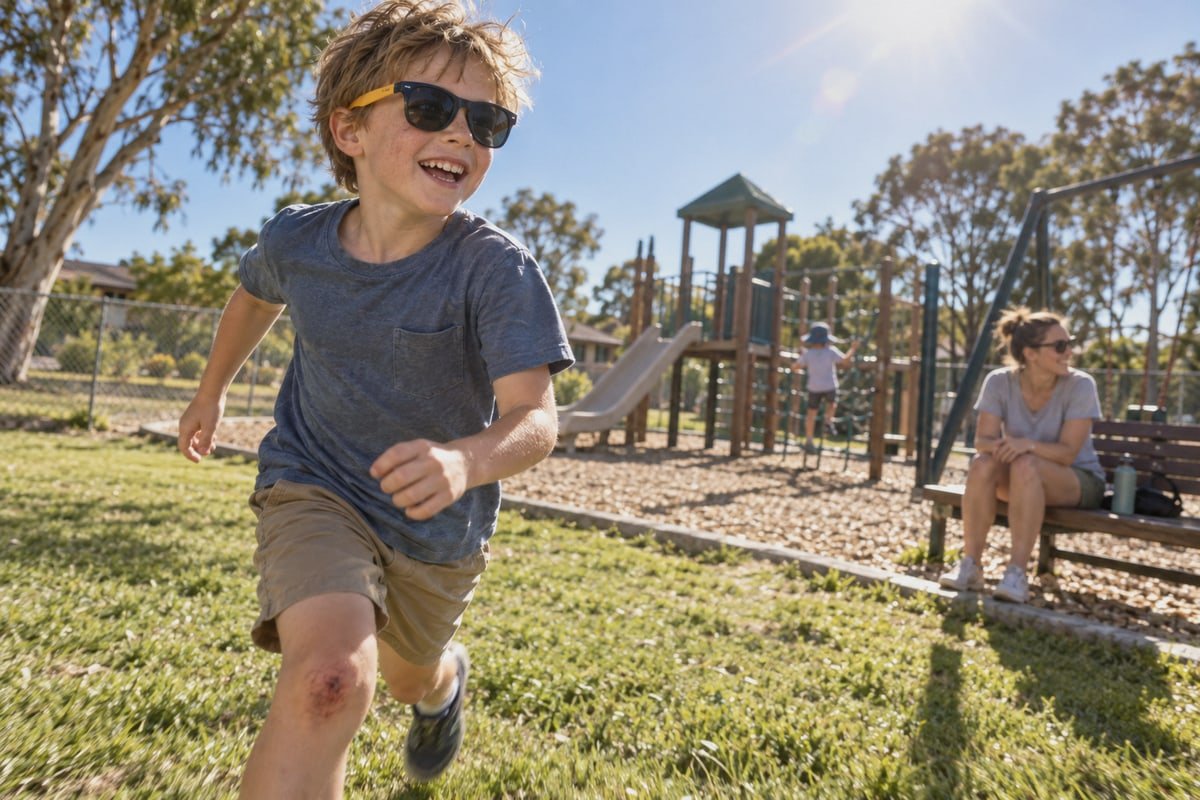
There is a second fact that reframes everything. Natural sunlight delivers up to 1,000 times more blue light than a digital device 3. A child on a playground gets far more HEV light exposure than a child on a couch. That is why UV400 protection stays the primary reason to buy sunglasses at all.
Where blue light filtering does help
Filtering is not useless. It has three plausible benefits.
- Some children feel less digitaler Augenbelastung during long screen sessions, especially when the lens also carries an anti-reflective coating.
- Amber or orange lenses worn before bed reduce melatonin suppression and support a stable circadian rhythm.
- Good filters reduce chromatic aberration. Short wavelengths scatter more, so cutting them lowers "visual noise" and can improve reading endurance for children with high visual sensitivity.
| Glastyp | Typical blue light filtered | Bester Anwendungsfall | Weak point |
|---|---|---|---|
| Clear filtering coating | 30–50% | Daytime screens | Coating can wear off; small benefit |
| Amber / orange tint | 90–99% | Evening use, sleep support | Color distortion; poor for daytime |
| Dark gray sun lens with UV400 | Cuts all visible light, blue included | Outdoor play | Not a targeted blue light filter |
| Fototrop | Changes with tint state | Indoor–outdoor hybrid | Slower in cold weather; higher cost |
The blue light paradox
Here I get cautious. Emerging research suggests that over-filtering blue light during daylight may interfere with emmetropization, the process that guides normal eye growth. Some researchers connect this to the axiales Längenwachstum 4 behind myopia. Modern smart classrooms add another wrinkle. They use tunable LED lighting with cool-spectrum light meant to boost alertness. Blue-blocking glasses can filter out exactly that light. So heavy filtering all day is not automatically "safer" for a child.
Should I Offer Blue Light Protection as a Standard Feature in My Kids' Sunglasses Line?
Every added lens feature raises unit cost and lengthens the claim list we must defend. When brands ask us to make blue light standard, I weigh margin against honesty.
No. Do not make blue light protection standard across a kids' sunglasses line. Make UV400 protection and impact-resistant lenses standard on every style. Offer blue light filtering as a clearly specified option for photochromic or indoor-outdoor styles where screen use is part of the actual use case.
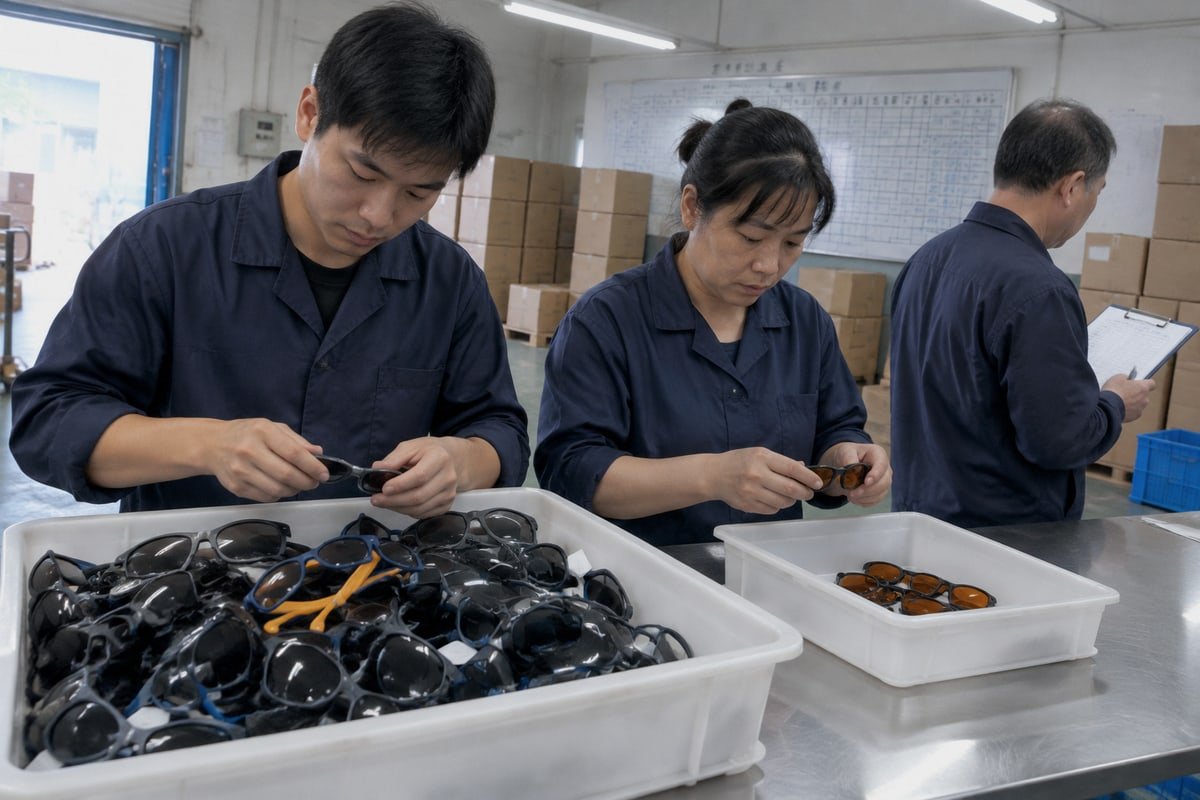
My reasoning comes from how kids actually wear these products. A dark gray sun lens already cuts most visible light, and blue is part of visible light. So a proper UV400 sunglass reduces HEV light exposure 5 outdoors by design. Adding a separate "blue light protection" label to that lens is partly redundant. It costs you money and adds a claim you must prove.
A simple decision process
Here is the process I walk buyers through when they plan a line with us.
- Define the use case for each style. Outdoor play, everyday casual wear, or indoor–outdoor hybrid.
- Lock the must-haves. UV400 protection and impact-resistant lenses go on every child's frame, no exceptions.
- Decide which styles genuinely meet screens. Usually that is a photochromic or light-tint style, not a beach sunglass.
- Add blue light filtering only to those styles, with the percentage and wavelength written into the spec sheet.
- Prefer substrate-integrated filtering for kids. The chromophores are infused into the lens material during molding, so the protection cannot scratch off like a surface coating. Children are hard on lenses, and a coating that wears away is a claim that expires.
| Merkmal | Recommended status | Warum |
|---|---|---|
| UV400 / UVA-UVB blocking | Standard on every style | The proven outdoor safety benefit |
| Stoßfeste Gläser | Standard on every style | Safety during active play |
| TR90-Rahmen mit TPEE-Bügeln | Standard for kids | Flexible, lightweight, comfortable, durable |
| Polarisierte Linsentechnologie | Optional, sport styles | Cuts glare on water and pavement |
| Blaulichtfilter | Optional, hybrid styles only | Small daytime benefit; avoid over-filtering all day |
| Amber sleep tint | Separate product, not sunglasses | Evening use only; distorts color |
How our catalog supports this approach
We keep around 800 existing styles, so a brand can build this tiered line without heavy mold investment. A dual-tone wayfarer with a navy front and yellow-orange TPEE temples works as the everyday outdoor hero with a solid gray UV400 lens. A matte navy sport wrap with a gradient gray lens is the natural home for polarized lens technology. A glossy black retro oval can carry a light photochromic lens for kids who move between classroom and playground. Blue light protection in TR90 kids sunglasses then becomes one deliberate option in the line, not a blanket promise across all of it. That keeps your cost structure clean and your marketing defensible.
What Certifications Should I Request to Verify Blue Light Claims from My Manufacturer?
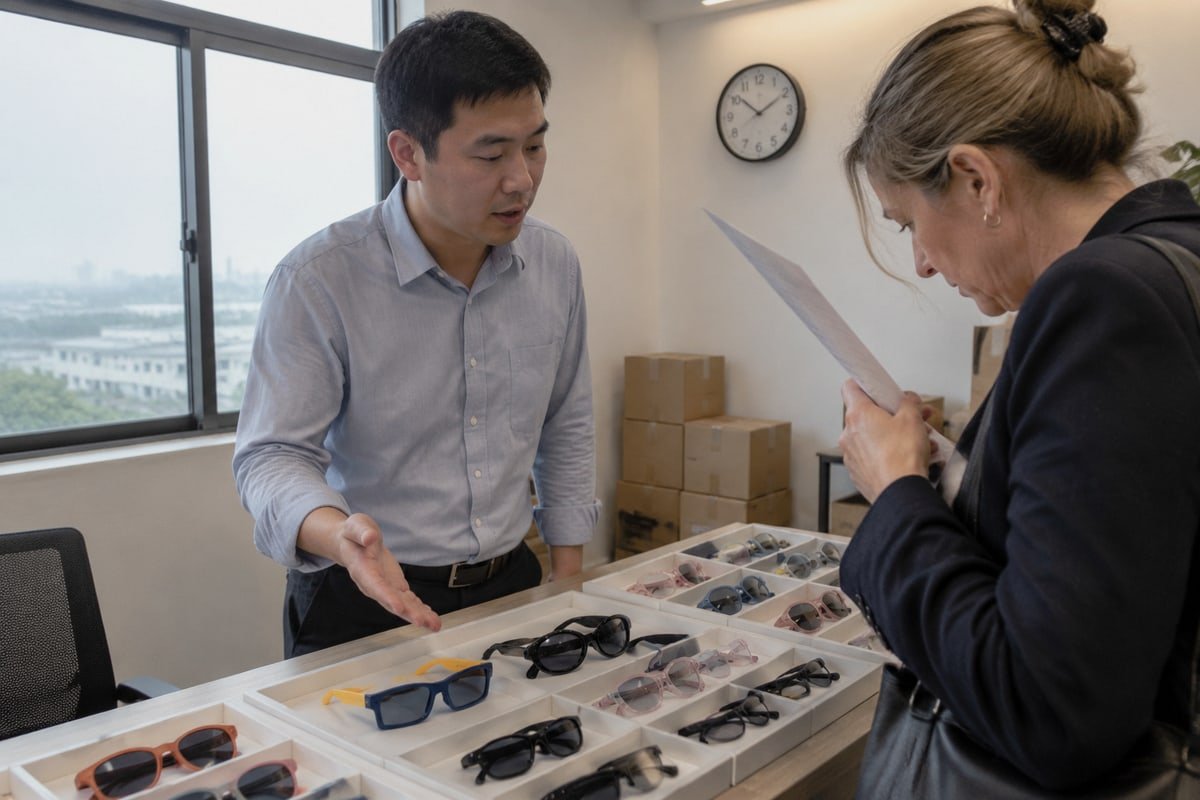
A procurement manager from Australia once sent me a competitor's listing that promised 99% blue light blocking and UV400. She asked one question: where is the report? I liked her.
Request a third-party spectral transmittance report showing blocking percentage at stated wavelengths, such as 430 nm, plus sunglass standard certification like ISO 12312-1, ANSI Z80.3, or AS/NZS 1067.1 for UV400. Add impact tests and children's product safety reports covering materials.
The first thing I tell buyers is uncomfortable. There is no single global "blue light certification." When a listing says "certified blue light lens," it usually means one lab measured one sample and issued a report. That report is useful. But you need to read it, not just see the word. One product page in the market claims a certified lens filters up to 40% of blue light at 430 nm. Another claims 99%. Both may be true for their lens type, yet they describe completely different products. Without the wavelength and percentage, the word "certified" tells you nothing.
The documents that actually prove the claim
| Claim on the box | Was zu beantragen ist | Was es beweist |
|---|---|---|
| Blue light protection | Spectral transmittance curve from an independent lab, 380–500 nm | The real filtering percentage at each wavelength |
| UV400-Schutz | Test report to ISO 12312-1 (EU), ANSI Z80.3 (US), or AS/NZS 1067.1 (Australia/NZ) | UVA and UVB blocking up to 400 nm |
| Stoßfeste Gläser | Drop-ball impact test report | The lens will not shatter on a child's face |
| Safe for children | Materials testing to children's product rules such as CPSIA (US) or EN 71-3 (EU) | No restricted heavy metals or phthalates in frame or temple |
| Scratch-proof filtering | Coating adhesion or abrasion test, or proof of substrate-integrated filtering | The protection lasts the life of the product |
Questions to ask before you sign a purchase order
Beyond the paperwork, I suggest a short interview with your supplier. Ask these questions in writing and keep the answers.
- Is the blue light filter a coating or is it built into the lens substrate?
- What is the blocking percentage at 415 nm, 430 nm, and 455 nm?
- Does the filter change the lens color, and how does that affect optical clarity for a child?
- Is the UV400 test done on the finished lens in the frame, or only on raw lens blanks?
- Will you supply the same report for each production batch, or only for the sample?
On our side, we source lenses with supplier transmittance data and support buyers who want batch samples sent to an independent lab. A factory with a 5S-managed workshop should not resist that request. If a supplier cannot answer the wavelength question, that silence is the answer.
How Can I Market Blue Light Protection Honestly Without Overstating the Benefits to Parents?
One packaging draft came back from a European client's legal team covered in red ink. The phrase protects eyes from damage caused it. Now our wording follows the data.
Market blue light protection honestly by stating the measured filtering percentage and wavelength, positioning it as comfort and sleep support, and keeping UV400 protection as the headline safety claim. Avoid words like prevents, cures, or damage. Add clear screen time management guidance instead.
Parents in Australia, Japan, and Europe are well informed. Many have already read that screen blue light does not damage eyes. If your packaging says otherwise, you lose trust with the exact buyer you want. I have watched this play out in retail returns and in negative reviews. Honest wording is not just ethical. It is also the safer commercial choice.
Build a claim hierarchy
I recommend a three-level hierarchy on every kids' sunglass package and product page.
- Headline safety claim: UV400 protection and impact-resistant lenses. This is proven, testable, and what regulators expect.
- Comfort claims: flexible TR90 frame, soft TPEE temples, lightweight fit, and reduced glare. These describe how the product feels, and children will actually wear glasses that feel good.
- Supporting feature: blue light filtering, stated as a number, framed as comfort or sleep support.
| Overstated wording | Honest alternative |
|---|---|
| Protects your child's eyes from blue light damage | Filters 40% of blue light at 430 nm for more comfortable screen viewing |
| Blocks 99% of harmful blue light | Amber lens filters up to 99% of blue light; designed for evening use |
| Prevents eye strain and headaches | May reduce digital eye strain symptoms during long screen sessions |
| Doctor recommended blue light protection | Lens spec verified by independent laboratory testing |
| Total protection for growing eyes | UV400 protection blocks UVA and UVB up to 400 nm |
Add honest guidance parents can use
The strongest marketing I have seen from our clients does not oversell the lens. It teaches. A small card inside the retail box can explain three things. First, sunglasses with UV400 protection are the real outdoor priority. Second, blue light filtering is a comfort aid, not a medical device. Third, the best sleep protection is screen time management, meaning devices off an hour before bed, with an amber lens as a backup on busy nights. Mention that daytime filtering should be light, because children's eyes need natural daylight for healthy development.
Through our OEM/ODM service, we help brands design this card, the hang tag, and the box artwork around the actual lens spec. Custom colors and logos are easy. The harder and more valuable work is making sure every printed word can be backed by the report in your file. That is what turns blue light protection in TR90 kids sunglasses from a risky slogan into a credible feature.
Schlussfolgerung
Parents deserve real protection, not slogans. Prioritize TR90 comfort, UV400 protection, and honest lens specs. Blue light filtering earns its place only when the data and use case match.
Interested in sourcing the products mentioned in this article? See details and request a quote here:
Fußnoten
1. Official site of the developer of TR90, providing technical specifications for this high-performance thermoplastic material. ↩︎
2. Authoritative medical organization providing guidance on the effects of digital screens and blue light on children’s eyes. ↩︎
3. Global technical organization providing standards and research regarding the light emissions and safety of electronic digital devices. ↩︎
4. National library of medicine database containing research on the physiological factors contributing to the development of myopia. ↩︎
5. International standards body that defines measurement criteria for high-energy visible (HEV) light in optical products. ↩︎
Weitere Artikel, die Ihnen gefallen könnten


Auf der Suche nach einem zuverlässigen Partner für Kinderbrillen?
Entdecken Sie über 800 sofort verfügbare Modelle und umfassenden OEM/ODM-Support, der auf Ihre Marke zugeschnitten ist.
Kontakt aufnehmen English
  Español de México
  Deutsch
  Français
  日本語
日本語  العربية
  Português do Brasil