Do Kids’ Sunglasses Need Salt Spray or High-Low Temperature Testing?
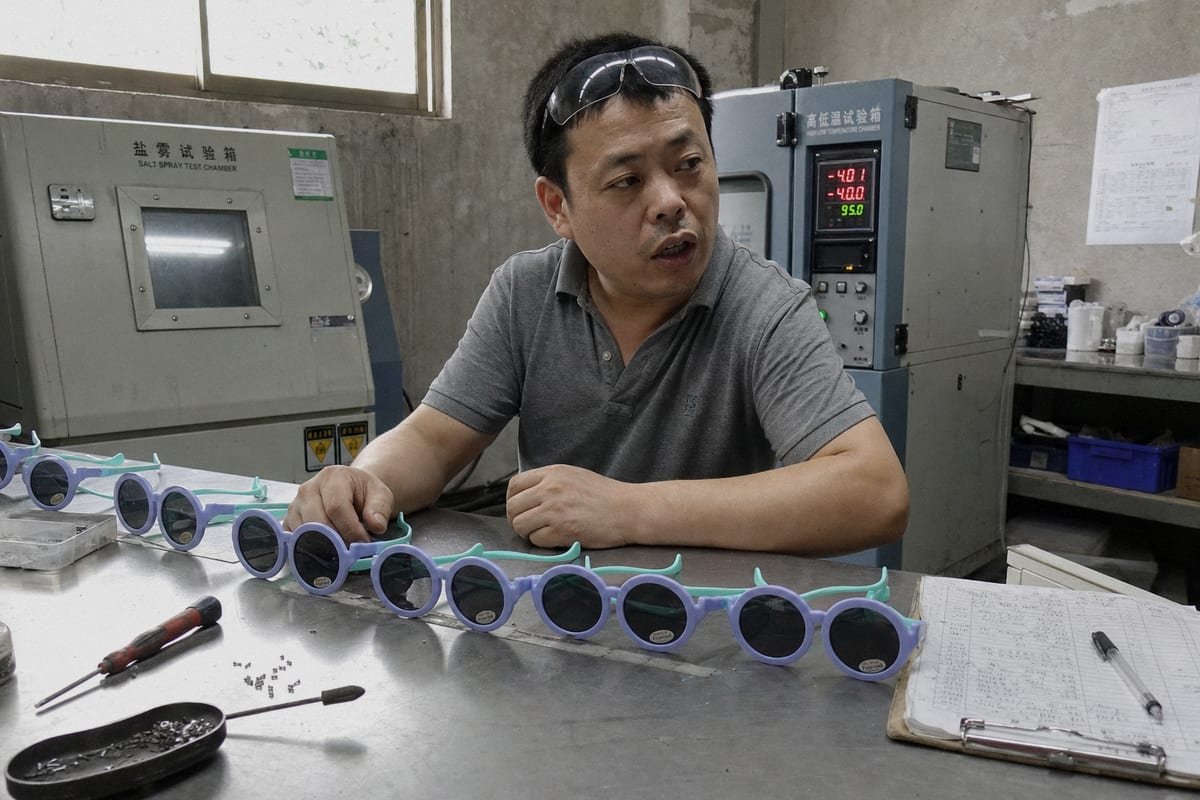
Buyers ask me about kids’ sunglasses salt spray and high-low temperature testing almost weekly thermoplastic material 1. Skip these checks, and hinges corrode, frames warp, and returns pile up — problems our Taizhou factory prevents daily.
Kids’ sunglasses do not legally require salt spray or high-low temperature testing to be safe; UV400 protection and impact resistance are the core requirements. However, these environmental stress tests verify durability — protecting hinges, coatings, and frame integrity in beach, travel, and hot-car conditions.
So the short answer is: not required, but often worth it. Let me explain when these tests matter, what they actually measure, and what you should demand from your supplier.
What Do Salt Spray and High-Low Temperature Tests Actually Measure on Kids' Sunglasses?
Last summer, a European buyer sent back a competitor's sample with green corrosion around the hinge screws. Our QC team knew instantly: that product had never seen a salt spray chamber.
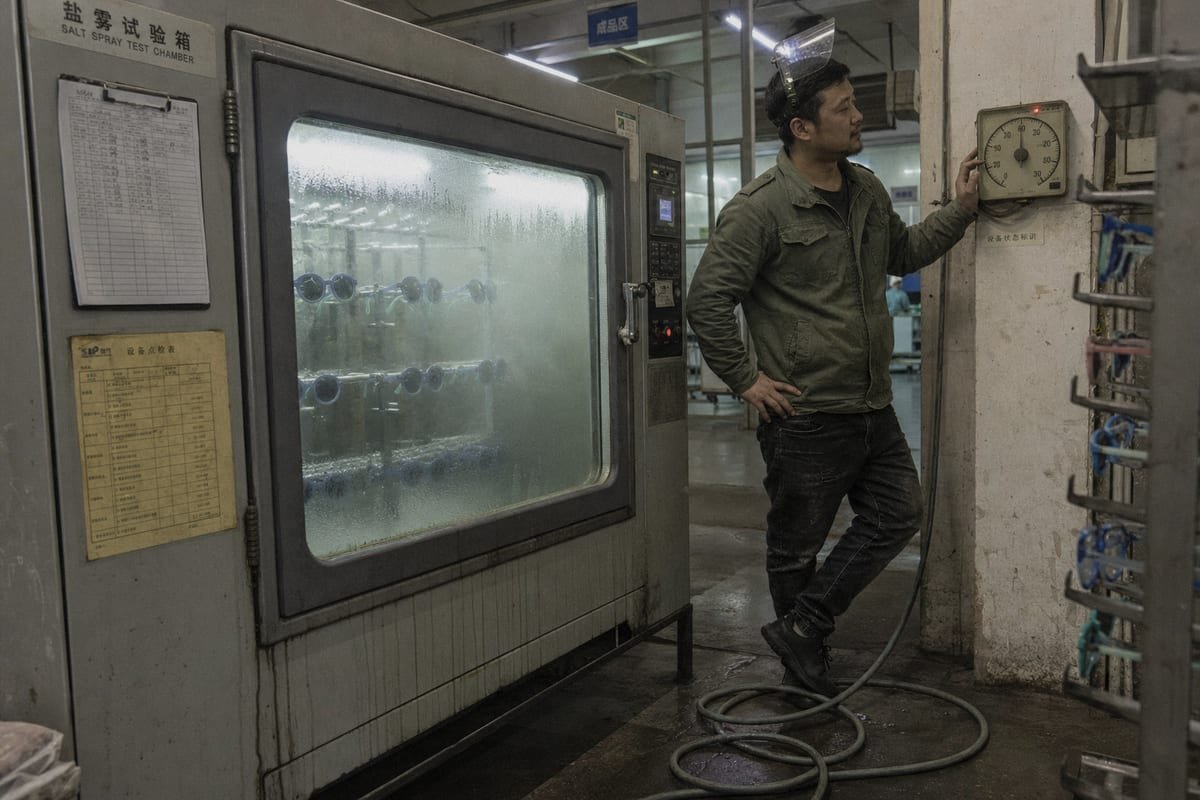
Salt spray testing measures corrosion resistance of metal hinges, screws, and decorative coatings under accelerated salty conditions. High-low temperature testing measures thermal stability — checking whether frames warp, coatings craze, or adhesives fail when cycled between extreme heat and cold.
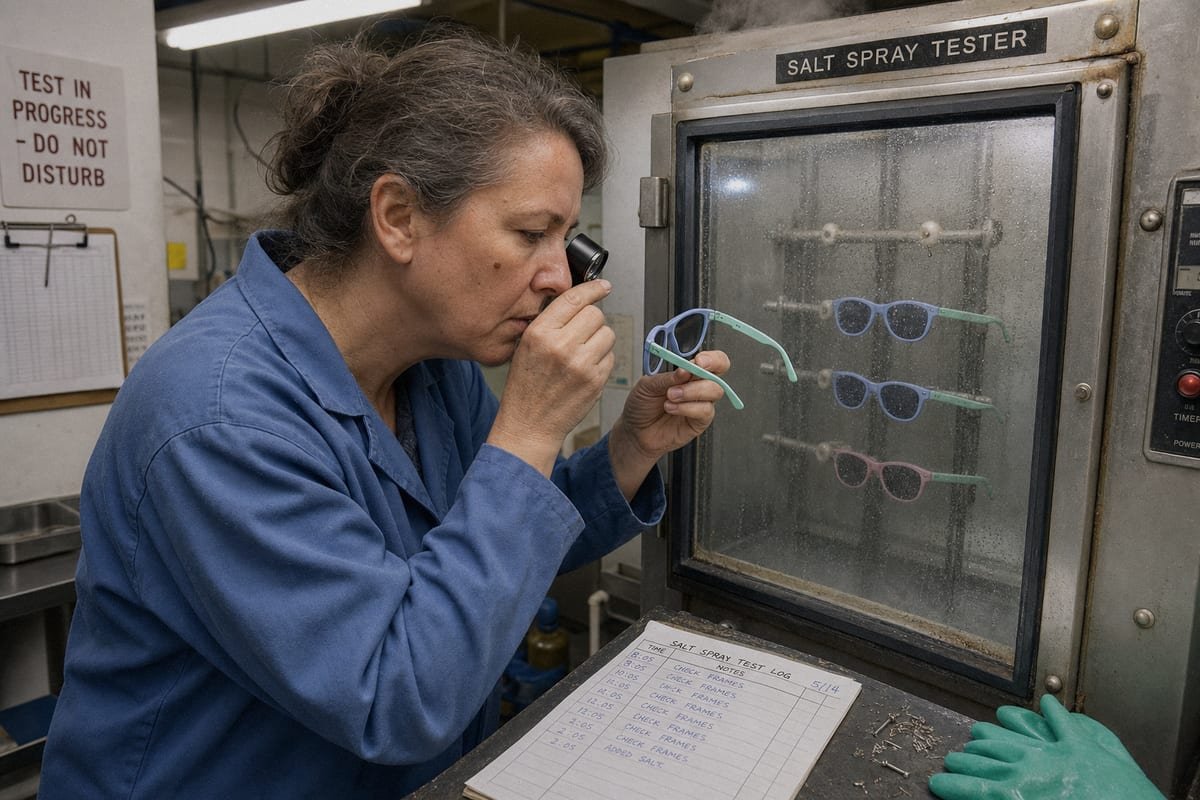
Neither test tells you whether a lens blocks UV rays. That is a completely different measurement. Instead, these are environmental stress testing 2 tools. They simulate months or years of real-world abuse in a compressed timeframe. Think of them as accelerated aging for eyewear.
What Salt Spray Testing Checks
A salt spray chamber sprays a fine salt mist over the product for a set number of hours, usually 24 to 96. Afterward, technicians inspect for rust, pitting, blistering, or discoloration. On kids' sunglasses, the vulnerable points are the small metallic hinge screws, any spring hinges, metal core wires inside temples, and plated or painted decorative parts. Salt crystallization inside a spring hinge can even cause mechanical seizing — the hinge jams or pinches skin.
What High-Low Temperature Testing Checks
Temperature cycling moves the product between hot and cold chambers repeatedly. For eyewear, this reveals problems that a single-temperature check misses.
| Failure Mode | سبب | Real-World Trigger |
|---|---|---|
| التواء الإطار | Material softens under heat | Sunglasses left on a car dashboard |
| Lens coating crazing | Mismatched expansion rates between lens and coating layers | Winter ski trip to summer beach |
| Adhesive failure | Glue joints lose grip | Repeated hot-cold swings during shipping |
| Loose fit | Frame dimensions shift | Hot climates, direct sun exposure |
| Brittleness | Material degradation in cold | Winter outdoor play |
One point matters most here: these are quality assurance protocols, not consumer safety laws. A pair can pass every environmental test and still fail at UV protection. That is why we run both categories of checks separately on our production line.
Why Should I Ask My Supplier for These Test Reports Before Placing an Order?
A procurement manager from Australia once told me her previous supplier's sunglasses looked perfect at inspection — then faded and rusted within one coastal summer. That conversation shaped how we present test data to new buyers.
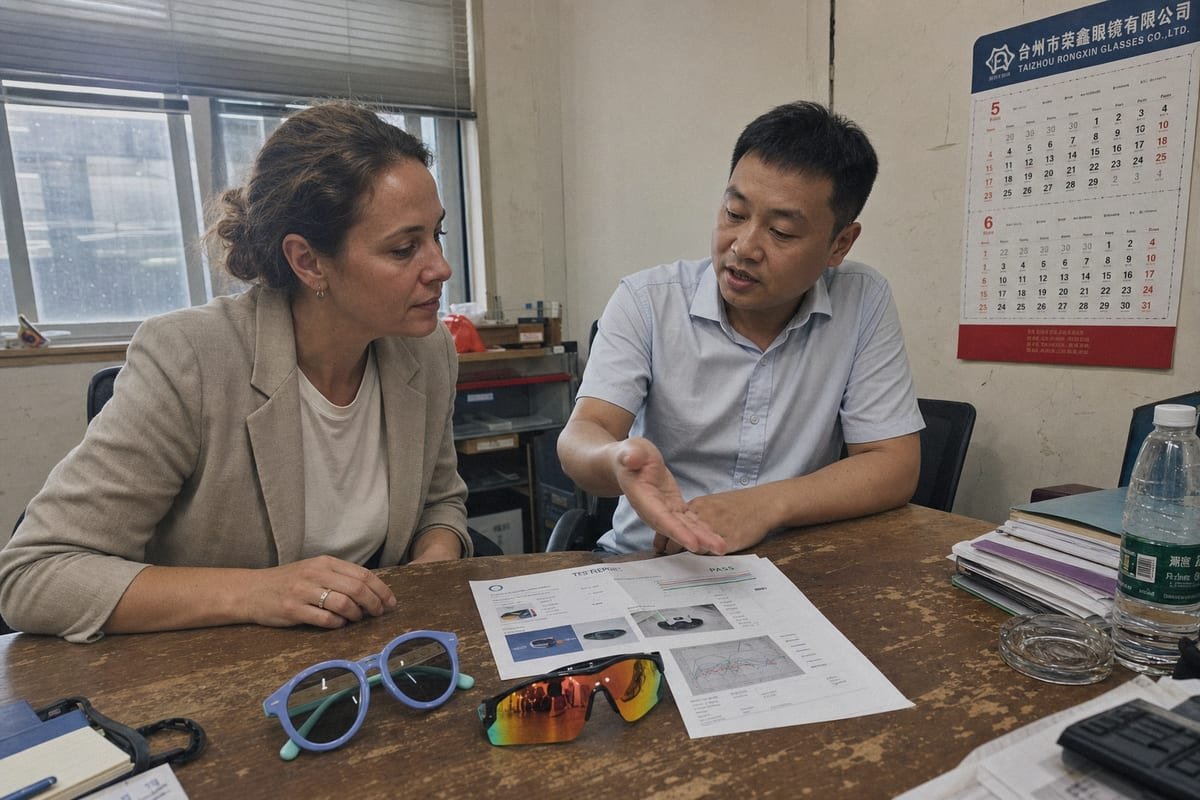
Requesting salt spray and temperature test reports protects you from hidden durability failures that only appear after shipment. Reports reveal whether hinges corrode, coatings peel, or frames warp in transit and use — reducing returns, negative reviews, and warranty claims for your brand.
Here is the uncomfortable truth about eyewear sourcing: a factory inspection catches cosmetic defects, but it cannot catch time-delayed failures. Corrosion takes weeks. Coating crazing takes temperature swings. Material degradation takes UV exposure. By the time your customer's child wears the sunglasses through one beach holiday, the product has faced conditions no pre-shipment inspection simulates.
The Hidden Costs of Skipping Durability Verification
Consider what a durability failure 4 actually costs a kids' brand. It is never just the refund.
- Return processing costs — often higher than the unit price itself.
- Negative reviews — parents write emotional reviews when a child's product fails.
- Retailer chargebacks — if you sell into chains, quality claims hit hard.
- Brand trust erosion — the most expensive and slowest to rebuild.
What a Good Test Report Should Show You
When we share reports with buyers, we always include the test standard used, the duration or cycle count, the pass criteria, and photos of the sample after testing. Vague statements like "passed durability test" mean very little. Ask your supplier these questions: Which hours of salt exposure? What temperature range? Was the tested sample from mass production or a hand-picked golden sample?
In our experience exporting to 20+ countries over 15 years, buyers who ask for specific durability data before ordering almost never face surprise quality disputes later. The report is cheap. The dispute is not. And a supplier who cannot produce environmental test data quickly probably is not running those tests at all — which tells you something important before you commit to a container.
How Do TPEE and TR90 Materials Perform Under These Durability Tests?
Material choice was the biggest lesson of my early years in this factory. We tested cheap PC frames against TR90 and TPEE side by side in a temperature chamber, and the difference changed our entire product strategy.
TPEE and TR90 perform exceptionally well in durability testing. Both resist warping across wide temperature ranges, spring back after bending, and contain no metal parts prone to salt corrosion in all-plastic designs. Their flexibility and thermal stability make them ideal for active children's eyewear.
Both materials belong to a family of flexible, memory polymers 5. TR90 is a thermoplastic material known for its light weight and shape memory. TPEE is a مطاط حراري مرن 6 with rubber-like softness and excellent fatigue resistance. On our lines, we often combine them — a TR90 front frame with TPEE temples — to balance structure with softness against a child's head.
Side-by-Side Performance Comparison
| Test Category | TR90 | TPEE | Standard Plastic (PC/PVC blends) |
|---|---|---|---|
| High-temperature warping | Excellent resistance | Excellent resistance | Prone to softening |
| Low-temperature brittleness | Stays flexible | Stays very flexible | Can crack |
| Bend and twist recovery | Strong shape memory | Rubber-like rebound | May snap or stay deformed |
| Salt spray relevance | Low (non-metal) | Low (non-metal) | Low, but coatings vary |
| الوزن | خفيف جدا | خفيف جدا | معتدل |
| Skin comfort for kids | جيد | Excellent (soft touch) | مقبول |
Where Testing Still Matters With Good Materials
Great base materials do not eliminate testing needs. Three areas still deserve attention. First, the hinge hardware: even our flexible frames often use a small metal hinge screw, and that screw needs corrosion resistance testing 7 if the product targets coastal markets. Second, lens coating adhesion: mirrored and polarized coatings — like the gradient orange-to-teal mirror lenses on our sport shield styles — expand and contract at different rates than the lens base, so thermal cycling checks for crazing. Third, color stability: matte pastel finishes, like the periwinkle-and-mint two-tone frames popular with our toddler lines, must hold their color through accelerated aging under UV and humidity.
The takeaway for buyers: TPEE and TR90 give you a strong head start on frame integrity, but the assembled product — screws, coatings, prints — still benefits from environmental verification.
Which Certifications or Test Standards Should I Request From an Eyewear Manufacturer?
When a Japanese baby-brand buyer first audited our workshop, she arrived with a checklist of standards longer than our sample catalog. That meeting taught me to organize test requirements by market, not by guesswork.
Request UV400 verification, impact resistance results, and the sunglasses standard for your market — ISO 12312-1 for Europe and international sales, ANSI Z80.3 compliance for the US, plus CPSIA chemical testing for children's products. Salt spray and thermal cycling reports are valuable optional extras.
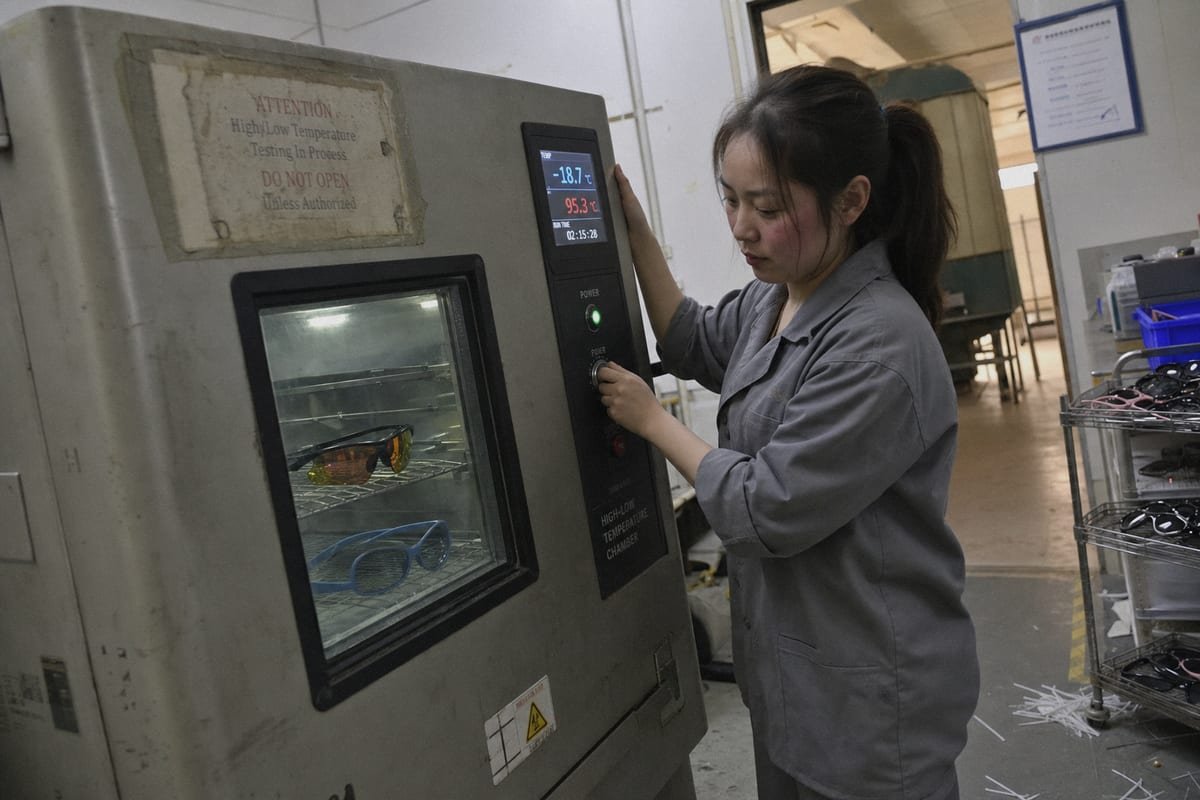
The key is separating mandatory safety standards from optional durability tests. Both matter, but they answer different questions. Safety standards ask: can this product harm a child? Durability tests ask: will this product survive real life?
Standards Checklist by Priority
| Priority | Standard / Test | ما يغطيه | Who Needs It |
|---|---|---|---|
| Must have | حماية من الأشعة فوق البنفسجية 400 / 100٪ UVA-UVB | Radiation protection for young eyes | Every market |
| Must have | ISO 12312-1 standards | Optical quality, UV, robustness (EU/international) | Europe, AU, most markets |
| Must have | ANSI Z80.3 compliance | US non-prescription sunglasses requirements | الولايات المتحدة |
| Must have | Impact resistance (drop ball) | Lens shatter safety during play | US FDA requirement; wise everywhere |
| Must have | CPSIA / EN 71 chemical tests | Lead, phthalates, toxins (kids chew frames) | US / EU children's products |
| Recommended | Salt spray (e.g., 24–48h) | Hinge and coating corrosion resistance | Coastal, beach, boating markets |
| Recommended | High-low temperature cycling | Warping, coating crazing, adhesive strength | Hot climates, travel products |
| Recommended | Perspiration resistance | Dye leaching, skin reaction risk | Sport and active lines |
How to Ask Without Slowing Down Your Order
A practical sequence works best. First, confirm the mandatory standards for your destination market in your very first inquiry. Second, request existing reports on the specific model — with roughly 800 existing styles in our catalog, we usually have data on hand, which means no new mold cost and no testing delay for you. Third, for custom OEM/ODM projects with new colors, coatings, or packaging, budget two to three weeks for fresh third-party testing before mass production.
One more tip from our side of the table: ask whether reports come from an accredited third-party lab or only internal QC. Internal data is useful for process control, but retailers and customs authorities usually want independent verification. A supplier confident in its quality assurance protocols will welcome that question, not dodge it.
الخلاصة
Kids' sunglasses don't need salt spray or thermal testing to be safe — they need UV400 and impact resistance. But durability testing separates lasting products from summer disappointments. Choose suppliers who offer both.
ملاحظات ختامية
1. Authoritative Wikipedia entry defining thermoplastic polymers and their properties. ↩︎
2. Authoritative Wikipedia page covering the measurement of equipment performance under specified environmental conditions. ↩︎
3. Official FDA guidance on impact resistance requirements for sunglasses to ensure consumer safety and lens integrity. ↩︎
4. Authoritative Wikipedia page defining product durability and factors affecting functional lifespan. ↩︎
5. Technical explanation of shape-memory polymers, the material class encompassing high-performance eyewear frames like TR90. ↩︎
6. Authoritative Wikipedia page explaining materials with both thermoplastic and elastomeric properties. ↩︎
7. Scientific overview of corrosion, critical for evaluating the longevity of metal components in eyewear hardware. ↩︎
مقالات أخرى قد تعجبك
August 1, 2026
هل يجب على المصنع التعامل مع تغليف ووضع ملصقات نظارات الأطفال الشمسية، أم استخدام مورد مخصص؟

August 1, 2026
مستودع خاص مقابل الوفاء المباشر من المورد: أيهما يقلل تكاليف الإرجاع لعلامات نظارات الأطفال الشمسية؟

August 1, 2026
مباشر إلى ميناء المستودع أو التخزين الخارجي: أيهما يوفر أكثر على شحن نظارات الأطفال الشمسية؟
هل تبحث عن شريك موثوق به للنظارات للأطفال؟
استكشف أكثر من 800 نمط جاهز ودعم OEM/ODM كامل مصمم خصيصًا لعلامتك التجارية.
اتصل بنا English
  Español de México
  Deutsch
  Français
  日本語
日本語  العربية
  Português do Brasil