How to Set Lead Time, Quality, and Response Metrics for Kids Sunglasses Supplier Evaluations?
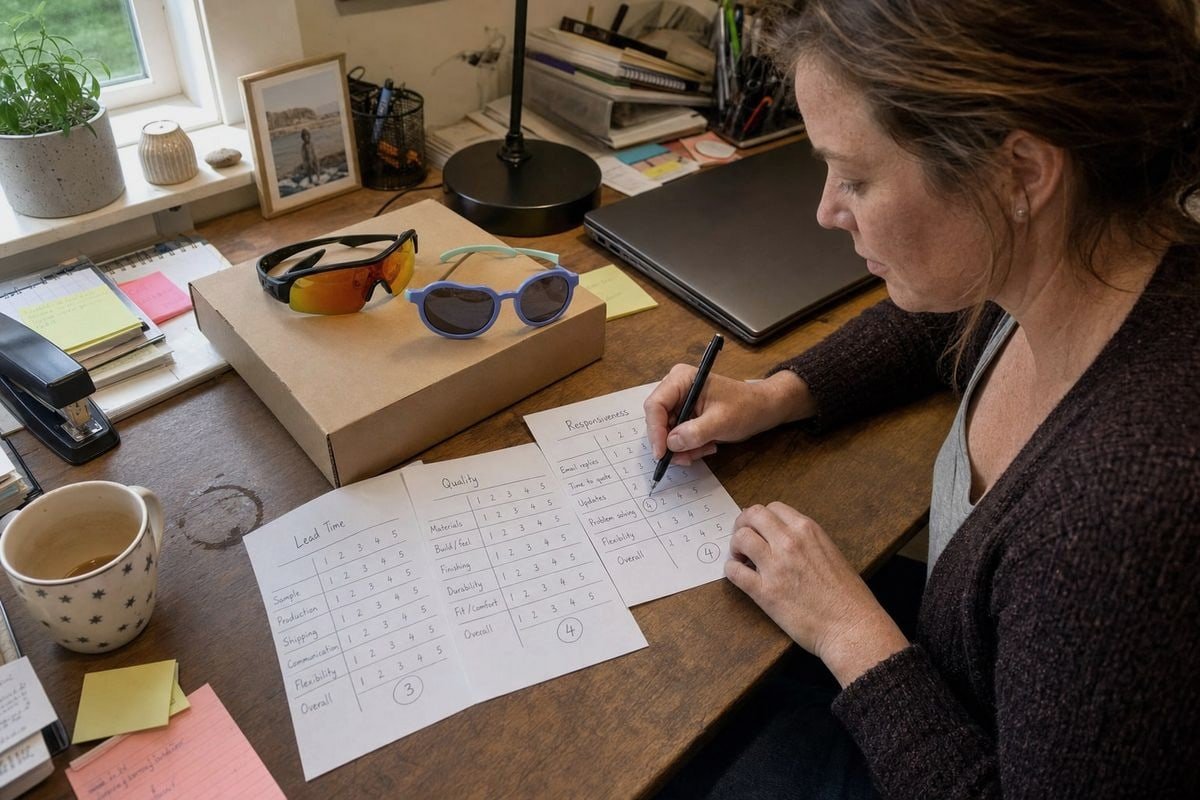
Choosing a kids sunglasses supplier on gut feeling is risky عيد رأس السنة الصيني 1. I have watched buyers lose entire summer seasons because a vendor missed dates, shipped defects, and went silent when problems appeared.
Evaluate kids sunglasses suppliers with three separate scorecards: lead time (sample 7–15 days, bulk 30–45 days, 95%+ on-time rate), quality (AQL 2.5/4.0 acceptance, compliance documents, batch consistency), and responsiveness (routine replies under 24 hours, urgent issues under 4–12 hours, plus proactive delay warnings).
Those numbers only work if you define each metric clearly and measure it the same way on every order. Let me walk you through how to set each one up.
What lead time benchmarks should I expect from a reliable kids sunglasses manufacturer?
A buyer from Australia once asked me why our quoted "35 days" beat a competitor's "25 days" in practice. The answer was simple: we defined where the clock started, and they never did.
Expect sample lead times of 7–15 days, new molds of 20–30 days, and bulk production of 30–45 days for kids sunglasses, plus transit time. Reliable manufacturers state when the clock starts, break the timeline into milestones, and hit committed ship dates at least 95% of the time.

The single biggest lead time mistake I see buyers make is accepting one broad number like "30 days" without asking what it covers. On our production line in Taizhou, a full order actually moves through five distinct phases, and each one has its own clock. If your supplier cannot break these down in writing, you cannot hold them accountable to anything.
Break lead time into components
Here is how the phases typically map out for children's sunglasses, whether the frame is a flexible TPEE wraparound sport style 2 or a two-tone TR90 round frame:
| Phase | Typical Range | Clock Starts When |
|---|---|---|
| Sample making | 7–15 days | Artwork and spec confirmed |
| New mold / tooling | 20–30 days | Mold deposit paid |
| Material sourcing | 5-10 أيام | Sample approved, deposit received |
| Bulk production | 30-45 يومًا | Materials arrive at factory |
| Inspection and packing | 3–7 days | Production complete |
| Ocean or air transit | 5–35 days | Goods leave factory |
Two warnings from experience. First, some suppliers quote very short delivery windows because they are selling stock goods, not true OEM production 3. That is fine for testing the market, but do not compare a stock quote against a custom-color, custom-logo quote. One of the reasons we keep roughly 800 existing styles is precisely so new brands can launch fast without mold investment — but we always tell buyers which timeline applies.
Second, track variance, not just the average. A supplier who delivers in 32, 35, and 33 days is more valuable than one who delivers in 25, 28, and 55 days. Watch results over a rolling 12-month window so عيد رأس السنة الصيني 4 and pre-summer peak seasons show up in the data. Flag any supplier whose actual lead time runs more than 10% over plan on repeat orders.
How can I measure and verify consistent quality across every production batch?
During a repeat order for a mirrored-lens sport shield style last year, our QC team caught a slight gradient shift between lens batches. The buyer never saw it — but only because we check every batch against a sealed master sample.
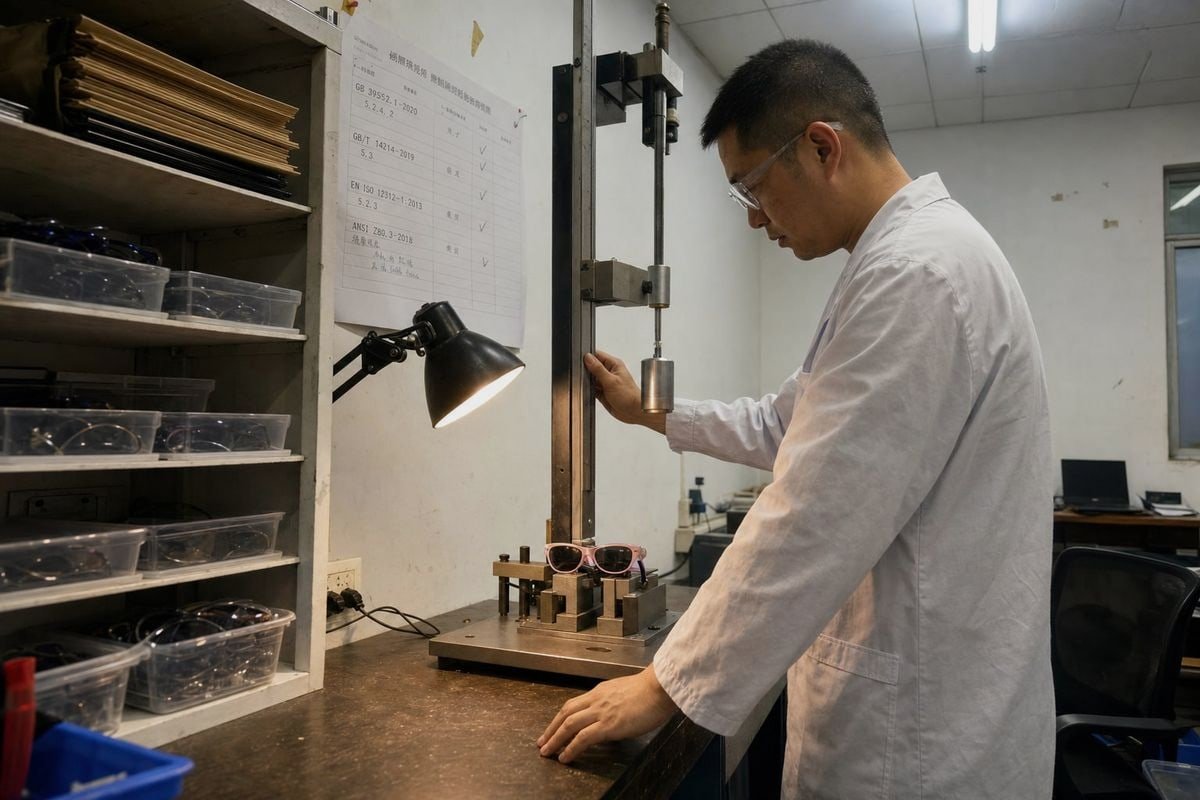
Measure quality with an acceptance rate (accepted units ÷ received units), AQL sampling at 2.5 for major and 4.0 for minor defects, batch-to-batch comparison against a master sample, and mandatory compliance documents such as CPSIA, EN ISO 12312-1, and lens impact-resistance reports.
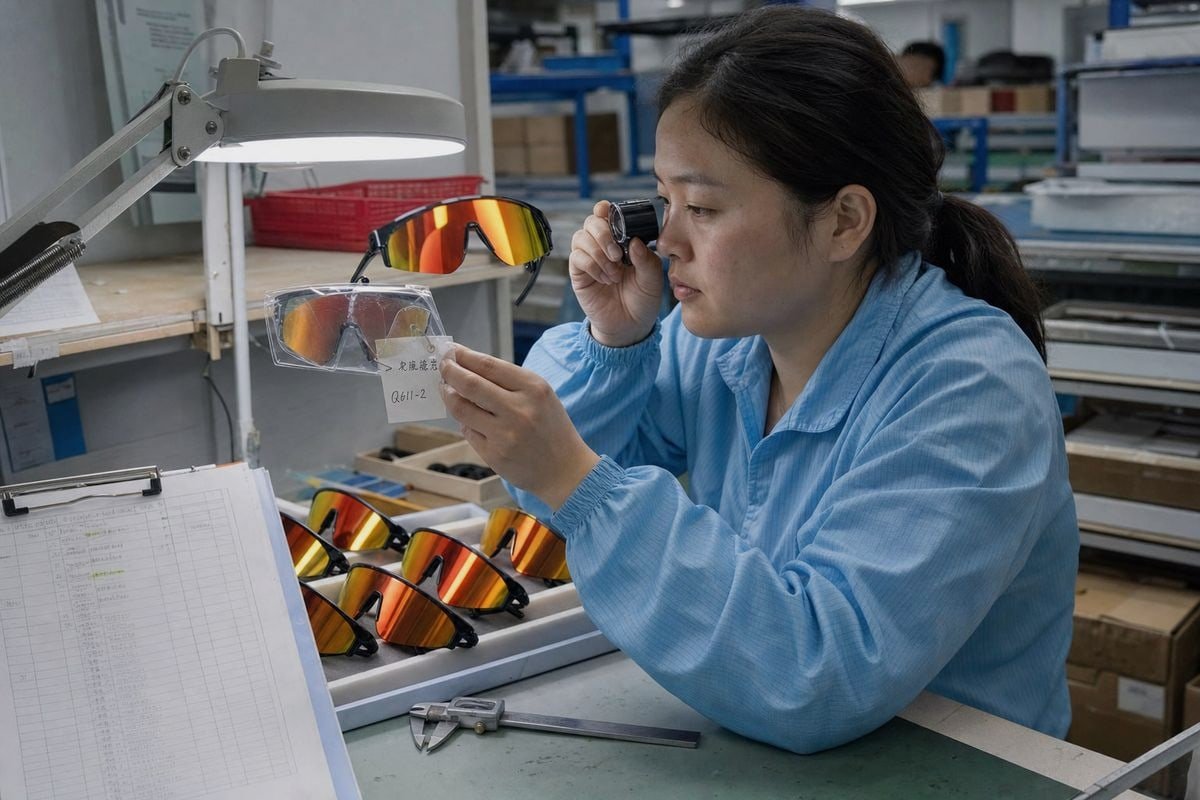
Quality for children's eyewear is not one number. It is a stack of checks, and each layer catches a different failure mode. In our workshop, we run checkpoints at injection, polishing, assembly, and packing, because a defect caught at injection costs cents while a defect caught at your warehouse costs a season.
Separate critical, major, and minor defects
Not all defects deserve equal weight in your scorecard. For kids sunglasses, I recommend this severity split:
| Severity | أمثلة | Tolerance |
|---|---|---|
| Critical | Failed UV400 claim, sharp edges, small parts that detach (choking hazard), failed impact test | Zero — automatic batch rejection |
| Major | Loose hinges, cracked frames, wrong logo, heavy color mismatch, warped lens | AQL 2.5 |
| Minor | Faint mold lines, slight packing scuffs, minor print offset | AQL 4.0 |
Critical defects should be a pass/fail gate, never just a deduction on a score. A child's product that fails a small-parts or UV test is not "a 7 out of 10 supplier" — it is a stop-ship event.
Verify, do not trust
Require these as evidence, not promises:
- A signed, sealed master sample kept at the factory and one kept with you.
- Pre-shipment inspection reports with photos or video, especially for customized orders.
- Compliance certificates matched to your market — CPSIA for the US 5, EN ISO 12312-1 for Europe.
- Sub-tier disclosure: ask who supplies the lenses and hinges. UV and durability failures 6 often originate two tiers down, not at final assembly. Because we mold TPEE and TR90 in-house and control our lens sourcing, we can answer that question in one email — a supplier who cannot is a red flag.
Also track quality over time. Repeated defects within a six-month window should compound the score more heavily than one isolated slip. Systemic problems and one-off errors are different animals.
What response time standards should I require to avoid communication delays with my supplier?
There is a trade-off I weigh constantly: answering a buyer instantly with half an answer, or taking a few more hours to reply with complete, usable information. The second builds trust; the first just fills inboxes.
Require first replies within 24 hours for routine questions, 4–12 hours for urgent quality or shipment issues, 24–48 hours for revised quotations, and proactive notification of delays before you have to ask. Track the share of messages answered within target, not just averages.

Slow communication is rarely just slow typing. In fifteen years of exporting children's eyewear to buyers in 20+ countries, I have found that response speed is a leading indicator of everything else. A supplier who takes four days to answer a hinge specification question usually has weak internal documentation, unclear ownership, or a capacity problem they are hiding. The email delay is the symptom; the disease is inside the factory.
Measure more than email speed
A useful response scorecard covers four distinct behaviors:
| Response Metric | Target | What It Reveals |
|---|---|---|
| First useful reply (routine) | Under 24 hours | Basic account management discipline |
| First reply (urgent issue) | Under 4–12 hours | Escalation habits and seriousness about problems |
| Revised quote or spec document | 24–48 hours | Internal engineering and costing capability |
| Proactive delay warnings | Before you ask | Honesty and production visibility |
That last row is the one most buyers skip, and it is the most predictive. A reactive supplier answers questions. A proactive one tells you about a resin shortage, a holiday closure, or a vessel delay 7 before it hits your timeline. When we see a material delay coming on our side, our sales team flags it the same day — because a buyer planning a summer retail launch needs bad news early, not perfectly.
Also count follow-up attempts. If you need three chasers to get one answer during the quotation stage — when the supplier is trying hardest to impress you — imagine the communication after your deposit clears. Track the percentage of messages answered within the target window across a full project, from first inquiry through after-sales, and put that number on the scorecard.
Which metrics should I track over time to decide if a supplier deserves a long-term partnership?
A lesson I learned early in our factory's history: the suppliers of our own raw materials who looked best on a single order were not always the ones worth keeping. Trends beat snapshots, every time.
Track on-time delivery rate (target 95%+), lead-time variance, defect and acceptance rates per batch, response-time compliance, and seasonal capacity flexibility over 6–12 months. Combine them in a weighted scorecard — roughly 40% delivery, 30% quality, 20% lead-time reliability, 10% responsiveness — with hard safety gates.
A single good order proves a supplier can perform once. A long-term partnership decision needs rolling data. Here is a practical weighted scorecard model you can adapt:
| مقياس | الوزن | Green | Yellow | Red |
|---|---|---|---|---|
| On-time delivery rate | 40% | ≥95% | 90–95% | <90% |
| Quality acceptance rate | 30% | ≥98% | 95–98% | <95% |
| Lead-time reliability (variance vs promise) | 20% | Within 5% | 5–10% over | >10% over |
| Responsiveness (in-target reply rate) | 10% | ≥90% | 75–90% | <75% |
Adjust the weights to your buying model. For a new private-label launch, shift weight toward quality and sample responsiveness, because you are still proving the product. For replenishment of established styles, delivery reliability dominates, because stockouts kill seasonal revenue. But for children's eyewear, keep quality and compliance as minimum pass gates in every model — a critical safety failure should override any score.
Add two category-specific trackers
First, a seasonal flexibility score. Kids sunglasses demand spikes hard before summer and back-to-school. Rate how your supplier performs when you double an order in March versus October. Our 5S-managed workshop plans capacity around these peaks precisely because buyers judge us most harshly in Q2.
Second, a weighted decay model for defects. Two similar quality issues within six months should hurt the score more than double one incident, because repetition signals a systemic process gap rather than bad luck. Review the full scorecard quarterly, share it with the supplier, and give them a chance to respond. The good ones treat the data as a roadmap; the weak ones treat it as an accusation. That reaction itself tells you whether you have a partner or just a vendor.
الخلاصة
Guesswork picks cheap suppliers; metrics pick reliable ones. Define lead time in phases, gate quality on safety, demand fast honest communication, and let the scorecard decide who earns your long-term business.
ملاحظات ختامية
1. Background on the holiday period that affects manufacturing lead times in China. ↩︎
2. Explains the thermoplastic elastomer material used in flexible children’s sunglasses frames. ↩︎
3. Explains OEM manufacturing concept referenced when comparing stock versus custom orders. ↩︎
4. Background reference explaining the seasonal factory closure period that affects lead-time variance data. ↩︎
5. CPSIA is the US federal law governing children’s product safety compliance. ↩︎
6. WHO provides authoritative background on UV radiation risks relevant to lens durability. ↩︎
7. Links to the international body overseeing shipping regulations that can cause the vessel delays mentioned. ↩︎
مقالات أخرى قد تعجبك

August 1, 2026
هل يجب على المصنع التعامل مع تغليف ووضع ملصقات نظارات الأطفال الشمسية، أم استخدام مورد مخصص؟

August 1, 2026
مستودع خاص مقابل الوفاء المباشر من المورد: أيهما يقلل تكاليف الإرجاع لعلامات نظارات الأطفال الشمسية؟

August 1, 2026
مباشر إلى ميناء المستودع أو التخزين الخارجي: أيهما يوفر أكثر على شحن نظارات الأطفال الشمسية؟
هل تبحث عن شريك موثوق به للنظارات للأطفال؟
استكشف أكثر من 800 نمط جاهز ودعم OEM/ODM كامل مصمم خصيصًا لعلامتك التجارية.
اتصل بنا English
  Español de México
  Deutsch
  Français
  日本語
日本語  العربية
  Português do Brasil