What Product Page Info Is Required Under GPSR for Private Label Kids’ Sunglasses?

Last spring, one of our European buyers had a listing suspended overnight because the GPSR product page info for private label kids’ sunglasses was incomplete. No warning, no grace period — just a frozen listing. That is the harsh reality now General Product Safety Regulation 1: incomplete traceability details or missing safety warnings can stop your sales cold, even when the sunglasses themselves are perfectly safe. The good news is that fixing your product page is far easier once you know exactly which fields the regulation demands, and once your factory hands you accurate data from day one.
Under GPSR, product pages for private label kids’ sunglasses must show the manufacturer’s name and contact details, the EU Responsible Person if the maker is outside the EU, importer details where applicable, a product identifier such as batch or model number, a product image, and all safety warnings in the target market’s language.
That is the short answer. But each of those fields hides practical questions. Who counts as the manufacturer when you private label? Where do warnings go? Do you link the Declaration of Conformity 2? Let me walk you through each piece, section by section.
What safety warnings and age recommendations must I list on my product page under GPSR?
During a packaging review for a German client, our QC team flagged a listing that showed our two-tone TPEE frames beautifully — but carried zero safety text. That gap is exactly what market surveillance authorities 3 now check first.
GPSR requires your product page to display all safety warnings and instructions a consumer needs before purchase, in the official language of each target Member State. For kids' sunglasses, this typically includes UV filter category, "not for direct sun observation" warnings, age suitability, and driving-use limitations.
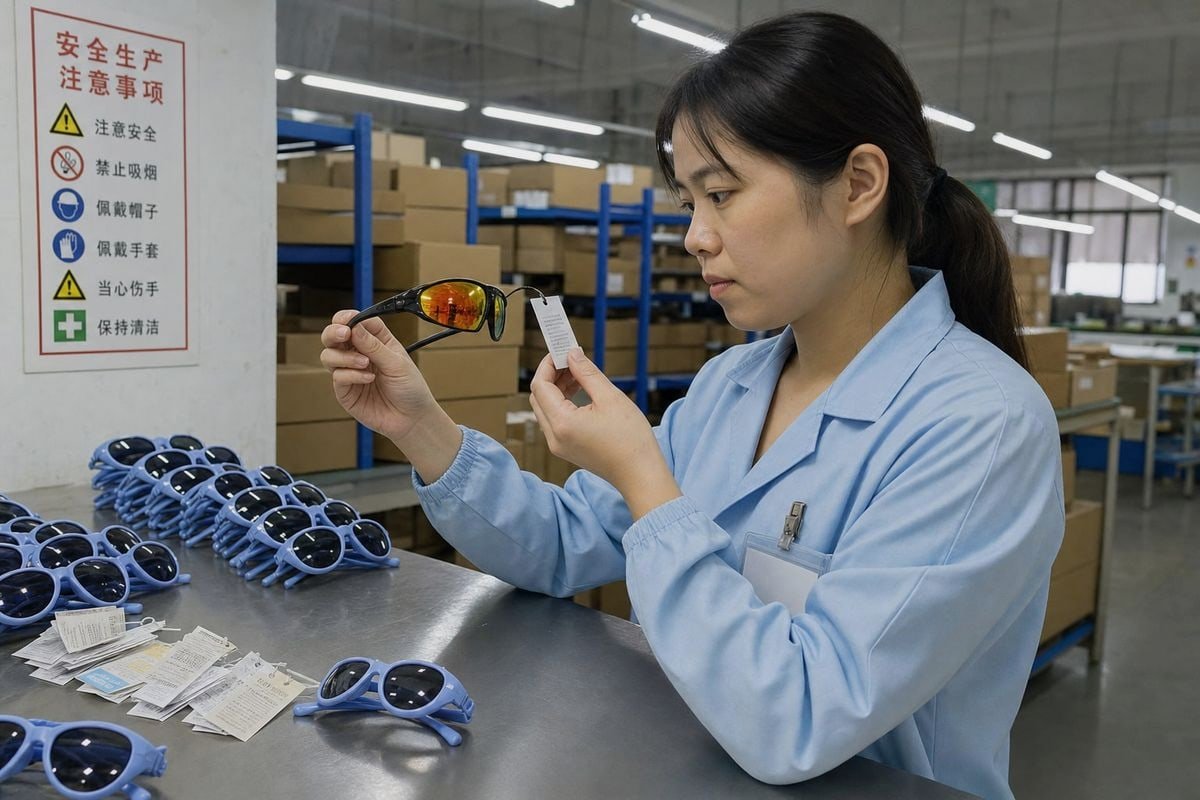
Here is the nuance many sellers miss. GPSR is horizontal legislation. It tells you that safety warnings and instructions must be visible before purchase, but it does not write the eyewear-specific wording for you. Those specifics come from the product rules that apply to sunglasses — chiefly the PPE Regulation 2016/425 4 and the EN ISO 12312-1 standard. So your product page needs two layers of content: the general GPSR disclosure and the sunglasses-specific safety information.
The warnings that matter for kids' eyewear
From the listings we help prepare for buyers across Europe, these are the warnings that consistently belong on a children's sunglasses page:
| Warning or information | Why it is required | Typical wording basis |
|---|---|---|
| Lens filter category (0–4) | PPE-specific technical disclosure | EN ISO 12312-1 5 |
| Not suitable for direct sun observation | Prevents dangerous misuse (e.g., eclipse viewing) | EN ISO 12312-1 |
| Not for protection against artificial light sources | Clarifies limits of sun-glare protection | EN ISO 12312-1 |
| Driving/twilight restrictions (category 4 lenses) | Safety-critical use limitation | EN ISO 12312-1 |
| Age recommendation | Child-suitability signal for parents and authorities | GPSR safety information duty |
| Care and usage instructions | Safe use and durability guidance | GPSR Article 19 pre-purchase info |
Language is not optional
Every warning must appear in a language consumers in your target market can easily understand. If you sell into France, Germany, and Spain from one listing, that means three language versions. In our experience preparing artwork for multi-market brands, this is the single most common gap — the English text is fine, but the German translation is missing. Platforms like Zalando explicitly request instructions and warnings as PDFs with language sequencing per market, and Amazon requires the warnings on the product detail page itself. Plan your translations at the same time you plan your packaging print run, not after.
Which manufacturer and importer details am I required to display for traceability?
A procurement manager from Australia once asked me whether her brand name alone could stand in as "manufacturer" on EU listings. It is the most common private label question we hear — and the answer depends on legal roles, not on whose logo sits on the temple arm.
You must display the manufacturer's legal name, registered trade name or trademark, postal address, and electronic contact. If the manufacturer sits outside the EU, add the EU Responsible Person's name and contact details. If an importer exists in the chain, list its name and address too.

Traceability is the heart of GPSR. Authorities want to trace any pair of sunglasses from a consumer complaint back through the listing, the importer, and the factory batch. That is why manufacturer contact information must be specific and functional — guidance from EU responsible person providers stresses that the electronic address must enable direct communication, not just point to a static homepage.
Who is the "manufacturer" when you private label?
Here is where private label changes the analysis. If you place your own brand on the sunglasses and market them as your own, EU law generally treats your brand as the manufacturer — with the manufacturer's full liability for safety risk assessments and the technical documentation file 6. Some sellers assume the Chinese factory always remains the legal manufacturer. That assumption is wrong and dangerous. When your logo goes on our frames, you step into the manufacturer role, and your details belong on the page.
| Legal role | Who it usually is in private label | What the product page must show |
|---|---|---|
| Manufacturer | The brand owner marketing under its own name | Legal name, trade name/trademark, postal + electronic address |
| EU Responsible Person | An appointed EU entity (if manufacturer is non-EU) | Name, postal + electronic address |
| Importer | The EU company bringing goods into the Union | Name, postal + electronic address |
| Factory (like us) | OEM production partner | Not shown, but must supply batch data and test reports |
Product identifiers close the loop
Alongside operator details, the listing needs a unique product identifier — model or type code, batch or serial number, SKU, or EAN/GTIN — plus a clear product image. On our production lines in Taizhou, we laser-mark or print batch codes so the physical product, its packaging, and the online listing all match. Some sophisticated sellers even use dynamic metadata fields to keep rotating production batch numbers synchronized with the live product detail page. Without that match, product traceability labels lose their value in a recall scenario.
Do I need to show CE marking or a declaration of conformity link on my listing?
Weighing what to print on a swing tag versus what to publish online is a trade-off we discuss with nearly every new brand client. CE marking 7 sits right at the center of that conversation.
Sunglasses are Category I PPE under Regulation 2016/425, so they must carry CE marking on the product or packaging. GPSR does not force you to publish the EU Declaration of Conformity on your listing, but you must hold it and provide it to authorities on request.
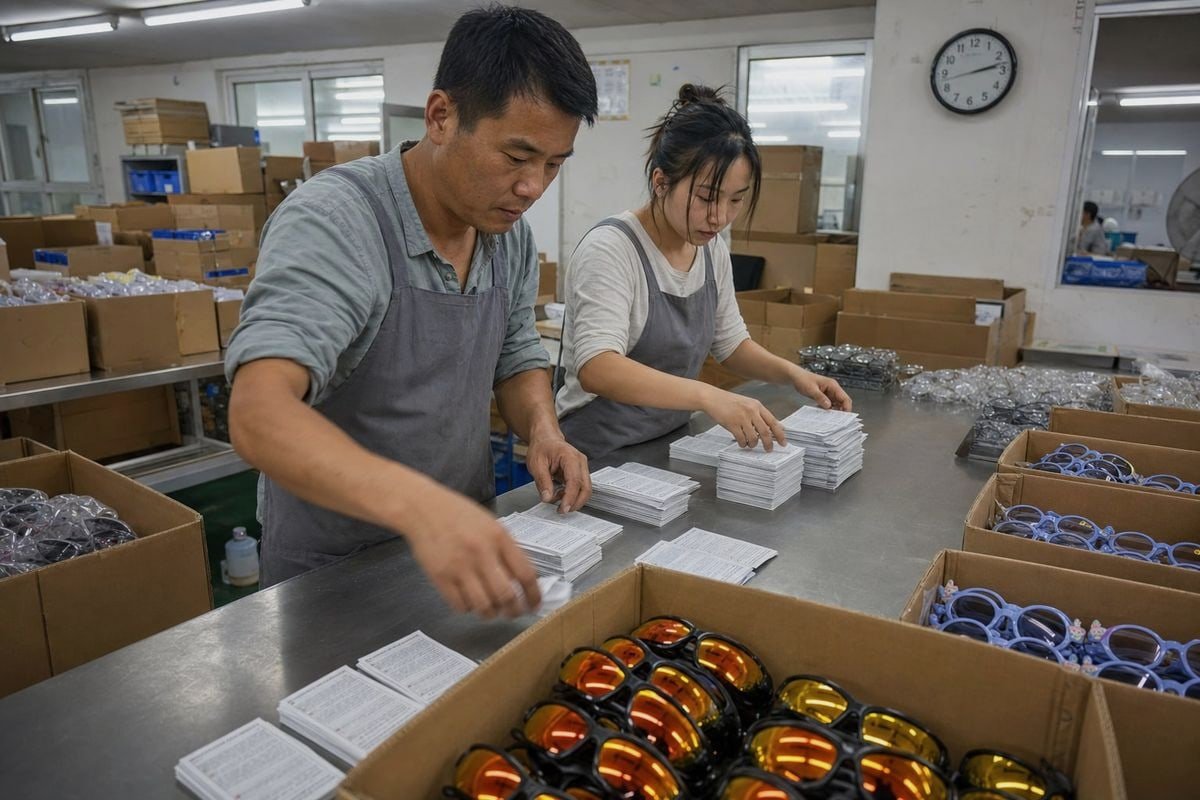
Let me separate what is legally mandatory from what is commercially smart, because platforms and consultants often blur the two.
Legal minimum versus platform practice
The GPSR text for distance sales focuses on operator identification, product identifiers, images, and warnings. It does not literally say "post your EU Declaration of Conformity online." However, CE marking compliance under the PPE Regulation 2016/425 is a separate, mandatory layer: the CE mark must appear on the sunglasses or their packaging, and you must maintain a technical documentation file and a signed Declaration of Conformity behind it. Some marketplaces go further than the legal minimum and ask sellers to upload conformity documents during listing creation. My advice: treat platform practice as your operating standard. It exceeds the strict legal floor, but it protects your listing from suspension.
A practical decision guide
- Confirm your sunglasses are CE marked under PPE Regulation 2016/425 — for kids' sunglasses sold in the EU, this is non-negotiable.
- Keep the EU Declaration of Conformity and EN ISO 12312-1 test reports in your technical documentation file, ready for authorities within days, not weeks.
- Mention CE compliance and the applicable standard on the product page — a short line like "CE marked, tested to EN ISO 12312-1, UV400 filter category 3" builds trust with parents.
- Optionally, link a downloadable conformity PDF; several large platforms already treat this as expected practice.
At our factory, we supply UV400 and polarized lens test data with every OEM order UV400 protection 8 precisely so buyers can assemble this documentation without chasing paperwork after shipment.
How can my eyewear factory help me prepare accurate, GPSR-ready product information?
Fifteen years of exporting children's eyewear taught us one blunt lesson: compliance problems almost never start at the listing stage. They start at the factory, in missing batch codes and undocumented material specs.
Your factory should supply batch or serial numbers, material and lens test reports, EN ISO 12312-1 documentation, filter category data, warning text templates, and consistent markings on product, packaging, and cartons — so your listing, label, and technical file all tell the same story.

Because we run an OEM/ODM operation focused on TPEE and TR90 children's frames, we sit at the source of nearly every data point your GPSR product page needs. Here is how a capable factory partner shortens your compliance path.
The data package a factory should hand you
| Information you need for GPSR | What the factory provides | When you should receive it |
|---|---|---|
| Batch or serial number | Marked on frames, printed on packaging and cartons | With every production run |
| Lens filter category and UV data | UV400 / polarized lens test reports | Before mass production approval |
| EN ISO 12312-1 conformity evidence | Third-party test reports for your technical documentation file | With pre-shipment documents |
| Material safety details | TPEE / TR90 material declarations, biocompatibility and allergen-free status | At sampling stage |
| Warning and instruction artwork | Print-ready templates for multi-language packaging | During packaging design |
| Matching product images | High-resolution photos matching the shipped item | At order confirmation |
Why material transparency matters more for kids
Children chew temples, sit on frames, and wear sunglasses for hours in the sun. That is why we build with flexible TPEE temples on TR90 fronts — and why we document material composition proactively. Disclosing frame material biocompatibility on your page is not yet a strict GPSR field, but with EU chemical restrictions tightening, buyers who disclose early pre-empt future problems. It also reassures the parents actually reading your listing.
Lower-risk market entry
One more practical point. Because we maintain roughly 800 existing styles — from playful round two-tone frames for toddlers to sporty wraparound shield designs for active kids — new brands can launch GPSR-compliant products without heavy mold investment. You choose a proven style, we customize colors, logos, lenses, and retail-ready packaging, and the compliance data travels with the order. Testing a market becomes a documentation exercise, not a gamble.
Conclusion
Incomplete GPSR product page info can freeze your listings and stall your brand. Get operator details, identifiers, warnings, and factory documentation right, and compliance becomes your competitive advantage.
Footnotes
1. Provides background on the core EU legislation the article discusses throughout. ↩︎
2. EU official page explaining conformity assessment and declaration requirements for products. ↩︎
3. EU resource describing the authorities enforcing product safety and traceability rules. ↩︎
4. Explains the personal protective equipment framework governing sunglasses classification. ↩︎
5. Official ISO standard reference for sunglasses UV filter and safety testing requirements. ↩︎
6. Background concept on technical documentation required for product conformity records. ↩︎
7. Background on the CE conformity marking system referenced for PPE compliance. ↩︎
8. WHO resource on UV radiation risks relevant to sunglasses UV protection claims. ↩︎
More Articles You Might Like

August 1, 2026
Should Factory Handle Kids Sunglasses Packaging & Labeling, or Use a Designated Supplier?

August 1, 2026
Own Warehouse vs Supplier Direct Fulfillment: Which Cuts Return Costs for Kids Sunglasses Brands?

August 1, 2026
Direct-to-Port Warehouse or Overseas Staging: Which Saves More on Kids Sunglasses Shipping?
Looking for a Reliable Kids Eyewear Partner?
Explore 800+ ready styles and full OEM/ODM support tailored to your brand.
Get in Touch English
  Español de México
  Deutsch
  Français
  日本語
日本語  العربية
  Português do Brasil