What Customs Data Is Needed for CPC eFiling on Kids Optical Frames (Effective July 2026)?

Customs data for CPC eFiling on kids optical frames is now the question our export team hears weekly Partner Government Agency (PGA) Message Set 1. Miss one field after July 2026, and your shipment can sit frozen at the port.
CPC eFiling on kids optical frames requires seven data elements filed through ACE by July 8, 2026: a product identifier, each applicable CPSC safety rule, date and place of manufacture, most recent testing date, testing laboratory contact details, and the records custodian’s contact information.
That is the short answer. Below, I break down each data element, show how it maps to real frame SKUs, and explain what your supplier must hand over before your cargo ships.
What CPC Documentation Should I Prepare Before the July 2026 Deadline?
Last spring, a buyer in Australia asked our team to re-issue three years of test reports in one week HTS classification 2. That scramble taught us both why early CPC preparation matters.
Before July 8, 2026, prepare a complete Children's Product Certificate for every kids optical frame style, backed by third-party test reports from a CPSC-accepted lab, plus structured records of the manufacturer's address, testing dates, lab contacts, and the party who holds the supporting files.

First, a point of clarity. In this context, CPC means Children’s Product Certificate — a CPSC document — not the Customs Procedure Code (CPC) used in European import declaration requirements. Kids optical frames are children's products under U.S. law, so they need a CPC rather than a General Certificate of Conformity (GCC). That distinction matters because CPC data must come from third-party testing at a CPSC-accepted laboratory 3, not from self-declared results.
The eFiling rule takes the paper CPC and turns it into structured data. Your customs broker will transmit that data through the Automated Commercial Environment (ACE) 4 via the Partner Government Agency (PGA) Message Set at the time of entry. If the data set is incomplete or inconsistent, the entry can be flagged and release delayed.
The Seven Core Data Elements
| Data Element | What It Means for Optical Frames |
|---|---|
| Product identifier | GTIN, SKU, UPC, or model number for each frame style |
| Applicable safety rule(s) | The specific CPSC children's product rules cited on the CPC |
| Date of manufacture | When the finished frame was produced |
| Place of manufacture | Factory name, full address, and contact details |
| Most recent testing date | Date of the latest third-party compliance test |
| Testing laboratory | Lab name, address, and contact information |
| Records custodian | Who holds the test records, with full contact details |
Some implementation guides describe eight elements by splitting out internal document-handling contacts. That is a workflow choice, not a legal one. The officially discussed core set is seven, and I recommend organizing your records around those seven fields first.
How Do I Know If My Kids Optical Frames Supplier Can Provide Compliant Testing Data?
There is a trade-off we weigh on every new project: test each colorway separately, or group variants under one report. Getting that grouping wrong is the fastest way to fail an eFiling audit.
A compliant supplier can show current third-party test reports from a CPSC-accepted laboratory covering lead, phthalates, and applicable safety standards for optical frames, matched to your exact SKUs, with clear testing dates, lab contact details, and material declarations for every frame and temple component.

Ask your supplier five direct questions. First, which CPSC-accepted lab performed the testing, and can you contact that lab? Second, does the report cover the exact frame style, colorway, and material combination you are buying — not just a similar item? Third, when was the most recent test, and does it reflect the current bill of materials? Fourth, who holds the raw test records? Fifth, can they document material composition, including declarations for BPA-free or hypoallergenic plastics that children's eyewear regulations increasingly demand?
At our Taizhou factory, we test TR90 fronts and TPEE temples as distinct materials, because a frame that mixes a rigid acetate-style front with flexible silicone temple tips — like our black-and-navy sporty kids style — contains several substrates. Each substrate must be covered by the test data. A report that only tested the front frame leaves the temple material undocumented, and that gap becomes visible the moment structured data hits ACE.
Red Flags Versus Green Flags
| Red Flag | Green Flag |
|---|---|
| One generic report for the whole catalog | Reports mapped to specific styles and materials |
| Testing date older than the current material batch | Retesting after any material or supplier change |
| Lab name given, no contact details | Full lab address and contact information provided |
| Vague "meets CPSC" claims | Specific safety rules cited on the CPC |
| No answer on records custodian | Named party who maintains supporting files |
A serious factory treats these documents as part of the product, not paperwork you chase afterward. If a supplier hesitates on any of the five questions, treat that hesitation as your answer.
What HTS Codes and Product Details Do I Need for Accurate CPC eFiling?
A distributor in Japan once sent us a purchase order describing forty frame variants as one line: "kids glasses." Untangling that into filing-ready data took longer than production itself.
You need the correct HTS classification for plastic spectacle frames, a unique identifier per style or SKU, a plain product description that matches your CPC, invoice, and packing list, plus the country of origin, manufacture date, and declared value for each entry line.
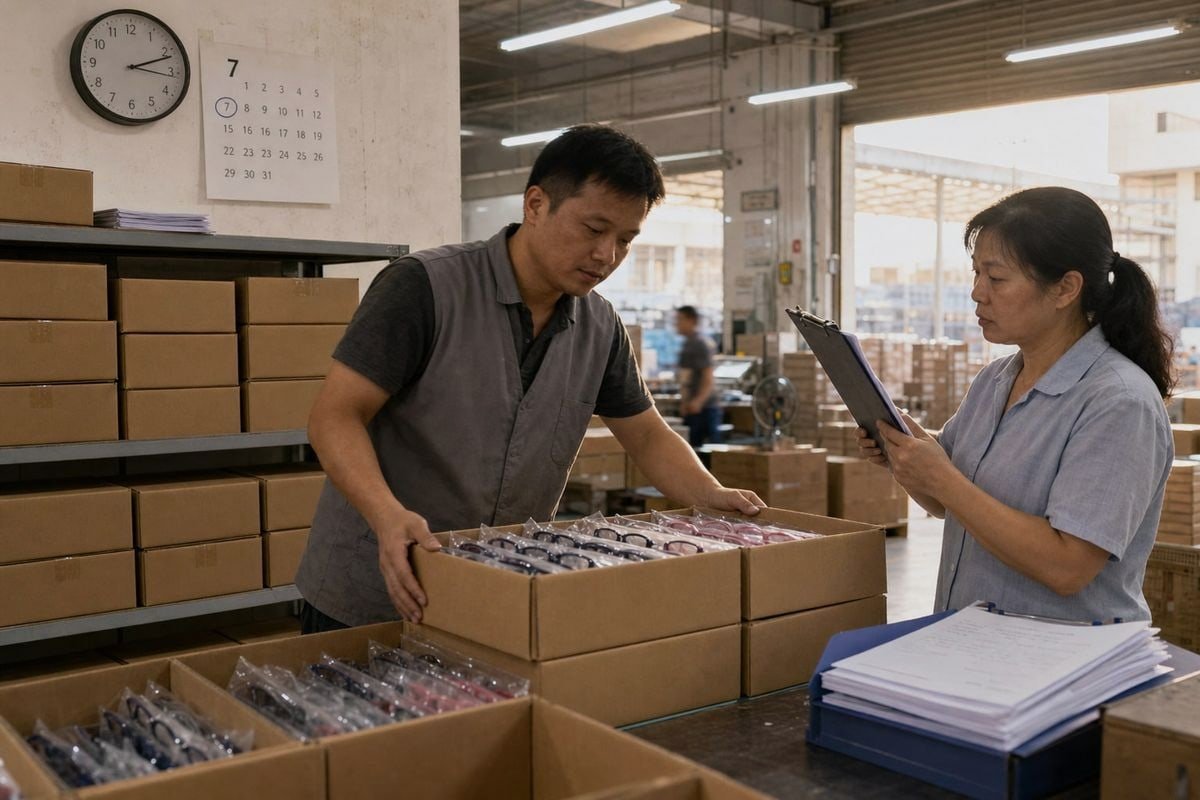
Product classification for eyewear sits in Chapter 90 of the tariff schedule. HS codes for optical frames distinguish plastic frames from metal ones, and getting this right drives duty rates and PGA flagging. Your broker handles the electronic customs declaration, but the source data — description, material, value — comes from you and your supplier. Standard valuation methods at customs start with transaction value, so your commercial invoice must show the real price paid, matched to the same SKUs your CPC cites.
Making Product Data Match Across Documents
The most common failure point we see is inconsistency. The CPC says "Model K-102," the invoice says "children's sunglasses assorted," and the packing list says something else again. When CBP systems cross-check the PGA data set, mismatches trigger reviews. Align every document to one identifier scheme before the goods leave the factory.
| Document | Must Show |
|---|---|
| CPC | Product identifier, safety rules, factory address, lab data |
| Commercial invoice | Same SKU, accurate description, transaction value |
| Packing list | Same SKU, quantities per carton |
| Entry filing | HTS code, country of origin, PGA/CPC data set |
Handling Variants and Origin
Should each colorway carry its own identifier? For eFiling, yes — SKU-level or style-level traceability beats a generic family description. Our translucent pink acetate style and our black TR90 sporty style may share a family name, but they use different materials and need distinct identifiers. Country of origin rules also matter: if frames are molded in one factory and assembled in another, document the place where the finished product was made, with a full address. A reusable product registry, whether inside trade compliance software or a disciplined spreadsheet, lets your broker pull consistent data every time instead of rebuilding it per shipment.
Can My Manufacturer Help Me Avoid Customs Delays When the New CPC Rules Take Effect?
One lesson from fifteen years of exporting kids' eyewear: customs problems are almost never created at the port. They are created months earlier, at the factory, in missing data.
Yes — a capable manufacturer prevents delays by supplying complete CPC data before production ships, maintaining SKU-level test records, labeling products so identifiers match your filing, and responding quickly when your broker or the importer of record needs verification during entry.

Let me be honest about responsibility first. Importer of record responsibilities 5 do not transfer to the factory. Even when your broker transmits the data and your supplier generates the test reports, you carry the legal accountability for accuracy. What a good factory does is make that accountability manageable.
Here is the workflow we run for brand clients preparing for July 2026:
- At quotation: we confirm which safety standards for optical frames apply to the target market and whether existing test reports cover the chosen style, or new testing is needed.
- At order confirmation: we lock the SKU scheme with the buyer so molds, packaging, cartons, invoice, and CPC all use one identifier. With roughly 800 existing styles, most buyers can select tested designs and skip fresh mold investment entirely.
- During production: our QC team records the manufacture date per batch, because the eFiling data set requires the finished product's production date, not a vague season.
- Before shipment: we deliver the full data package — factory name and address, testing dates, lab contact details, and material declarations — so your broker loads it into ACE before the vessel sails, not while it waits at anchor.
- After arrival: we keep records accessible so verification requests get same-day answers.
Do not wait until cargo is in transit to gather certificate information. Customs automation is only getting stricter; future systems may cross-reference eFiled data with recall databases and historical import records for predictive risk scoring. Many of our larger clients now push CPC fields directly into their ERP systems so the data flows to brokers automatically. Whatever your scale, the principle is the same: the factory should hand you filing-ready data, and you should have it in hand weeks before entry.
Conclusion
CPSC eFiling turns children's product compliance into a data-management problem. Gather the seven CPC elements per SKU now, align every document, and choose suppliers who deliver filing-ready data.
Footnotes
1. Explains the electronic data elements required by Partner Government Agencies for import entries. ↩︎
2. Provides the official Harmonized Tariff Schedule for classifying imported goods and determining duties. ↩︎
3. Provides a list and criteria for CPSC-accepted third-party testing laboratories. ↩︎
4. Describes the U.S. Customs and Border Protection’s system for processing imports and exports. ↩︎
5. Outlines the legal duties and obligations of the importer of record for goods entering the U.S. ↩︎
More Articles You Might Like

August 5, 2026
Bio-Based vs Regular Cellulose Acetate: What's the Difference for Kids' Frames?

August 5, 2026
How Recyclable Are Kids' Optical Frame Materials, and What Eco-Friendly Alternatives Exist?
August 5, 2026
Do Kids Optical Frames Whiten or Age in Storage, and How to Control Warehouse Conditions?
Looking for a Reliable Kids Eyewear Partner?
Explore 800+ ready styles and full OEM/ODM support tailored to your brand.
Get in Touch English
  Español de México
  Deutsch
  Français
  日本語
日本語  العربية
  Português do Brasil