Why Do TR90 & TPEE Kids Sunglasses Cause Dizziness Or Distorted Vision?
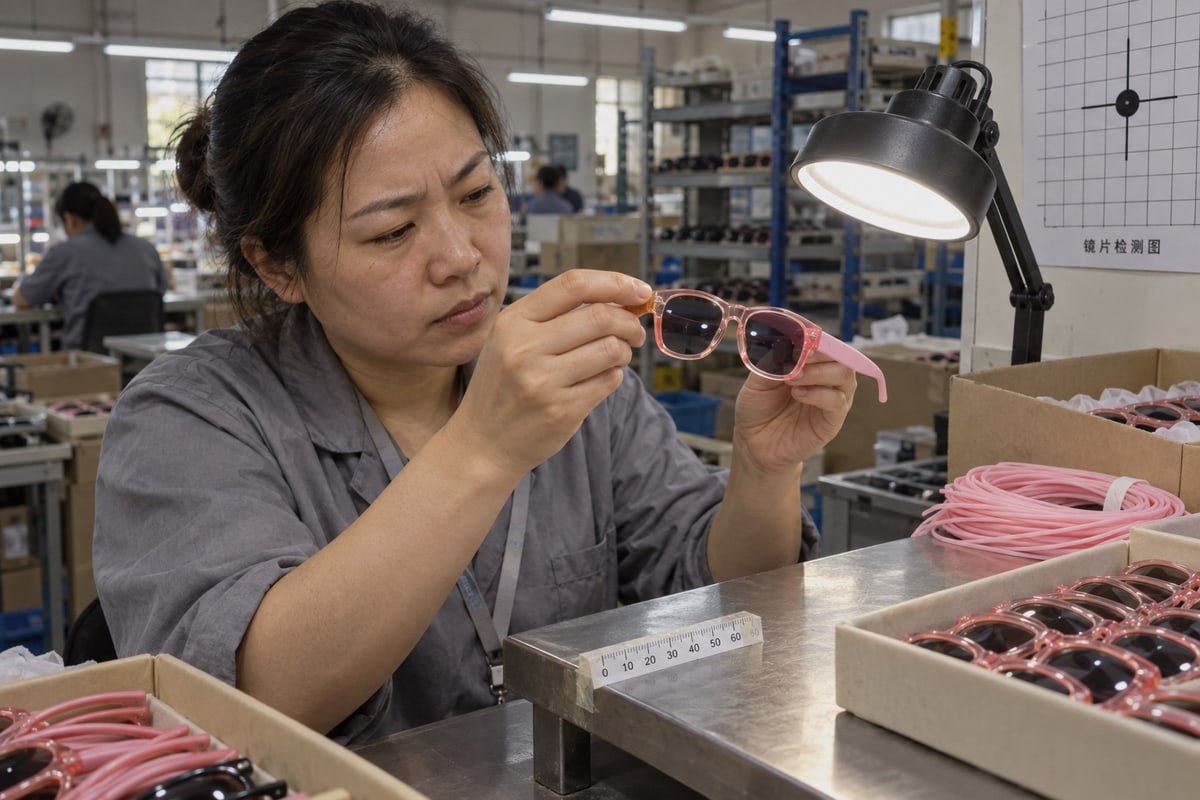
Buyers ask us why TR90 and TPEE kids sunglasses cause dizziness or distorted vision. Returns pile up, reviews suffer. On our Taizhou line, the fix is optical, not material.
TR90 and TPEE kids sunglasses rarely cause dizziness because of frame material. Distorted vision usually comes from optical faults: lens optical centers that miss the child’s pupillary distance, high-wrap frames without decentered lenses, low-Abbe lens materials, uneven polarized film, or a frame that bends and shifts lens position.
This matters for your brand. A child who feels dizzy will not wear the sunglasses. A parent who sees that will write a review. So I want to walk through the real causes one by one. I will show you how to check lenses, how fit changes optics, what to put in your spec sheet, and why one batch can differ from the next. Each section ends with something you can act on.
How Do I Know If My Supplier Is Using Substandard Lenses That Cause Distortion?
Last year our QC team rejected an incoming lens lot because straight lines wobbled through the edges. The lenses looked fine to the eye. A simple grid test exposed them.
You can spot substandard lenses with four checks: look through them at a straight-line grid for waviness, compare left and right tint under a light box, rotate two polarized lenses against each other for uneven blackout, and ask your supplier for lens material, Abbe value, and thickness tolerance.
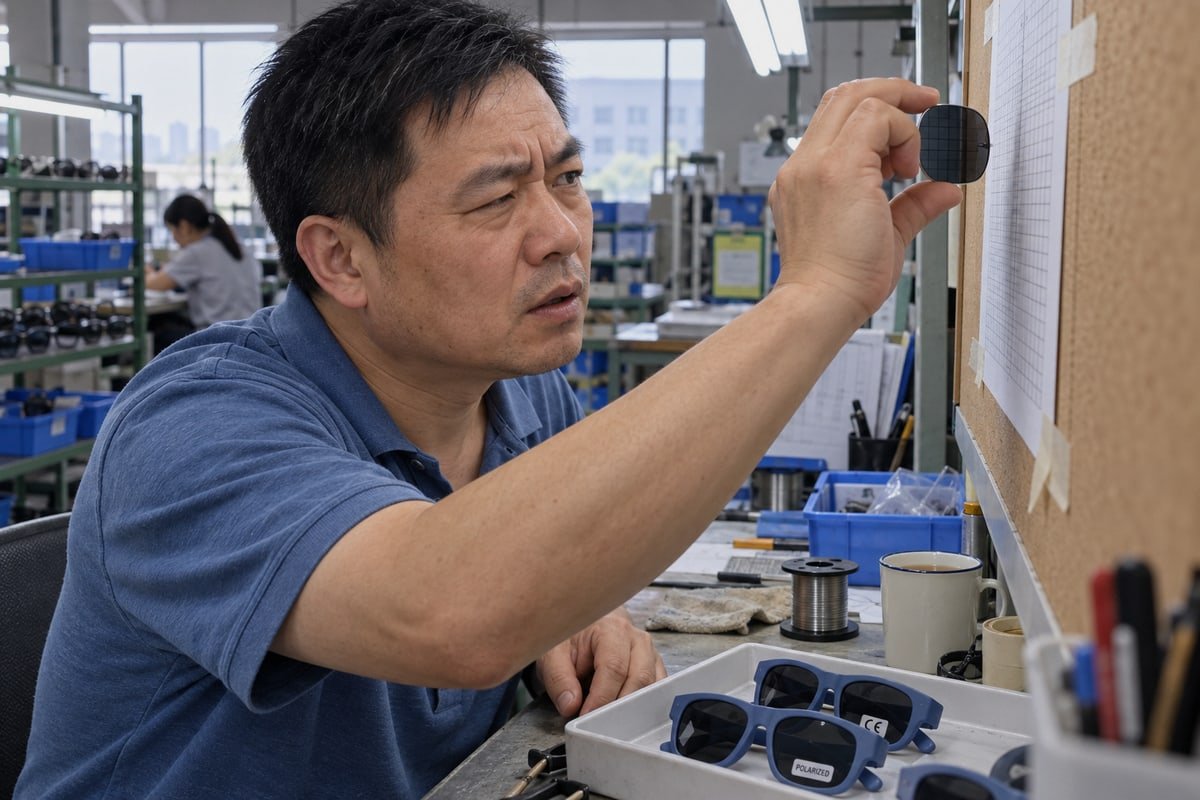
Substandard lenses are the most common reason a child sees "weird." The frame gets blamed because the frame is what the parent can touch. But the lens is what the child looks through. So I always start there.
Start with the lens material, not the price
Most kids sunglasses use one of three lens types. The first is TAC polarized lenses, which are a laminated film stack. The second is polycarbonate lenses, which are tough and light. The third is low-grade acrylic sheet, which is cheap. Each behaves differently.
Polycarbonate has a lower Abbe value than CR-39 or glass. That means it spreads colors more. On thick or highly curved lenses, the child can see color fringing at the edges. This is chromatic aberration. It is not dangerous, but it feels strange, and a child will call it "blurry."
Low-grade acrylic has a different problem. The sheet is often thermoformed with poor thickness control. The result is "waves." Light refracts unevenly across the lens, and straight lines bend. This is the exact fault our grid test caught.
TAC polarized lenses can be excellent. But if the film is laminated with uneven pressure, the polarization is patchy. The child gets dark spots and light spots. The brain tries to balance them, and that effort feels like dizziness.
| Tipo de lente | Typical use in kids sunglasses | Main distortion risk | What to ask the supplier |
|---|---|---|---|
| TAC polarized lenses | Polarized styles, glare reduction | Uneven film lamination, patchy blackout | Polarization efficiency, axis, film source |
| Lentes de policarbonato | Impact-resistant, sports styles | Chromatic aberration on curved lenses | Abbe value, base curve, thickness |
| Low-grade acrylic | Promotional or ultra-cheap styles | Thickness waves, peripheral blur | Thickness tolerance, grid test results |
Three bench tests you can run without a lab
- Grid test. Hold the lens over graph paper at arm's length. Move it slowly. Lines should stay straight to the edge.
- Cross-polarizer test. Put two polarized lenses face to face and turn one ninety degrees. Good lenses go evenly dark. Patchy dark means uneven film.
- Light-box tint match. Left and right lenses should show the same shade. A mismatch makes each eye work differently.
If your supplier cannot describe these tests, that tells you something. In our workshop these checks happen before lens insertion, not after a complaint.
Can Poor Frame Fitting Really Affect My Child's Vision Comfort?
A buyer from Australia once sent back samples that were optically perfect on our bench. Kids still complained. The bridge sat too low, so every lens sat below the pupils.
Yes. Frame fit decides where a lens sits before the eye. A slipping bridge, an over-wide temple, or wrong pantoscopic tilt moves the optical center away from the pupil. That creates a prismatic effect, induced astigmatism, or visual swim, even with good lenses.
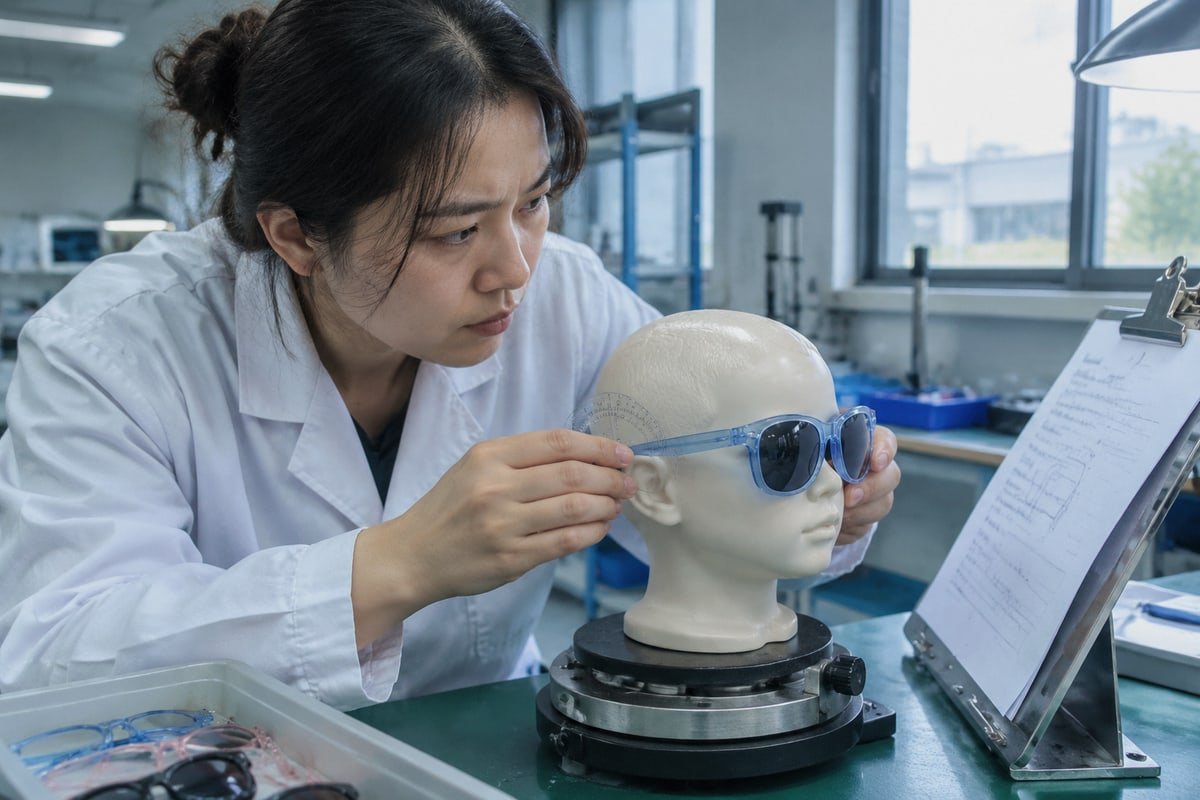
That return taught me that lens quality and frame fit are two separate problems. A pair can pass one and fail the other. Parents cannot tell the difference. They just see a child pulling the sunglasses off.
Is the flexible material the real problem?
Buyers often raise one objection here. They say a soft TPEE frame feels "unstable," so the material must be causing the dizziness. I understand why they think that. But flexibility only matters when it changes lens position.
Here is the honest part. A fully soft TPEE front can bow under slight pressure, for example when a child pushes the sunglasses up onto the forehead. That bow warps the lens and shifts the focal point away from the eye. Ultra-soft fronts can also micro-vibrate when a child runs. That gives a high-frequency visual jitter, and the brain's balance system does not like it. This is a real vestibular-visual mismatch, and it feels like motion sickness.
So we do not deny the effect. We design around it. Many of our children's styles use a TR90 front with TPEE temples. The TR90 front holds the lens geometry stable. The TPEE temples flex, survive chewing, and stay gentle on small ears. The material stays safe, and the optics stay put.
Four fit parameters that move the optical center
| Fit parameter | What goes wrong on a child's face | What the child reports | O que verificar |
|---|---|---|---|
| Pupillary distance 1 vs. lens optical center | Oversized frame puts centers far outside the pupils | Headache, "eyes feel pulled" | Measure PD range for the age group, match lens centers |
| Ângulo de curvatura facial (curvatura da armação) | Low nose bridge makes lens hang at the wrong vertical angle | "Floor looks tilted," visual swim | Bridge height and pad shape for flat bridges |
| Medição B | Lightweight frame slides down, distance changes with movement | Vision "shifts" when running | Temple grip, nose pad friction, weight balance |
| Ângulo de curvatura da armação | High curvature without decentered lenses | Fishbowl edges, curved lines | Lens decentration matched to wrap |
Growth changes fit faster than you think
A frame that fits at age four can sit wrong at age six. The face widens, the bridge rises, and the temple angle changes. The optical center drifts.
One useful rule for your customer service team: mild oddness from a new tint or new polarization usually fades within days to a week. If a child still complains after that week, the problem is fit or lens, not adaptation. Children rarely say "blurry." They say "my head feels funny" or they feel sick. Treat that as an optical complaint.
What Lens Quality Standards Should I Require From My Manufacturer To Avoid Dizziness Complaints?
Every quotation forces a choice between lens cost and optical consistency. We weigh that trade-off on each order, because a cheaper lens sheet can wipe out a brand's review score.
Require UV400 protection, a stated lens material with an Abbe value, matched base curve between lens and frame, decentered lenses on any wrapped frame, a left-right optical center tolerance, polarization efficiency checks, and grid-distortion inspection on every batch. Ask for these in a written specification before you approve samples.
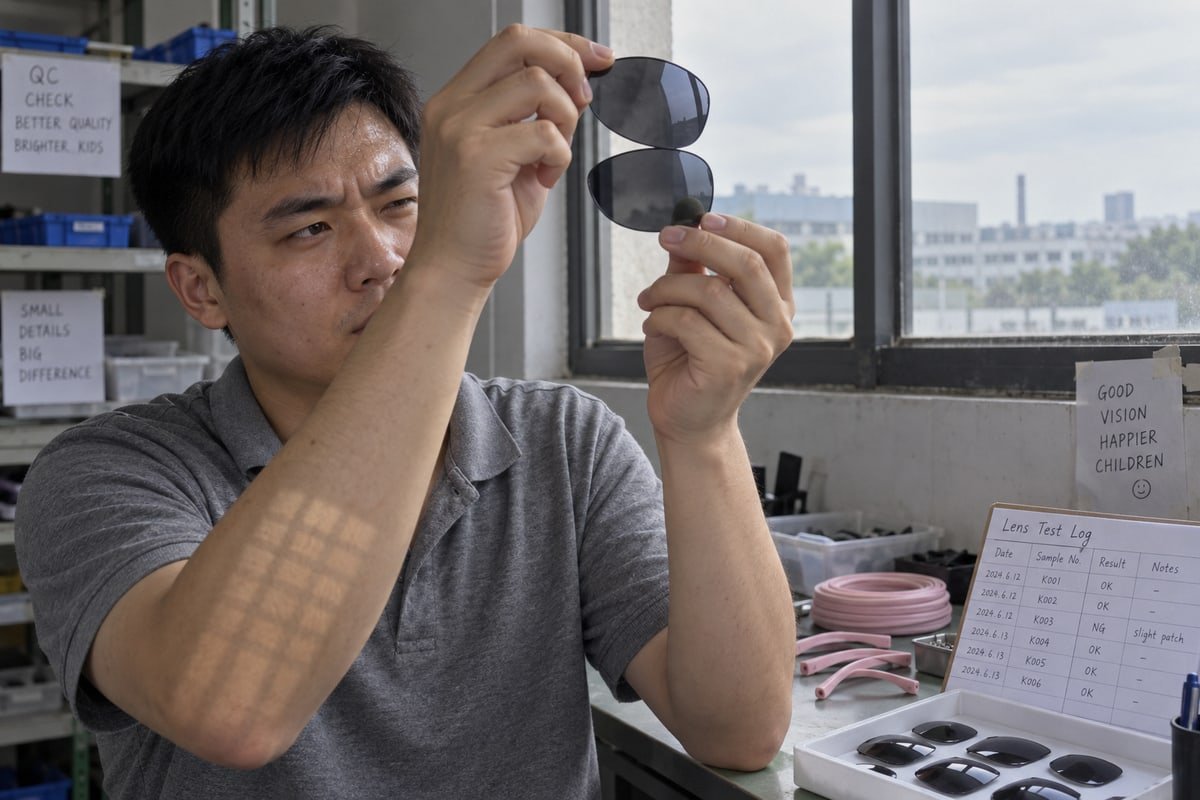
A spec sheet protects both sides. It tells us what to build. It tells you what to reject. Vague words like "good quality lens" protect nobody. Here is the list I recommend to product managers who send us a brief for TR90 and TPEE kids sunglasses.
The seven items that belong in your written specification
- UV400 as the baseline. This is non-negotiable for children. Tint without UV blocking is worse than no sunglasses, because the pupil opens wider behind a dark lens.
- Named lens material and Abbe value. "Polarized" is a feature, not a material. Ask whether it is TAC polarized lenses, polycarbonate lenses, or something else, and ask for the Abbe value.
- Refractive power tolerance. A sunglass lens for a child without a prescription should be plano. Ask for near-zero sphere and cylinder, checked on a lensmeter. Unwanted power means the sheet was formed badly.
- Lens base curve matched to the frame. If the lens base curve does not match the frame curve, the frame forces the lens to bend. That creates stress and distortion.
- Decentered lenses on wrapped frames. Any frame with a strong wrap angle needs lenses whose optical centers are shifted outward. Without that, the child gets the fishbowl effect at the edges.
- Optical center alignment tolerance. Ask for a maximum left-right difference and a target position based on the pupillary distance range of the age group.
- Polarization checks. Efficiency, axis orientation, and uniformity. The axis should block horizontal glare evenly across the whole lens.
Verification, not promises
| Especificação | Why it prevents dizziness | How to verify on samples |
|---|---|---|
| UV400 | Protects the eye; lets the tint do its job safely | UV meter reading, test report |
| Plano refractive power | Removes unwanted prismatic effect and blur | Lensmeter check on both lenses |
| Matched base curve | Stops frame from warping the lens | Curve gauge on lens and frame |
| Decentered lenses on wrap | Removes peripheral fishbowl distortion | Mark optical centers, compare to pupil positions |
| Polarization uniformity | Prevents blind spots the brain must compensate for | Cross-polarizer test under a light box |
| Grid distortion inspection | Catches thickness waves before shipping | Grid test on AQL sample per batch |
For market compliance, ask for reports to the standard your region uses. In Europe that usually means EN ISO 12312-1 2 behind the CE mark. Australia and New Zealand use AS/NZS 1067. The United States uses ANSI Z80.3. The polarized sticker on the lens should be backed by a report, not just printed.
Our OEM/ODM process supports all of this. Custom colors, logos, lens choices, and packaging are the visible part. The written optical spec is the part that keeps your inbox quiet after launch.
Why Does My Current TR90 Or TPEE Eyewear Batch Perform Inconsistently On Vision Clarity?
One lesson took us years to learn: a frame can leave the mold looking perfect and still squeeze the lens unevenly days later. Residual molding stress hides until it doesn't.
Batch inconsistency usually comes from process drift, not the material. Residual stress in TR90 injection molding, lens sheets from different lots, loose lens-groove tolerances, and hand insertion that bows the lens all change how each pair refracts light. Fix it with lot control, stress checks, and per-batch optical inspection.
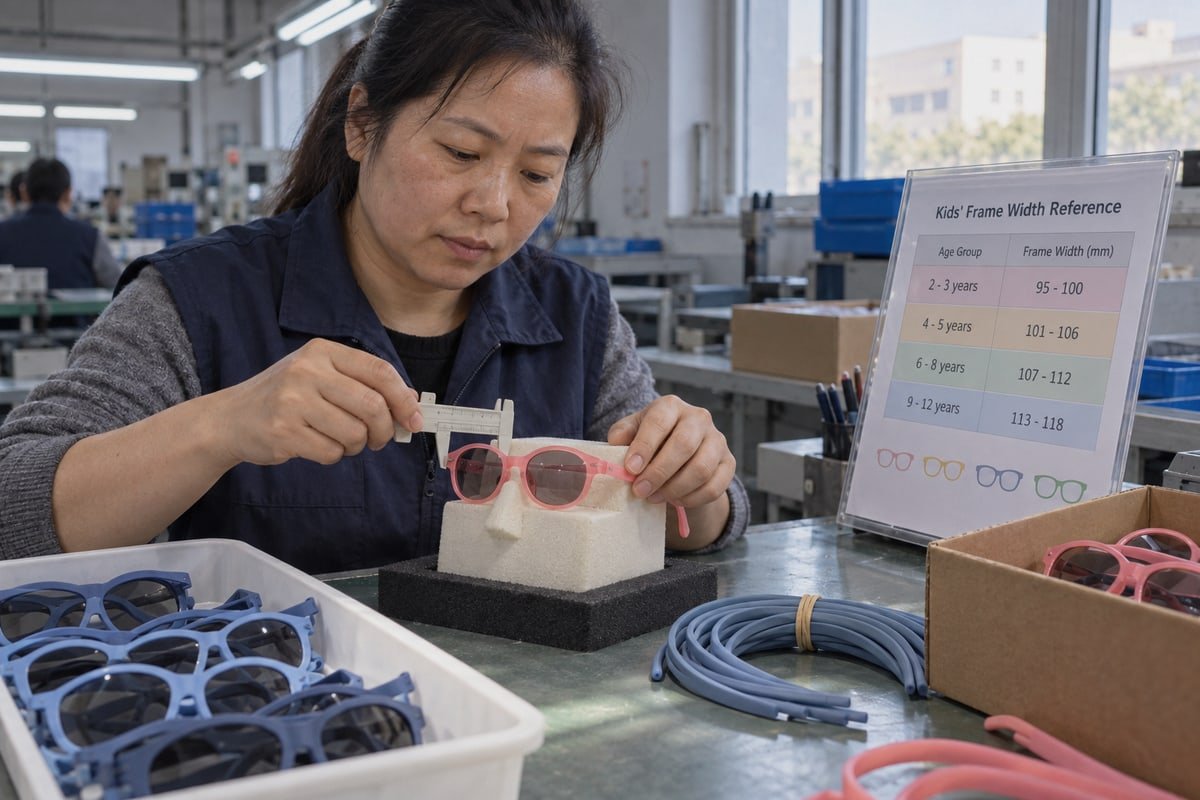
Inconsistency is the complaint that frustrates buyers most. The first sample was clear. Then the bulk order arrived, and a few pairs felt "off." Nothing looks different. So let me compare the two materials first, and then show where the drift comes from.
TR90 vs. TPEE: how each one affects lens position
| Propriedade | TR90 | TPEE | Effect on vision clarity |
|---|---|---|---|
| Stiffness | Firm but flexible thermoplastic | Soft, rubbery, chew-resistant | TR90 holds lens geometry better; TPEE fronts can bow |
| Typical age range | Older kids, optical frames, sunglasses | Babies and toddlers | Match material to how the child handles the frame |
| Molding risk | Residual stress if cooling drifts | Low stress, but dimensional creep under load | Both need groove tolerance control |
| Peso | Muito leve | Muito leve | Both can slip and change vertex distance |
| Our common build | TR90 front | TPEE templados | Stable optics, safe flex where it matters |
Neither material distorts light on its own. Both change vision only when they move the lens.
Where batch drift comes from
Residual molding stress. TR90 cools with internal stress. If mold temperature or cycle time drifts mid-run, some frames grip the lens harder on one side. The lens shows stress birefringence 3, which disrupts light waves. You can see it as rainbow bands under crossed polarizers.
Lens lot changes. Two lens sheets from different lots can differ slightly in thickness and curve. Mixed lots inside one order give you pairs with slightly different refractive power.
Groove tolerance and hand insertion. A lens groove that is a little tight forces the lens to bow during insertion. A groove that is a little loose lets the lens rock. Both shift the focal point.
Distância do vértice. Ultra-light frames slide during movement. Each slide changes the distance between eye and lens, so the effective power fluctuates as the child plays.
The batch control routine we run
- Lock one lens sheet lot per purchase order.
- Rest molded TR90 fronts before lens insertion so stress relaxes.
- Spot-check frames and lenses under crossed polarizers for stress birefringence.
- Run the grid test on samples from each carton, not just the first pair.
- Keep a retained sample for every order for future comparison.
Our workshop runs on 5S discipline, with around 120 workers and fifteen years of eyewear experience behind these routines. That is also why we can offer around 800 existing styles with confidence: each style already has a proven groove spec and lens curve, so a new brand can launch without a mold and still get consistent clarity from carton to carton.
Conclusão
Dizziness complaints hurt a kids' brand fast. In our experience, frame material is rarely guilty. Demand optical center alignment, matched base curves, controlled lenses, and batch checks.
Interested in sourcing the products mentioned in this article? See details and request a quote here:
Notas de rodapé
1. Authoritative health source explaining the measurement of distance between pupils for optical alignment. ↩︎
2. Official ISO standard page for eye and face protection requirements for sunglasses. ↩︎
3. Scientific explanation of how internal stress in materials causes optical distortion. ↩︎
Mais Artigos que Você Pode Gostar


Procurando um Parceiro Confiável em Óculos Infantis?
Explore mais de 800 estilos prontos e suporte completo OEM/ODM adaptado à sua marca.
Entre em Contato English
  Español de México
  Deutsch
  Français
  日本語
日本語  العربية
  Português do Brasil