What Does a TPEE Kids Sunglasses Warranty Cover, and What Counts as User Damage?
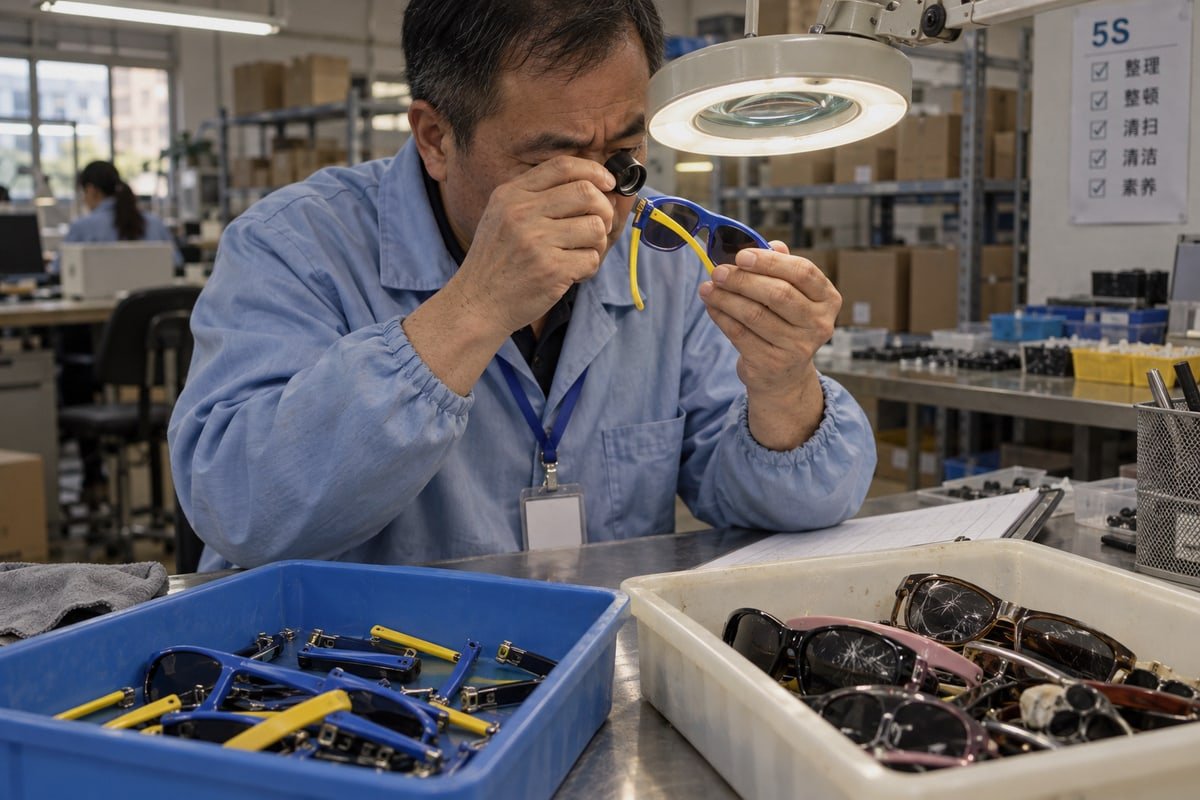
Every week, our Taizhou production line fields the same question about a TPEE kids sunglasses warranty: a pair broke, is it covered? Guess wrong, and refunds eat your margin.
A TPEE kids sunglasses warranty covers manufacturer defects in materials and workmanship, such as failed hinges, split frames, and peeling lens coatings, usually for one year. User damage means scratches, impact cracks, heat warping, chewing, loss, or misuse, and it is excluded unless a separate accidental-damage plan applies.
The rest of this guide walks through the four questions buyers ask us most. I will show what we cover, what we do not, what you can negotiate, and what paperwork gets a claim approved fast.
How Do I Know if a Defect Is Covered by My Supplier's Warranty?
Last spring our QC team pulled a batch where the hinge screws had been under-torqued. That is a defect. A pair snapped under a school bag is not.
A defect is covered when the failure comes from materials or workmanship rather than use: hinges that loosen without impact, frames that split along a mold line, lens coatings that bubble or peel, or color that fades early. Your supplier will check the failure point, production lot, and timing.
The three tests we apply to every returned pair
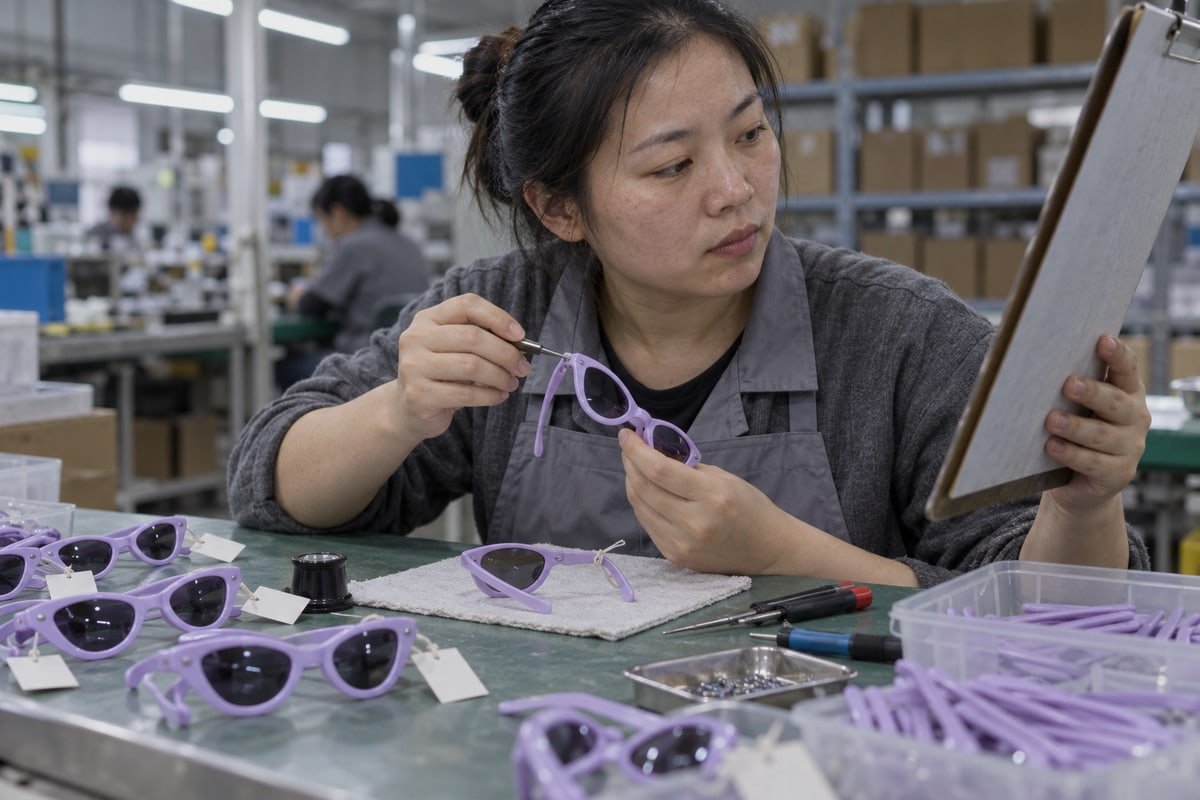
When a pair comes back to our factory, the QC team asks three questions. First, where did it fail? A clean split along a mold line points to a material or molding issue. A jagged break in the middle of the temple points to bending force. Second, when did it fail? A hinge that loosens in the first weeks of light use looks like an assembly problem. The same hinge after a year of daily play looks like wear. Third, does the lot show a pattern? If several pairs from one production lot show the same fault, that is a manufacturer defect, and we replace them without debate.
Covered vs. not covered: quick reference
| Cenário | Likely classification | Covered by a basic defect warranty? |
|---|---|---|
| Frame splits at the hinge under light use | Defeito de fabricação | Sim |
| Polarized lens coating peels or bubbles | Defeito de fabricação | Sim |
| Temple pin falls out within the first month | Workmanship defect | Sim |
| Lenses scratched from daily use | User wear | Não |
| Frame warped on a hot car dashboard | User neglect | Não |
| Chew marks from a child or pet | User damage | Não |
| Lost or stolen pair | Not a product failure | Não |
Material behavior that is not a defect
Thermoplastic Polyester Elastomer is soft and springy. That is why we use it for armações flexíveis 1 and temples on children's faces. But two behaviors of this material get mistaken for flaws. One is material creep. Over years of use, the frame can stretch slightly and lose lens tension. That is a physical property, not a defect. The other is surface tackiness. Some chemical compounds in sunscreens react with the TPEE surface and make it feel sticky. We see this on returned pairs every summer. It usually wipes off with mild soap, and it is not covered.
A 1-year defect window 2 is the common standard in the eyewear trade. Our brand partners 3 in Europe and Japan mostly use that window as a starting point. Anything outside it, or anything caused by handling, falls to the customer.
What Kind of Damage Will My Supplier Consider Normal Wear and Tear?
When we set lens specs, we weigh a harder revestimento resistente a arranhões against resistência ao impacto 4. Harder coatings scratch less but can craze. Neither choice makes scratches a warranty item.
Normal wear and tear includes lens scratches from daily use, small nicks and scuffs on the frame, gradual loosening of temple tension, fading from sun exposure, and dulling of the gloss finish. These changes come from ordinary handling over time, not from a flaw, so standard warranties exclude them.
Four buckets of damage
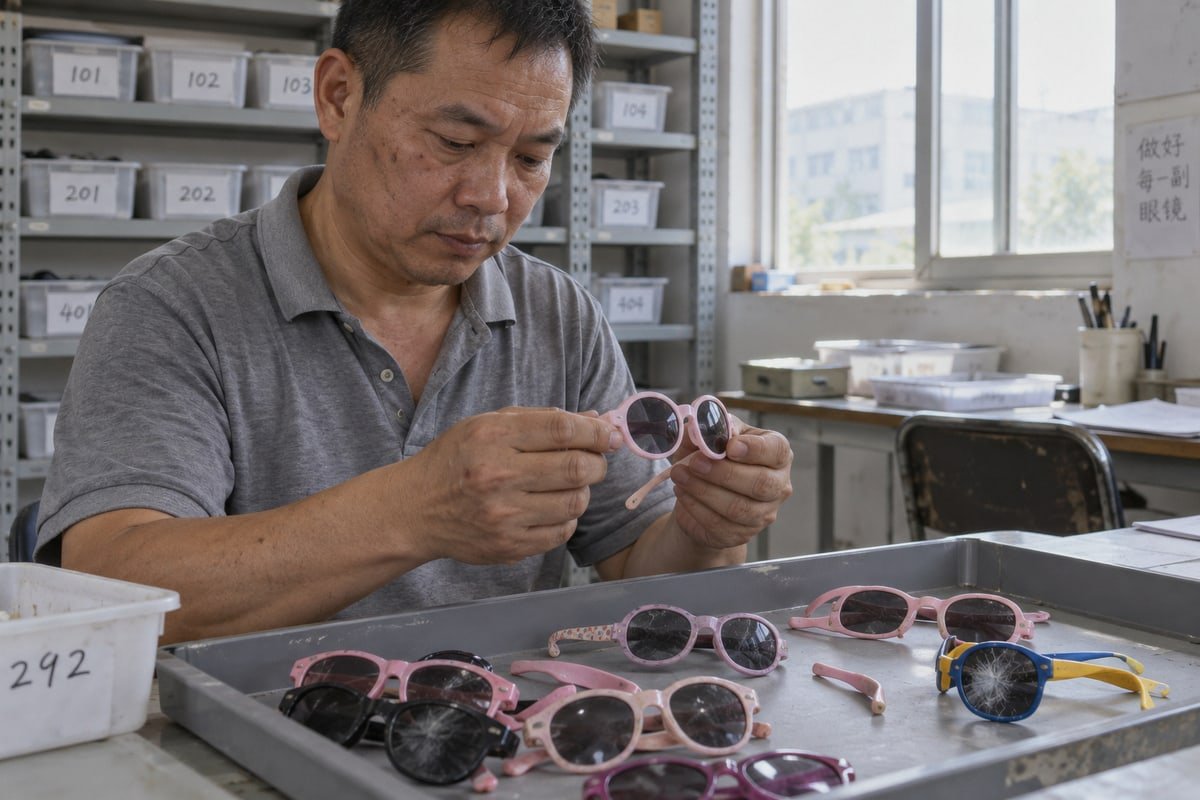
Not all damage is equal. We sort it into four buckets before we decide anything.
| Balde | Exemplos | Who pays under a standard policy |
|---|---|---|
| Wear and tear | Fine lens scratches, scuffed temple tips, faded color, loose fit after long use | The customer |
| Quebra acidental | Stepped-on frame, cracked lens from a fall, snapped hinge from a backpack | The customer, unless a protection plan applies |
| Neglect or misuse | Heat warping, chewing, chemical damage, unauthorized repairs | The customer |
| Defeitos do fabricante | Mold flaws, weak hinge assembly, bubbling coatings, material impurities | The supplier |
The first three buckets are all user damage. Only the fourth is our responsibility under a basic policy.
Why scratches are always wear
Lens scratches are the most common claim we see, and they are the most consistently rejected. A scratch-resistant coating slows scratches. It does not stop them. Kids drop glasses lens-down on concrete and sand. Even shatterproof lenses with strong impact resistance will scratch when dragged across a table. So scratches sit in the wear bucket unless the brand buys a separate scratch plan for a limited period.
Thermal memory: fix it before you file
TPEE has a useful property we call thermal memory. If a temple has bent out of shape from being sat on, gentle, controlled warmth lets it return toward its molded form. We show our brand partners how to describe this in their care leaflets. It resolves many minor deformations without any claim. It does not fix warping from a car dashboard. That heat is far beyond controlled warmth, the damage is permanent, and it counts as user neglect.
The parent objection
Parents argue that kids' products deserve more accident coverage. They have a point. Children drop, bend, and scratch far more than adults. Our answer is not to stretch the definition of a defect until it means nothing. It is to help the brand offer a separate accident layer, which I cover next.
Can I Negotiate a Custom Warranty Policy for My Brand's Kids Sunglasses?
A baby-brand buyer in Australia once asked us for unconditional replacement on every pair. We said no to that, but yes to a one-time accidental replacement with a copay.
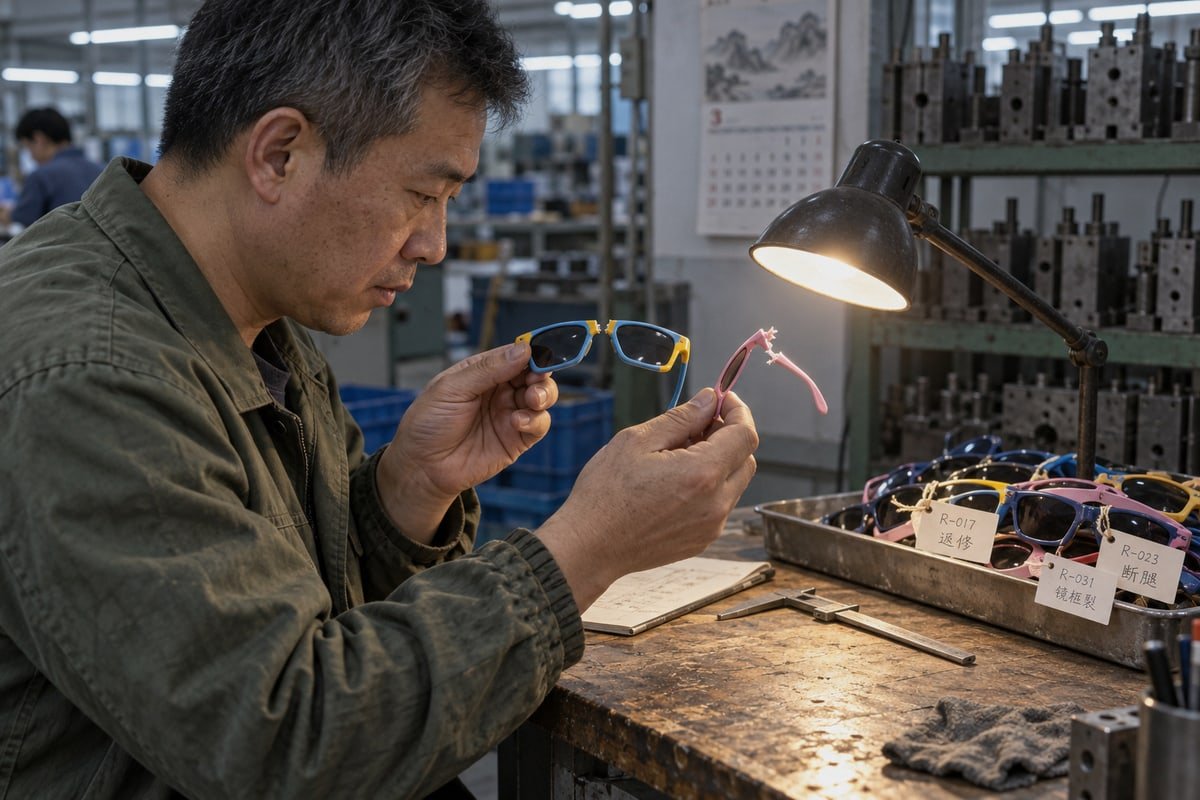
Yes. Most OEM/ODM suppliers will negotiate a custom warranty policy for a brand's kids sunglasses. Typical options include a longer defect window, a spare-parts allowance, a one-time accidental replacement for children under 12, or a circularity return program. Each extra layer is priced into the unit cost.
Three tiers we can build
| Policy tier | O que cobre | Impacto de custo típico | Melhor para |
|---|---|---|---|
| Basic defect warranty | Manufacturer defects for 1 year | Incluído | Wholesalers, promotional buyers |
| Free child replacement plan | One-time replacement for accidental breakage, kids 12 and under | Small per-unit allowance, often funded by spare parts | Kids' and baby brands |
| Paid protection plan | Breakage, chips, excessive scratching, extended exchange window, with a copay | Sold to the parent at retail | Optical retailers, premium brands |
How we make the middle tier affordable
The middle tier is where most of our brand partners land. Two things make it work. First, our roughly 800 existing styles share many common components. Temples, hinge pins, and lens sets can be ordered as spares alongside the main run. A brand that keeps a small spare-parts stock can honor a replacement policy for accidental breakage without buying whole new pairs. Second, TR90 frames with TPEE temples fail in predictable places. After 15 years of making eyewear, we know which parts to stock and which to skip.
The retailer objection
Retailers and importers worry that generous coverage invites abuse and drives replacement costs up sharply. That is a fair concern. We resolve it with limits, not refusal. One replacement per pair. A copay. An age cap of 12. A requirement to return the damaged pair. These rules keep the plan honest while still reducing purchase anxiety for parents, which is the whole reason the plan exists.
Circularity as a warranty feature
A newer option is a circularity program. Outgrown or damaged frames go back to the brand for recycling, and the parent gets a loyalty discount. This turns a claim into a repeat sale. It also fits how we already position the material as environmentally friendly and BPA-free. We can print the return instructions on the packaging and lens cloth as part of full OEM/ODM support, alongside custom colors, logos, UV400 protection lenses, and accessories. The two-tone blue-and-yellow frame in our catalog, for example, has run under three different brand policies without a single mold change.
What Documentation Do I Need to File a Successful Warranty Claim?
We learned the hard way that a blurry photo of a broken temple settles nothing. Now every claim from our brand partners starts with a lot number and three pictures.
A successful warranty claim needs proof of purchase with the date, the product SKU and production lot number, clear photos or video of the failure point, a short description of how the damage happened, and the warranty registration record if your program requires one. Ship samples back when asked.
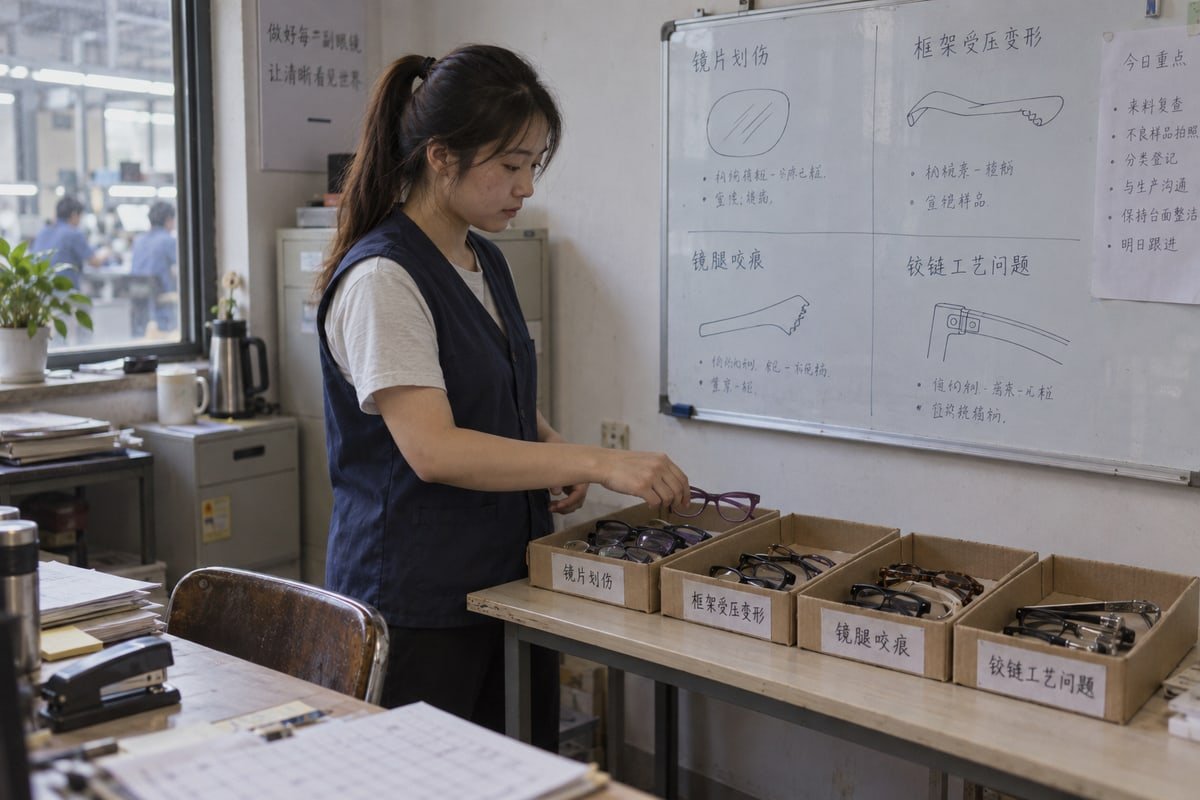
The five-step claim process
- Confirm the product. Send the SKU, color code, and production lot number. On most of our styles, the lot and CE marking are engraved on the inner left temple, so a close photo of that spot is enough.
- Prove the date. Attach the invoice or retail receipt. The 1-year defect window starts at the sale date the brand and supplier agreed on, not the day the child first wore them.
- Show the failure. Three photos: the whole pair, the failure point up close, and the opposite side for comparison. Video helps for loose hinges.
- Describe the event. One or two honest sentences. "Hinge came loose during normal wear" is different from "frame was stepped on." Both are fine to say. Only one is covered.
- Return samples when asked. For lot-level issues we need physical pairs to test on our line and compare against retained samples.
What each document does
| Documento | Por que importa | Who provides it |
|---|---|---|
| Proof of purchase | Sets the warranty clock | Parent or retailer |
| SKU and lot number | Links the pair to a production record and retained sample | Brand, from the temple engraving |
| Photos or video | Distinguishes defect from user damage | Parent or retailer |
| Warranty registration | Required by some protection plans | Parent, at purchase |
| Return sample | Lets the factory test the failure | Marca |
Why warranty registration helps everyone
Warranty registration is optional in a basic defect policy. It becomes important when a brand runs a protection plan. Registration ties the pair to a child, a date, and an age, which enforces the under-12 rule and the one-replacement limit. It also gives the brand a customer list for the circularity program later. We help partners design a registration card that fits inside the retail box, next to the lens cloth and the care leaflet. When the paperwork is complete, most claims are settled within one round of emails. When it is missing, the same claim can drag for weeks.
Conclusão
Flexible frames reduce breakage, but a TPEE kids sunglasses warranty still covers defects, not every accident. Define both clearly with your supplier before launch, and claims stop hurting.
Interested in sourcing the products mentioned in this article? See details and request a quote here:
Notas de rodapé
1. Technical overview of eyewear construction, including the use of flexible frames for durability and safety. ↩︎
2. The FTC provides legal frameworks for businesses regarding the duration and coverage of product defect warranties. ↩︎
3. The European Commission provides guidance for brand partners on compliance with EU safety and customs regulations. ↩︎
4. ISO 12312-1 defines the international requirements for the impact resistance and physical integrity of sunglasses. ↩︎
Mais Artigos que Você Pode Gostar



Procurando um Parceiro Confiável em Óculos Infantis?
Explore mais de 800 estilos prontos e suporte completo OEM/ODM adaptado à sua marca.
Entre em Contato English
  Español de México
  Deutsch
  Français
  日本語
日本語  العربية
  Português do Brasil