What Structural Support Do TR90 & TPEE Kids Sunglasses Need for Sports Use?
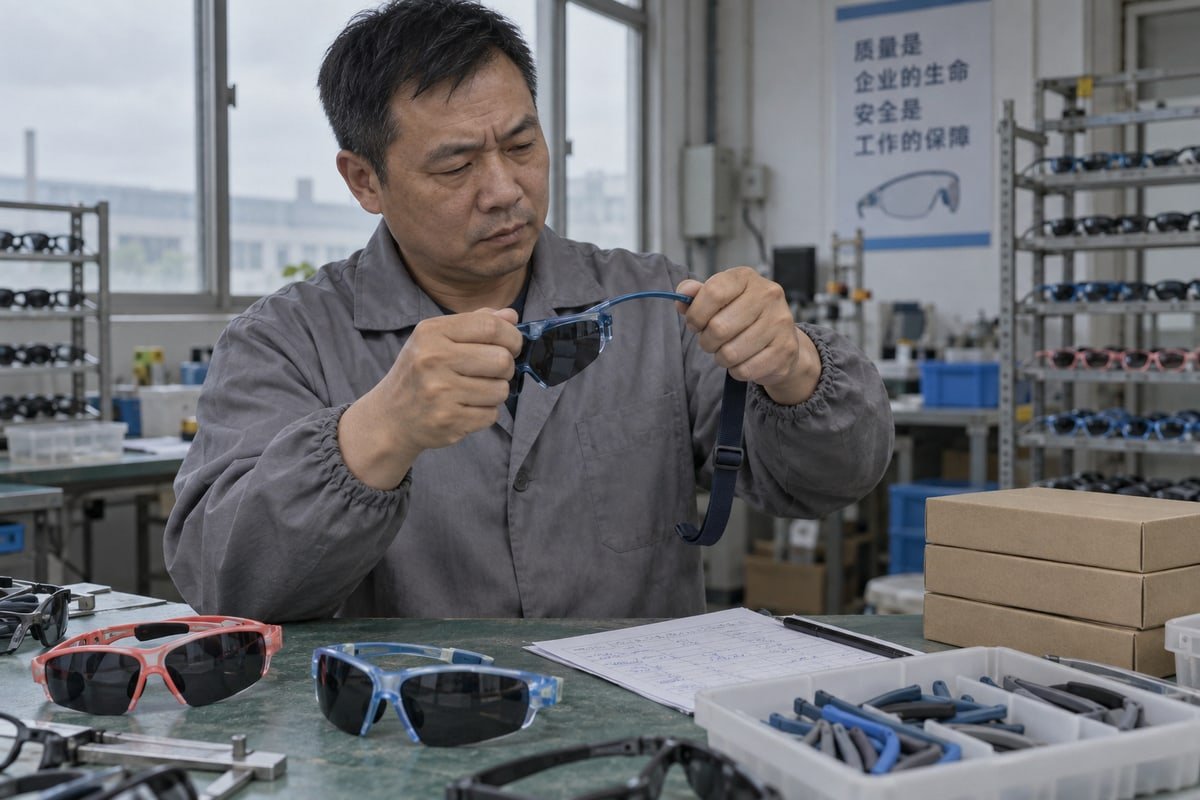
Structural support for TR90 & TPEE kids sunglasses decides whether a sports pair survives one season material safety reports 1. On our production line I have watched lenses pop and temples sag; better architecture fixes both.
Structural support for TR90 & TPEE kids sports sunglasses means a stable wrap-around front, snap-fit lens channels holding shatterproof polycarbonate lenses, screwless or reinforced hinges, controlled-flex temples, anti-slip nose pads, and an adjustable elastic strap so the frame stays seated during running, cycling, and ball sports.
Flexibility gets all the marketing attention. Yet flexibility alone does not keep a frame on a moving child. In this article I will walk through the four structural areas that matter most, and show you what to ask your supplier about each one.
How do I choose the right hinge and temple design for kids' sports sunglasses that won't loosen with movement?
Last spring our QC team pulled a batch from the line because one temple did not return fully to its original position after flexing. That small drift is how sports frames start loosening.
Choose screwless or reinforced safety-lock hinges, TR90 temples with built-in flex zones for torsion flexibility, and a curve that grips behind the ear near the mastoid area. Add TPEE or rubber temple tips and an optional adjustable elastic strap for high-motion sports.
Why hinges are the first thing to loosen
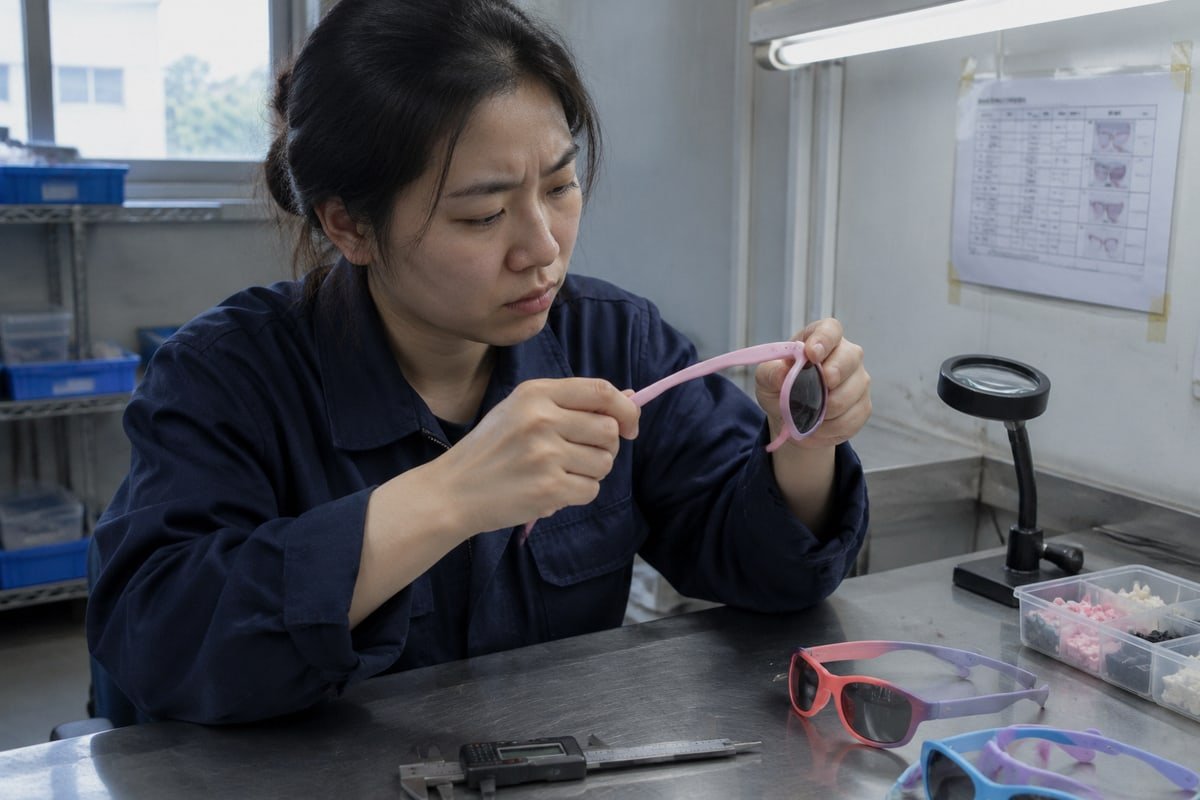
Kids grab sunglasses by one arm. They pull them off with one hand. They sit on them. Each of these actions puts a twisting load through the hinge. A standard screw hinge slowly backs out under that load. Once the screw loosens, the temple wobbles, and the frame no longer holds side pressure against the head. Our casual wayfarer styles, like the translucent coral-to-lavender gradient frame with matte pink temples, use simple metal rivet hinges. That is fine for the playground and the beach. For baseball or cycling we move buyers to a different architecture.
| Tipo de dobradiça | How it behaves in sports | Small-parts risk | Melhor uso |
|---|---|---|---|
| Metal rivet hinge | Stable but can loosen after repeated twisting | Baixo | Casual and fashion wear |
| Screw hinge | Adjustable but screws back out over time | Médio | Optical frames with service access |
| Screwless snap hinge | No fastener to loosen, flexes and returns | Muito baixo | Youth sports and toddlers |
| Safety-lock or breakaway hinge | Releases under extreme force, then re-seats | Muito baixo | Contact and ball sports |
Temple geometry that stays put
A temple should not clamp the ear. It should curve so the lateral pressure lands on the flatter bone area behind the ear, near the mastoid. This spreads the load and keeps the temple compatible with helmets and batting masks. TR90 is a shape memory polymer 2, so it can hold this curve through heat, sweat, and repeated bending. TPEE is softer and bends further, but on its own it can lose lateral pressure faster. In our TR90 frames with TPEE temples, the TR90 front holds shape while the TPEE arm cushions the head. We add a controlled flex zone near the hinge so a one-handed pull bends the temple instead of snapping it.
When to add a strap
For running, cycling, and baseball, I recommend an adjustable elastic strap that clips to the temple tips. It does not replace a good temple design. It backs it up. We supply straps as an OEM accessory so brands can bundle them in retail-ready packaging.
What nose bridge support features should I look for to keep TR90 & TPEE frames secure during active play?
A procurement manager from Australia once sent us photos of a competitor's frame sliding down a toddler's nose mid-run. The bridge had no grip and no shape.
Look for a low, wide stress-distribution bridge shaped for children's flatter nasal bridges, hydrophilic anti-slip nose pads in rubber or silicone that grip more as kids sweat, integrated or co-molded pads that cannot detach, and a wrap-around frame design that shares load with the temples.
Children's noses are not small adult noses
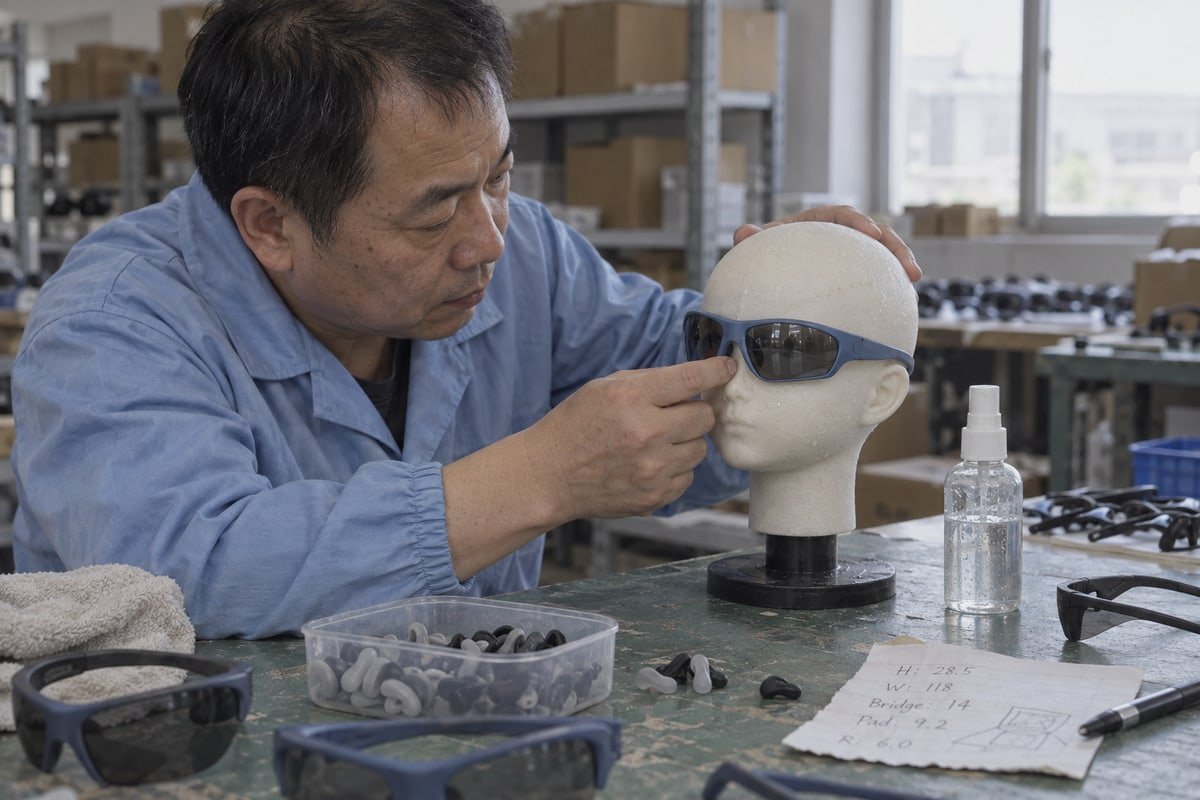
Adult frames are scaled down too often. A child's nasal bridge sits lower and flatter. If the bridge is shaped for an adult, the frame rests on the cheeks instead of the nose. Then the frame bounces with every step and slides forward under the small G-forces of running or braking on a bike. We design our children's bridges with a wider contact area so the load spreads across the nose instead of pinching one point. This is what many buyers call stress-distribution bridge architecture. It also protects comfort, which matters for kids who are sensitive to pressure.
Grip that increases with sweat
Dry plastic on a dry nose has some grip. Dry plastic on a sweaty nose has almost none. Hydrophilic rubber or silicone pads do the opposite. They grip harder as moisture builds. On sports lines we prefer pads that are co-molded into the bridge rather than glued, because a glued pad is a small part that can peel off and end up in a toddler's mouth.
Weight, wrap, and the TPEE question
Weight is part of bridge support. Product examples for TR90 sports frames often list total weights under 20–22 grams. A light frame has less mass to bounce, so the bridge has less to fight. A wrap-around frame design helps too. When the front curves with the face, the temples and bridge share the retention load instead of the bridge doing all the work.
Buyers sometimes tell me that TPEE must be the right choice for young children because it is softer. Softness on the skin is real, and we use TPEE for that reason. But a bridge molded entirely in very soft TPEE can compress and lose its shape under a helmet strap or after a hot afternoon. My practical answer is this:
- For toddlers in casual play, a full TPEE frame is soft, forgiving, and comfortable.
- For active kids in sports, keep the bridge and front in TR90 so the geometry holds.
- Add TPEE or silicone only where skin contact and cushioning matter: nose pads and temple tips.
That combination gives you the grip of soft material and the stability of a structured front.
How can I ensure the lenses stay impact-resistant and securely mounted for sports safety standards?
Every lens spec sheet forces one trade-off: a thinner lens is lighter and cheaper, but a thicker polycarbonate lens survives a baseball. We weigh this on every sports project.
Specify shatterproof polycarbonate lenses with UV400 protection, ask for testing against the ASTM F803 standard for sports eyewear, and require interlocking snap-fit lens channels or a locking bezel so lenses cannot push inward toward the eye during impact or pop out during frame twisting.
Pick the lens material first
Frame strength is only half the safety story. A tough frame with a brittle lens is still a hazard. Here is how the common kids' lens options compare for sports use.
| Material da lente | Resistência ao impacto | Peso | Typical use in kids' eyewear |
|---|---|---|---|
| Policarbonato (PC) | Very high, shatterproof | Leve | Sports, safety, active kids |
| TAC polarized | Good, resists cracking | Muito leve | Casual polarized sunglasses |
| Acrylic / standard plastic | Low, can shatter | Leve | Fashion or promotional only |
For sports, I steer buyers to shatterproof polycarbonate lenses. Sources widely describe polycarbonate as far more impact-resistant than standard plastic. Our TAC polarized lenses, which you see with the "POLARIZED" sticker on our translucent sky-blue and gradient pink styles, are excellent for glare and everyday wear. For a ball-sport line we move to polycarbonate, and we can still offer polarized or UV400 versions.
Mounting matters as much as material
The lens-frame junction is the most common failure point in flexible kids' frames. If the lens is held by friction alone, repeated bending opens the groove. Then the lens pops out during a twist, or worse, pushes inward toward the eye during a collision. Ask for one of these instead:
- Interlocking snap-fit lens channels with a raised inner lip that blocks inward travel.
- A locking bezel or wrap shield where the lens is captured, not just seated.
- Lens groove tolerances checked on every batch, not just on the first sample.
Standards, fog, and honest claims
O padrão ASTM F803 3 covers eye protectors for selected sports. If your target market or retailer references it, request test reports for the specific model and lens thickness. Do not accept a general claim. Ask your supplier about ventilation channels or air-flow ports in the frame too, because a fogged lens is a safety issue during intense play. Finally, treat "unbreakable" as a marketing word. TR90 and polycarbonate 4 are highly resistant to breakage in normal sports use. Neither is a guarantee against failure.
What flexibility and durability tests should I request from my manufacturer to confirm the frame withstands rough sports use?
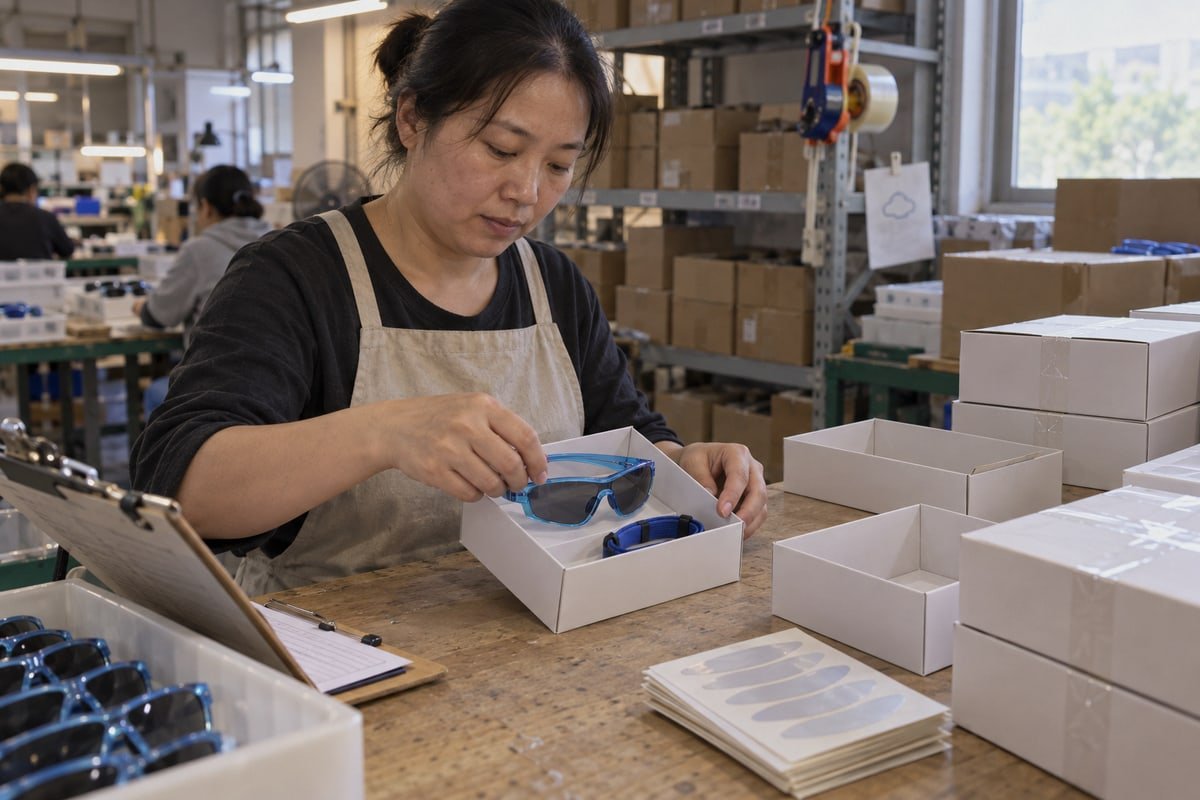
Fifteen years in eyewear taught me one thing: a frame that bends once in a showroom proves nothing. Repeated cycles, heat, and twist reveal the truth.
Request repeated temple flex cycling, torsion flexibility and shape-recovery checks, hinge open-close cycling, lens retention push-out tests, drop tests, heat and sweat aging, and material safety reports for BPA-free construction. Ask for documented pass criteria and photos of samples before and after testing.
The test list I recommend to buyers
A single bend demo shows flexibility. It does not show fatigue. Rough sports use is about repetition, so every test on this list should run many cycles, not one.
| Teste | O que prova | What to ask your supplier for |
|---|---|---|
| Temple flex cycling | Flex zones survive repeated one-handed pulls | Cycle count and post-test return-to-shape check |
| Torsion and shape recovery | Front and temples act as a shape memory polymer, not a soft bag | Photos before and after twist, measured spread of temples |
| Hinge open-close cycling | Screwless hinges keep tension over time | Cycle count and tension comparison |
| Lens push-out and pull-out | Lens channel resists inward and outward force | Pass/fail criteria for both directions |
| Teste de queda. | Frame and lens survive falls onto hard floors | Height, surface, number of drops, orientation |
| Heat and sweat aging | Wrap geometry and grip hold after hot cars and sweaty days | Exposure conditions and post-test fit check |
| Segurança do material | Frame and pads meet BPA-free construction and your market's chemical rules | Test reports for the exact material lot |
How to run the request
- Send the supplier your target sports and age range. Toddler play and youth cycling need different pass levels.
- Ask which tests are already part of their routine QC and which need a third-party lab.
- Agree on the pass criteria in writing before sampling starts.
- Request the same tests on production samples, not only on the pre-production prototype.
- Keep a retained sample from each order so you can compare later batches.
What this looks like in a real factory
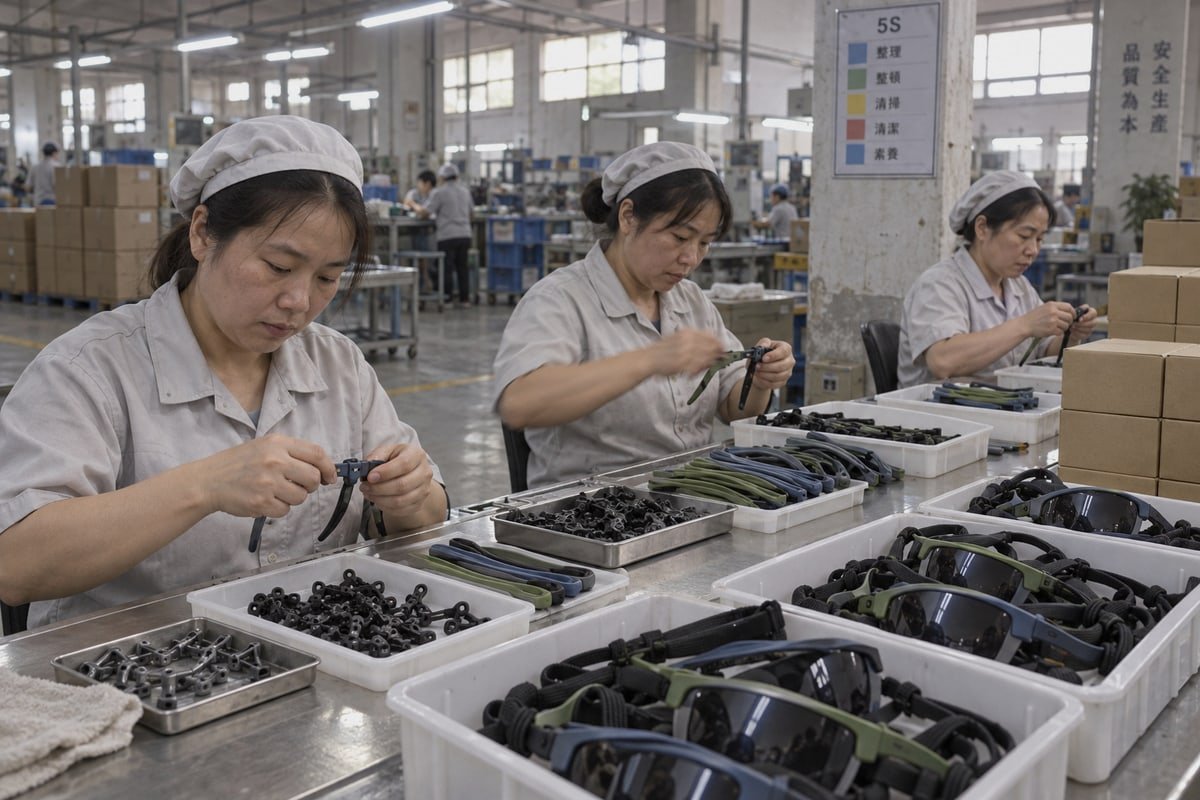
Em nosso oficina gerenciada por 5S 5, flex and hinge cycling are part of routine checks on flexible styles. Buyers who start with one of our roughly 800 existing styles can test real samples in weeks, without paying for a new mold first. That lowers risk while the tests run. When a brand later wants a custom color, logo, lens, or strap accessory, we repeat the relevant tests on the modified version. A change as small as a thicker temple tip can shift how the frame recovers from torsion, so I never assume the old report still applies.
Conclusão
Kids sports sunglasses fail at hinges, bridges, and lens seats, not at the polymer label. Choose structure first, then material, and demand documented tests from your manufacturing partner.
Interested in sourcing the products mentioned in this article? See details and request a quote here:
Notas de rodapé
1. Authoritative source for safety documentation and compliance standards in manufacturing and material handling. ↩︎
2. Scientific technical overview of shape memory polymers, the material class for TR90 frames. ↩︎
3. Official authority for the ASTM F803 standard governing safety requirements for sports eye protectors. ↩︎
4. FDA resource for impact-resistant lens materials and safety standards in protective eyewear. ↩︎
5. Updated EPA link for 5S methodology. ↩︎
Mais Artigos que Você Pode Gostar

Procurando um Parceiro Confiável em Óculos Infantis?
Explore mais de 800 estilos prontos e suporte completo OEM/ODM adaptado à sua marca.
Entre em Contato English
  Español de México
  Deutsch
  Français
  日本語
日本語  العربية
  Português do Brasil