What to Report to the ACCC Within 2 Days for Kids’ Sunglasses Eye Injuries Under ACL?
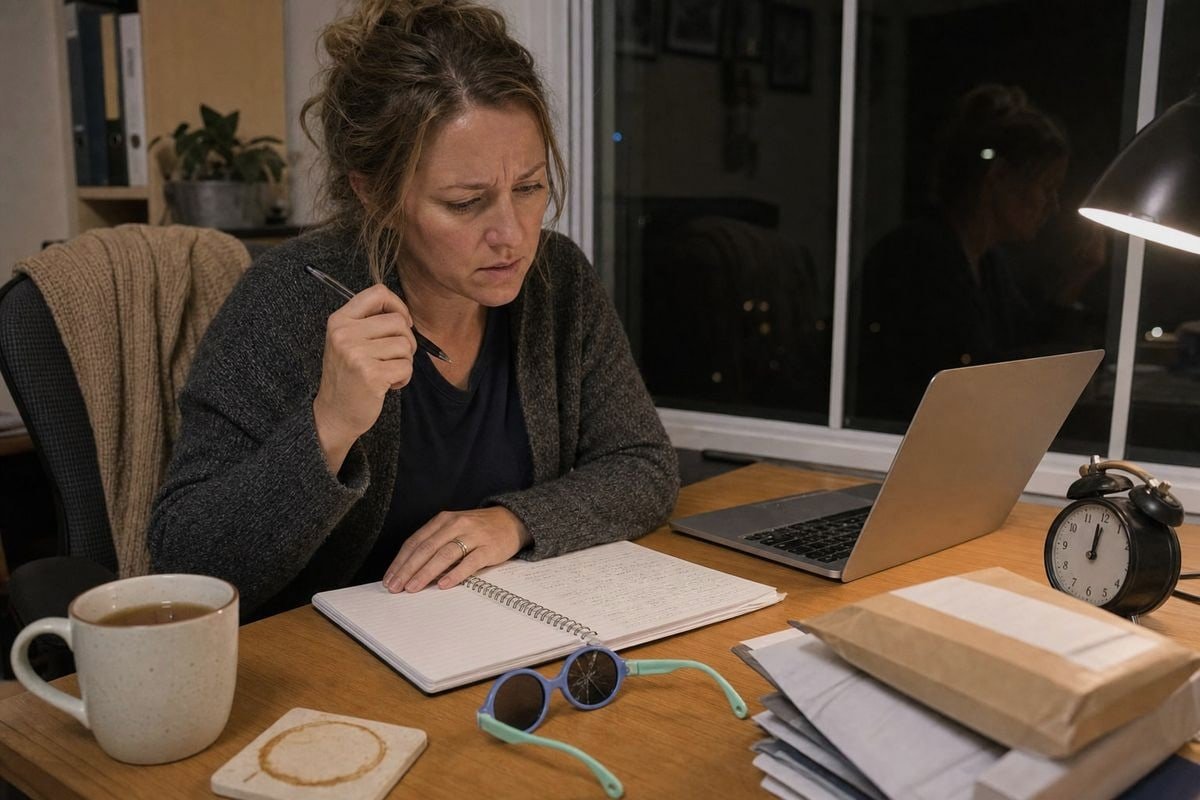
ACCC mandatory injury reports scare many of our Australian buyers medical or surgical treatment 1. One eye injury complaint 2 arrives, the 2-day clock starts, and panic follows. I have watched it happen — and helped brands prepare so it never derails them.
Under the ACL, suppliers must report to the ACCC within 2 days of becoming aware that kids’ sunglasses caused, or may have caused, a serious injury requiring medical or surgical treatment. The report must identify the product, describe the incident and injury, and include supplier details.
That is the short answer. But the details matter. Below, I break down what goes into the report, when an eye injury crosses the legal threshold, what happens if you miss the deadline, and how the right factory partner reduces your risk.
What information do I need to include in my ACCC mandatory injury report?
A procurement manager from Melbourne once emailed us at 11 p.m. her time. A customer claimed a broken lens had scratched a child's eye strict liability offence 3. Her first question was simple: what do I actually put in the report? Our batch records answered half of it within an hour.
Your ACCC mandatory injury report must identify the consumer goods (brand, model, batch), describe when and where the incident happened, explain the mechanism and nature of the injury, state what medical treatment was needed, and provide your supplier and contact details — to the best of your knowledge.
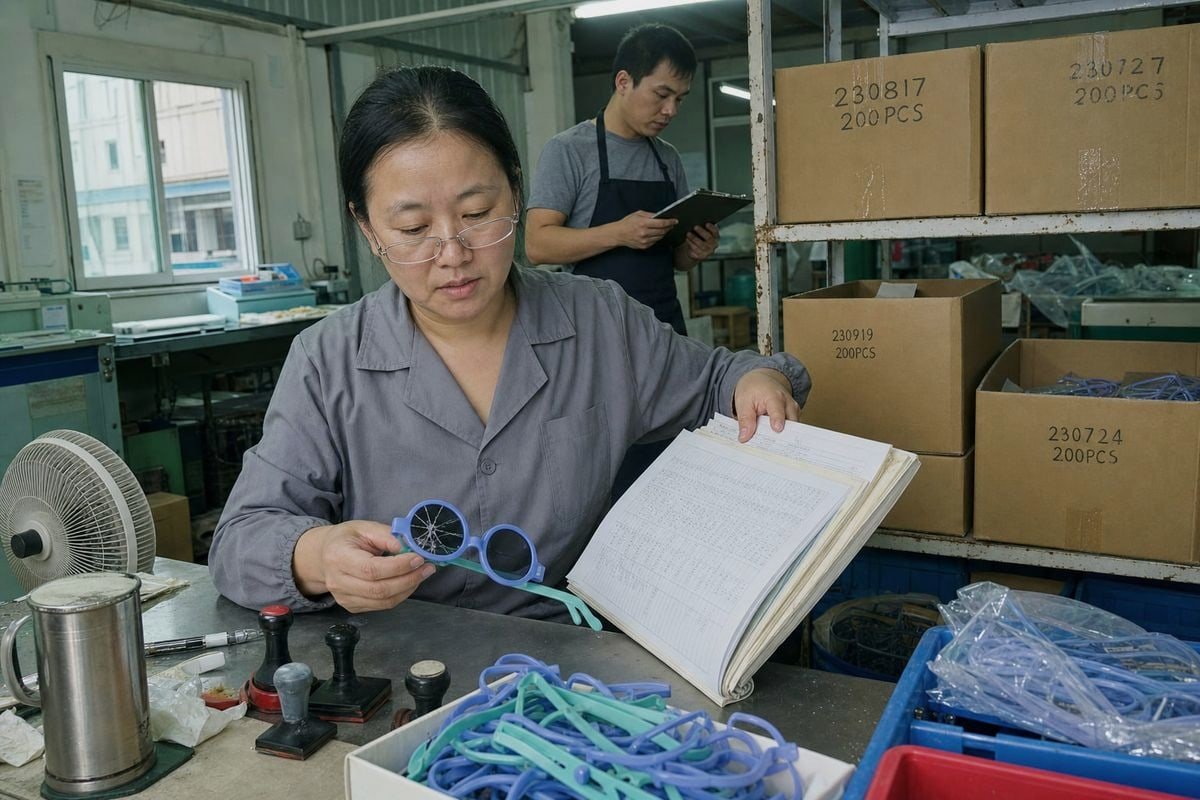
The ACCC's online mandatory reporting form walks you through the required fields step by step. It covers report details, product details, supplier details, injury details, and contact details. The structure of that form tells you exactly what the regulator expects you to know quickly. In my experience supplying children's eyewear to brands in more than 20 countries, the businesses that struggle are the ones who cannot trace a product back to a batch within 48 hours.
The core data points, field by field
| Report Section | What You Should Provide | Where It Usually Comes From |
|---|---|---|
| Product identity | Brand, model name, SKU, batch or lot number, whether sold as sunglasses or fashion spectacles | Your PO records and factory batch codes |
| Incident details | Date, location, and circumstances of the injury | Customer complaint, staff notes, or media reports |
| Injury mechanism | Did the lens break? Did the frame shatter? Did the child fall while wearing them? | Customer statement, returned product, photos |
| Injury and treatment | Nature of the eye trauma and the clinical treatment required | Information supplied by the consumer |
| Supplier details | Your legal entity, role in the supply chain, contact person | Internal records |
| History | Prior complaints, recalls, or similar incidents | Complaint logs and quality records |
One point I stress with every buyer: the ACL requires the report "to the best of your knowledge" at the time. You do not wait for complete facts. If the batch number is unknown on day one, you still file. You can supplement information later. Waiting for perfect data is the most common way suppliers blow the 2-day deadline. Keep the product sample, photos, and any medical notes the customer shares — they support both the product safety notification and any later investigation.
How do I know if a kids' sunglasses eye injury meets the ACL reporting threshold?
The trade-off I weigh constantly in frame design is stiffness versus give. A rigid frame holds its shape, but a flexible TPEE temple 4 bends instead of snapping near a child's eye. That engineering question maps directly onto the legal one: what kind of injury actually triggers mandatory reporting obligations 5?
An eye injury meets the ACL threshold when it is acute and requires medical or surgical treatment by, or under the supervision of, a medical practitioner or nurse. Minor redness or self-treated irritation does not qualify; corneal abrasions, lacerations, or embedded fragments needing clinical care do.
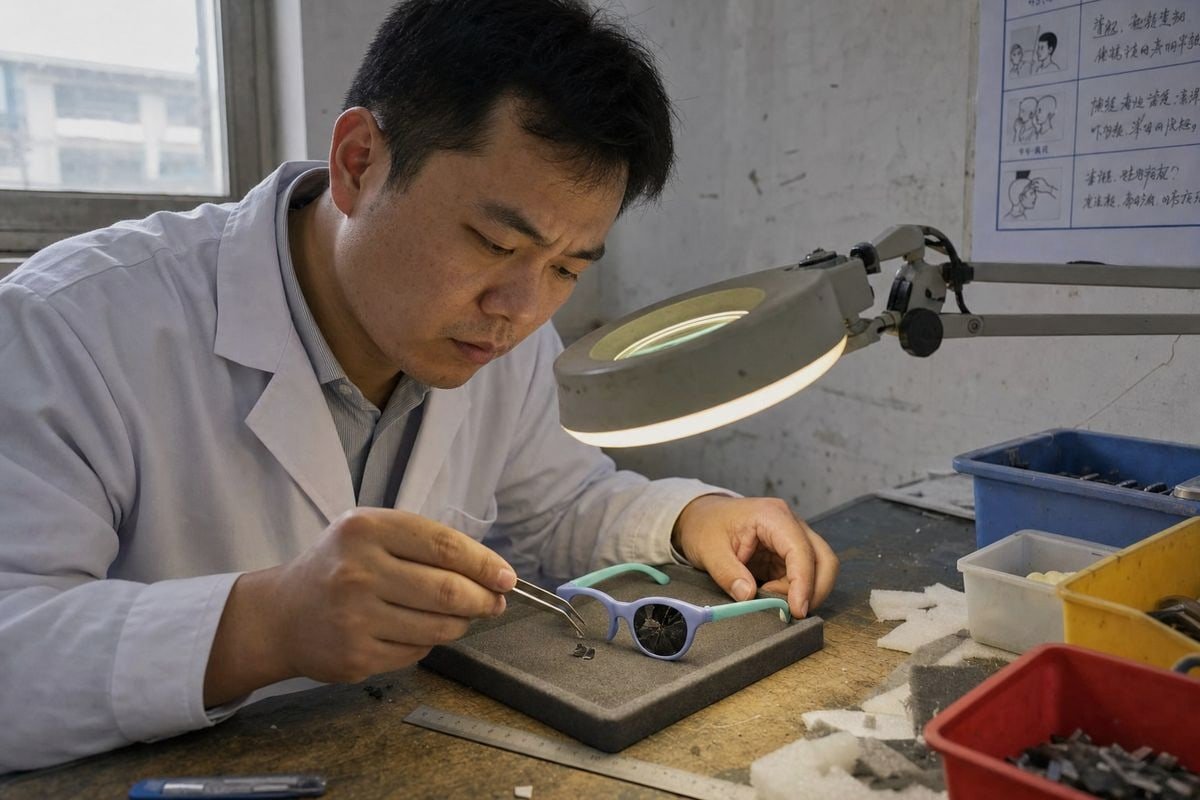
The line that matters is not "eye injury versus no eye injury." It is "medical treatment required or not." This is where many eyewear sellers get confused, so let me make it concrete with examples drawn from the kinds of incidents that get discussed in our quality reviews.
Reportable versus non-reportable eye incidents
| Incident Type | Likely Reportable? | Por quê |
|---|---|---|
| Corneal abrasion from a shattered lens, treated by a GP | Sim | Acute injury with medical treatment |
| Lens fragment embedded in the eye, removed at a clinic | Sim | Surgical or medical removal required |
| Laceration near the eye from a broken hinge, needing stitches | Sim | Acute injury treated by a practitioner |
| Temporary redness after wearing tight frames, resolved at home | Não | No medical treatment required |
| Mild discomfort from a poor fit, no clinical care | Não | Below the serious injury or illness threshold |
Two nuances deserve attention. First, the guidance indicates an injury is "serious" if it requires treatment — even if, in some views, the family never actually visited a doctor. If the injury is the kind that needs clinical care, treat it as reportable. Second, the trigger is "caused or may have caused." You do not need certainty. If the sunglasses were involved and any person believes they may have contributed — even in a case of foreseeable misuse, like a child falling while wearing them — the duty can apply. This is also why lens impact resistance and the AS/NZS 1067.1:2016 standard 6 matter at the sourcing stage: lenses that resist shattering rarely create acute eye trauma in the first place. When in doubt, the ACCC's own advice is to report.
What happens if I miss the 2-day reporting deadline for a product safety incident?
A hard lesson from fifteen years in this industry: deadlines you did not know had started are the ones that hurt most. The 2-day clock does not wait for your legal team to convene. It starts the moment anyone in your business becomes aware of the incident.
Missing the 2-day deadline is a strict liability offence under the ACL, exposing your business to significant fines without the ACCC needing to prove intent or negligence. It can also trigger regulator scrutiny, undermine product liability insurance claims, and damage retailer relationships.
Let me unpack how the clock actually works, because this is where compliant businesses stumble on technicalities. The day you become aware is not counted. So if a complaint lands on Monday, your report is due by end of Wednesday. If day two falls on a weekend or public holiday, the due date moves to the next business day. But "becoming aware" is broad. A frontline staff member reading a return note, a contractor seeing a social media tag on your brand page, an agent forwarding a media report — any of these can start the clock for the whole business.
Why enforcement risk is rising
The ACCC has renewed its focus on enforcing mandatory reporting obligations as a product safety priority. That changes the calculus for children's eyewear sellers. This is no longer a technical footnote in consumer product safety rules 7; it is an operational risk. And critically, every entity in the supply chain — manufacturer, importer, distributor, retailer — carries an independent duty to report the same incident. A retailer cannot assume the importer will handle it, and vice versa.
A practical readiness process
- Train frontline staff to flag any injury mention immediately, whatever the channel.
- Assign one named person who decides whether the 2-day clock has started.
- Monitor official social media pages daily, including comments and tags.
- Keep a template pre-filled with your supplier details and product data.
- Preserve the product, photos, and customer correspondence from day one.
- Log every complaint, even non-reportable ones, so patterns surface early — this record also supports product recall guidelines if escalation is ever needed.
One more objection I hear from buyers: "If I report, won't I be admitting fault?" No. The report is confidential and is not an admission of liability. The real liability risk runs the other way — a late or missing report is far harder to defend than a prompt, honest one.
Can working with a compliant manufacturer help me reduce the risk of reportable injuries?
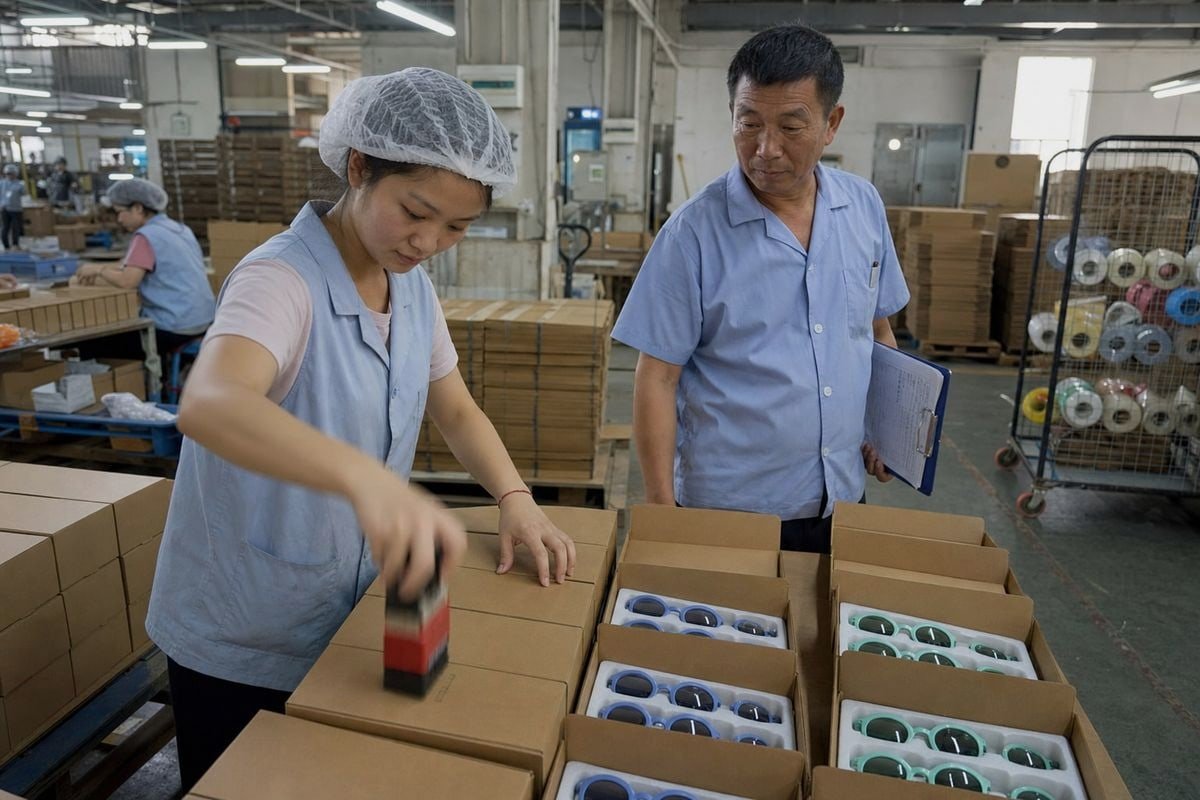
When we developed our armações TR90 8 with TPEE temples at our Taizhou factory, the design brief was blunt: a child will drop these, sit on them, and fall while wearing them. The frame must bend, not break. That single design decision prevents most of the incident types that end up in ACCC reports.
Yes. A manufacturer using flexible, shatter-resistant materials like TPEE and TR90, testing lens impact resistance against standards such as AS/NZS 1067.1:2016, and maintaining traceable batch records dramatically reduces both the likelihood of serious injuries and the difficulty of filing any required report.
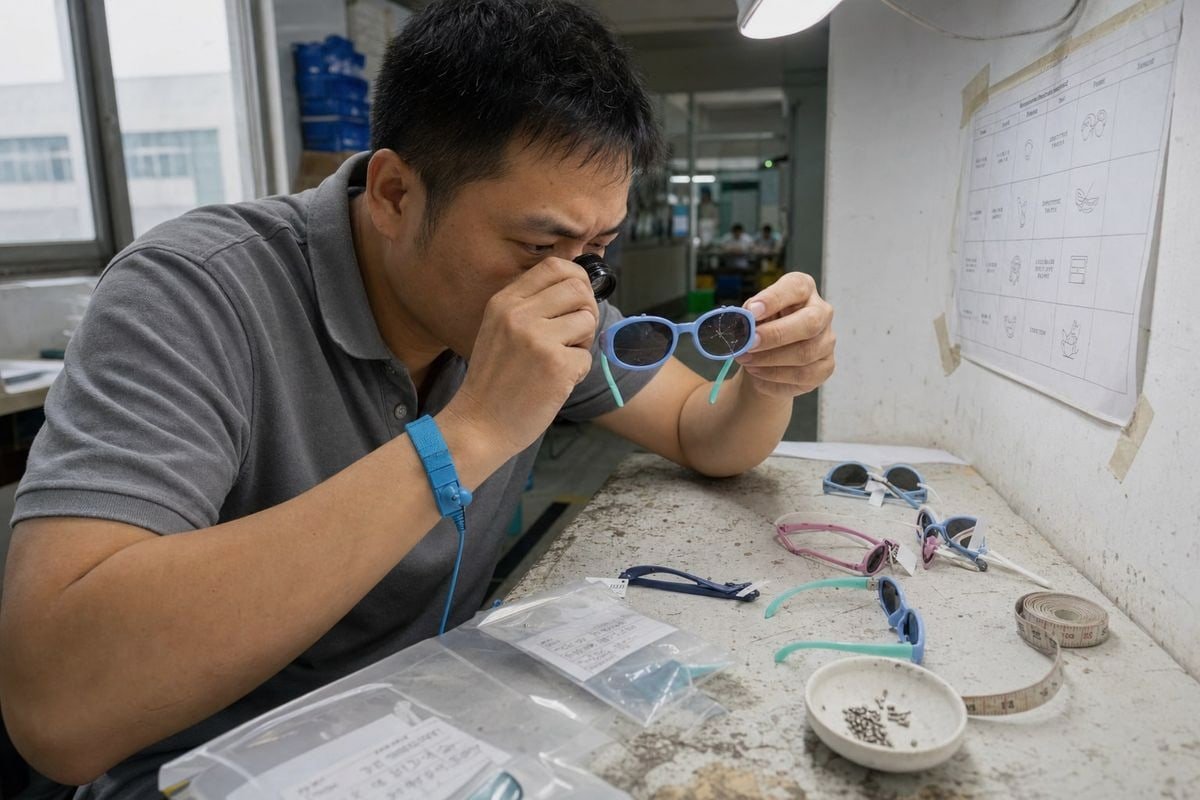
Think about what actually causes a reportable kids' sunglasses injury: a lens that shatters into sharp fragments, a frame that snaps at the hinge and leaves a jagged edge near the eye, or a rigid temple that gouges skin during a fall. Each of these is a material and construction choice made months earlier at the factory. Supplier compliance requirements start on the production line, not in the legal department.
How factory decisions map to injury risk
| Factory Decision | Injury Risk It Reduces | What to Ask Your Supplier |
|---|---|---|
| Flexible TPEE / TR90 frames | Snapped frames and sharp break edges near the eye | Can you demonstrate frame flex and return-to-shape? |
| Impact-tested UV400 or polarized lenses | Shattered lenses causing corneal abrasion | What lens impact resistance testing do you perform? |
| Smooth hinge and screw finishing | Lacerations from exposed hardware | How are hinge areas inspected in QC? |
| Batch and lot coding | Slow, incomplete mandatory reports | Can you trace any unit to a production batch? |
| Documented QC under 5S management | Inconsistent quality between shipments | What in-line and final inspection records do you keep? |
There is a market misconception worth resolving here. Some buyers assume that because they can pick from a big catalog — we offer around 800 existing styles so brands can launch without heavy mold investment — the safety engineering must be generic. The opposite should be true. Every style in a serious catalog should already embody flexible-material expertise, and full OEM/ODM support means custom colors, logos, lenses, and packaging get layered onto a proven safe base, not a cheap shell. A second misconception: "sustainable" frame materials are automatically safer. Environmentally friendly materials still need validation, because some biodegradable plastics degrade differently under UV exposure and can splinter. Ask for evidence, not adjectives. When your factory keeps traceable records and answers within hours, the 2-day deadline stops being frightening — it becomes a process you can execute calmly.
Conclusão
A serious kids' sunglasses eye injury means an ACCC report within 2 days. Know the threshold, prep your data, act fast — and source frames engineered to prevent the injury entirely.
Notas de rodapé
1. Australian Government Department of Health resources regarding clinical care and medical standards. ↩︎
2. Official ACCC guidance on how consumers and businesses handle product safety complaints. ↩︎
3. Legal definition of strict liability and its application in consumer protection law. ↩︎
4. Technical explanation of thermoplastic elastomers used for flexible, durable eyewear components. ↩︎
5. Comprehensive business guide for complying with mandatory injury reporting under the ACL. ↩︎
6. Detailed requirements for the mandatory safety standard governing sunglasses in Australia.
Mais Artigos que Você Pode Gostar
1 de agosto de 2026
A Fábrica Deve Lidar com a Embalagem e Rotulagem de Óculos de Sol Infantis, ou Usar um Fornecedor Designado?

1 de agosto de 2026
Armazém Próprio vs. Envio Direto do Fornecedor: Qual Reduz os Custos de Devolução para Marcas de Óculos de Sol Infantis?

1 de agosto de 2026
Armazém Direto ao Porto ou Estiva no Exterior: Qual Economiza Mais no Envio de Óculos de Sol Infantis?
Procurando um Parceiro Confiável em Óculos Infantis?
Explore mais de 800 estilos prontos e suporte completo OEM/ODM adaptado à sua marca.
Entre em Contato English
  Español de México
  Deutsch
  Français
  日本語
日本語  العربية
  Português do Brasil