What Are the Model Differences in Kids’ Sunglasses Across Age Groups?
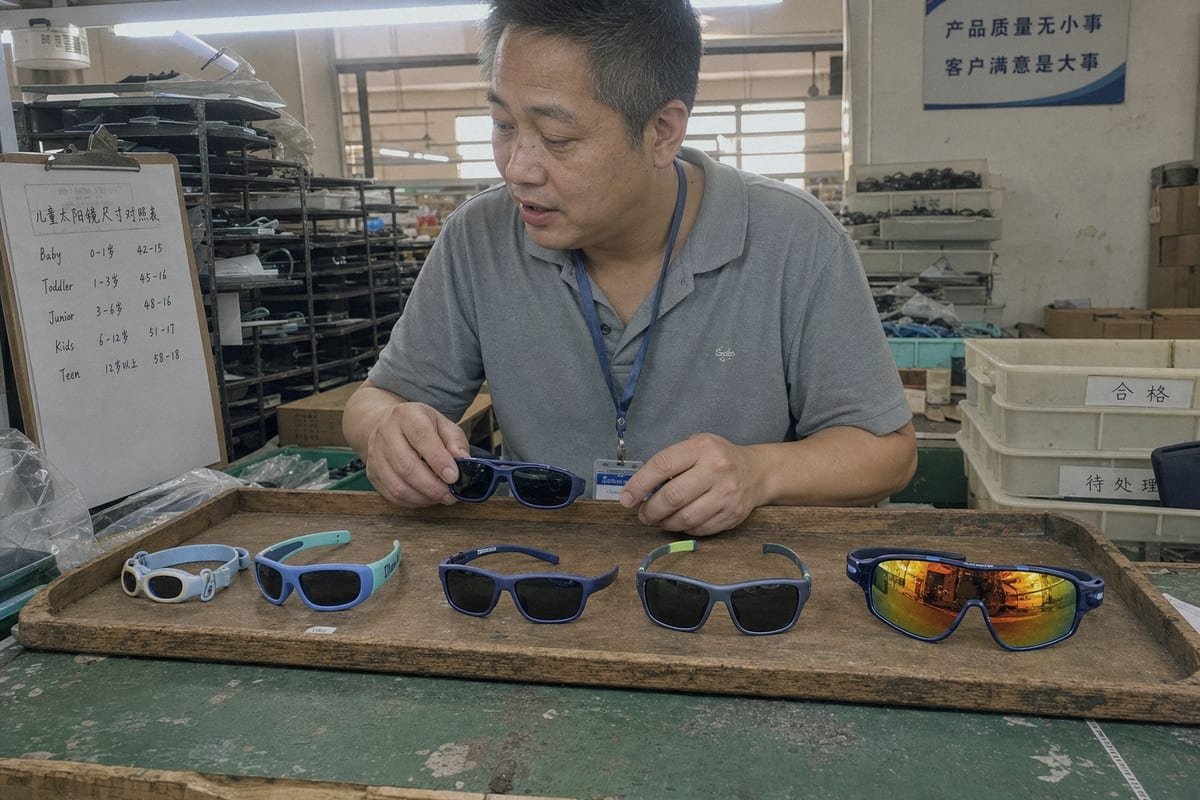
On our production line in Taizhou, I see the model differences in kids’ sunglasses every day. Many brands still order one generic size — and returns pile up when frames slip off toddlers or embarrass teens.
Kids’ sunglasses differ by age in frame size, retention method, material flexibility, and style. Babies need strap-secured, hinge-free flexible frames; toddlers need durable wrap-around designs; school-age kids need proper nose bridge fit plus style; teens need adult-like sport and fashion models. UV400 protection stays constant for all ages.
In this guide, I will break down each age group. I will cover sizing, lenses, materials, and sourcing. Everything comes from what we build for brand buyers every week.
How do frame sizes and fit change as my child grows from toddler to teen?
A buyer from Australia once asked me why her toddler samples fit her seven-year-old tester. The answer was simple: the factory she used before ignored age-based sizing entirely.
Frame sizes grow with the child. Lens width runs about 35–38 mm for babies, 40–42 mm for toddlers, 43–45 mm for ages four to seven, 45–47 mm for ages seven to ten, and 47–52 mm for tweens and teens. Retention shifts from elastic straps to fitted temples.
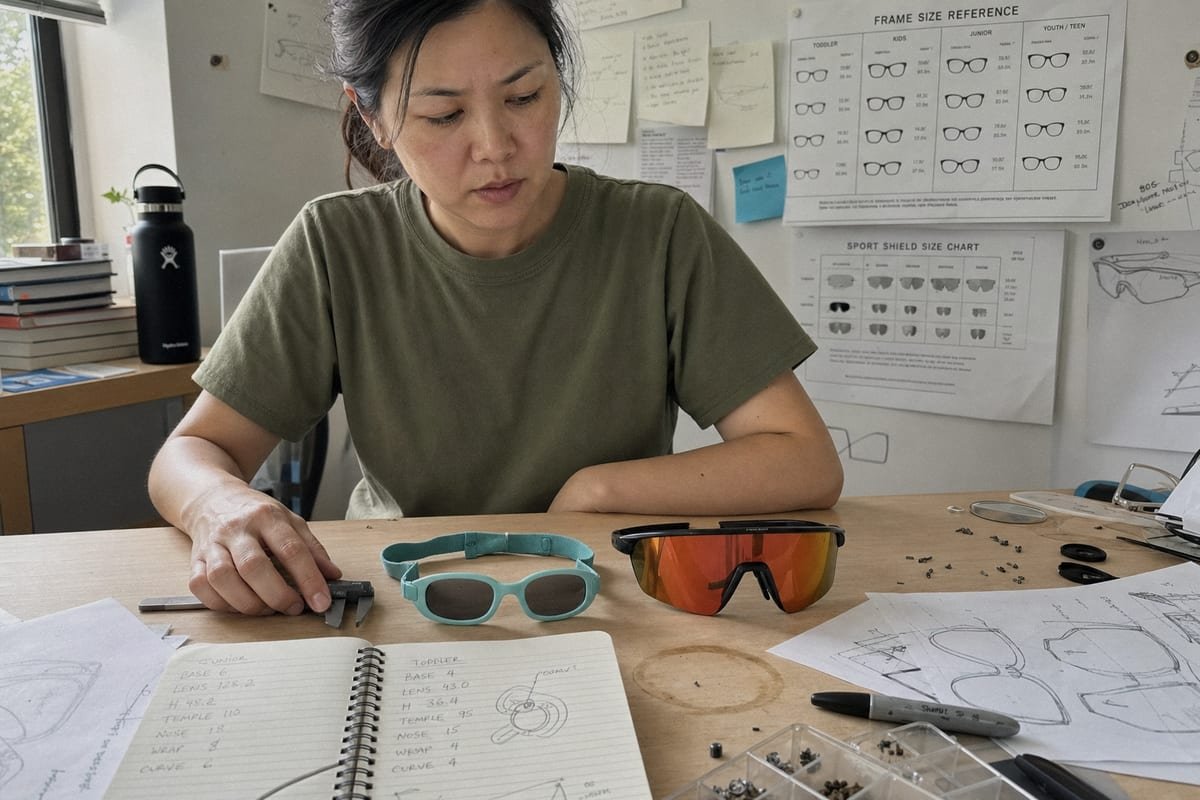
Fit is the single biggest reason kids' sunglasses succeed or fail in the market. A child's face is not a scaled-down adult face. Babies have a nearly flat nasal bridge. Toddlers have chubby cheeks that push frames upward. School-age kids develop a defined bridge, and teens approach adult proportions. Each stage demands a different frame geometry.
Sizing benchmarks we use in development
When we develop a new model at our factory, we start from these ranges. They come from measuring real children's faces, not from shrinking adult tooling.
| Faixa Etária | Typical Lens Width | Bridge Style | Retention Method |
|---|---|---|---|
| 0–2 years (baby) | 35–38 mm | Flat, wide, soft | Adjustable elastic straps |
| 2–5 years (toddler) | 40–42 mm | Low-bridge geometry | Strap optional, grippy temples |
| 4–7 years (junior) | 43–45 mm | Slightly raised bridge | Curved temple tips |
| 7–10 years (kids) | 45–47 mm | Standard kids bridge | Fitted temples, spring feel |
| 10–16 years (teen) | 47–52 mm | Near-adult bridge | Adult-style temples |
Why nose bridge fit matters most
A poor nose bridge fit ruins everything else. If the frame rests on the cheeks instead of the nose, the lenses fog, the child fidgets, and the glasses come off. For toddlers, we design a low-bridge shape that spreads weight across a wider soft pad. For teens, we move toward a defined bridge with a more precise contact point. Between those two stages, the transition should be gradual across your product line. Skipping a size band is the most common sizing mistake I see new brands make.
Retention also evolves. Adjustable elastic straps are essential for babies because they cannot hold glasses in place themselves. By school age, straps feel babyish, and kids reject them. Well-shaped temple tips do the job instead.
Which lens features matter most for different age groups’ eye safety?
During lens inspection last spring, we rejected a batch of tinted lenses that failed our UV transmission check. Dark tint, weak protection — a dangerous combination for children's eyes.
Every age group needs 100% UV400 protection and impact-resistant polycarbonate lenses. Babies and toddlers do best with non-polarized Category 3 tints; school-age kids benefit from polarized lenses near water or snow; teens can add mirrored coatings and sport-grade shatterproof lenses for performance.
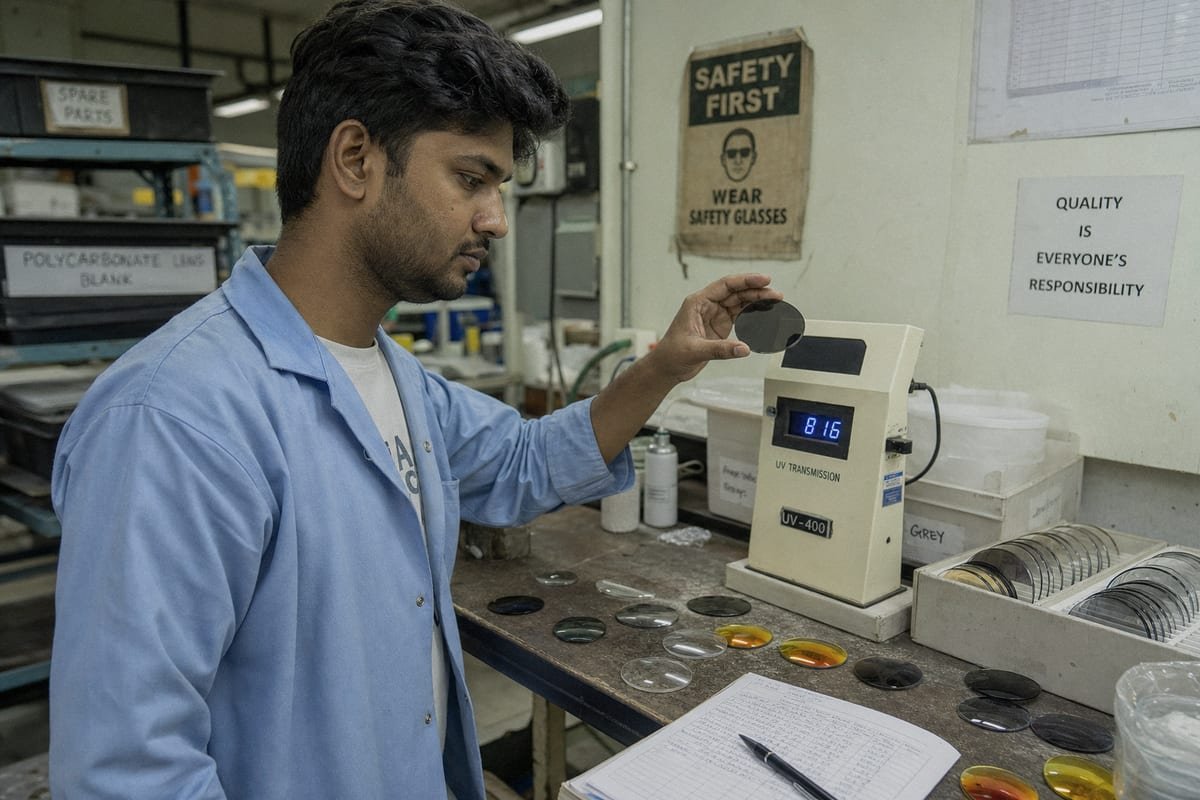
Children’s eyes are more vulnerable than adult eyes. Kids have clearer crystalline lenses 1 and larger pupils, so more UV light reaches the retina. That is why UV protection is non-negotiable at every age. But beyond that baseline, lens priorities shift as children grow.
The non-negotiables at every age
Two features never change. First, Proteção UV400 2, meaning the lens blocks 100% of UVA and UVB rays. Second, impact-resistant policarbonato 3. Glass lenses have no place in children's eyewear. Polycarbonate is lightweight, shatterproof, and survives drops onto concrete. We also verify that our lens suppliers meet recognized benchmarks such as ANSI safety standards for impact resistance.
What changes by age
| Lens Feature | Babies (0–2) | Toddlers (2–5) | Kids (6–10) | Teens (11+) |
|---|---|---|---|---|
| Proteção UV400 | Required | Required | Required | Required |
| Polycarbonate shatterproof lenses | Required | Required | Required | Required |
| Lentes polarizadas 4 | Optional | Optional | Recommended near glare | Popular for sports |
| Mirrored coatings | Raro | Raro | Ocasional | Common |
| Tint category | Cat 3 | Cat 3 | Cat 3 | Cat 2–3 |
Polarized or not?
Here is a nuance many buyers miss. Polarized lenses cut glare from water, sand, and pavement. That is genuinely useful for older kids at the beach or on a bike. But for a baby in a stroller, polarization adds cost without much benefit. Non-polarized UV400 lenses are usually the practical choice for the youngest ages. I always tell buyers: polarization is an environment-based upgrade, not a universal requirement. UV protection matters far more.
One more misconception worth killing: darker tint does not mean better protection. Tint controls brightness. UV blocking is a separate lens property. A dark novelty lens with no UV filter is worse than no sunglasses at all, because the dark tint dilates the pupil and lets in more UV. Some of our optical customers also ask about blue light protection for kids' everyday frames, which we can add, but for outdoor sunglasses, UV400 remains the core spec.
What flexible materials should I choose for younger versus older kids?
The trade-off I weigh most often in development is flexibility versus structure. Bend a baby frame fully in half, and it must spring back. A teen sport frame needs stiffness to hold a shield lens steady.
Choose ultra-soft, hinge-free flexible TPEE frames for babies and toddlers, because they bend without breaking and feel gentle on skin. For school-age kids, use TR90 frames with TPEE temples for balanced flex and structure. Teens can move to firmer TR90 or sport-grade frames.

Material choice is where cheap kids' sunglasses fail first. Hard, brittle plastic snaps at the hinge, leaves pressure marks on soft skin, and can crack into sharp edges. After fifteen years making children's eyewear, our answer is two materials used in the right combination for each age.
TPEE: the baby and toddler workhorse
TPEE is a thermoplastic elastomer. It is soft, rubbery, and almost impossible to break through normal twisting. For infants, we build hinge-free, one-piece flexible TPEE frames. No hinge means no pinch point and no small screws. Babies chew on everything, so the material must also be BPA-free and non-toxic 5. TPEE handles that requirement, and its smooth, seamless finish is gentle even for children with sensory sensitivities who find hard plastics abrasive.
TR90: structure for growing kids
TR90 6 is a lightweight nylon-based material. It flexes and returns to shape, but it holds a defined form better than pure TPEE. Our most popular construction for school-age children combines a TR90 front frame with TPEE temples. The front keeps the lenses aligned; the soft temples grip comfortably behind the ears without pressure.
| Faixa Etária | Recommended Material | Hinge Type | Por Que Funciona |
|---|---|---|---|
| 0–2 anos | One-piece TPEE | Hinge-free | Fully bendable, chew-safe, no screws |
| 2–5 anos | TPEE ou hastes de TR90 + TPEE | Hinge-free or reinforced | Survives throwing, sitting, twisting |
| 6–10 years | TR90 front + TPEE temples | Reinforced hinge | Structure plus comfort and flex |
| 11+ years | TR90 or sport frames | Standard or spring hinge | Adult feel, lightweight durability |
Both materials are lightweight, which matters more than buyers expect. A heavy frame slides down a small nose within minutes. Both are also environmentally friendly options compared with many cheap PVC-based plastics, which increasingly matters to brands in Europe, Japan, and Australia.
How can I select age-appropriate styles when sourcing from a manufacturer?
A lesson I learned early in exporting: safety gets sunglasses approved by parents, but style gets them worn by kids. One European buyer doubled reorders simply by splitting her line into proper age segments.
Segment your line by age: playful rounded frames in bright two-tone colors for toddlers, versatile classic shapes for school-age kids, and adult-inspired sport shields or fashion silhouettes for teens. Verify UV400 certification, request samples per size band, and use OEM options for colors and branding.

Style is not decoration. It is compliance. A child who dislikes their sunglasses simply will not wear them, and then all the UV400 engineering is wasted. When buyers visit our showroom of roughly 800 existing styles, I walk them through the range in age order, because the aesthetic logic changes at each stage.
Style logic by age group
- Toddlers and preschoolers. Think soft, rounded shapes and cheerful two-tone colors. One of our popular models pairs a matte periwinkle-blue round front with mint-teal temples — playful, minimal, and unisex. Rounded edges are also a safety feature, not just a look.
- School-age kids. Children start caring what friends think. Classic shapes work here: small wayfarer-style frames, gentle rounds, and early sport looks. Keep colors fun but less babyish.
- Tweens and teens. This group wants adult styling. Wrap-around design shield lenses with mirrored orange-to-yellow coatings, glossy black or clean white sport frames, aviators, and retro silhouettes all perform well. Function follows too: secure athletic fit for cycling, running, and beach sports.
A practical sourcing checklist
When you source from a factory like ours, I recommend this sequence. First, request UV transmission test reports, not just verbal claims. Second, order samples across every size band you plan to sell, and fit-test them on real children. Third, check hinge durability by flexing samples repeatedly. Fourth, confirm the material is BPA-free 7 with documentation. Finally, use OEM/ODM support wisely: custom colors, logos, lens tints, and retail-ready packaging let you build a distinct brand without heavy mold investment. Starting from existing tooling lowers your risk while you test which age segments sell best in your market.
Conclusão
The model differences in kids’ sunglasses come down to one idea: children change, so eyewear must change with them. A baby needs a strap-secured, hinge-free TPEE frame that survives chewing. A toddler needs a durable low-bridge wrap-around design. A school-age child needs a proper nose bridge fit and a style they are proud to wear. A teen needs adult-grade performance with polarized lenses and sport styling. Ignore these stages, and your line will disappoint parents and stall at retail. Respect them, and every SKU earns its place. Through our TPEE and TR90 expertise, our library of existing styles, and full OEM/ODM support, we help brands get each age band right the first time. If you are building or refreshing a children’s eyewear line, start with age-appropriate fit, insist on UV400 protection, and let the styling win the child over — that combination is what turns sunglasses into products kids actually wear.
Notas de rodapé
1. Background on eye anatomy clarifies why children’s crystalline lenses transmit more UV light. ↩︎
2. WHO explains UV radiation risks, supporting the need for UV400 protection in children’s eyewear. ↩︎
3. Wikipedia explains polycarbonate properties, relevant to shatterproof children’s lens material. ↩︎
4. Explains the optical principle behind polarized lenses reducing glare for outdoor activities. ↩︎
5. Cites FDA guidance on BPA safety relevant to children’s product materials. ↩︎
6. TR90 is a nylon-based polymer; Wikipedia’s nylon entry gives material background context. ↩︎
7. FDA page on BPA safety supports the claim about BPA-free children’s frame materials. ↩︎
Mais Artigos que Você Pode Gostar
1 de agosto de 2026
A Fábrica Deve Lidar com a Embalagem e Rotulagem de Óculos de Sol Infantis, ou Usar um Fornecedor Designado?

1 de agosto de 2026
Armazém Próprio vs. Envio Direto do Fornecedor: Qual Reduz os Custos de Devolução para Marcas de Óculos de Sol Infantis?

1 de agosto de 2026
Armazém Direto ao Porto ou Estiva no Exterior: Qual Economiza Mais no Envio de Óculos de Sol Infantis?
Procurando um Parceiro Confiável em Óculos Infantis?
Explore mais de 800 estilos prontos e suporte completo OEM/ODM adaptado à sua marca.
Entre em Contato English
  Español de México
  Deutsch
  Français
  日本語
日本語  العربية
  Português do Brasil