What Environmental Regulations Must Kids Sunglasses Meet for EU and US Export?
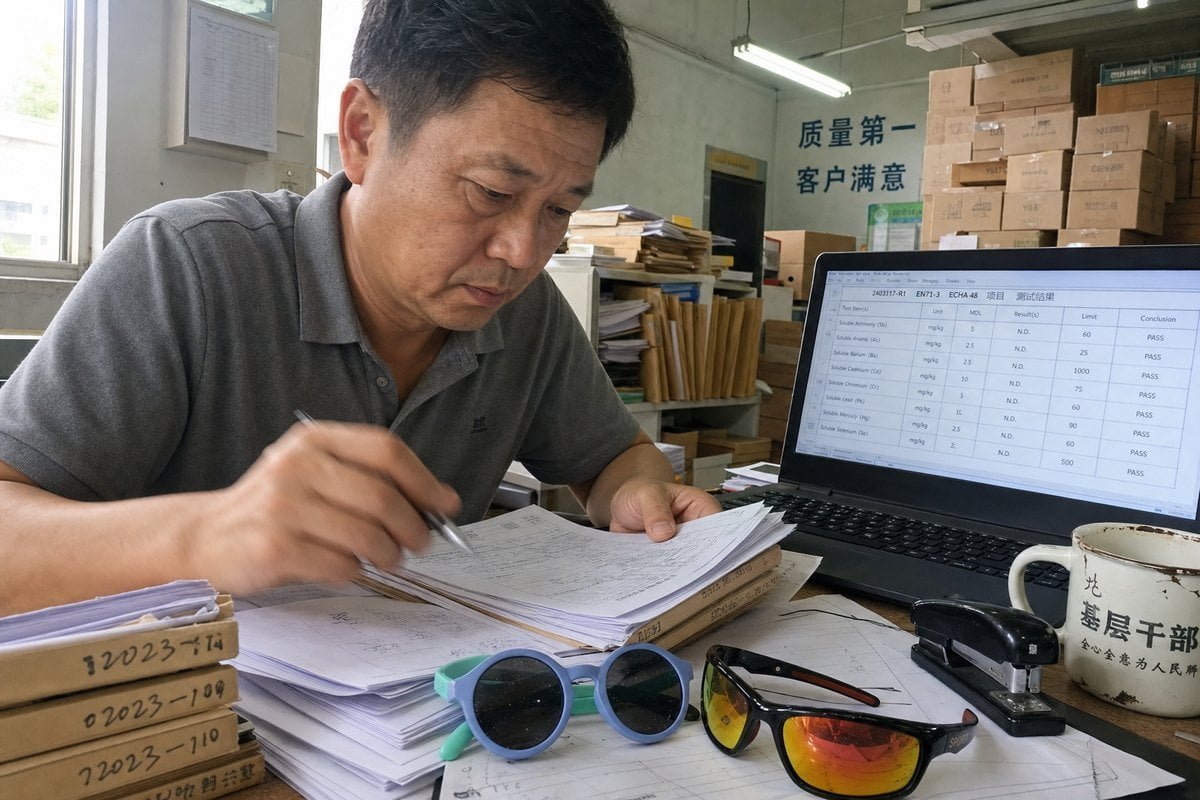
Environmental regulations for kids sunglasses trip up more buyers than pricing ever does REACH chemical results 1. I’ve watched shipments from our Taizhou factory sail through customs while a competitor’s container sat frozen over one missing test report.
Kids sunglasses exported to the EU must meet REACH chemical restrictions, CE marking under PPE Regulation 2016/425, and EN ISO 12312-1. For the US, they must satisfy FDA eyewear regulations, 21 CFR 801.410 impact resistance, and CPSIA lead and phthalate limits.
That sounds like a lot. It is. But the rules break down into clear layers once you see how they fit together PPE Regulation 2016/425 2. Let me walk you through each one, market by market.
How do I know if my kids sunglasses supplier meets EU REACH and US CPSIA requirements?
A buyer from Germany once asked me for our REACH file before he even asked for a quote. That question told me he had been burned before, and our team respected him for it.
Verify a supplier meets REACH and CPSIA by requesting third-party test reports from accredited labs covering lead, cadmium, and phthalates; a Declaration of Conformity; CPSIA-compliant Children's Product Certificates; and material declarations for every component, including coatings, inks, and packaging.
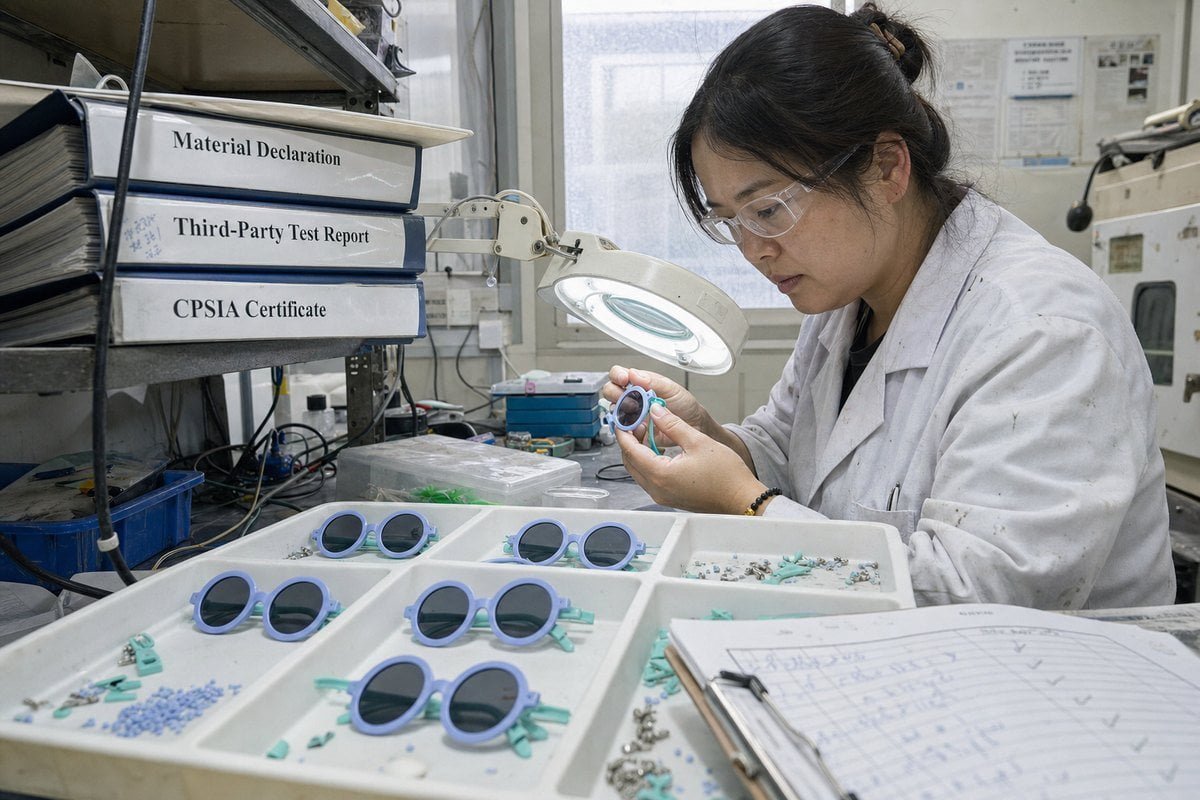
The key insight here is that "environmental regulations" for kids sunglasses really means chemical-substance restrictions. Neither the EU nor the US has a single environmental law just for children's eyewear. Instead, both markets restrict what chemicals can be inside the product. The EU does this through REACH chemical restrictions. The US does it through CPSIA lead limits and phthalate rules for children's products.
What REACH actually restricts
REACH applies to the whole article, not just the frame. That means the plastic rims, the lens coatings, the nose pads, the hinge screws, and even the printed logo on the temple arm. The headline limits buyers should know are phthalates at 0.1% by total weight, and heavy metals like lead, cadmium, mercury, and hexavalent chromium at very low thresholds, often cited at 0.01% by weight. Nickel release from metal parts is also restricted, which matters for hinge screws that touch a child's skin.
What CPSIA demands
CPSIA is stricter in one important way: it requires third-party testing at a CPSC-accepted lab. Lead in substrates and surface coatings must stay below 100 ppm. Specific phthalates must stay below 0.1%. Your supplier must issue a Certificado de Produto Infantil 3 based on those results. Ask for phthalate-free certification documents, not verbal promises.
| Requisito | EU (REACH) | US (CPSIA) |
|---|---|---|
| Lead limit | Restricted at trace levels in articles | Below 100 ppm in substrates and coatings |
| Ftalatos | 0.1% by total weight | 0.1% for specified phthalates |
| Testing body | Accredited lab recommended | CPSC-accepted third-party lab required |
| Key document | Declaration of Conformity, test reports | Certificado de Produto Infantil |
In our own workflow, we keep material declarations on file for every resin batch of TPEE and TR90 we buy. When a client asks, we can trace a frame color back to its pigment supplier. That traceability is what separates a compliant factory from a lucky one.
What UV400 and lens safety standards should I verify before shipping to Europe or America?
Early in my export career, I learned that a dark lens is not the same as a protective lens. A tint without UV filtering can actually be worse, because the pupil dilates behind it.
Verify UV400 protection through accredited lab reports, EN ISO 12312-1 compliance for EU shipments with correct lens category labeling, and 21 CFR 801.410 drop-ball impact resistance for US shipments. Marketing claims like 100% UV protection must be backed by documented test data, not supplier statements.
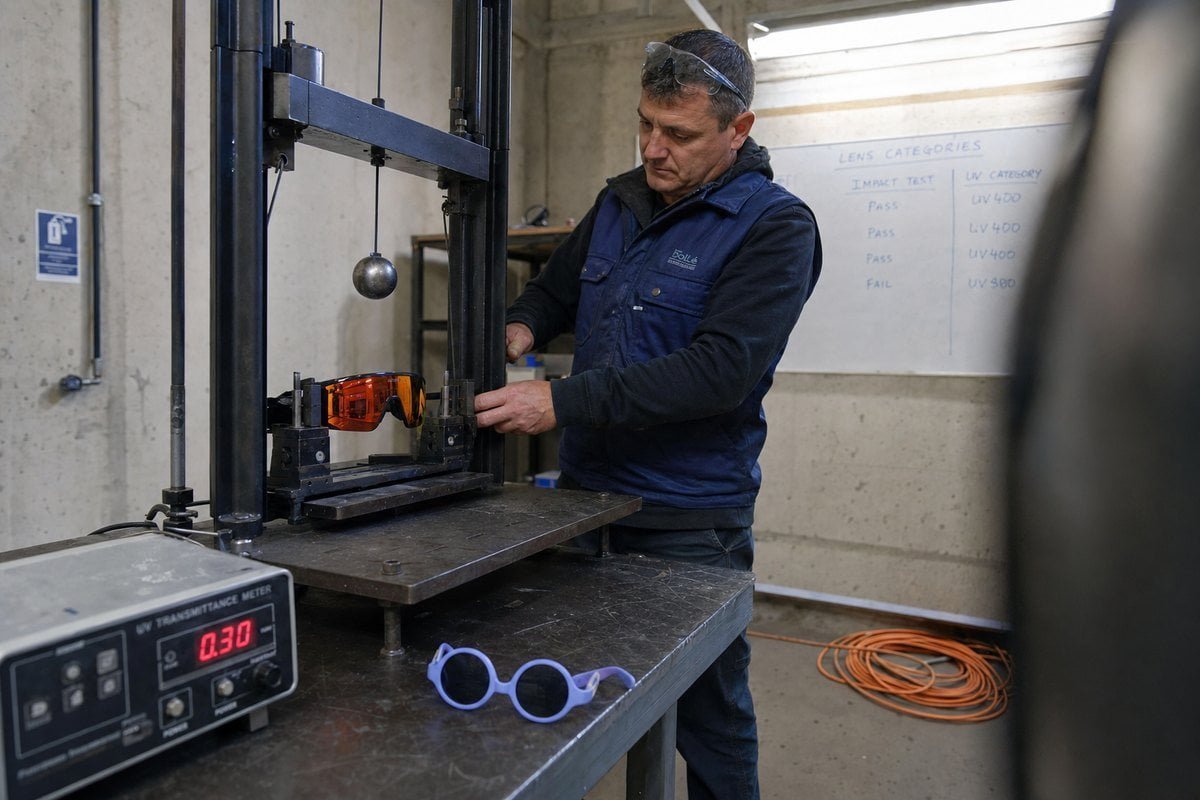
Lens safety is a two-market, two-logic problem. The EU cares most about optical quality and UV filtering. The US cares most about impact resistance. Your product needs both if you sell in both places.
The EU lens framework
The EU treats sunglasses as Category I personal protective equipment. EN ISO 12312-1 is the harmonized standard behind the CE marking process. It covers UV transmittance, optical clarity, refractive power, and mechanical durability. Lenses must also carry a filter category from 0 to 4. Most kids sunglasses fall into category 3, which suits bright daylight. Category 4 lenses are too dark for driving and need a warning, though that matters less for children's styles.
The US lens framework
FDA eyewear regulations 4 classify sunglasses as Class 1 medical devices. They are exempt from 510(k) premarket notification, but the manufacturer still needs establishment registration, device listing, and quality system compliance. The central test is 21 CFR 801.410 5. A 5/8-inch steel ball is dropped from 50 inches onto the lens. The lens must not fracture. For children's active styles, like the wraparound sport shields we produce with gradient mirrored lenses, we test the full curved lens geometry, not just a flat sample.
Here is a quick comparison to keep the two systems straight:
| Lens requirement | UE | EUA |
|---|---|---|
| Padrão principal | EN ISO 12312-1 | 21 CFR 801.410 |
| Main focus | Filtragem UV, qualidade óptica | Impact resistance (drop-ball test) |
| Marcação | CE mark, lens category number | FDA registration and listing 6 |
| UV claim basis | Tested transmittance data | Tested transmittance data |
One practical tip: ask your supplier for the spectral transmittance curve 7, not just a pass/fail line. A real UV400 lens blocks wavelengths up to 400 nanometers. The curve proves it. On our production line, we spot-check lenses from each batch with a UV transmittance meter before assembly, because a mislabeled lens shipment from a sub-supplier can otherwise slip through unnoticed.
Which material certifications matter most when sourcing TPEE and TR90 children's eyewear?
Material choice is where we spend most of our development time. When we built our TR90 frames with TPEE temples, the goal was a frame a toddler could bend, chew, and drop without harm.
Prioritize suppliers holding REACH test reports for TPEE and TR90 resins, CPSIA lead and phthalate certificates, phthalate-free certification for soft-touch components, and nickel-release results for metal hinges. For infant styles, ISO 10993 biocompatibility testing adds meaningful assurance for chew-safe frames.
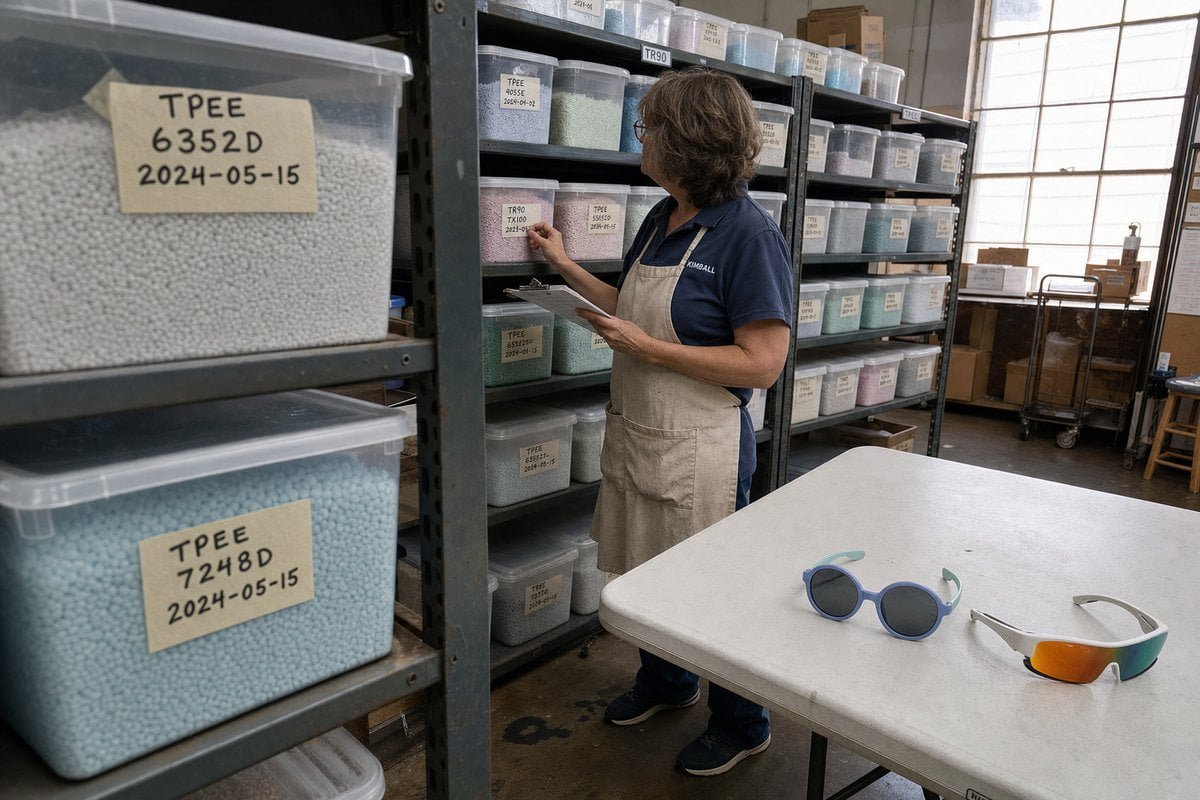
TPEE and TR90 are popular for children's eyewear for good reason. Both are lightweight, flexible, and free of the plasticizers that make cheap PVC frames risky. But the base polymer is only part of the story. Colorants, UV stabilizers, mold-release agents, and surface treatments all enter the final product. Each one can carry restricted substances.
Certifications ranked by importance
- REACH SVHC and restricted-substance test reports. These prove the finished frame, not just the raw pellet, stays under EU chemical limits.
- CPSIA lead and phthalate certificates. Non-negotiable for the US children's market.
- Phthalate-free certification for rubberized parts. Temple tips, nose pads, and soft grips are the highest-risk components because plasticizers make plastics soft.
- Nickel-release testing. That small metallic hinge screw on a round pastel frame touches skin. It must pass EU nickel limits.
- ISO 10993-5/10 cytotoxicity and irritation testing. Increasingly requested for the 0–3 age group, since infants mouth their eyewear.
Watch the newer environmental rules
Two developments deserve attention. First, the EU microplastics restriction under REACH Annex XVII now affects decorative glitter and shimmer coatings, which are common on kids' fashion frames. Second, anti-greenwashing rules mean any "biodegradable" claim on bio-based acetate frames needs real certification, such as ISO 14855-1 industrial composting verification. A "bio-based" resin is not automatically biodegradable, and EU regulators now police that distinction. While RoHS compliance formally targets electronics, some large retailers apply RoHS-style heavy-metal screening to accessories too, so having those results ready never hurts.
In our experience, buyers who ask about material certifications early avoid ninety percent of downstream problems. Resin-level documentation plus finished-product testing is the combination that holds up.
How can I confirm my manufacturer's testing and documentation will pass customs in both markets?
A procurement manager from Australia once sent me a two-page document checklist before placing her first order. We filled every line. She has reordered every season since, and that checklist taught me what serious buyers expect.
Request the CE Declaration of Conformity, EN ISO 12312-1 test report, REACH chemical results, FDA registration and listing numbers, drop-ball test records, and a CPSIA Children's Product Certificate from a CPSC-accepted lab. Cross-check lab accreditation, report dates, and that reports match your exact product SKU.
Documentation is where good products fail. Customs officers and import compliance teams do not judge your frame's comfort. They judge your paperwork. The most common failure I see is a test report for a similar model, not the actual SKU being shipped. Labs test specific samples. If you changed the lens coating or the temple color after testing, the old report may not cover the new product.
The document stack by market
| Documento | EU shipment | US shipment |
|---|---|---|
| CE Declaration of Conformity | Required | Not applicable |
| EN ISO 12312-1 test report | Required | Useful but not sufficient |
| REACH restricted-substance report | Required | Helpful for retailers |
| FDA establishment registration and device listing | Not applicable | Required |
| 21 CFR 801.410 drop-ball records | Not applicable | Required |
| Children's Product Certificate (CPSIA) | Not applicable | Required |
| Tracking label on product/packaging | Recommended | Required under CPSIA |
Beyond federal entry: state and retail layers
Passing customs is step one. Retail compliance is step two. California Proposition 65 8 may require warning labels if lenses contain BPA, which polycarbonate can. Maine and Minnesota now demand PFAS disclosure for intentionally added "forever chemicals" in anti-fog or hydrophobic lens coatings. Some retailers also ask for ASTM F963 toy safety testing when kids sunglasses are sold as novelty or dress-up items rather than functional eyewear. Small-parts and choking-hazard checks fall under that umbrella too.
My advice is simple. Build a compliance binder per SKU. Verify the lab holds ISO 17025 accreditation. Confirm report dates fall within your buyer's validity window, usually one year for children's products. Then keep everything organized so a customs query gets answered in hours, not weeks.
Conclusão
Non-compliant kids sunglasses risk seized shipments, recalls, and lost brand trust. One missing certificate can undo months of work. The fix is layered compliance done early.
Remember the two-layer rule. First, the product must be safe as eyewear: UV400 lenses proven by transmittance data, EN ISO 12312-1 conformity for Europe, and drop-ball impact resistance for America. Second, because the wearer is a child, the chemistry must be clean: REACH restrictions in the EU, CPSIA lead and phthalate limits in the US, plus state-level rules like Proposition 65 and PFAS reporting. After fifteen years of building flexible TPEE and TR90 eyewear for brands in more than twenty countries, our team has learned that documentation discipline matters as much as material quality. Choose a factory that treats test reports, material declarations, and traceability as part of the product, not an afterthought. Do that, and both EU and US export markets open smoothly for your children's eyewear line.
Notas de rodapé
1. Official European Chemicals Agency guide explaining the REACH regulation’s impact on chemical safety in consumer products. ↩︎
2. Direct EU legal text for the PPE Regulation governing CE marking of sunglasses. ↩︎
3. Official CPSC guide on the mandatory safety certificate required for children’s products to prove compliance with safety standards. ↩︎
4. FDA’s medical device page covers classification rules applicable to sunglasses as Class 1 devices. ↩︎
Mais Artigos que Você Pode Gostar
1 de agosto de 2026
A Fábrica Deve Lidar com a Embalagem e Rotulagem de Óculos de Sol Infantis, ou Usar um Fornecedor Designado?

1 de agosto de 2026
Armazém Próprio vs. Envio Direto do Fornecedor: Qual Reduz os Custos de Devolução para Marcas de Óculos de Sol Infantis?

1 de agosto de 2026
Armazém Direto ao Porto ou Estiva no Exterior: Qual Economiza Mais no Envio de Óculos de Sol Infantis?
Procurando um Parceiro Confiável em Óculos Infantis?
Explore mais de 800 estilos prontos e suporte completo OEM/ODM adaptado à sua marca.
Entre em Contato English
  Español de México
  Deutsch
  Français
  日本語
日本語  العربية
  Português do Brasil