Can TR90 & TPEE Kids Sunglasses Recover After Bending? How to Fix?
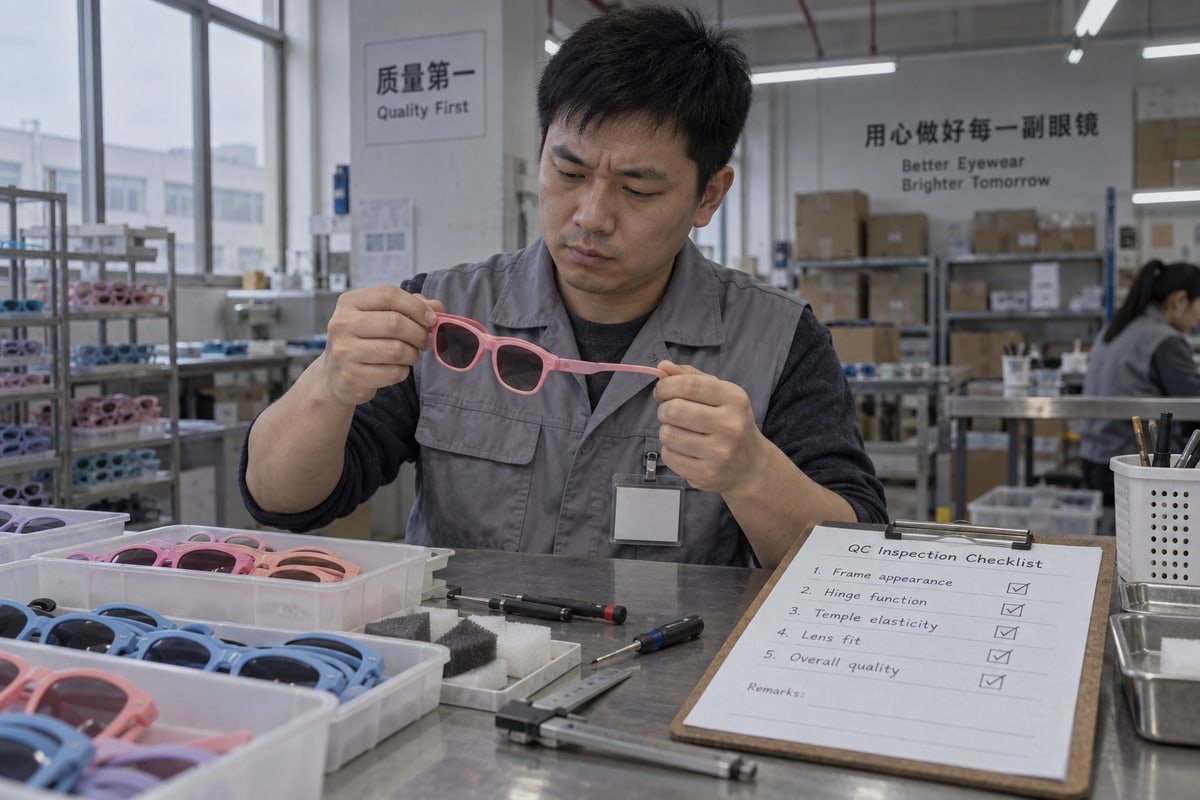
Bent kids sunglasses land on my desk from our Taizhou QC line, and parents fear the worst. Twisted TR90 & TPEE kids sunglasses look ruined. Usually they are not.
Yes, TR90 & TPEE kids sunglasses usually recover after bending because both are shape memory polymers that flex and spring back. Recovery has limits. A simple bend can be reshaped by hand, but cracks, stress whitening, loose hinges, or unseated lenses mean the frame is damaged, not just deformed.
The real question is not whether the frame bent. Kids bend everything. The question is whether the frame is only out of shape, or whether a weak point has actually failed. Below, I explain the materials, show you how to diagnose the damage, walk through safe repair steps, and explain why we still build our children’s range on these two polymers.
How do I know if my TR90 or TPEE kids sunglasses can actually recover their original shape after bending?
On our 5S-managed workshop floor, every TR90 front gets a hand flex check before packing. The frames that fail teach us exactly where shape recovery ends.
You can tell if your TR90 or TPEE kids sunglasses will recover by checking for damage, not just distortion. If the frame is bent but shows no cracks, stress whitening, loose hinges, or shifted lenses, it will usually return to shape with gentle pressure. Whitening or splits mean permanent fatigue.
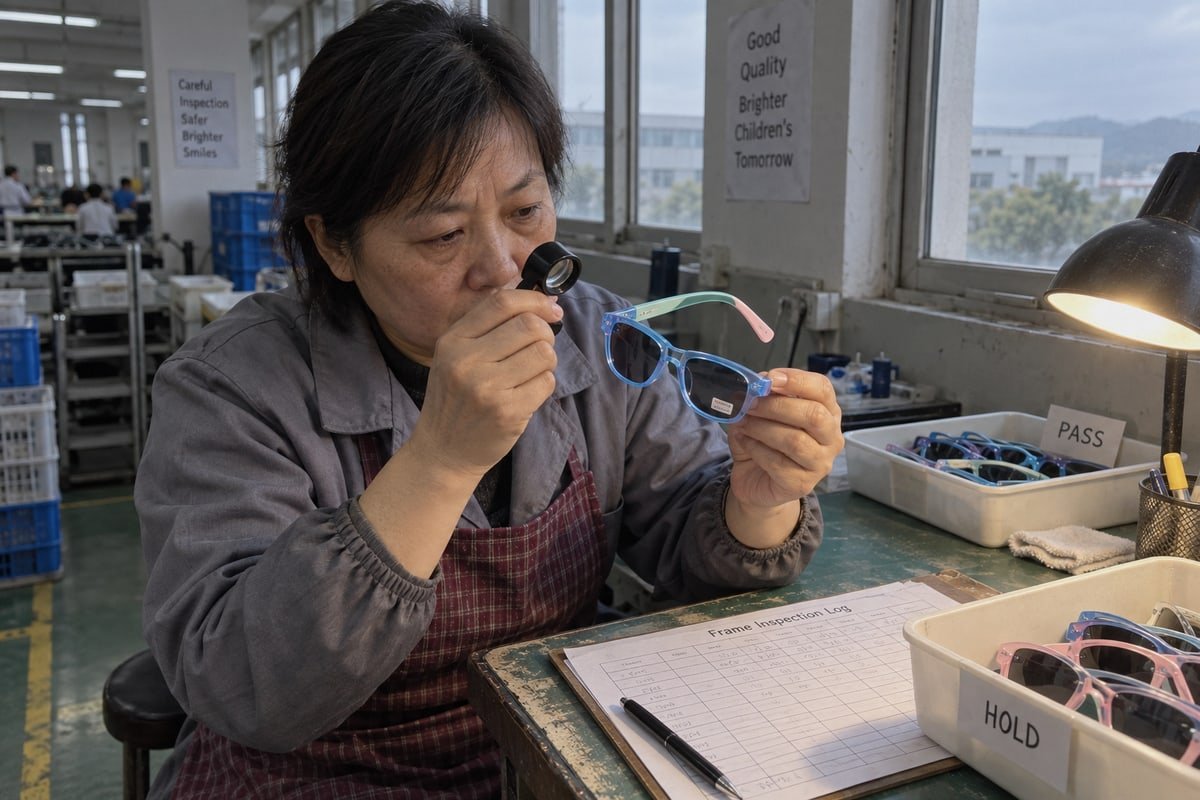
What makes these materials spring back
TR90 is a polyamide. Most of the eyewear industry 1 knows it by the trade name Grilamid TR90. It is a shape memory polymer 2, which means the molecular chains are set during molding and want to return to that molded position after a bend. TPEE is a thermoplastic polyester elastomer. It sits between rubber and plastic. It stretches further than TR90, and it snaps back with less force. In our factory, we often pair a glossy translucent TR90 front, like our coral-pink gradient or sky-blue wayfarer styles, with matte TPEE flexible temple arms. The front holds the lens shape. The temples take the abuse.
Where recovery ends
Every polymer has a tensile strength limit. Bend a frame too far at one point, and the chains stretch past that limit. You will see a pale, chalky streak. That is stress whitening. It is permanent molecular fatigue. The frame may still bend back, but it will never recover as well at that spot again. The second weak point is not the material at all. It is the hinge and the lens-frame junction. Repeated flexing can loosen a rivet or open the lens groove, and no memory effect fixes that.
| Sign after bending | O que significa | Recoverable at home? |
|---|---|---|
| Frame sits crooked, no marks | Simple shape distortion | Yes, gentle hand reshaping |
| One temple splayed outward | Temple misalignment | Yes, gradual adjustment |
| Pale white streak at bend | Stress whitening, molecular fatigue | Partially, avoid further stress |
| Hinge loose or wobbly | Rivet or hinge failure | Rarely, needs professional or replacement |
| Lens rattles or pops out | Lens seat loosened | Sometimes, if groove is undamaged |
| Visible crack or split seam | Structural failure | No, replace |
A word on marketing claims
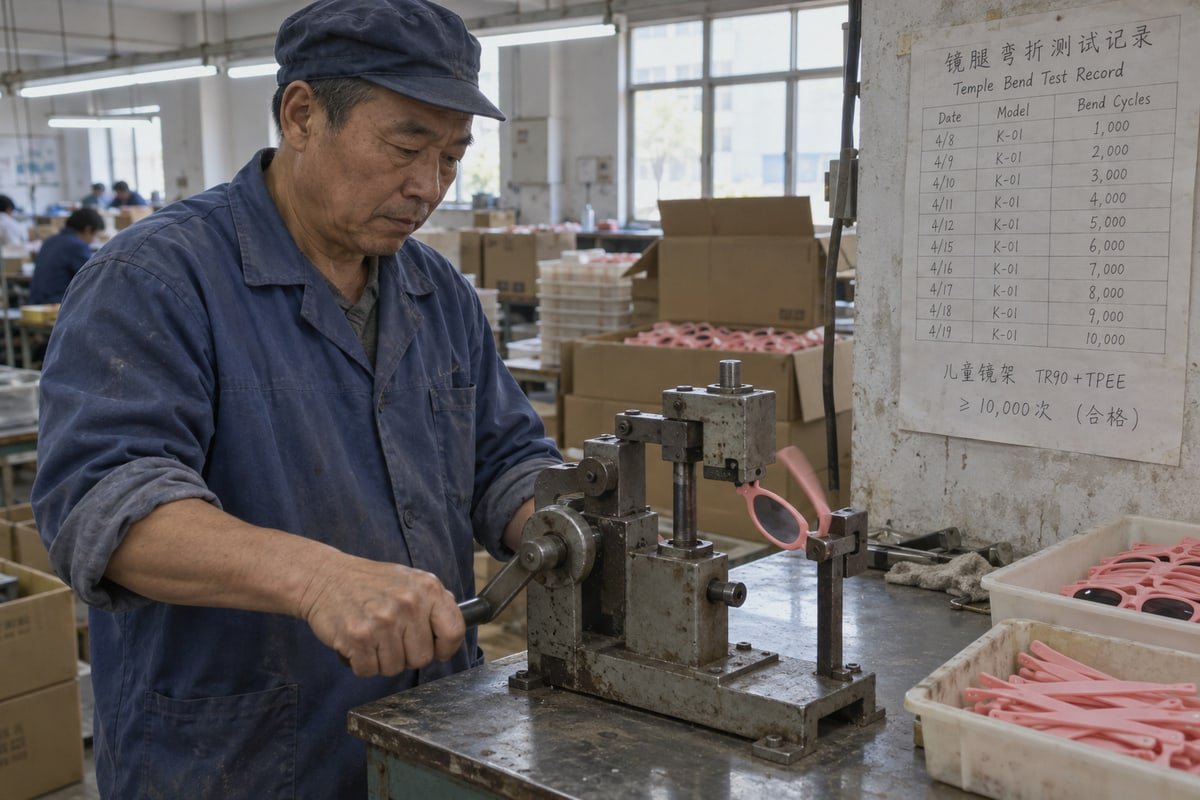
Some suppliers say their TR90 frames bend 90 degrees and return to shape. Others advertise 500+ bending cycles for TPE frames, or claim a full 180-degree twist is safe. I treat these as product claims, not universal engineering facts. A 90-degree temple flex is a reasonable expectation for good TR90 & TPEE kids sunglasses. A repeated 180-degree twist is not something I would encourage a child to try.
What should I do if my kids' sunglasses frame gets bent out of shape during daily use?
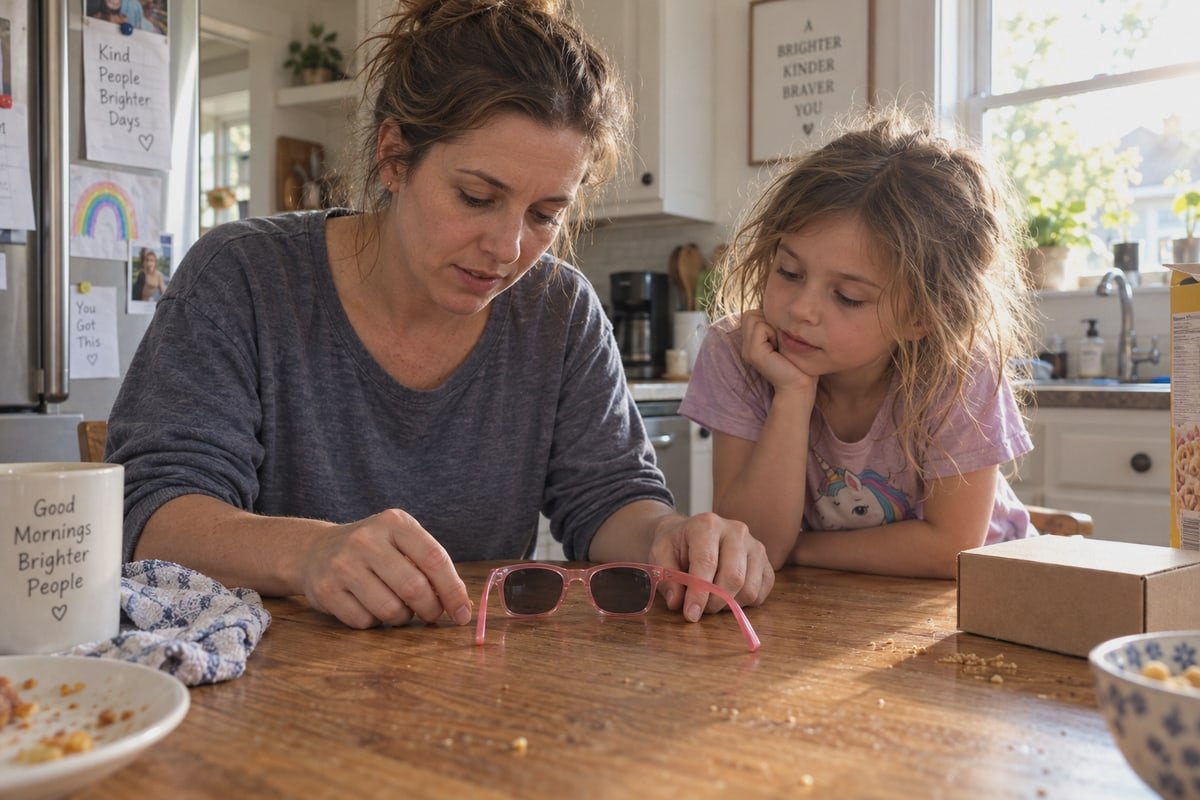
A procurement manager from Australia emailed me a photo of a slate-blue kids frame flattened in a school bag. Her first question was whether to bend it back right away.
If your kids' sunglasses frame gets bent during daily use, stop and inspect it first. Lay it on a flat surface to find the raised temple or bridge, check hinges and lens seats, then reshape slowly by hand. If you see cracks or whitening, do not force it.
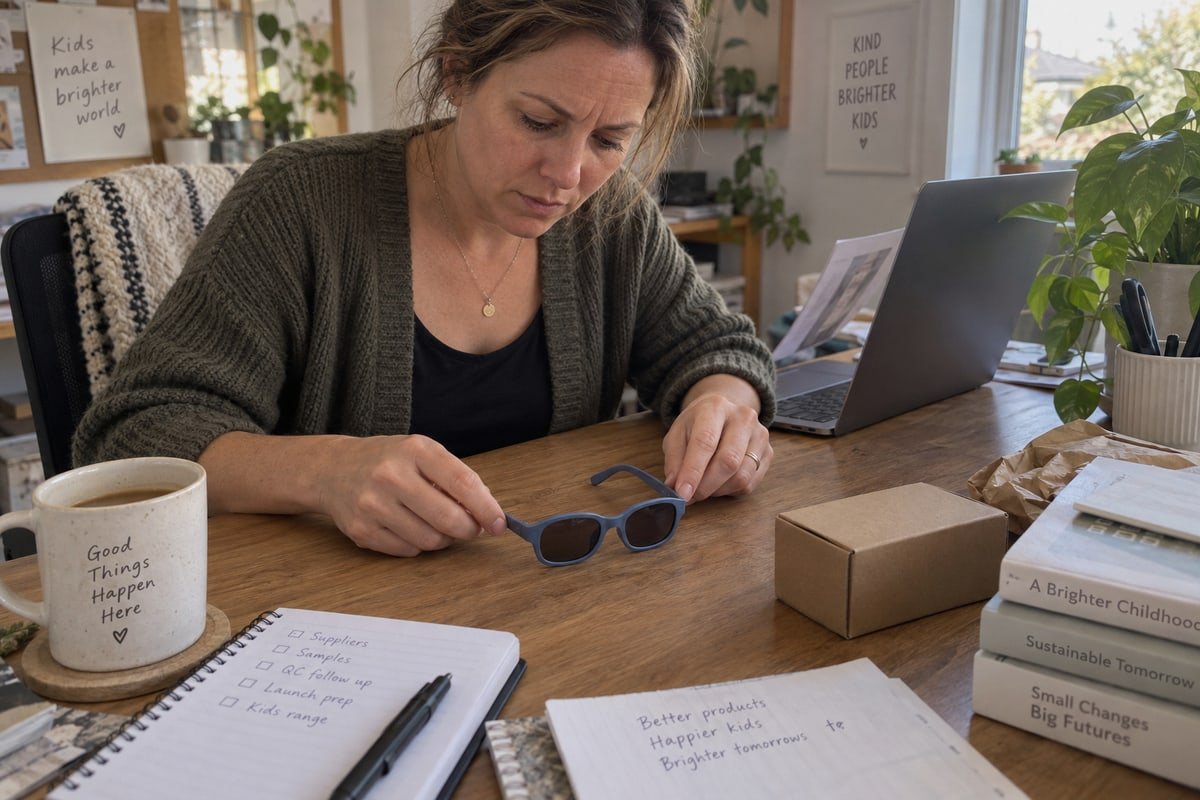
My answer to her was simple. Do not bend it back yet. Look first. Daily damage on kids' eyewear follows a few patterns. A child sits on the frame. The frame gets crushed in a bag. The child pushes it up on the forehead and stretches the temples, like the chunky slate-blue style in our range that kids love to wear as a headband. Each pattern hurts a different part of the frame, so I follow a fixed order every time a bent sample reaches me.
The five-step check I use
- Place the frame upside down on a flat table. Both temple tips and the bridge should touch the surface. If one temple lifts, that side is bent. If the bridge rocks, the front is twisted.
- Compare left and right temples. Hold the frame at arm's length and look from the front. One temple usually shifts more than the other. Note which one.
- Open and close each hinge. It should move smoothly with slight resistance. Wobble or grinding points to a loose rivet.
- Press gently around the lens edge. The lens should not click or shift. Repeated flexing loosens the lens-frame junction before anything else fails.
- Look at every bend point under good light. You are hunting for a pale streak or a hairline crack. If you find one, stop.
A special case for TPEE
TPEE has one weakness that TR90 does not share. If a soft TPEE temple sits under a heavy object for a long time, it can take on compression set. The material simply holds the flattened shape. This is not a crack, and it is not whitening. It usually responds to the gentle warmth and reverse-tension method I describe in the next section. So if a TPEE temple looks squashed rather than bent, do not panic. It is one of the easier problems to reverse.
Only after these checks do I start reshaping. Most of the frames sent back to us pass every step. They are simply out of alignment, and a few minutes of patient work brings them back.
How can I fix a bent TR90 or TPEE frame without damaging the material?
Warmth makes a polymer easier to reshape, but it also softens the lens seat. Every time we adjust a sample front, we weigh speed against that risk.
To fix a bent TR90 or TPEE frame without damage, start with slow hand pressure in small increments, using a microfiber cloth to protect the surface. If it resists, warm the frame gently in warm water, remove or protect the lenses to avoid crazing, then realign and hold until cool.
Start cold, always
The first frame adjustment technique is also the safest. Hold the frame with a microfiber cloth on each side of the bend. Apply steady pressure in the opposite direction. Move a few millimeters, then stop and check on the flat surface again. Repeat. Small increments matter because you cannot undo an over-correction without adding a second stress point. For a splayed temple, I work the hinge area with a plastic-tipped tool rather than bare metal pliers. Metal leaves marks on the glossy translucent fronts we produce, and marks are the first thing a parent notices.
When to add warmth
Cold pressure fixes most misalignment. It struggles with two problems: a twisted front and TPEE compression set. That is when a mild heat restoration method helps. The table below shows how I rank the options.
| Método | Melhor para | Nível de risco | My note |
|---|---|---|---|
| Cold hand pressure | Temple splay, minor twist | Baixo | Always the first step |
| Warm water, not boiling | TPEE compression set, stubborn twist | Médio | Even warmth, easy to control |
| Secador de cabelo, configuração baixa | TR90 front twist | Medium to high | Uneven heat, easy to overdo |
| Boiling water or open flame | Nothing | Muito alto | Never, on any kids frame |
TR90 is more heat-resistant than standard acetate. It needs more concentrated and more even warmth before it becomes pliable. That is why warm water beats a hairdryer for TR90. Water heats the whole section at once, while a hairdryer creates hot spots.
Protect the lenses
Heating a frame with lentes polarizadas 3 inside risks crazing. The lens coating expands at a different rate than the polymer. It can form fine cracks that ruin the optics. So I pop the lenses out first when the design allows it. If the lenses cannot be removed, I keep the warmth away from the rim and work only on the temple.
The reverse-tension fix for TPEE
Para uma flattened TPEE temple, warm it in water for about a minute, then bend it slightly past its correct position and hold it there while it cools. The material resets its memory in the new position. Release it, and it relaxes back to roughly the right shape.
Hinge-less designs need one extra step
Some ultra-flexible frames have no hinges at all. In those designs, the lens acts as the skeleton. If you reshape the front, re-seat the lens while the frame is still slightly warm. The lens locks the alignment as the polymer cools. Skip this step, and the front slowly drifts back to the bent position.
Why should I choose TR90 or TPEE frames if I want long-lasting flexibility for my kids' eyewear line?
Fifteen years of making children's frames taught me one thing. Flexibility sells the first pair, but consistent recovery after abuse is what earns the reorder.
Choose TR90 or TPEE frames for a kids' eyewear line because both are lightweight, BPA-free shape memory polymers with high impact resistance. TR90 is stiffer and suits active school-age kids, while TPEE is softer and safer for toddlers. Together, they deliver flexibility that rigid acetate cannot match.
TR90 vs TPEE at a glance
| Característica | TR90 (Grilamid) | TPEE |
|---|---|---|
| Toque | Firm but springy | Soft, rubber-like |
| Melhor faixa etária | Active kids, sports, school age | Babies, toddlers, preschool |
| Shape recovery | Excellent within elastic range | Excellent, tolerates deeper bends |
| Resistência ao impacto | Alto | Muito alto |
| Finish options | Glossy, translucent, gradient colors | Matte, opaque colors |
| Typical weight | Light, one supplier quotes 15 to 20 grams | Light, similar range |
| Main weakness | Hinge and lens seat wear | Compression set under long pressure |
| Common role in our frames | Front and lens rim | Flexible temple arms, full toddler frames |
The objection I hear most
Buyers often ask me a fair question. If some product pages call these unbreakable eyewear frames that bounce right back, why do I keep warning about hinges and lens seats? The answer is that flexible does not mean invincible. The polymer can survive a 90-degree bend. One supplier even claims 5,000+ open-close cycles with no permanent temple deformation, and another claims TPE frames survived 1.5-meter drops. I have no reason to doubt those tests. But a frame is a system. The rivet, the lens groove, and the bridge decide how long the whole product lasts. A brand that promises indestructible frames and ships weak hinges will face returns. A brand that promises flexible, safe, recoverable frames and backs it with solid construction will keep customers.
Why we still build on these two materials
Both TR90 and TPEE are BPA-free materials, which matters for a product that toddlers chew. Both are light enough that a child forgets the frame is there. Both recover from the daily abuse I described earlier. That is why nearly all of our roughly 800 existing styles use one or both. A brand founder in Japan or Europe can pick from those styles, add custom colors, logos, UV400 or polarized lenses, and embalagens prontas para varejo 4, and launch without paying for a new mold. When the market responds, we move to full OEM/ODM development. Either way, the material choice is the same, because after fifteen years and buyers in more than 20 countries, nothing else has matched this balance of flexibility, safety, and recovery.
Conclusão
Bent frames scare parents and buyers alike. Most TR90 & TPEE kids sunglasses recover with patient reshaping. Diagnose first, fix gently, and replace when hinges or lenses fail.
Interested in sourcing the products mentioned in this article? See details and request a quote here:
Notas de rodapé
1. ISO provides international standards for the eyewear industry and product safety. ↩︎
2. Technical definition of the material property that allows frames to recover their original shape. ↩︎
3. Expert guidance from the American Academy of Ophthalmology on selecting sunglasses and polarized lenses. ↩︎
4. General information on packaging standards and requirements for retail products. ↩︎
Mais Artigos que Você Pode Gostar
Procurando um Parceiro Confiável em Óculos Infantis?
Explore mais de 800 estilos prontos e suporte completo OEM/ODM adaptado à sua marca.
Entre em Contato English
  Español de México
  Deutsch
  Français
  日本語
日本語  العربية
  Português do Brasil