Will TPEE Kids Sunglasses Deform in a Hot Car? What’s Their Heat Resistance Limit?
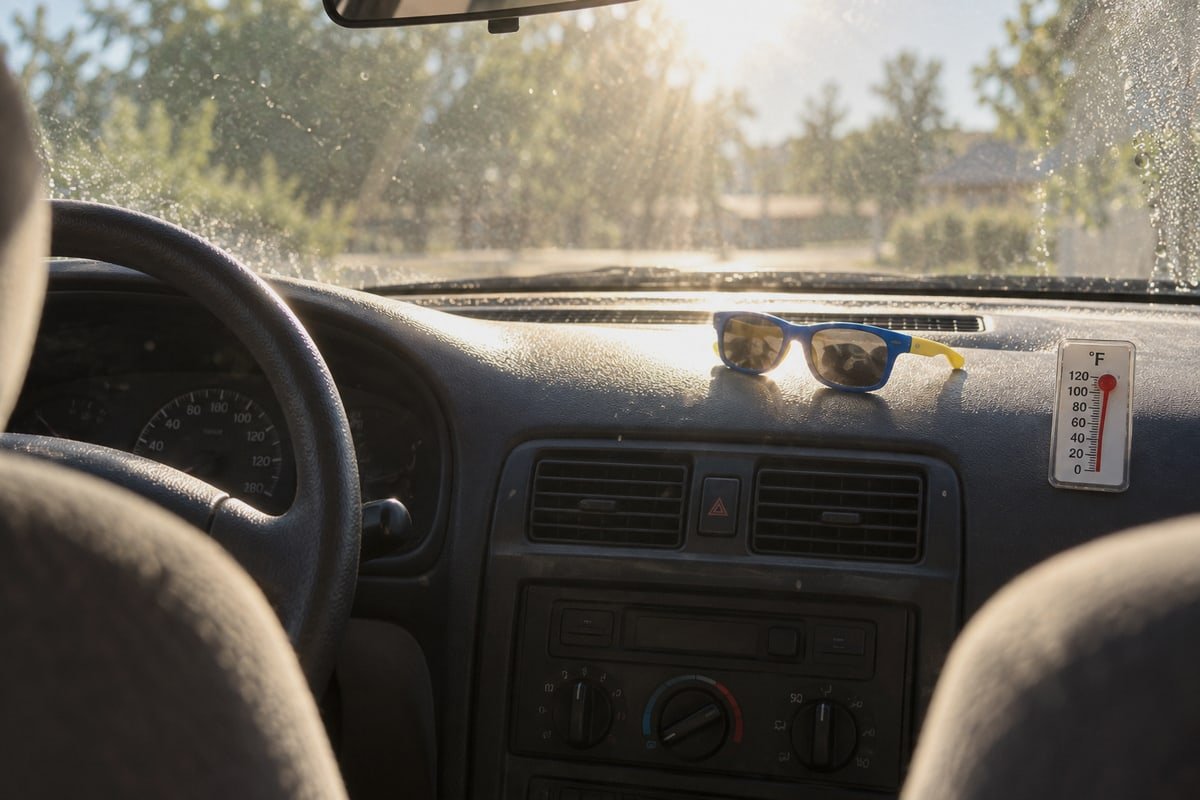
Every summer, a parent somewhere finds TPEE kids sunglasses bent on a hot dashboard. That fear reaches our Taizhou production line as a buyer question, so we take it seriously.
TPEE kids sunglasses will not melt in a hot car, because TPEE melts at 180–220°C while car interiors peak near 90°C. However, some TPEE grades begin softening around 70°C, so prolonged exposure can cause temporary warping, loose lenses, or permanent set under pressure.
That short answer hides a lot of detail. The real question is not whether the frames melt. It is where the safety margin sits, and how you confirm it before you order thousands of pairs. Below, I walk through testing, temperature limits, material comparisons, and the questions I would ask any supplier.
How can I test if TPEE frames will hold their shape in extreme summer heat?
One of our QC inspectors keeps a small oven beside the 5S workshop bench. Before a new TPEE temple design ships, it spends an afternoon in there.
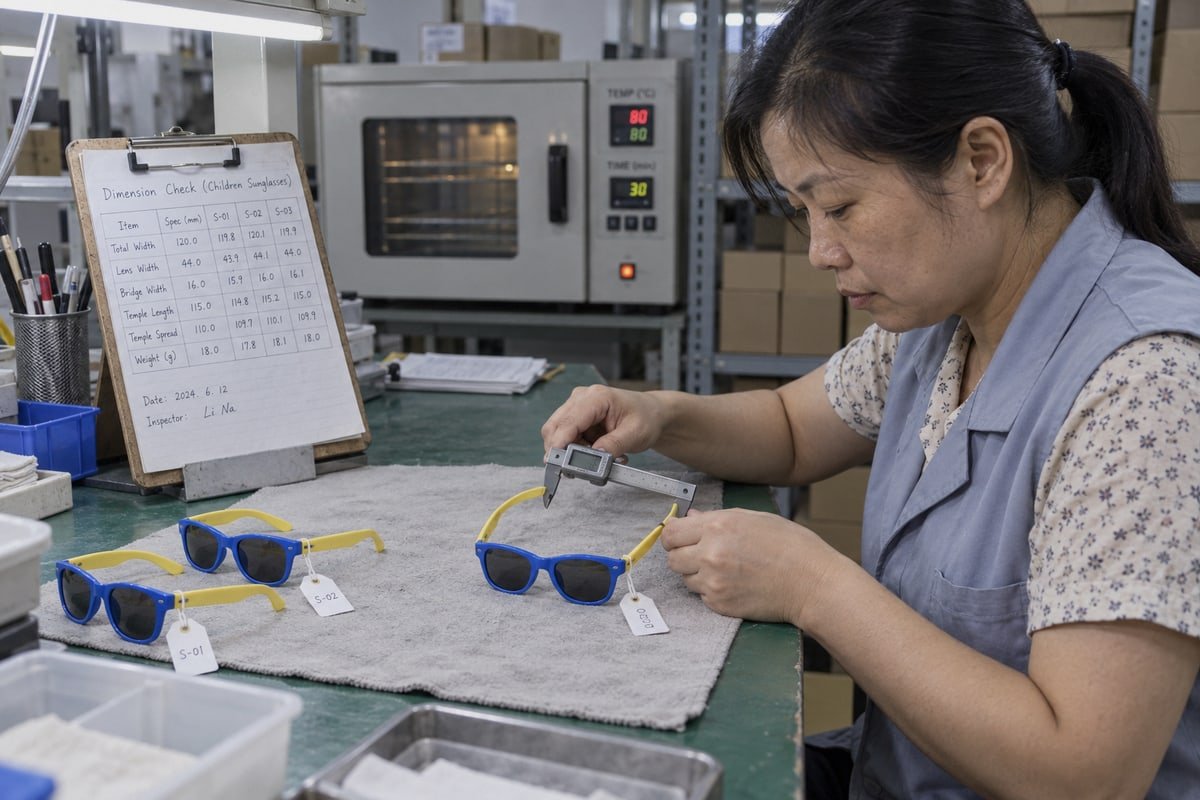
Test TPEE frames by heating them in a controlled oven at 70°C, 80°C, and 90°C for two to four hours each, then measuring temple spread, bridge width, and lens retention after cooling. Repeat the cycle several times and load one sample under weight to check for permanent compression set.
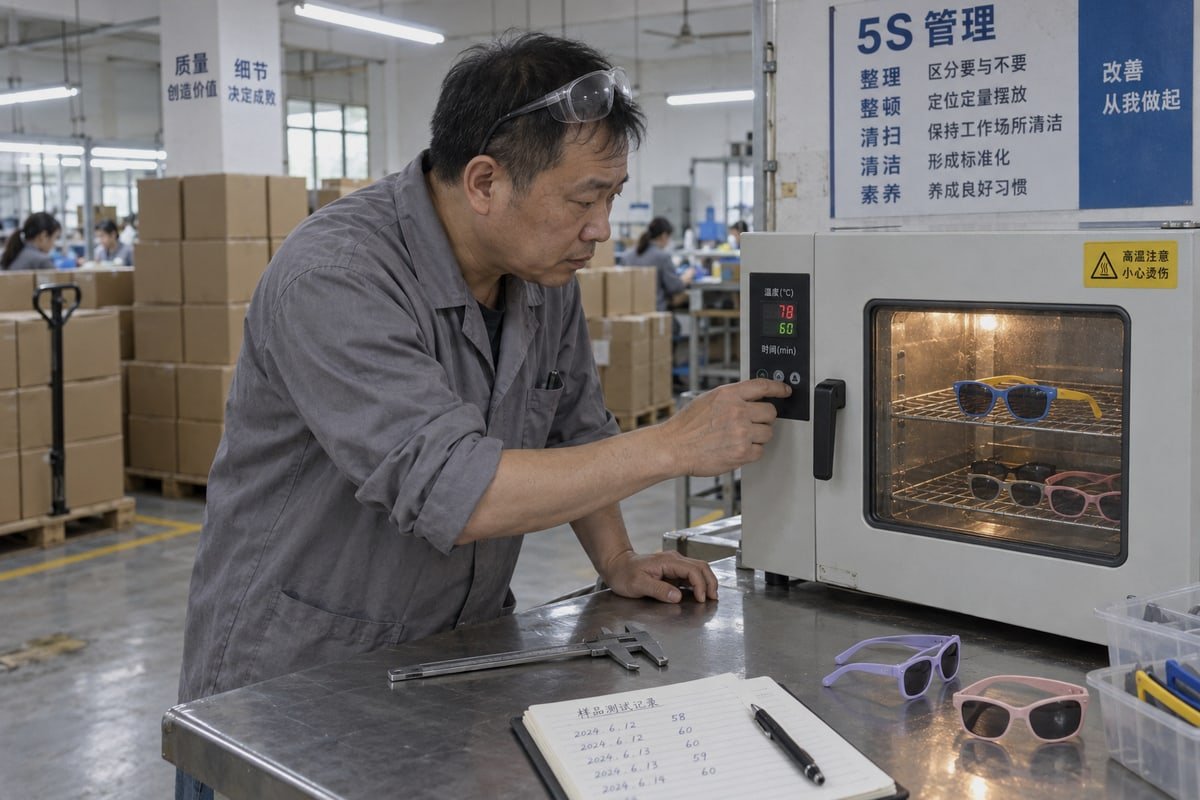
You do not need a materials lab to run a meaningful check. You need a small oven with a reliable thermostat, a set of calipers, a bright lamp, and enough samples to spare a few. Here is the process I recommend to buyers who want their own evidence before a bulk order.
A five-step hot-car simulation you can run on samples
- Condition the samples at room temperature for 24 hours. Record baseline measurements: temple spread at the tips, bridge width, lens seating depth, and hinge tension.
- Heat one set at 70°C for two hours. This matches the thermal deformation temperature listed for at least one TPEE grade, so it reveals early softening in weaker formulations.
- Heat a second set at 90°C for four hours. That is the realistic peak interior temperature of a parked car in strong sun, and it sits well above the 60°C–70°C point where acetate and standard plastics lose shape.
- Cool every sample for one hour, then measure again. Compare each number with the baseline.
- Cycle a third set five times between the 90°C oven and a 20°C room. This imitates the thermal shock of moving glasses between a hot car and an air-conditioned home.
| O que medir | How to check it | Sinal de alerta |
|---|---|---|
| Temple spread | Calipers at the temple tips, frame resting open | Spread grows and does not return after cooling |
| Largura da ponte | Calipers at the narrowest inner point | Bridge opens or closes more than a hair's width |
| Retenção da lente | Gentle thumb pressure from behind the lens | Lens clicks, rotates, or pops out of the groove |
| Hinge feel | Open and close ten times | Loose, floppy, or gritty movement |
| Acabamento superficial | Bright lamp at a low angle | Dull patches, bloom, or foggy residue |
Add load to catch compression set
TPEE is a memory material. It usually returns to its molded shape once it cools. The exception is pressure. If a softened frame is pinned under a heavy bag, it can suffer compression set, and that deformation is permanent. So place a modest weight across one sample during the 90°C run. After cooling, check whether the temples still sit parallel.
Não se esqueça das lentes
Frames are only half the story. Look for crazing, which appears as fine web-like cracks in the lens coating when the substrate and coating expand at different rates. Check lentes polarizadas 1 for bubbles or edge lifting, because polarized filters and adhesives are more heat-sensitive than the frame itself. Finally, wipe the lens with a clean cloth. Lower-grade TPEE blends can outgas under heat and leave a foggy film that resists normal cleaning.
What temperature range can TPEE sunglasses safely withstand before losing quality?
Softer TPEE feels gentler on a toddler's temples, yet softer grades usually soften earlier under heat. We weigh that trade-off on every children's frame we develop.
Quality TPEE sunglasses keep full mechanical strength and flexibility up to about 120°C and melt only between 180°C and 220°C. Long-term service ranges span roughly -40°C to 150°C depending on grade, but heat-deflection values run from 43°C to 193°C, so some formulations soften near 70°C.
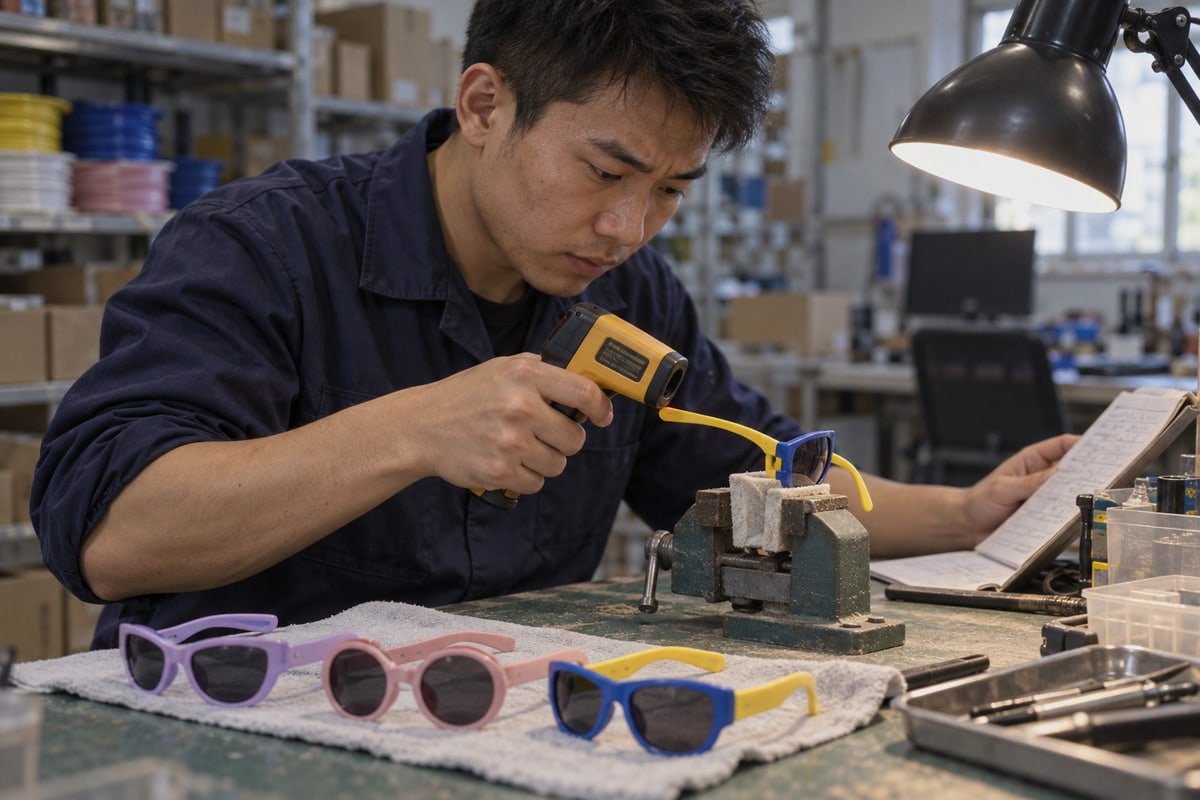
Buyers often send me two conflicting documents. One is a supplier brochure that promises a service range of -70°C to 180°C. The other is a consumer review saying a soft TPEE frame stretched in a parked car. Both can be true. The gap between them comes from how thermoplastic polyester elastomer properties change with formulation, and from the difference between several distinct heat effects.
One material, many numbers
| Temperatura | What happens to TPEE | Where the figure comes from |
|---|---|---|
| Below freezing | Glass transition temperature 2 of the soft segments sits well below 0°C, so the frame stays bendable in winter | Material references citing -40°C to -70°C low-end service |
| About 43°C | Lowest heat-deflection value seen on a generic datasheet under a demanding load | Datasheet range of 43°C to 193°C |
| About 70°C | Thermal deformation temperature listed for one specific grade; early softening begins | Individual grade reference |
| About 90°C | Typical peak temperature inside a closed car in strong sun | Hot-car measurements |
| Up to 120°C | Mechanical strength and flexibility 3 remain intact in good grades | Material property summaries |
| 150°C to 180°C | Upper end of long-term service depending on grade | Supplier claims, formulation-dependent |
| 180°C to 220°C | Melting point; the frame physically melts | Polymer data |
Notice where 90°C falls in that table. It is far below the melting point. It is also above the 70°C figure for the weaker grade. That overlap is the whole story. Whether your frames survive depends on which grade sits inside them.
Melting, softening, warping, and permanent set are four different things
Melting only happens near 200°C, so a car will never melt a TPEE frame. Softening starts near the heat-deflection temperature 4, and the frame becomes easier to bend. Warping is temporary shape loss while soft, and TPEE's memory usually reverses it on cooling. Permanent set happens when a soft frame is stressed, stretched, or crushed long enough that the polymer chains relax into a new position. Thin temples, slim nose bridges, and springy wraparound shapes reach that point sooner than chunky fronts.
Why "heat-resistant" is not "heatproof"
Some suppliers argue that TPEE survives automotive paint-bake ovens and retains performance better than TPU at high temperature, so a parked car cannot harm it. That is a fair point for a thick industrial part. It is not a guarantee for a two-millimeter temple tip on a child's frame. Thermal degradation, where the polymer actually breaks down, needs far more heat than a car provides. Dimensional stability under mild load is the real concern, and it depends on grade, wall thickness, and how long the heat lasts.
Are TPEE frames more heat-resistant than TR90 or regular plastic sunglasses?
A procurement manager from Australia once asked me why her rubber-coated frames warped while our TR90 samples survived the same courier van. That question deserves a careful comparison.
TPEE frames resist heat better than acetate and standard plastics, which soften at 60°C–70°C, and hold shape memory better than TPU. TR90 keeps rigid dimensional stability slightly better at peak car temperatures, which is why TR90 fronts with TPEE temples combine the strengths of both.
| Material | Behavior near 90°C | Flexibility and impact resistance | Hot-car risk | Best role in kids' eyewear |
|---|---|---|---|---|
| TPEE | Softens in weaker grades, recovers shape on cooling, resists creep in good grades | Very high; bends flat without cracking | Low to moderate, grade-dependent | Temples, nose bridges, soft full frames for toddlers |
| TR90 | Stays rigid and stable; high heat tolerance for a nylon-based material | High; flexible but firmer than TPEE | Baixo | Fronts and optical frames that must hold lens alignment |
| TPU | Softens earlier than TPEE at elevated heat and can feel tacky | Muito alto | Moderado | Budget soft frames and grips |
| Policarbonato (PC) | Rigid and stable; used for shatterproof lenses | High impact resistance, little bend | Low for the frame, but lens coatings can craze | Lenses and rigid sport frames |
| Acetate and standard plastics | Begin to soften and lose shape at 60°C–70°C | Low; can snap under bending | Alto | Fashion adult frames, not active kids |
| Rubberized coatings | Coating can go soft or peel | Depends on the core | Moderado a alto | Grip zones only |
Why flexible does not mean heatproof
Many buyers assume a frame that bends flat must shrug off heat. That is a common mistake. Flexibility comes from a low glass transition temperature in the soft segments. Heat resistance comes from the hard crystalline segments and their melting point. TPEE happens to score well on both, which is why we use it so much. TPU has similar flexibility but weaker heat retention, so it drifts sooner. Acetate has neither advantage in a car.
Why we pair TR90 fronts with TPEE temples
Our two-tone square style, with a royal blue front and yellow temples, shows the logic. The front holds the lenses and needs dimensional stability, so TR90 does that job. The temples take the twisting, chewing, and sitting-on that children deliver, so TPEE handles flexible frame durability there. In a hot car, the rigid front resists movement while the soft temple can recover its shape after cooling.
Where the lenses fit in
TPEE has a higher coefficient of thermal expansion 5 than polycarbonate. At peak heat, the frame can expand away from the lens and loosen the fit, which is one reason lenses pop out of cheap soft frames. A deep lens groove and a properly sized lens reduce that risk. Polarized filters and lens adhesives remain the most heat-sensitive parts of any pair, whichever frame material you choose.
What should I ask my manufacturer to confirm heat resistance before placing a bulk order?
Years ago, we learned that a datasheet without a grade name is worth very little. Now we share the exact TPEE grade and its heat-deflection data with every bulk buyer.
Ask your manufacturer for the exact TPEE grade name, its heat-deflection temperature under load, its glass transition temperature, and a hot-storage test report at 70°C–90°C. Also confirm lens adhesive heat tolerance, polarized film limits, BPA-free certification, and whether frame and lens expansion rates were matched.
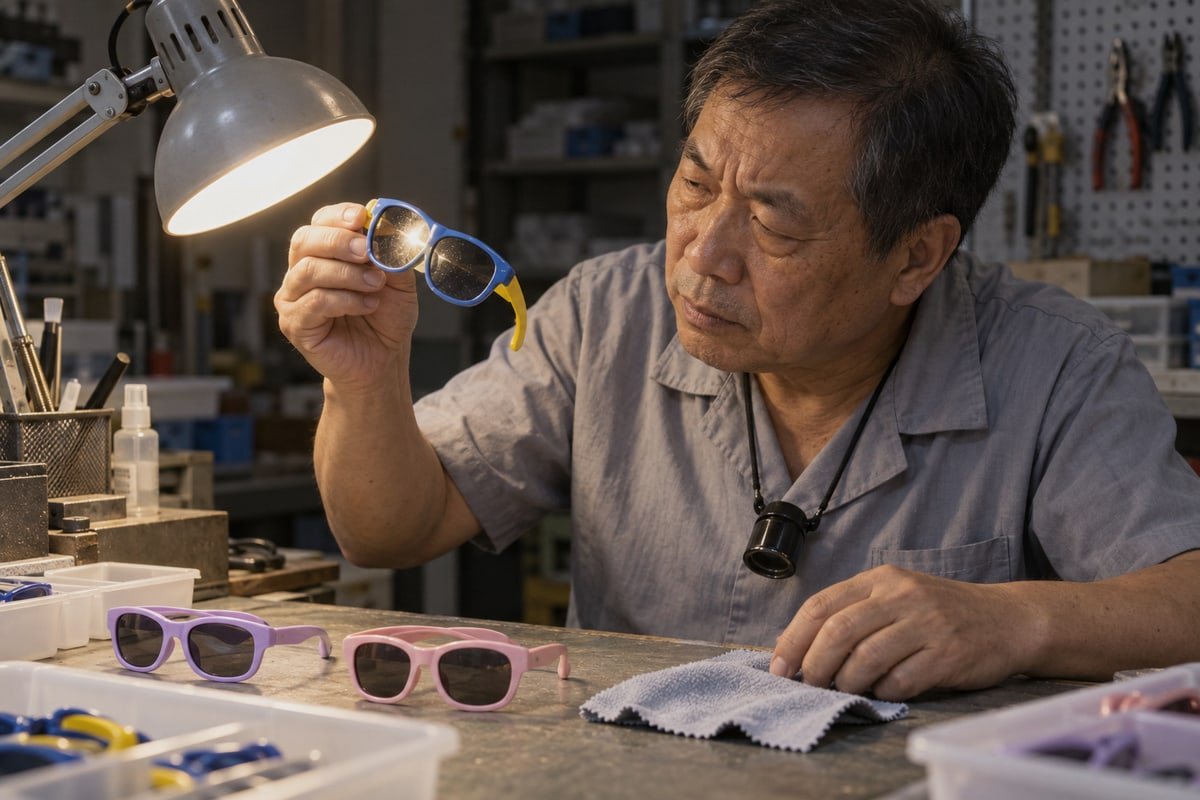
The goal of these questions is not to trap a supplier. It is to find out whether they understand their own material. A factory that has worked with TPEE for years will answer quickly and show documents. A trading company will often pause and forward your email. That pause tells you a lot.
Questions about the raw material
| Pergunta | Uma boa resposta se parece com | A weak answer looks like |
|---|---|---|
| Which TPEE grade and supplier do you use? | A named grade with a datasheet attached | "Standard TPEE" or "high-quality TPEE" |
| What is the heat-deflection temperature under load? | A number with the test load and method stated | A single service range copied from marketing |
| Is the material BPA-free and does it meet food-grade safety standards? | Certificates from the resin supplier and third-party tests on the finished frame | A verbal yes with no paperwork |
| How does the grade handle thermal degradation during molding? | Controlled melt temperatures and dried resin, with scrap rate awareness | No clear process description |
The BPA-free material question matters more for toddlers than for older children, because young kids chew temple tips. Some buyers in Japan and Europe also ask whether the elastomer meets food-grade safety standards as an extra layer of reassurance. Good grades can, so ask.
Questions about the finished frame
Ask for a hot-storage test at 70°C and 90°C on your exact style, not on a random sample. Wall thickness changes results, so a chunky round frame like our blush-pink kids' model behaves differently from a slim lavender cat-eye. Ask how the lens groove was sized against the thermal expansion of the polycarbonate shatterproof lenses. Ask whether the polarized film supplier states a maximum storage temperature. And ask how many heat cycles the sample survived, because thermal shock across several seasons slowly reduces elastic recovery.
Questions about your program
If you are launching a new brand, ask whether you can start from existing tooling. Choosing from a large library of existing styles, in our case around 800, lets you test heat performance and market response without paying for molds first. Then confirm that custom colors, logos, lens options, and packaging can be added under full OEM/ODM support without changing the base material grade. Finally, request a care-label text about hot cars. Even the best frame benefits from a parent who knows to move it off the dashboard.
Conclusão
TPEE kids sunglasses will not melt in a car, but heat can warp weak grades. Test the frames, pick a proven grade, and guide parents on storage.
Interested in sourcing the products mentioned in this article? See details and request a quote here:
Notas de rodapé
1. International standard covering requirements for sunglasses and polarized filters. ↩︎
2. Scientific resource explaining glass transition temperature in polymer science. ↩︎
3. Authoritative scientific definition of mechanical strength and material flexibility. ↩︎
4. Official ISO standard for testing the heat deflection temperature of plastics. ↩︎
5. Comprehensive explanation of how materials expand and contract with temperature. ↩︎
Mais Artigos que Você Pode Gostar
Procurando um Parceiro Confiável em Óculos Infantis?
Explore mais de 800 estilos prontos e suporte completo OEM/ODM adaptado à sua marca.
Entre em Contato English
  Español de México
  Deutsch
  Français
  日本語
日本語  العربية
  Português do Brasil