How to Pair Size and Color SKUs for TR90 Kids Optical Frames by Age Group?

Pairing size and color SKUs for TR90 kids optical frames sounds simple until a buyer’s first order sits in our Taizhou warehouse: right styles, wrong sizes, colors nobody wanted.
Combine SKUs de tamanho e cor para armações ópticas infantis em TR90 por faixa etária: 40–44 mm para idades de 2 a 5 anos em cores translúcidas vibrantes, 44–46 mm para idades de 5 a 7 anos com básicos escuros, 45–48 mm para idades de 7 a 10 anos com opções em dois tons e 48–50 mm para 10+ anos em tons estruturados e adequados para marcas.
That one-line answer hides a lot of decisions. Below, I walk through the sizing logic, the color logic, the SKU code structure, and the MOQ reality. Each section builds on the one before it.
Como determino os tamanhos de quadro corretos para diferentes faixas etárias de crianças?
Last spring, a European baby brand sent us a sizing chart based only on age. Our fitting samples showed why bridge width and temple length matter more.
Determine kids frame sizes by pairing age bands with lens width, bridge width and temple length: roughly 40–44 mm for ages 2–5, 44–46 mm for 5–7, 45–48 mm for 7–10, and 48–50 mm for 10+, then confirm fit with actual face measurements.

Age is a starting point, not a measurement. Two five-year-olds can differ by a full size band. So I always ask buyers to think in three numbers first, and in age second.
Reading pediatric frame measurements
Every kids frame carries three core numbers. Lens width is the horizontal width of one lens. Bridge width is the gap between the lenses. Temple length runs from the hinge to the tip. A common early-school anchor looks like 44-15-130: a 44 mm lens, 15 mm bridge, 130 mm temple. That is a real product spec I see repeated for the 5–7 band. Temple lengths across the kids range usually sit between 125 and 138 mm.
TR90 helps here. It is a poliamida termoplástica 1 with high flex memory. Because the front bends without cracking, a single bridge design can fit a wider range of small faces. That is why many toddler and preschool SKUs use a "universal fit" bridge instead of three bridge variants. We add almofadas de nariz de silicone or a molded saddle bridge on the smallest sizes so the frame stays put on a flat, developing nose.
Toddler to teen sizing charts
Aqui está o size ladder I recommend as a default. It matches what wholesalers and opticians already stock.
| Faixa etária | Largura da lente | Ponte | Haste | Fit notes |
|---|---|---|---|---|
| 0–3 anos | 35–40 mm | 14–15 mm | 115–125 mm | Wrap or strap temples, saddle bridge, silicone nose pads |
| 2–5 anos | 40–44 mm | 15 mm | 120–128 mm | Universal fit bridge, rounded edges, lightest weight |
| 5–7 anos | 44–46 mm | 15–16 mm | 130 mm | Core "kid size"; frames around 12 g feel almost weightless |
| 7–10 anos | 45–48 mm | 16 mm | 130–135 mm | Growth phase; adjustable temple tips help |
| A partir de 10 anos | 48–50 mm | 16–18 mm | 135–138 mm | Closer to teen eyewear, flexible spring hinges optional |
One more point. The 6–9 age gap is where the distance from bridge to ear changes fastest. For that band I suggest a "growth-adaptive" SKU: the same front, but a TPEE temple with an adjustable or extendable tip. It buys the parent an extra season of wear without a second purchase.
Some buyers push back. They say parents shop by age, so age labels should drive the SKU. I agree on the label. But the spec sheet behind that label must carry the real medidas de armações pediátricas 2. Age sells the frame. Measurements make it fit.
Which color palettes work best for boys, girls, and unisex TR90 frame collections?
Every color meeting in our sample room ends with the same trade-off: the shades children grab first are rarely the shades parents reorder for school.
The best TR90 color palettes shift with age: bright translucent pink, blue and candy tones for toddlers; primary colors plus navy or black for young kids; two-tone and tortoiseshell for 7–10; matte, crystal and dark shades for tweens. Teal, mustard and purple work as unisex anchors.
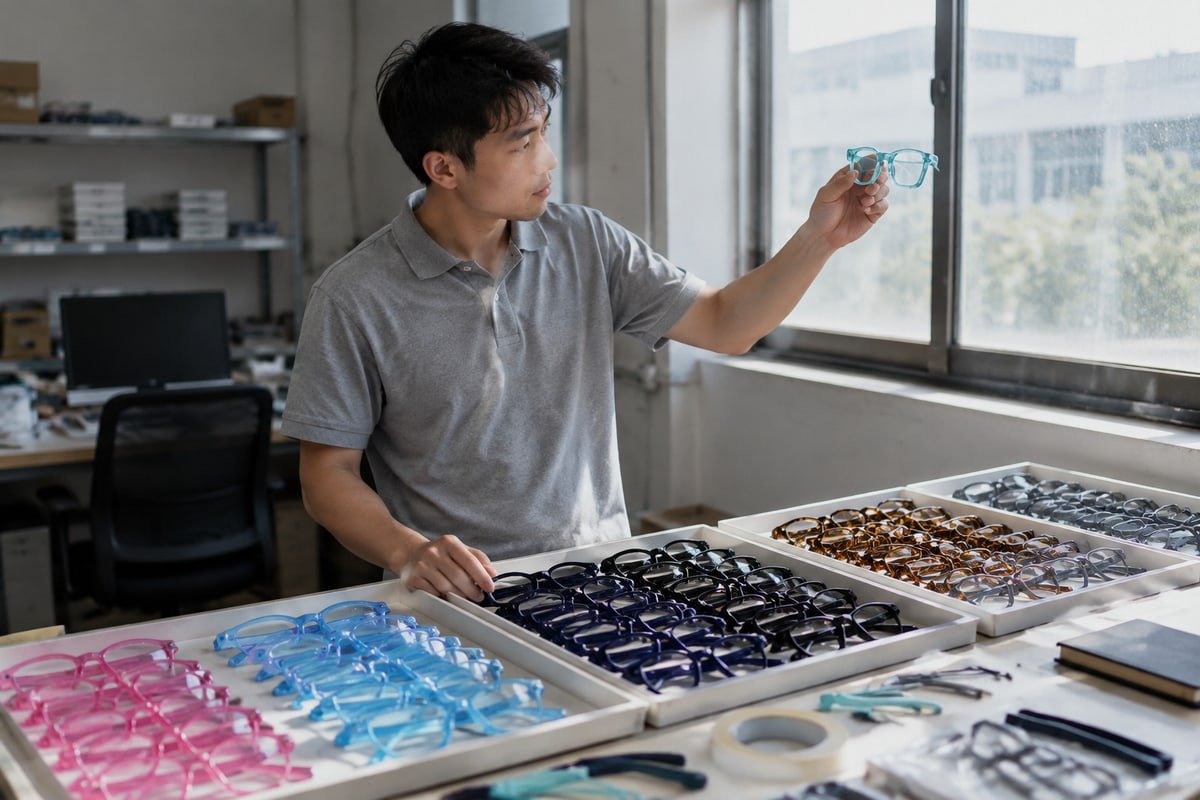
Color follows two things. It follows age, and it follows who makes the buying decision. Under six, the parent decides. Over ten, the child decides. In between, they negotiate. Your SKU list should reflect that shift.
Palette direction by age and gender
| Faixa etária | Boys lean | Girls lean | Unisex anchors | Buying driver |
|---|---|---|---|---|
| 0–5 anos | Electric blue, red, neon green | Translucent pink, lilac, candy tones | Purple, teal, clear crystal | Parent-led: visibility and fun |
| 5–7 anos | Blue/black, navy | Pink/grey, red | Teal, mustard, transparent grey | Parent-led with child veto |
| 7–10 anos | Black front with blue temples, tortoiseshell | Pink gradient, purple two-tone | Sage, slate, dual-tone crystal | Shared decision |
| A partir de 10 anos | Matte black, dark blue, metallic finishes | Crystal pink, matte lavender | Matte grey, crystal clear | Child-led: social self-image |
Two of our current samples show the pattern well. One is a round frame with a matte black front rim and glossy sky-blue TPEE temples over a keyhole bridge. That two-tone contrast sells into the 7–10 band for both boys and girls. The other is a rounded-square frame that fades from clear crystal at the lower rim to soft pink along the brow and temples. That candy gradient works from 5 up to about 9, and it reads as "unisex-leaning-girl" rather than strictly girl.
Matte vs glossy finishes
Finish changes how a color behaves in real life. TR90 takes pigment well, so kids colors look brighter and more delicate than the same shades in acetate. But that brightness raises a fair objection from buyers: do translucent and pastel frames show scuffs faster? In our experience the answer depends on finish more than hue. Glossy translucent frames show fine scratches as light marks. A matte or soft-touch finish hides them. So I pair glossy finishes with the youngest bands, where frames are replaced often anyway, and matte finishes with 7+ where the child keeps one frame longer. Nobody has published fading data for kids TR90, so treat this as a merchandising trade-off, not a defect.
Three newer color stories worth one SKU each
- "Digital-ready" metallics for 8+: a gunmetal or graphite TR90 finish paired with blue-light lens compatibility appeals to the gaming aesthetic.
- "UV-reactive" pigments for 5–10: a photochromic frame color that shifts in sunlight nudges outdoor eye protection.
- "Sensory-friendly" tones: rubberized soft-touch TR90 in sage, slate or muted lavender, useful for neurodivergent children who prefer low-arousal colors and materiais hipoalergênicos para óculos 3 against the skin.
I would not lead a range with these. But one or two of them in the upper bands give a brand a story to tell.
How can I structure my SKU system to simplify ordering across sizes and colors?
A procurement manager from Australia once asked me why her order sheet ran to dozens of lines for eight frames. Her SKU codes carried no size logic at all.
Structure the SKU system as style–size–color: choose 3–5 size bands, assign 2–4 core colors to each, add one or two fashion colors only in upper age bands, and encode the age band in the SKU so buyers can reorder a full matrix from one sheet.

The goal of inventory SKU optimization 4 in kids eyewear is not fewer SKUs at any cost. It is a narrow size ladder paired with a wider, age-appropriate color ladder. Here is the process I use with new brands.
A five-step SKU workflow
- Pick your size bands. Three is the minimum: toddler, junior, teen. Five gives finer fit. More than five creates dead stock.
- Assign core colors per band. Two to four. Core colors are the ones you will restock every season, such as navy, black, translucent pink and crystal.
- Add fashion colors only above age 7. One or two per band. These rotate. They should never appear in the toddler band, where turnover is parent-led and predictable.
- Encode size and color in the SKU. A human should read the code and know the band without a lookup table.
- Keep bridge variants to a minimum. Because TR90 flexes, a universal-fit bridge covers the 0–6 bands with one mold. Save bridge variants for 10+, where faces diverge.
A readable SKU code
| Code segment | Exemplo | Meaning |
|---|---|---|
| Estilo | K118 | Round keyhole-bridge optical frame |
| Size band | S44 | 44 mm lens, 5–7 band (44-15-130) |
| Cor | MBK-SBL | Matte black front, sky-blue temples |
| Full SKU | K118-S44-MBK-SBL | One orderable line |
With that code, the same style in the 47 mm band and a pink gradient becomes K118-S47-CPK. A buyer can build or reorder a whole size and color matrix from one sheet, and our warehouse team picks it without asking questions.
Worked matrix for one style
Take K118 across three bands. The 44 band carries four colors: matte black/blue, translucent pink, navy, crystal purple. The 47 band carries the same four plus one fashion color, say tortoiseshell. The 50 band drops translucent pink, keeps navy, black and crystal, and adds a matte graphite. That is 13 SKUs for one style across three sizes, not 15 or 18. The saving looks small on one style. Across 20 styles, it removes dozens of slow lines.
Buyers sometimes worry that trimming colors will cost them sales. The opposite is more common. Wide color runs spread demand thin and leave odd sizes stranded. A tight core plus one rotating fashion shade sells through faster and still gives the child a choice. Flexible spring hinges or TPEE temples can also be treated as a variant on the upper band rather than a whole new style, which keeps the code short.
What minimum order quantities should I expect when building a size and color matrix?
Fifteen years of injection runs taught our team one lesson: the pigment batch, not the mold, sets the real floor for a color MOQ.
Expect TR90 kids frame MOQs to be set per color per style, not per order total. Existing catalog styles in stock colors carry the lowest thresholds, custom colors require a full pigment and injection run, and mixing sizes within one color is often negotiable.

This is where the size and color SKUs for TR90 kids optical frames become a commercial question. Wholesale catalogs almost always quote MOQ by color. That single detail should shape how you build your matrix.
Why color drives the MOQ
TR90 is injection molded. Each color needs its own masterbatch mixed, loaded, purged and run. Switching colors costs machine time and scrap. So a factory sets the minimum at the level where one color run pays for itself. Size matters less. If two sizes of a style share a color, they often share the pigment batch, and many factories will let you split that color's MOQ across sizes. Ask for this. It is the single easiest way to fill a five-band ladder without over-buying.
MOQ tiers you will meet
| Tipo de pedido | MOQ relativo | O que o impulsiona | Melhor uso |
|---|---|---|---|
| Existing style, stock color | Mais Baixo | Frames or parts already in production flow | Market testing, first orders, filling small size bands |
| Existing style, custom color | Médio | New pigment batch and injection setup | Brand-matched core colors on proven shapes |
| Existing style, custom color plus logo and packaging | Médio a alto | Printing, pad-printing plates, box tooling | Retail-ready launch of a curated range |
| New mold | Mais alto | Mold cost amortized across units | Established brands with proven volume |
Our ~800 existing styles exist mainly to keep new brands in the first two rows. A founder in Japan or Australia can pick a dozen proven shapes, choose stock colors for toddler sizes, and reserve custom colors for the 7+ bands where color drives the sale. That spreads the investment where it earns the most.
What does not change with quantity
Some buyers assume a small first order means looser quality. It should not. Every run on our line, small or large, uses the same BPA-free frames material, the same hypoallergenic eyewear materials on temple tips, and the same checks against the impact resistance standards your market requires. Our 5S-managed workshop and roughly 120 workers run the same inspection steps whether the batch is one color or ten. If a supplier offers to skip testing to lower your MOQ, that is the wrong trade.
One more practical note. Plan MOQs on the color, then let the size ladder ride on top. Order your core unisex colors in every band, order gendered brights only in the bands where they sell, and fill the remainder of each color minimum with the size that turns fastest, which for most of our customers is the 44–46 mm junior band.
Conclusão
Wrong sizes and unsold colors drain kids eyewear margins. Set age-band sizes first, layer age-appropriate colors, encode both in your SKUs, and plan MOQs per color.
Interessado em adquirir os produtos mencionados neste artigo? Veja detalhes e solicite um orçamento aqui:
Notas de rodapé
1. ISO standards for polyamides like TR90 ensure material quality and safety in manufacturing. ↩︎
2. Authoritative guidance on selecting and sizing eyewear specifically for children’s facial structures. ↩︎
3. Scientific research on the biocompatibility and safety of hypoallergenic materials used in medical-grade eyewear. ↩︎
4. Business data and trends regarding efficient inventory and SKU management practices. ↩︎
Mais Artigos que Você Pode Gostar

6 de novembro de 2026
Qual informação da etiqueta os pais verificam primeiro nas armações de grau infantis de TR90?

4 de novembro de 2026
Quais Fatores Levam os Pais a Recomprar Armações Ópticas Infantis TR90?

3 de novembro de 2026
Por que as armações ópticas infantis em TR90 são devolvidas e como as lojas podem reduzir as devoluções?
Procurando um Parceiro Confiável em Óculos Infantis?
Explore mais de 800 estilos prontos e suporte completo OEM/ODM adaptado à sua marca.
Entre em Contato English
 Español de México
 Deutsch
 Français
 日本語
 العربية
 Português do Brasil