How Do Third-Party Testing Agencies Issue Test Reports for Kids’ Sunglasses?
Test reports for kids’ sunglasses confuse many first-time importers I talk with Proteção UV400 1. One missing document can freeze a shipment at customs, and our production team sees this happen far too often.
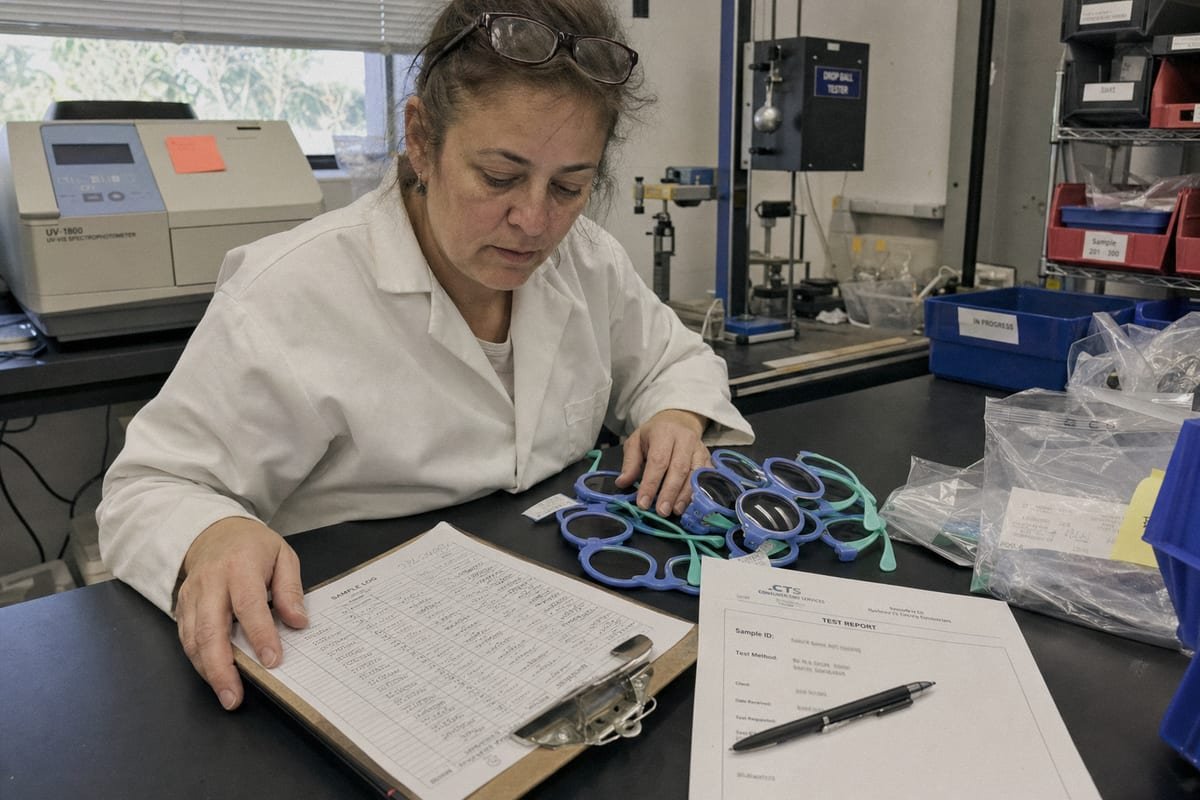
Third-party testing agencies issue test reports for kids’ sunglasses by receiving identical production samples, testing them against applicable standards such as CPSIA rules, ISO 12312-1, and impact resistance requirements, then issuing a signed report documenting methods, measurements, and pass/fail results on official laboratory letterhead.
That is the short answer. But the details matter, because a report is only useful if it matches your market, your product, and your legal obligations. Let me walk you through the whole process.
What testing standards should I ask my supplier to comply with for kids' sunglasses?
A buyer from Melbourne once asked me why her freight forwarder rejected her paperwork. Her lab report covered adult sunglasses standards only. Our team helped her rebuild the file from scratch.
For kids' sunglasses, request testing to CPSIA lead and phthalates limits, FDA drop ball impact resistance requirements, ISO 12312-1 or ANSI Z80.3 for UV and optical performance, and small parts choking hazard evaluation. The exact mix depends on your destination market and product claims.
The biggest mistake I see is treating kids' sunglasses as ordinary sunglasses. In the United States, they are a children's product 2 under federal law. That triggers a completely different compliance path. In our fifteen years of exporting children's eyewear, we have learned to map standards to markets before a single sample ships.
Standards by category
Here is how the requirements break down for a typical pair of children's sunglasses, like our rounded TR90 frames with flexible TPEE temples:
| Área de Teste | Standard / Rule | O que Verifica |
|---|---|---|
| Chemical safety | CPSIA lead limits | Lead below 90 ppm in coatings, 100 ppm in substrates |
| Chemical safety | Lead and phthalates testing | Phthalate content in plasticized parts |
| Impact safety | FDA 21 CFR 801.410 | Drop ball test — steel ball dropped from 50 inches onto the lens |
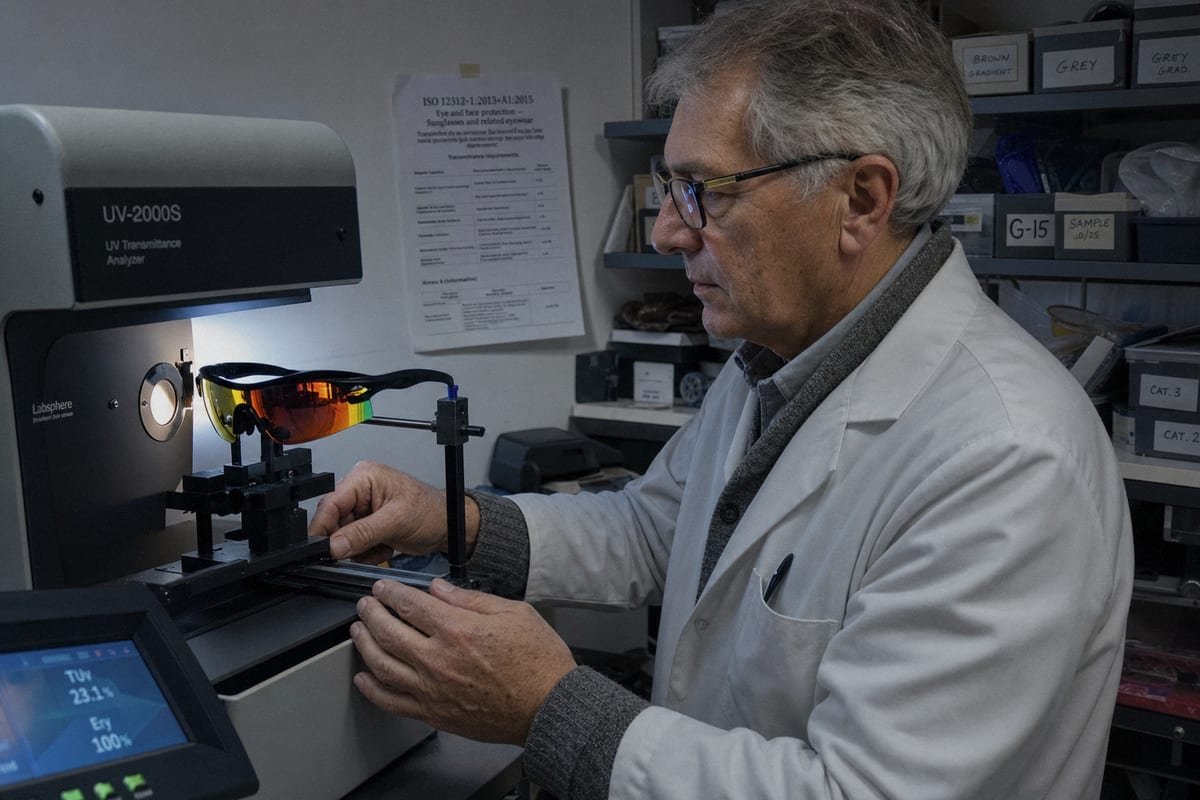
| Optical performance | ISO 12312-1 standard / ANSI Z80.3 | UV transmittance, refractive power, optical radiation safety |
| Mechanical safety | ASTM F963 safety standards (where applicable) | Small parts choking hazard, sharp edges, tension on screws and pads |
| EU market | EN ISO 12312-1 with CE marking | Sunglasses as personal protective equipment |
Match standards to your claims
Your claims create obligations. If your packaging says UV400, the lab must perform UV400 protection verification 3 against the referenced standard. If your design uses a retention strap, ask about breakaway testing to avoid strangulation risk. When we develop sport wraparound shields with mirrored gradient lenses for active kids, we always flag the lens coating for both optical and chemical review, because coatings can hide surprises.
My practical advice: send your supplier a written list of target markets and claims first. A good factory will tell you which standards apply before quoting the testing cost.
Which certifications and lab reports do I need before importing children's eyewear?
Paperwork, in my experience, sinks more shipments than product defects do. Our export team keeps a compliance checklist for every destination country precisely because the document stack differs so much.
Before importing children's eyewear into the US, you need third-party test reports from a CPSC accredited laboratory covering each applicable rule, plus a Children's Product Certificate (CPC) that you or the manufacturer issues based on those reports. Other markets require their own documentation, such as an EU Declaration of Conformity.
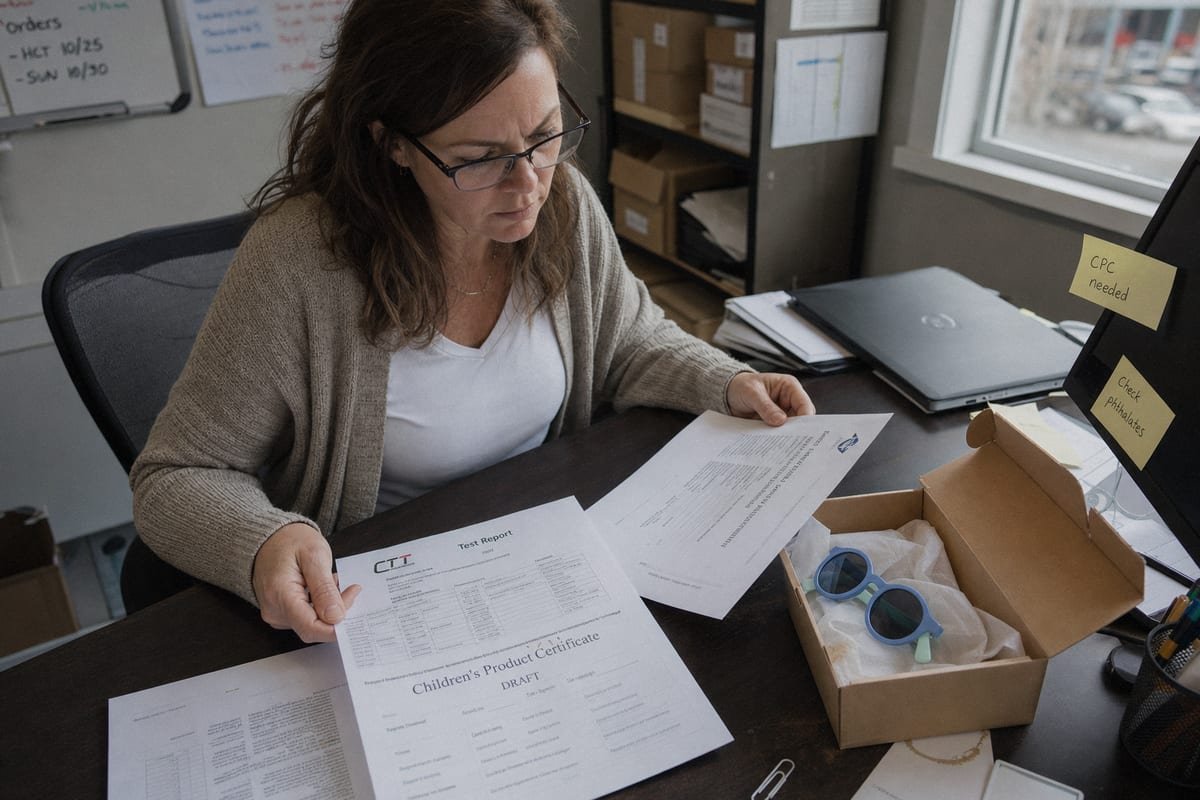
Here is the distinction that trips up almost every new brand: the lab tests, but the company certifies. A laboratory issues a test report. It does not issue your Children's Product Certificate (CPC). You, as the importer or private labeler 4, draft the CPC yourself, citing the lab reports as supporting evidence. Many buyers assume the lab "certifies" the sunglasses. It does not. The report is evidence; the certificate is your legal declaration built on that evidence.
The core document stack
For a US-bound container of children's sunglasses, your file should typically include:
- Test reports from a CPSC-accepted, ISO/IEC 17025-accredited lab for each children's product safety rule.
- A CPC listing the product, applicable rules, lab details, and manufacture date and location.
- FDA drop ball test documentation or the manufacturer's impact resistance statement.
- Tracking label information as required under CPSIA compliance.
- Any optical performance report supporting marketing claims like polarization or UV400.
Requirements differ by channel too
Marketplaces add their own layer. Amazon, for example, asks for children's product test reports 5 from CPSC-accepted labs before listing regulated kids' items. Retail chains often run their own document audits. And starting from July 2026, importers will need to eFile certificates of compliance electronically with US Customs at entry. When we prepare OEM orders for brands across twenty-plus countries, we build the document pack alongside the goods, not after them. That sequencing saves weeks.
| Market / Channel | Key Documents Required |
|---|---|
| Estados Unidos | CPSC-accepted lab reports + Children's Product Certificate (CPC) |
| União Europeia | EN ISO 12312-1 test report + Declaração de Conformidade 6 + CE marking |
| Austrália | Sunglasses standard test report per consumer law requirements |
| Amazon US | CPSC-accepted lab report uploaded for compliance review |
| General retail | Buyer-specified reports, often mirroring national law plus extras |
How do I verify that a test report from my manufacturer is authentic and up to date?
A hard lesson from years back shaped how we handle documentation. A distributor forwarded us a competitor's report to "reuse" for a similar frame. We refused, and I explained why that shortcut destroys businesses.
Verify a test report by checking the lab against the CPSC's list of accepted laboratories, confirming ISO/IEC 17025 accreditation for the specific test scope, matching the report's product description and photos to your actual product, checking the issue date, and contacting the lab directly to confirm the report number.
Fake and recycled reports circulate in this industry more than anyone likes to admit. Some suppliers photoshop dates. Others test one golden sample and apply the report to entirely different SKUs. A pastel periwinkle frame in TPEE and a glossy black sport shield in a different resin are not the same product, even if both are "kids' sunglasses." A report is tied to a specific sample, a specific standard, and a specific date.
A practical verification checklist
Work through these steps before you wire any balance payment:
| Verifique | How To Do It | Bandeira Vermelha |
|---|---|---|
| Lab accreditation | Search the CPSC's public list of accepted labs | Lab name not found for the cited rule |
| Report authenticity | Email or call the lab with the report number | Lab cannot confirm the report exists |
| Product match | Compare photos, materials, and colors in the report | Different model, lens, or material listed |
| Scope match | Read which rules and clauses were tested | UV tested but lead and phthalates missing |
| Date validity | Check issue date against production date | Report predates a material or design change |
| Sample identity | Confirm samples were identical in all material respects | "Representative sample" with no traceability |
Why dates matter more than buyers think
A report does not expire on a fixed calendar, but it stops being valid the moment the product materially changes. New lens supplier? New coating? New pigment in the temple arms? Each change can require retesting. In our workshop, we log every material and component change 7 per SKU so buyers know exactly when a fresh report is needed. Ask your supplier for the same traceability. If they cannot show it, treat every report they hand you with caution.
What role does my factory play in preparing samples for third-party lab testing?
Every quarter, our QC lead pulls sample sets straight from the line for lab submission — never from a display cabinet. That habit exists because the wrong sample invalidates the entire report.
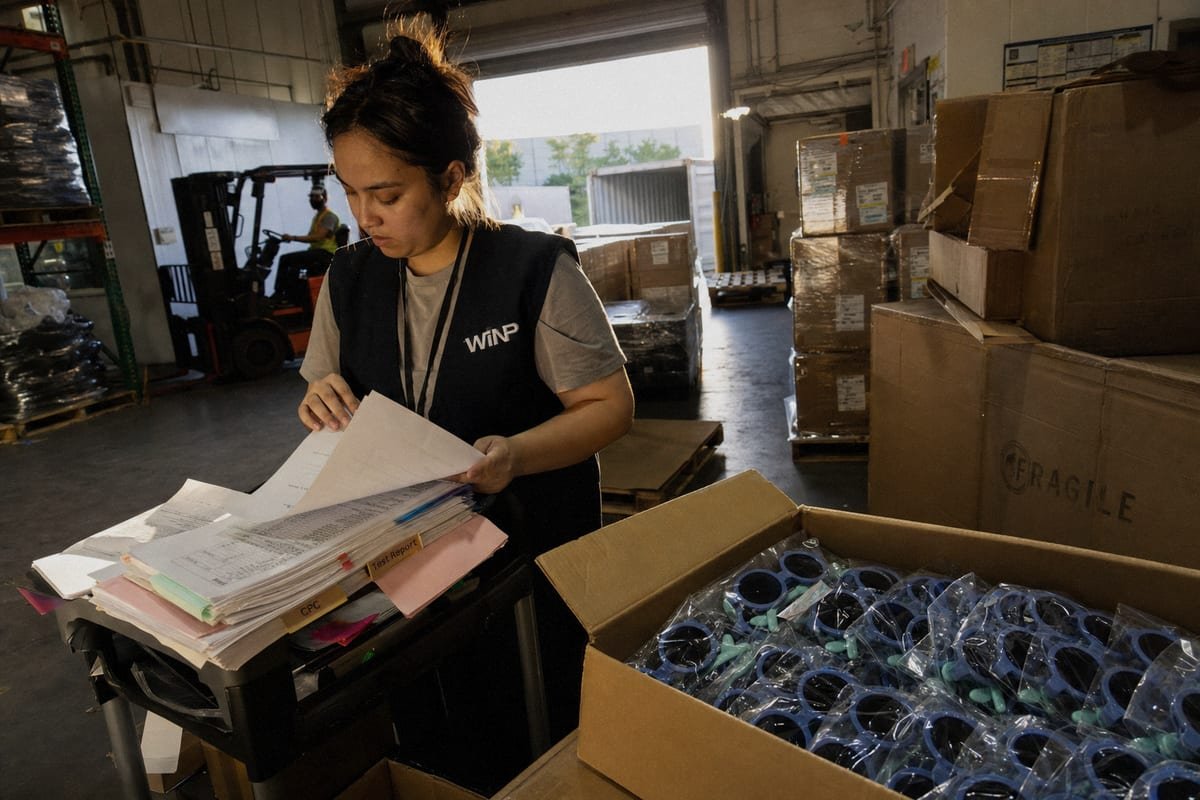
Your factory selects production samples identical in all material respects to the final product, documents materials and components, prepares the required quantity per test plan, ships samples with specifications to the lab, and coordinates with the lab on standards scope, retests, and corrective actions if anything fails.

The factory sits at the start of the evidence chain. If we get sample preparation wrong, everything downstream — the report, the CPC, your customs clearance — rests on flawed evidence. So let me explain what a responsible factory actually does at this stage.
The sample preparation workflow
Our internal process for a testing submission runs roughly like this:
- Confirm the test plan. We agree with the buyer and the lab on which rules apply: CPSIA chemical limits, drop ball impact resistance requirements, optical radiation safety under ISO 12312-1, and mechanical checks referencing ASTM F963 safety standards where relevant.
- Pull true production samples. Samples come from the actual production batch, using the final resins, lens stock, coatings, screws, and nose pads. Prototype parts are never substituted.
- Document the bill of materials. Every component gets listed with its material and supplier, so the lab can plan chemical testing per part.
- Prepare sufficient quantity. Destructive tests consume samples. A typical submission needs multiple identical pairs, sometimes a dozen or more, depending on scope.
- Ship with full specifications. We include product photos, intended age grade, marketing claims to verify, and packaging artwork when labeling review is required.
- Support the lab during testing. If the lab has questions about a hinge screw or a decorative element that might create a small parts choking hazard, our engineers respond quickly.
- Act on failures. If something fails, we identify root cause, change the material or design, and resubmit. We do not shop for a friendlier lab.
Why factory honesty is your real protection
A lab can only test what it receives. A dishonest factory can send special "test-grade" samples and then produce with cheaper materials. That is why we invite buyers to nominate their own lab and even arrange sample pulls during third-party inspections. With around 800 existing styles already in our catalog, many buyers also benefit from styles that have been through testing cycles before, which lowers both risk and cost for a first order. Your best defense is a factory that treats testing as engineering feedback, not as a paperwork hurdle.
Conclusão
Missing or fake reports can block shipments and ruin launches. The fix is simple: know your standards, verify your lab, and demand honest samples. We build children’s eyewear compliance in from day one.
Notas de rodapé
1. FDA resource on UV radiation supports claims requiring lab verification of UV400 protection. ↩︎
2. Official CPSC definition and regulatory scope for products intended for children 12 and under. ↩︎
3. Official ISO page for the international standard governing sunglasses and related eyewear performance. ↩︎
4. FDA guidance identifying entities, including private labelers, required to register and list medical devices like sunglasses. ↩︎
5. CPSC requirements for third-party testing of children’s products to ensure safety standards are met. ↩︎
6. European Commission page explains the Declaration of Conformity required for CE-marked products. ↩︎
7. Engineering process for tracking modifications to product materials and components during manufacturing. ↩︎
Mais Artigos que Você Pode Gostar
1 de agosto de 2026
A Fábrica Deve Lidar com a Embalagem e Rotulagem de Óculos de Sol Infantis, ou Usar um Fornecedor Designado?

1 de agosto de 2026
Armazém Próprio vs. Envio Direto do Fornecedor: Qual Reduz os Custos de Devolução para Marcas de Óculos de Sol Infantis?

1 de agosto de 2026
Armazém Direto ao Porto ou Estiva no Exterior: Qual Economiza Mais no Envio de Óculos de Sol Infantis?
Procurando um Parceiro Confiável em Óculos Infantis?
Explore mais de 800 estilos prontos e suporte completo OEM/ODM adaptado à sua marca.
Entre em Contato English
  Español de México
  Deutsch
  Français
  日本語
日本語  العربية
  Português do Brasil