How Does a Screwless One-Piece Hinge Work on TPEE Kids Sunglasses vs Spring Hinges?
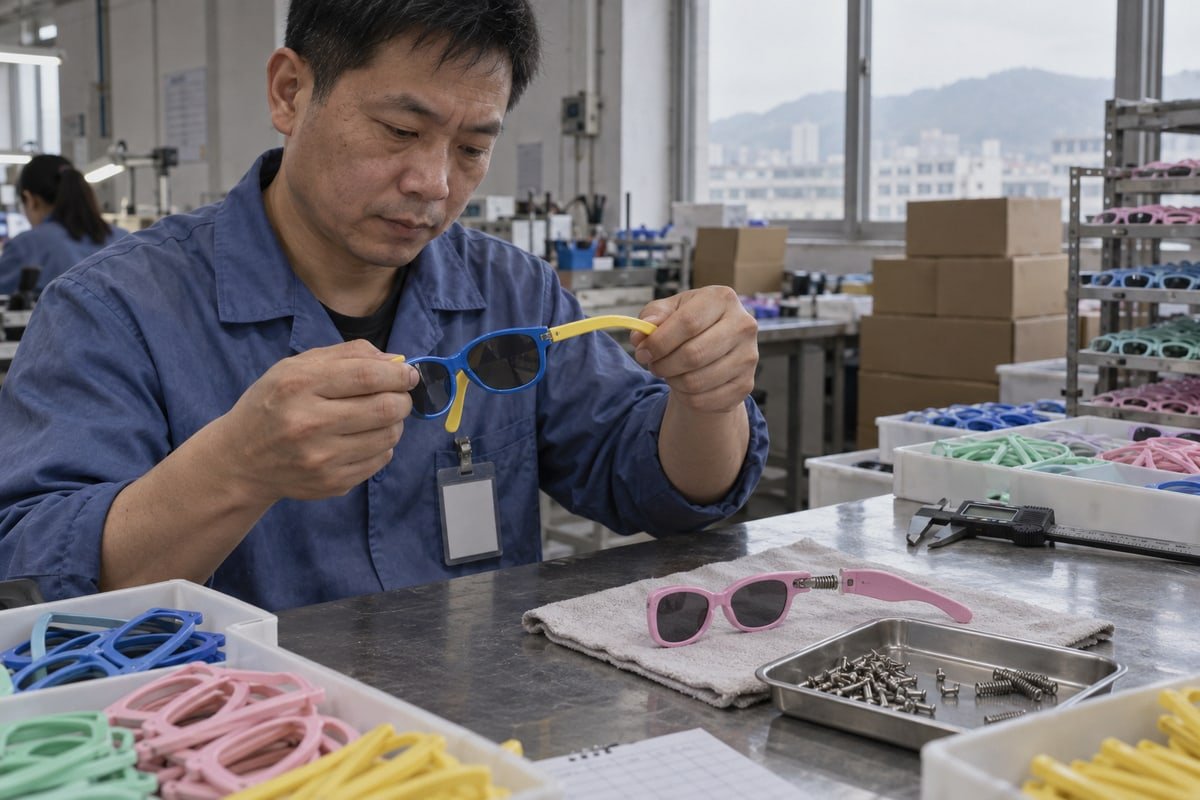
Screws fall out. Temples snap. Parents complain. A screwless one-piece hinge on TPEE kids sunglasses fixes this, and our Taizhou production line molds it into the frame itself.
A screwless one-piece hinge on TPEE kids sunglasses works by molding the pivot into the frame so the temple flexes on the material’s own elasticity, with no screw, pin, or coil. A spring hinge instead uses a metal coil inside a barrel to add 10–15 degrees of outward flex.
The two designs solve the same problem in different ways. Below, I explain how each one works, where each one fails, and how to pick the right one for your age group.
How does a screwless one-piece hinge actually stay durable without any screws to tighten?
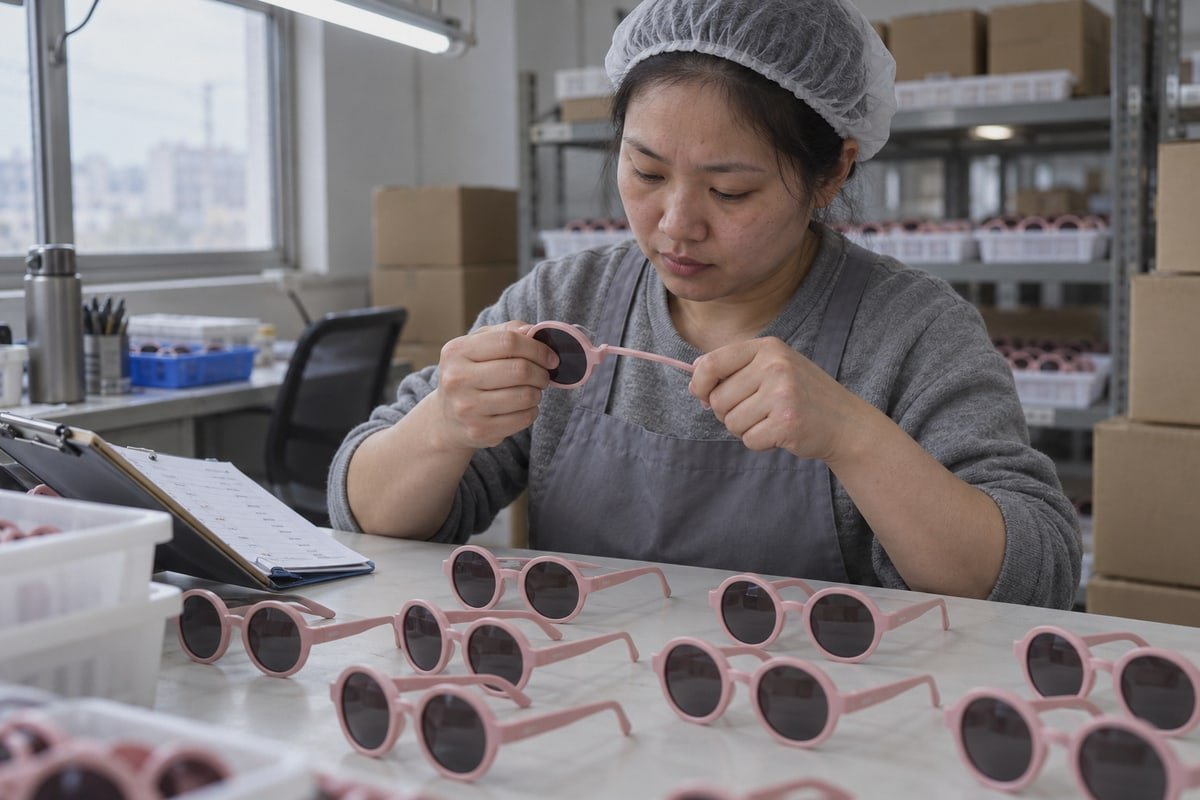
Last month our QC team pulled a batch of blush-pink round frames off the line and flexed every temple by hand before packing. Not one whitened at the hinge.
A screwless one-piece hinge stays durable because Thermoplastic Polyester Elastomer acts as a living hinge: its polymer chains realign under stress and recover their shape, so there is no screw to loosen, no coil to fatigue, and no rigid metal joint to crack or corrode.
Most people picture a hinge as two metal knuckles and a screw. A screwless one-piece hinge is not that. It is a shaped section of the frame that is designed to bend. Durability comes from the material, not from hardware.
What a living hinge actually does
When a child pulls a temple outward on a screwless TPEE frame, nothing rotates on a pin. The material bends. Thermoplastic Polyester Elastomer combines a rubber-like soft segment with a rigid segment. Under stress, the polymer chains slide and realign, then pull the temple back to its rest position. This is the "shape memory" that people talk about. Standard rigid plastics whiten or "craze" at a bend line after a few cycles. High-grade TPEE resists that whitening. That is why a temple can survive day after day of open-close motions, twisting, and being sat on.
Two ways we build it: integrated hinge design and snap-fit
In our workshop we use two screwless constructions. The first is a true one-piece frame. The temple and the front are molded as a single unit, so the hinge is simply a thinner, engineered zone in the mold. This is the integrated hinge design we favor for baby and toddler styles. The second is a hidden snap-fit mechanism. The TPEE temple carries a molded knuckle that locks into a matching socket in the front frame. It pivots on friction between two polymer surfaces. There is still no screw, but the temple can be replaced if a brand wants that option.
Where each hinge type tends to fail
| Ponto de falha | Screw hinge | Dobradiça de mola | Screwless one-piece TPEE |
|---|---|---|---|
| Screw loosens or falls out | Comum | Comum | Not possible |
| Coil loses tension | Não aplicável | Yes, over repeated use | Não aplicável |
| Rust or jamming from sand and dirt | Possível | More likely, because the coil sits in a cavity | No metal to rust |
| Whitening at the bend | Não aplicável | Não aplicável | Resisted by TPEE |
| Snap at the joint on impact | Yes, at the stress point | Yes, at the barrel | Rare, since force spreads through the frame |
Why beach sand and sweat do not matter
Kids' sunglasses live at the pool, the beach, and the playground. Sand gets into a spring barrel and jams it. Salt water and sweat reach the coil and start corrosion. A screwless TPEE hinge has no cavity for sand to enter and no metal for salt to attack. A parent rinses it under a tap and it is done. For us, that means fewer after-sales tickets for your customer service team, which is one reason brands in warm markets keep reordering this construction.
Why would I choose a screwless TPEE hinge over a traditional spring hinge for my kids' sunglasses line?
Every season we weigh the same trade-off with brand buyers: more flex range from a spring barrel, or fewer parts from a screwless temple. The wearer's age decides.
Choose a screwless TPEE hinge when your line targets babies, toddlers, or active young kids, because it removes small parts, cuts maintenance, lowers pinch risk, and supports an unbreakable message. Choose a spring hinge when you need wider fit tolerance and standard repair parts for older children.
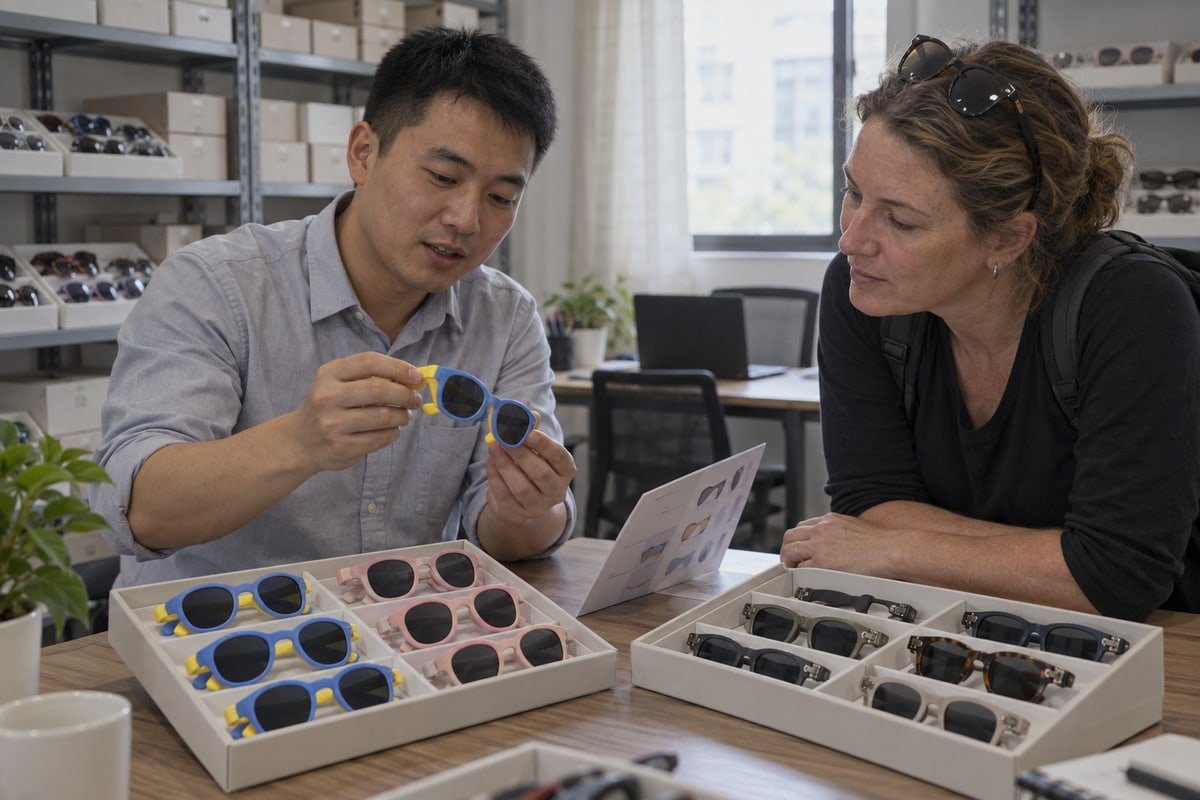
Here is the comparison I walk buyers through before we look at any samples.
| Fator | Screwless TPEE hinge | Dobradiça de mola |
|---|---|---|
| Peças pequenas | Nenhuma | Screw, coil, and barrel |
| Outward flex | Within the material's elastic limit | About 10–15 degrees beyond a standard stop |
| Fit tolerance | Fixed shape, relies on soft temples | Wider head-width range |
| Manutenção | Virtually none | Coil can rust, jam, or lose tension |
| Repair | Replace the temple or the frame | Standard replacement parts |
| Peso | Lightest option | Adds metal weight |
| Recyclability | Mono-material, no hardware removal | Metal must be stripped before recycling |
| Melhor faixa etária | Babies, toddlers, preschool | School-age kids and teens |
The objection: kids need extra flex
Buyers often tell me that spring hinges are recommended for pediatric frames because children put glasses on with one hand and pull them open too far. That is a fair point. A spring barrel gives 10–15 degrees of extra travel and then springs back. But a TPEE temple does something similar without a coil. The whole temple bends outward, not just the joint. In practice, a small child's hand cannot generate enough force to exceed the elastic limit of a well-designed TPEE temple. So the flex is there. It is simply spread across the arm instead of concentrated in a barrel. Where a spring hinge genuinely wins is fit range on older kids whose heads are close to adult width. For that group, we still recommend it.
The objection: proprietary hinges are hard to repair
This is true for some screwless systems on the market. A snapped temple on a fully integrated frame means the frame is done. We handle this in two ways. For toddler styles, we design the frame so that breaking it takes far more force than a child can apply, so repair is rarely needed. For snap-fit styles, we can include spare temples in your order, so your retailer can swap one without tools. That keeps the metal-free construction and still gives your customer service team an answer.
Cost and brand positioning
A spring hinge adds parts and assembly steps, so it costs more per unit. A screwless one-piece hinge simplifies assembly, but the mold is more demanding. The good news for a new brand is that you do not need to pay for that mold. Our ~800 existing styles already include both constructions, so you can test a screwless toddler frame and a spring-hinge kids frame in the same first order and let sell-through data guide your next step. The flexible frame durability also gives you a clean marketing story: no screws, no metal, no maintenance.
Is a screwless one-piece hinge safer for children than a spring-loaded hinge?
A baby-brand buyer from Australia once asked me to show her every part on a frame that could come off. With our screwless TPEE style, I had nothing to show.
Yes, for infants and toddlers a screwless one-piece hinge is safer than a spring-loaded hinge. It has no screw to become a choking hazard, no metal coil to pinch skin, no nickel contact for allergy-prone children, and it spreads impact force across the whole flexible frame.
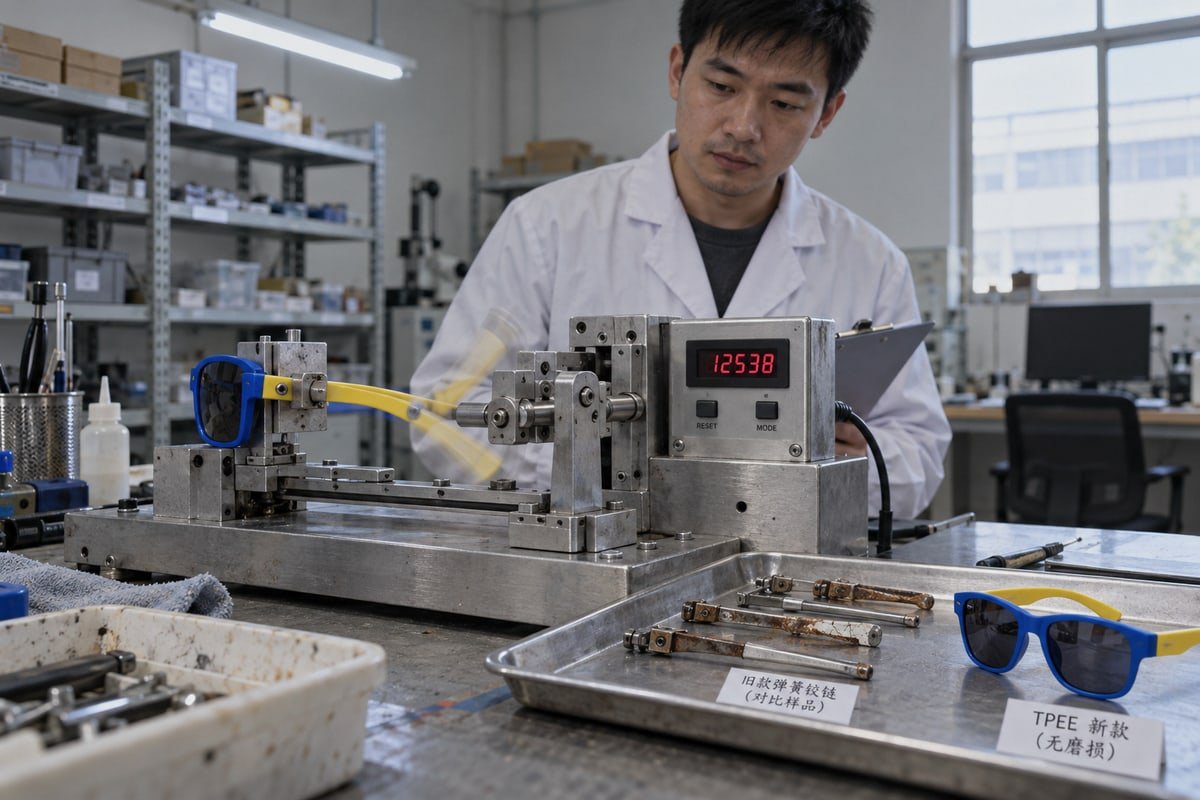
Safety on children's eyewear is not one feature. It is a stack of small risks removed one at a time. I break it into four mechanisms, because that is how our engineers review every new style before it enters the catalog.
- Choking hazard prevention. A hinge screw on kids' sunglasses is tiny. Once it backs out, a toddler can find it on the floor. A screwless one-piece hinge has no screw, so this risk goes to zero. Baby and toddler products across the market highlight "no hinges, no screws" for exactly this reason.
- No pinch points. A spring barrel opens and closes with force. Small fingers get caught. A TPEE living hinge 2 bends smoothly and closes gently, with no gap that can trap skin.
- Hypoallergenic eyewear. Spring hinges bring metal into contact with the temple area. For some children, nickel 3 in that hardware causes redness or itching. Our screwless frames use metal-free construction and a BPA-free frame material, so there is no metal-to-skin contact at all.
- Resistência ao impacto. When a child falls onto the frame or takes a ball to the face, a fixed metal joint concentrates the force at one point. That is where frames snap. A one-piece TPEE hinge acts as a kinetic energy dampener. The whole frame flexes and distributes the blow, so the joint is far less likely to fail or leave a sharp edge.
Where a spring hinge still earns its place
I do not want to overstate the case. A well-made spring hinge on a school-age frame is a safe product. The child is old enough not to mouth small parts. The wider flex range protects the frame when it is pulled off in a hurry. The metal is usually plated and enclosed. For a teen line, the safety gap between the two designs becomes small. The gap is largest under age five, and that is where we steer buyers toward the screwless option every time.
The lenses matter too
Hinge safety is only half of the picture. All of our kids' sunglasses ship with Lentes UV400 4, and buyers can specify polarized TAC lenses for glare-heavy environments like beaches and snow. A lens that pops out under impact is its own hazard, so we design the TPEE rim to grip the lens firmly while still allowing the frame to bend.
Can I get both screwless and spring hinge options when I source my kids' sunglasses from OKAY EYEWEAR?
One lesson from fifteen years of building kids' eyewear: no single hinge fits every age group. That is why our ~800 existing styles cover both constructions.
Yes. OKAY EYEWEAR supplies both screwless one-piece TPEE frames and spring-hinge TR90 frames with TPEE temples, all with UV400 or polarized lens options, custom colors, logos, and retail-ready packaging, so one brand can run a toddler line and an older-kids line from the same factory.
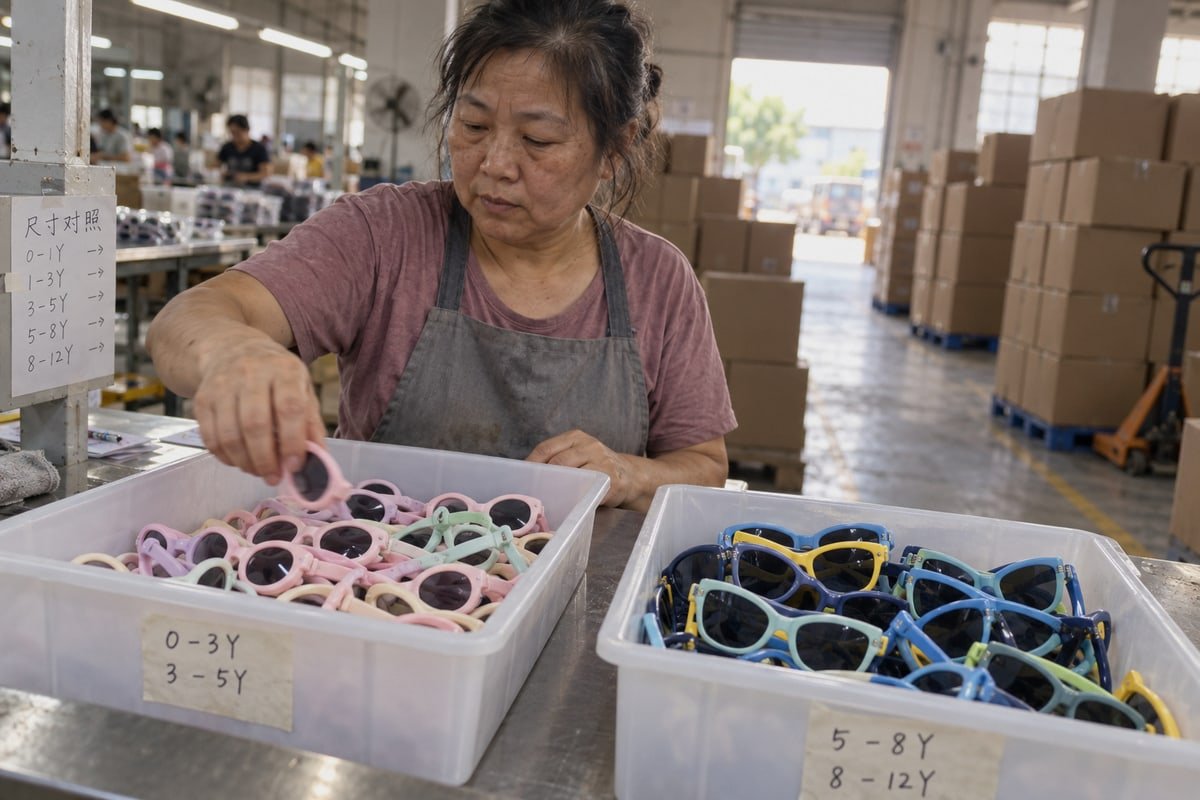
Brands rarely serve one age. A baby brand grows into a kids brand. A kids brand adds a teen range. We built our catalog so that you do not have to change suppliers as your customer grows up.
The three constructions we run
| Construção | Tipo de dobradiça | Typical wearer | Exemplo da nossa linha |
|---|---|---|---|
| One-piece TPEE frame | Fully integrated living hinge, no screw | Babies and toddlers | Compact blush-pink round frame with slim tapered temples |
| TPEE front with snap-fit TPEE temple | Hidden snap-fit mechanism, no screw | Preschool and early school age | Lavender cat-eye with slender temples and CE marking on the inner arm |
| TR90 front with TPEE temples | Spring hinge with metal barrel | School-age kids and teens | Royal blue square front with yellow temples and small silver hinge accents |
The royal blue and yellow color-blocked frame is a good example of where we still choose a spring hinge. It is a medium-sized, thicker frame aimed at older kids. The silver hinge detail is a design accent as well as a functional coil. The blush-pink round frame is the opposite case. It is sized for a small face and has no hardware at all.
How an OEM/ODM project moves through our factory
- Style selection. You pick from existing molds in either construction, so there is no tooling cost to start.
- Customization. We adjust colors, add your logo to the temple, choose UV400 or polarized TAC lenses, and design the case and packaging.
- Amostragem. Our engineers produce pre-production samples and flex-test the hinge zone by hand, whether it is a living hinge or a spring barrel.
- Production. Around 120 workers in a 5S-managed workshop run the order, with in-line checks on hinge fit, lens seating, and color consistency.
- Final QC and shipping. Each lot is inspected before it leaves Taizhou for any of the 20+ countries we currently supply.
What you should ask us before ordering
Tell us the age range, the market, and the price position. If you sell to parents of infants in Japan or Europe, I will push you toward the one-piece TPEE frame. If you sell sports sunglasses for ten-year-olds in Australia, I will show you the spring-hinge Armação TR90 5 with TPEE temples. If you are not sure, we can put both in one sample set. That is the point of a real factory partnership. You get the right hinge for each child, not the cheapest one on the list.
Conclusão
Loose screws and snapped temples cost brands trust. A screwless one-piece hinge on TPEE solves that for young kids, while spring hinges still serve older children. We build both.
Interested in sourcing the products mentioned in this article? See details and request a quote here:
Notas de rodapé
1. Technical definition of the material properties of TPEE used in flexible eyewear. ↩︎
2. Explains the engineering concept of a living hinge used in screwless frame designs. ↩︎
3. Authoritative study on nickel allergies related to metal components in eyewear. ↩︎
4. Authoritative medical guide from the American Academy of Ophthalmology specifically defining UV400 protection standards for sunglasses. ↩︎
5. Background on the polyamide material commonly used for high-quality spring-hinge frames. ↩︎
Mais Artigos que Você Pode Gostar


Procurando um Parceiro Confiável em Óculos Infantis?
Explore mais de 800 estilos prontos e suporte completo OEM/ODM adaptado à sua marca.
Entre em Contato English
  Español de México
  Deutsch
  Français
  日本語
日本語  العربية
  Português do Brasil