How to Request Matching Counter Display Stands from Kids’ Sunglasses Suppliers?
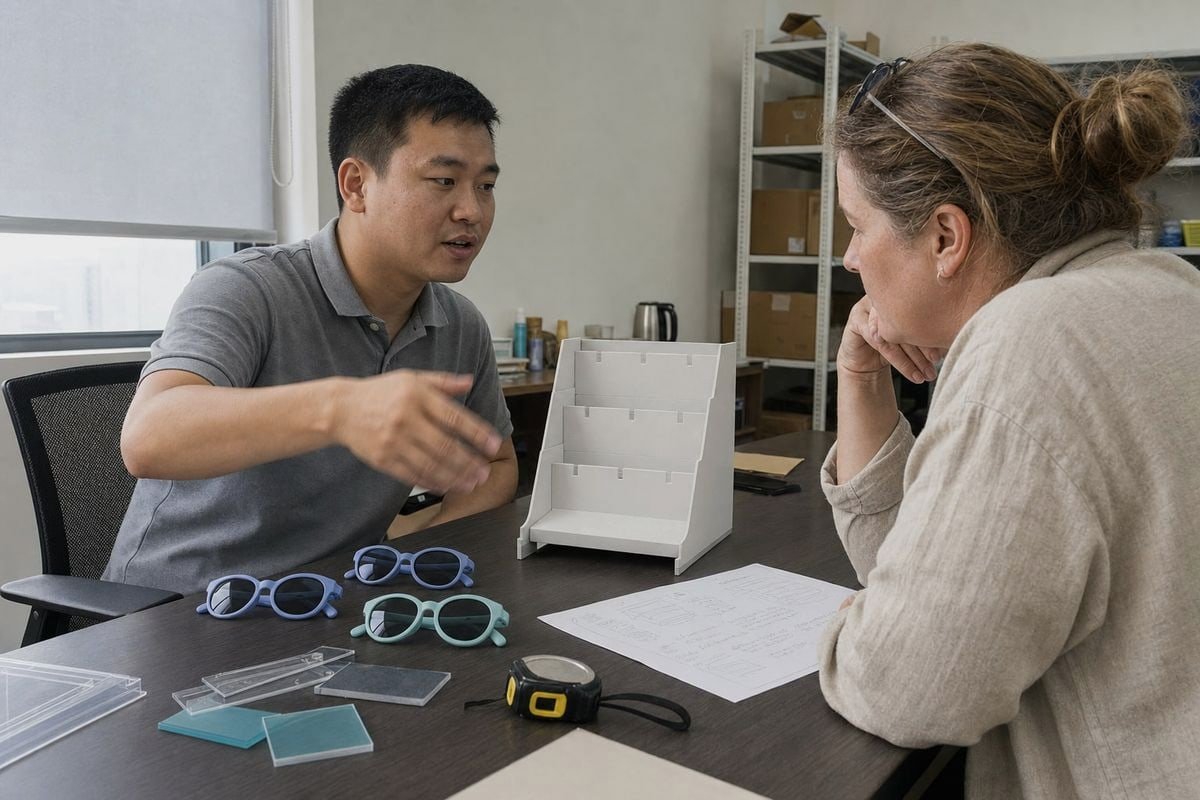
Requesting matching counter display stands from kids’ sunglasses suppliers sounds simple — until your frames arrive and the fixture doesn’t fit them Pantone color references 1. We see this problem at our Taizhou factory constantly.
To request matching counter display stands from kids’ sunglasses suppliers, ask at the same time you order frames. Provide your SKU list, pairs per stand, counter dimensions, brand colors, logo files, and material preference. Then request a drawing or 3D mockup before sampling, and confirm MOQ, lead time, and bundled shipping.
That is the short answer. Below, I will walk you through each step in detail, from spec sheets to shipping timelines, so your next order arrives retail-ready.
What should I look for in a counter display stand before I request one from my supplier?
A buyer from Australia once sent me a photo of adult-eyewear stands holding our TPEE kids' frames. The temples drooped over every slot. Sizing matters more than most buyers realize.
Before requesting a counter display stand, check five things: slot spacing that fits smaller kids' frames, a weighted anti-tip base, rounded kid-safe corners, durable material like reinforced acrylic, and capacity matched to your assortment. A stand built around your actual frame dimensions always outperforms a generic fixture.
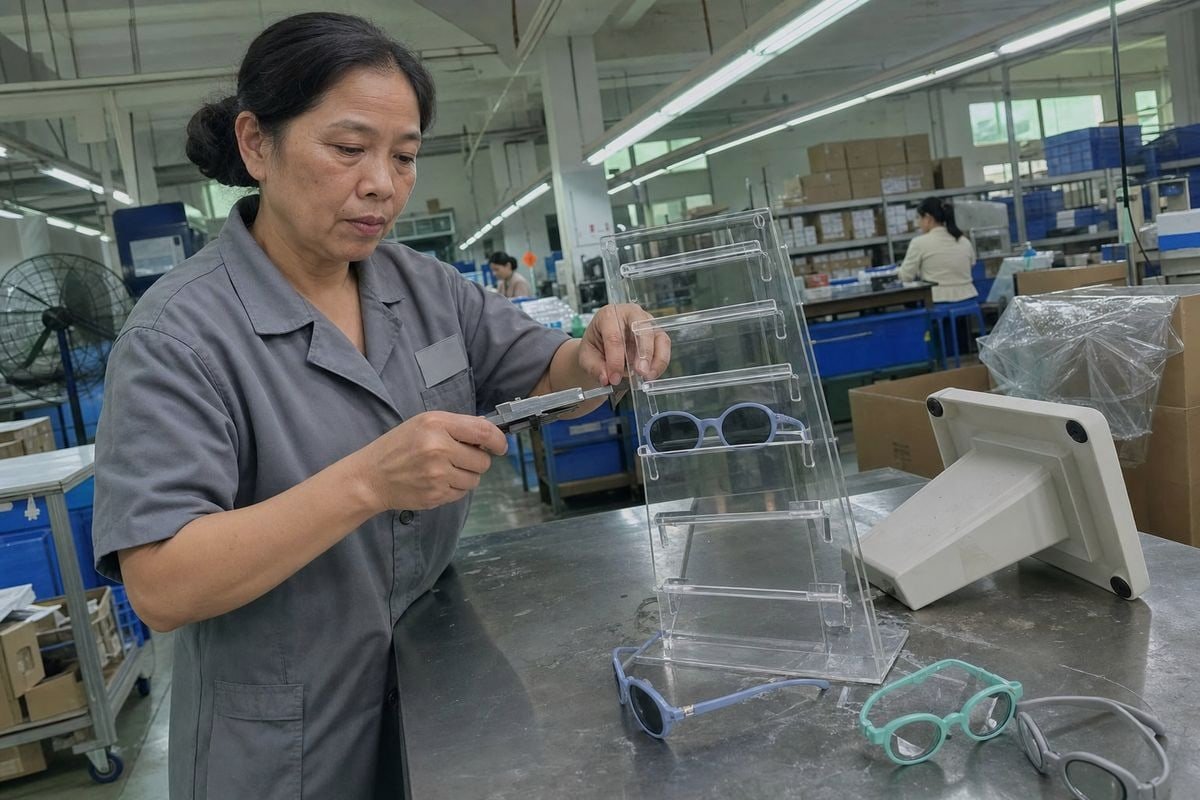
Let me break this down the way we do it during a customization consultation. Kids' sunglasses are not shrunken adult products. Our flexible TR90 frames with TPEE temples are lighter and narrower than adult frames, so a standard Point of Sale display 2 will hold them loosely. Loose frames slide, fall, and scratch. That kills your retail presentation before a single parent picks up a pair.
Safety and stability come first
Children grab things. A counter stand for kids' eyewear needs a weighted or wide base so it cannot tip when a five-year-old yanks a pair off the top tier. Rounded corners matter for the same reason. When we design visual merchandising 3 fixtures for our own buyers, we treat the stand like a children's product, not a shop accessory.
Fit, capacity, and shopability
Next, match the stand to your assortment. A rotating tower suits a compact counter with many SKUs. A tiered flat stand suits an impulse-purchase zone near the register. Consider a small shatterproof mirror at child eye height too — it triggers immediate try-on behavior, which drives conversion.
| Checkpoint | What to verify | Why it matters for kids' eyewear |
|---|---|---|
| Slot width and depth | Fits your smallest frame model | Prevents drooping and falling frames |
| Base weight | Anti-tip when pulled from top | Child safety and fewer breakages |
| Corners and edges | Rounded, no sharp acrylic edges | Kid-safe compliance and store liability |
| Capacity | Pairs per stand matches your SKU count | Full-looking display without crowding |
| Mirror | Shatterproof, low viewing angle | Encourages try-on by young customers |
| Material | Reinforced acrylic 4 or coated metal | Survives frequent handling and cleaning |
How do I customize a display stand to match my brand's packaging and colors?
One trade-off we weigh on every custom project is print method versus budget. UV printing 5 gives vivid, playful graphics; screen printing costs less at volume but limits color complexity.
To customize a display stand, send your supplier vector logo files, Pantone color references, and photos of your retail packaging. Specify logo placement, print method such as UV printing or screen printing, and the visual mood. Then approve a drawing or 3D mockup before any sample is produced.
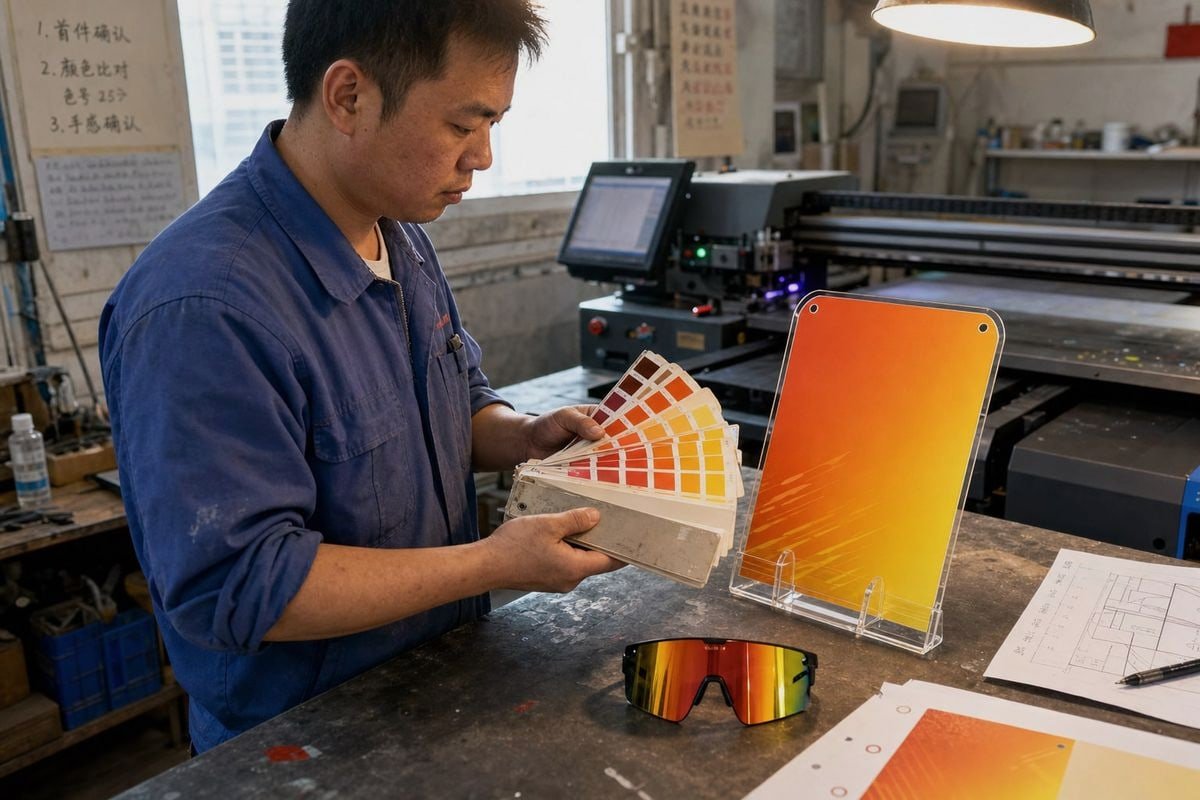
Matching is not just "make it blue." When our design team handles custom branding options for a private label manufacturing client, we align four separate layers, and I recommend you specify each one in your request.
The four layers of a matched display
First, color. Send Pantone codes, not screenshots. Screen colors shift, and a periwinkle-blue frame next to a mismatched purple stand looks careless on a store counter. Second, logo placement. The header card is the most visible spot; the base and side panels are secondary. Tell your supplier which you prefer. Third, visual style. Kids' eyewear sells through playfulness — bright gradients like our orange-to-yellow mirrored shield lenses deserve an energetic stand, while a minimalist two-tone frame line suits a cleaner look. Fourth, packaging harmony. If your cases and pouches are part of the shelf presence, the stand should echo them.
Smart upgrades worth asking about
Two options consistently earn their cost. A modular header with interchangeable magnetic graphics lets you swap seasonal themes — Back-to-School, Summer Break — without replacing the whole fixture. And a dedicated QR code panel can link to a virtual try-on filter, bridging physical retail and digital engagement. Eco-conscious parents also respond well to stands made from recycled materials 6, so ask whether your supplier offers circular merchandising options that fit your brand story.
Our normal workflow runs: inquiry, drawing, revision, sample, approval, production. Insist on the drawing stage. Skipping it is the number one cause of rejected samples we see.
What are the minimum order quantities and costs for custom counter displays?
A procurement manager in Japan once asked me why display quotes vary so wildly between suppliers. The answer usually hides in material choice and how the stand is bundled with the frame order.
Custom counter display MOQs typically start at 20–50 units for acrylic and lower for cardboard, with samples sometimes available from one piece. Many suppliers offer one complimentary stand per 12–24 pairs of sunglasses ordered, so bundle the display request into your frame order to negotiate better terms.
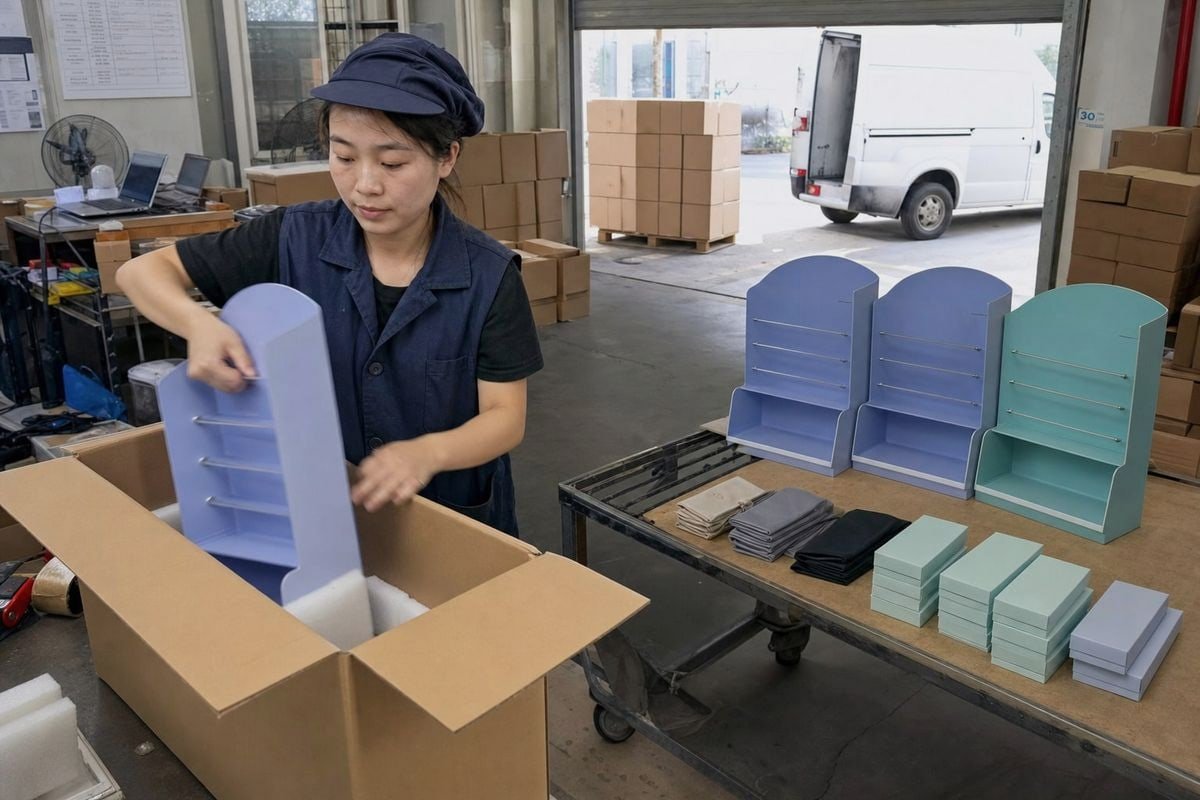
Cost is where bulk order negotiation skills pay off. In our experience exporting to buyers in 20+ countries, the display stand is rarely quoted in isolation. It is priced against the size and future potential of your eyewear order. A brand testing the market with a small run from our ~800 existing styles will get different display terms than a distributor placing a large seasonal order. That is normal, and it is negotiable.
Typical cost drivers
Material drives most of the price. Cardboard table displays are the cheapest and fastest, ideal for promotions. Countertop acrylic stands cost more but survive high-traffic handling and cleaning. Powder-coated metal and lockable cases sit at the premium end, suited to higher-value polarized kids' lines that need anti-theft protection.
| Material | Faixa típica de MOQ | Relative cost | Best use case |
|---|---|---|---|
| Corrugated cardboard | Low, often 10–20 units | $ | Short promotions, seasonal launches |
| Acrylic (reinforced) | 20–50 units | $$ | Everyday counter merchandising |
| Powder-coated metal | 30–50 units | $$$ | High-traffic retail store fixtures |
| Lockable acrylic/glass case | Often lower MOQ, higher unit cost | $$$$ | Premium or theft-prone locations |
How to negotiate the bundle
Anchor the display to your frame order. Ask directly: "If we order X pairs across these SKUs, can you include Y stands, or price them at cost?" Suppliers who value long-term wholesale eyewear accessories business will usually meet you partway. Also ask about flat-pack shipping — it cuts freight volume dramatically and often matters more to total landed cost than the unit price of the stand itself.
How can I make sure the display stand arrives on time with my sunglasses order?
A lesson we learned early in our 15 years of eyewear production: a perfect display that ships two weeks after the frames is a failed display. Launch timing is everything in kids' retail.
To ensure on-time delivery, request the display at the same time as your frame order, approve the mockup within days, and ask the supplier to align production schedules. Confirm in writing that stands ship in the same container, flat-packed, with retail-ready cartons and clear assembly instructions.
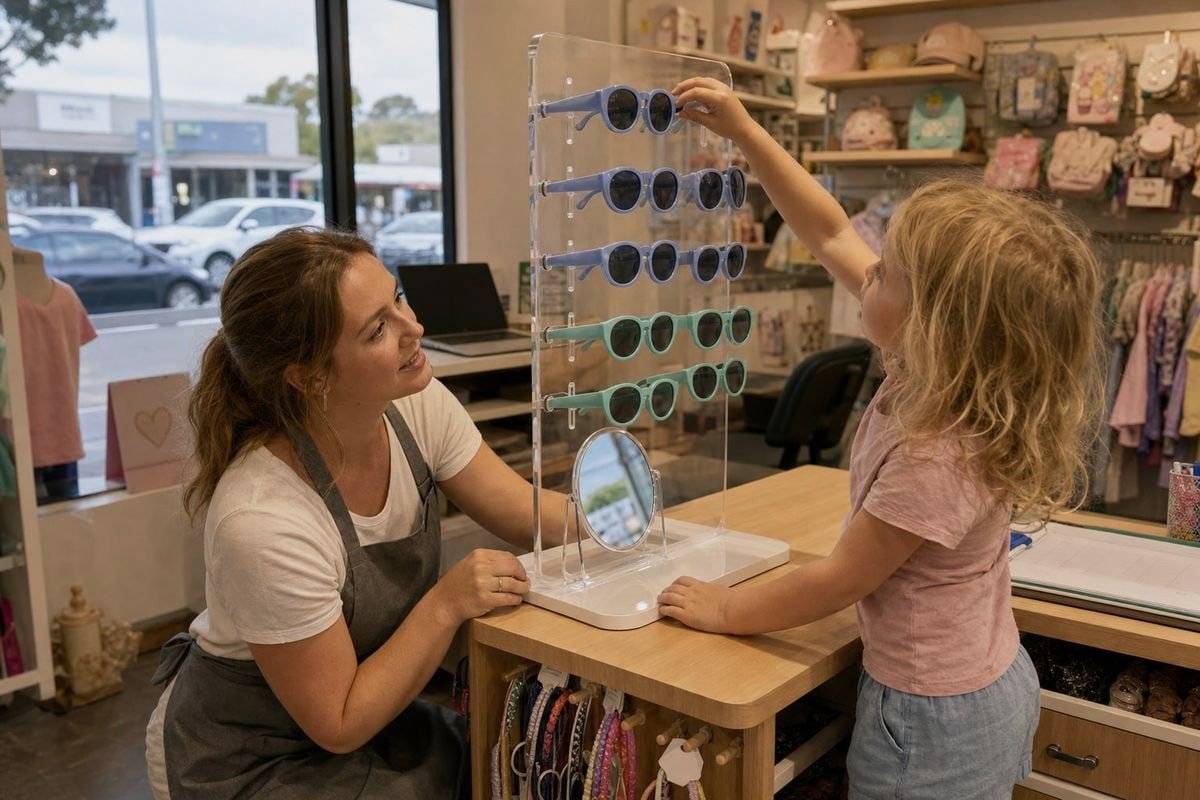
Timing failures almost always trace back to sequencing, not slow factories. If you order frames first and mention the stand three weeks later, the two production lines cannot converge on one shipping date. So treat the stand as part of the product launch, not an afterthought.
Understand the two clocks
Your frames and your stands run on separate timelines. Simple cardboard displays take roughly 5–7 business days after design approval. Custom acrylic or metal stands typically need 2–4 weeks, or 7–15 working days after sample confirmation for smaller runs. Meanwhile, your sunglasses order has its own production and QC schedule. Your job is to start both clocks together.
A practical sequence that works
- Send one combined RFQ covering frames and stands.
- Approve the stand drawing within 2–3 days of receiving it.
- Confirm the sample quickly, with photos or video if you cannot receive it physically.
- Ask for a consolidated shipping plan — one container, one set of documents.
- Confirmar Incoterms 7; DDP simplifies things if your supplier offers it.
- Request flat-pack, retail-ready configurations with printed assembly guides for store staff.
Here is a copy-paste request template you can adapt for any RFQ:
| Template line | What to fill in |
|---|---|
| "We are ordering kids' sunglasses and need a matching counter display stand for retail use." | Your SKU list and quantities |
| "Please recommend a design for ___ pairs per stand, sized for a counter of ___." | Capacity and counter dimensions |
| "The stand must match our brand colors and include our logo." | Pantone codes and vector logo file |
| "Please share a drawing or 3D mockup before sampling." | Your approval contact |
| "Confirm material options, MOQ, lead time, sample cost, and shipping terms." | Your target launch date |
| "Advise whether stands can be packed with the sunglasses order." | Preferred Incoterms |
One more objection worth addressing: not every frame supplier makes displays in-house. Some, like us, coordinate them through the same customization workflow; others outsource. Ask early. If displays are outsourced, add buffer time and insist your frame supplier owns the coordination.
Conclusão
A mismatched fixture wastes good frames. Requesting matching counter display stands from kids' sunglasses suppliers early — with clear specs, mockup approval, and bundled shipping — turns your counter into a retail merchandising strategy that sells.
Notas de rodapé
1. Background on the color-matching system suppliers use for accurate branding. ↩︎
2. Defines the retail fixture concept central to the article’s topic. ↩︎
3. Core retail concept underlying the article’s display stand design advice. ↩︎
4. Authoritative Wikipedia entry explaining the properties and durability of acrylic (PMMA) materials. ↩︎
5. Explains the print method referenced for branding display stands. ↩︎
6. EPA resource supporting the article’s mention of eco-conscious circular merchandising options. ↩︎
7. Official source defining shipping terms mentioned for delivery negotiations. ↩︎
Mais Artigos que Você Pode Gostar

1 de agosto de 2026
A Fábrica Deve Lidar com a Embalagem e Rotulagem de Óculos de Sol Infantis, ou Usar um Fornecedor Designado?

1 de agosto de 2026
Armazém Próprio vs. Envio Direto do Fornecedor: Qual Reduz os Custos de Devolução para Marcas de Óculos de Sol Infantis?

1 de agosto de 2026
Armazém Direto ao Porto ou Estiva no Exterior: Qual Economiza Mais no Envio de Óculos de Sol Infantis?
Procurando um Parceiro Confiável em Óculos Infantis?
Explore mais de 800 estilos prontos e suporte completo OEM/ODM adaptado à sua marca.
Entre em Contato English
  Español de México
  Deutsch
  Français
  日本語
日本語  العربية
  Português do Brasil