How Long Is the Standard Warranty Period for Kids’ Sunglasses?
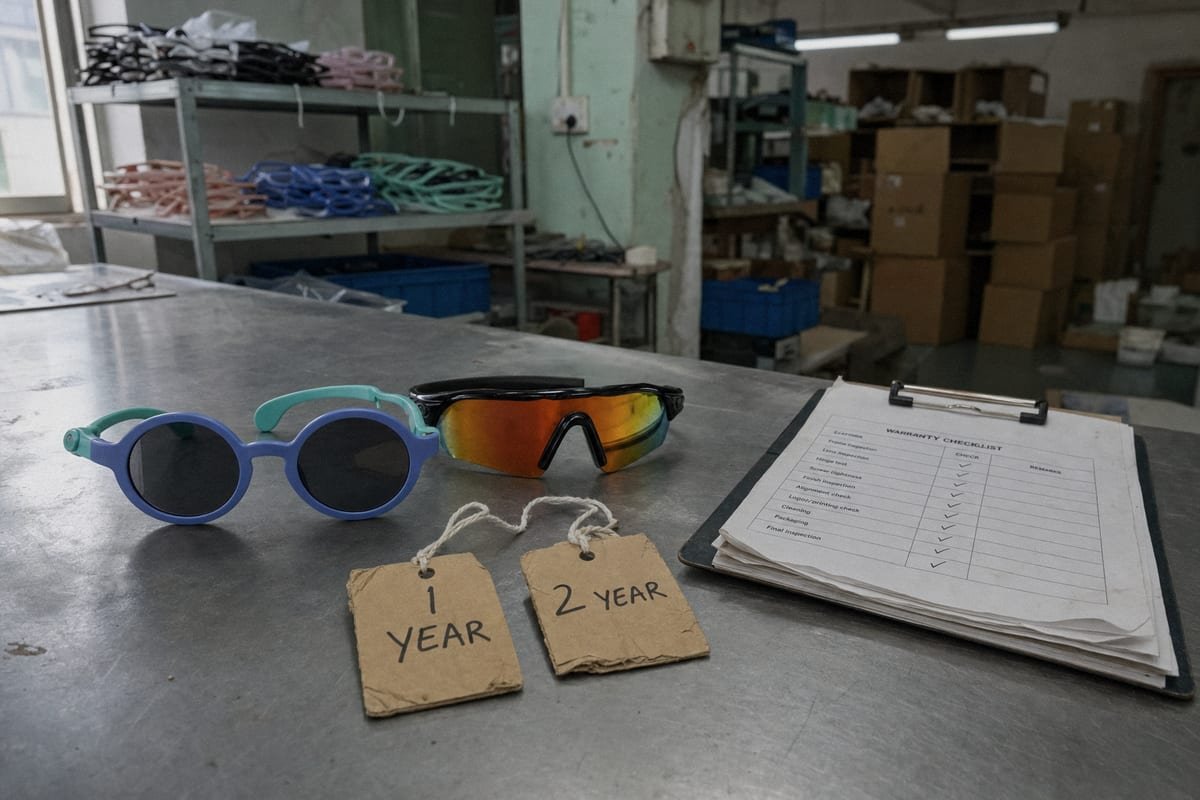
Buyers ask me about the standard warranty period for kids’ sunglasses almost weekly. On our production line in Taizhou, I see why: unclear warranty terms kill deals and damage brands.
The standard warranty period for kids’ sunglasses is typically 1 to 2 years. One year is the common baseline for mainstream eyewear, while youth-focused and premium brands often extend coverage to two years. Warranties cover manufacturer defects, not accidental damage, loss, or normal wear and tear.
That is the short answer. But the length of the warranty is only half the story. What it covers, what it excludes, and what it tells you about your supplier matter just as much. Let me walk you through each part.
What warranty period should I expect when sourcing kids' sunglasses from a manufacturer?
A procurement manager from Australia once asked me why two quotes for similar TPEE sunglasses 1 carried different warranty terms. The answer revealed a lot about each factory's confidence.
When sourcing kids' sunglasses, expect a 12-month warranty against manufacturer defects as the industry baseline. Suppliers with strong material expertise, such as TPEE and TR90 specialists, often offer 24 months. Anything shorter than 12 months on children's eyewear should raise questions about build quality.
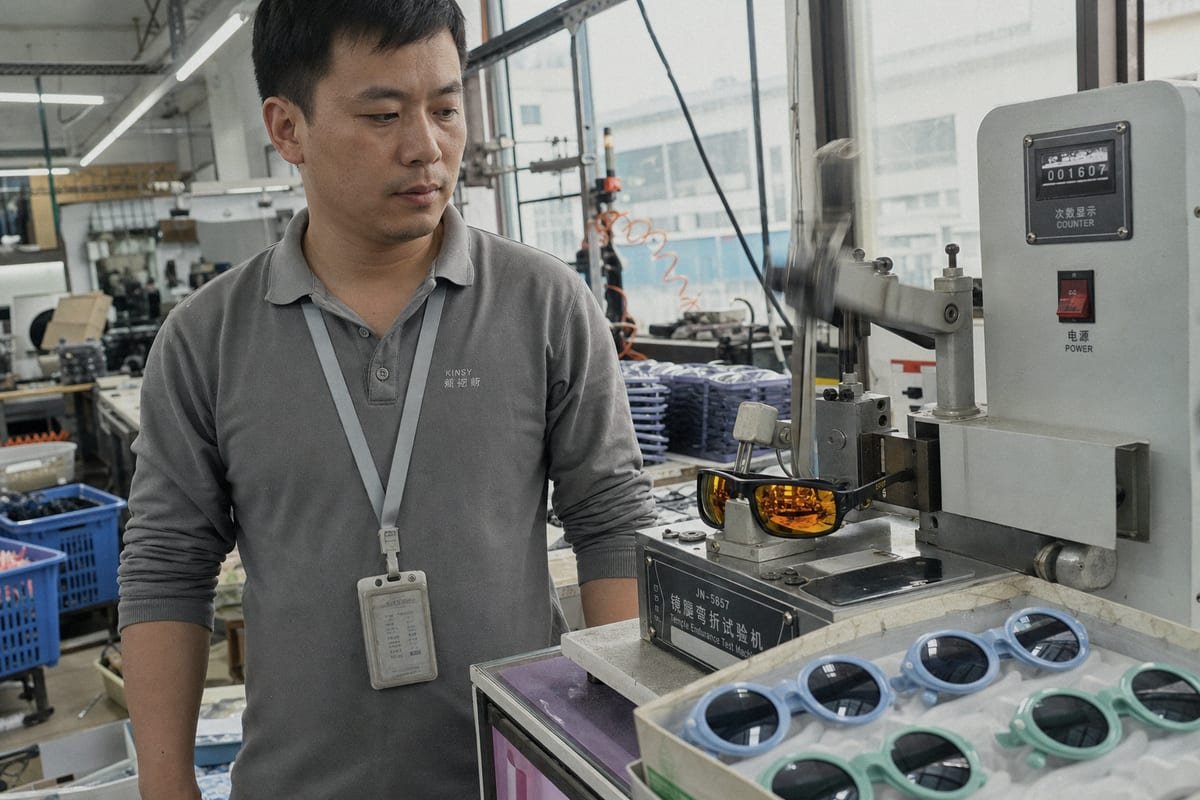
There is no single universal standard, and that is the first thing every buyer needs to understand. The warranty period for kids' sunglasses depends on who is selling, what they are selling, and how the product is positioned in the market. A fashion sunglass sold at a low price point rarely carries more than a one-year manufacturer's warranty. A youth-specific or "adventure-grade" product often carries two years, because the seller is using the longer duration as proof of durability.
In our fifteen years making children's eyewear, we have seen the market settle into three broad tiers. Here is how they compare:
| Warranty Tier | Typical Length | Common For | What It Signals |
|---|---|---|---|
| Baseline | 12 meses | Mainstream and budget kids' sunglasses | Standard defect coverage, minimum market expectation |
| Extended | 24 months | Youth-focused, premium, and sport eyewear | Confidence in flexible frame durability and materials |
| Lifetime | Lifetime (defects only) | Select premium brands and product lines | Brand positioning tool, not the market norm |
Why the tier matters for B2B buyers
If you are building a children's brand, the warranty your factory offers you sets the ceiling for the warranty you can offer your customers. When we supply armações TR90 2 with TPEE temples, we can support longer terms because the shatterproof materials 3 genuinely hold up to a toddler bending the temples backward. A factory using brittle, cheap plastic cannot make that promise honestly. So treat the offered period as a data point about the product itself, not just a legal term.
Also note that a lifetime guarantee sounds impressive, but it almost always covers manufacturer defects only. It rarely covers the way children actually break sunglasses. A realistic two-year defect warranty is often more valuable than a vague lifetime claim.
What factors influence how long a warranty a supplier is willing to offer?
Every time our engineers approve a new hinge design, we run a simple internal debate: how many open-close cycles will this survive on a real child's face? That answer shapes the warranty we can stand behind.
A supplier's warranty length is driven by material quality, frame construction, hinge and coating durability, price point, product positioning, and quality control maturity. Factories confident in flexible, shatterproof materials like TPEE and TR90 can offer longer terms because their defect rates stay predictably low.
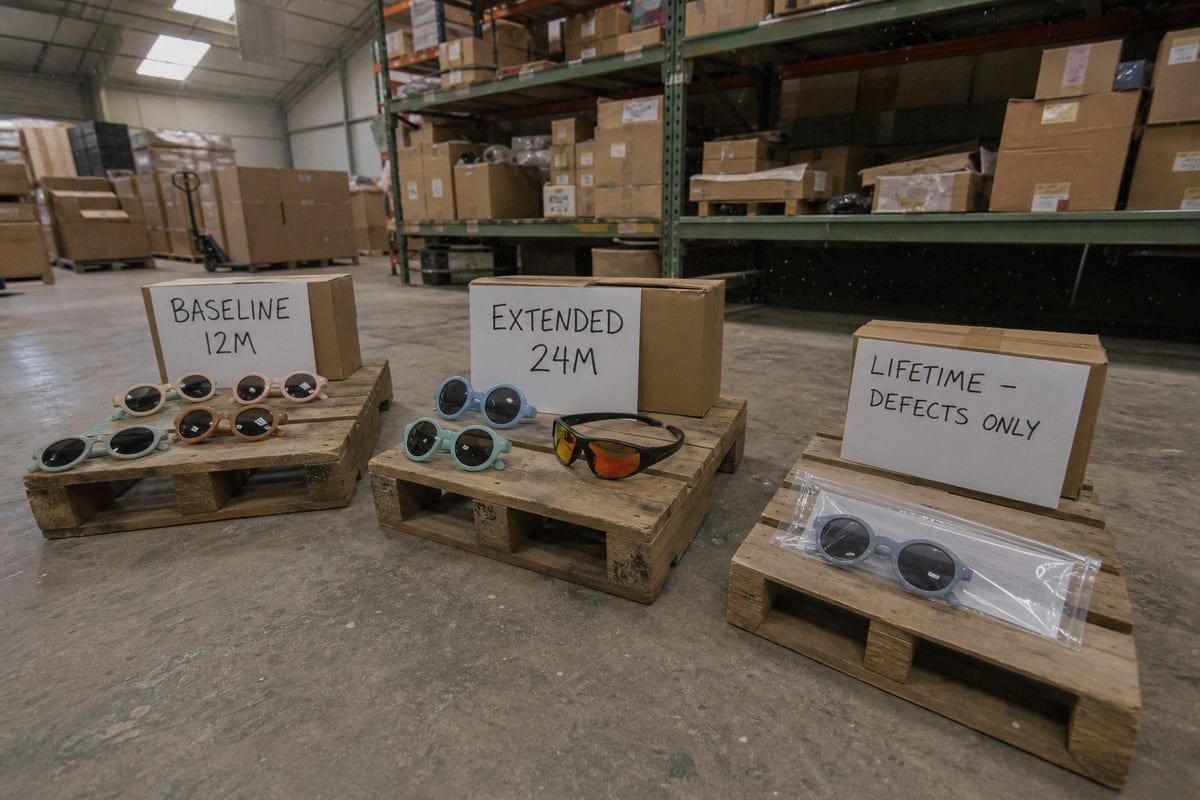
Warranty length is really a risk calculation. A factory offering 24 months is betting its own money that the product will not fail from a defect within that window. Several factors go into that bet.
Material choice comes first
Flexible frame durability is the single biggest driver. TPEE and TR90 frames bend, twist, and recover their shape. Rigid injection plastics crack at the hinge or bridge. When we developed our TR90 kids optical frames with TPEE temples, we specifically tested tension retention, because a frame that goes loose and slips off a child's nose after heavy use generates warranty claims even if nothing visibly "breaks." Newer warranties in the market are starting to include shape-memory integrity clauses for exactly this reason.
Component and coating quality
Cheap hinge screws loosen. Poor scratch-resistant coating 4 peels or hazes. Low-grade UV400 protection lenses can delaminate in a hot car. Each weak component shortens the honest warranty a supplier can offer.
Business factors stack on top
| Fator | Pushes Warranty Longer | Pushes Warranty Shorter |
|---|---|---|
| Material | TPEE, TR90, impact-resistant lenses | Brittle commodity plastics |
| QC system | Documented inspection at every stage | Spot checks only |
| Price point | Premium and mid-tier positioning | Race-to-the-bottom pricing |
| Product type | Youth, sport, and outdoor eyewear | Disposable fashion accessories |
| Order relationship | Long-term OEM/ODM partnerships | One-off spot buys |
In our 5S-managed workshop, consistent process control 5 is what lets us predict defect rates. A supplier who cannot predict defects will always default to the shortest warranty the market allows. So when you negotiate, ask why a factory offers the term it does. The reasoning tells you more than the number.
What does a typical warranty actually cover, and what stays excluded?
A Japanese buyer once returned a sample batch with a note: "Warranty terms unclear on lens scratches." That single line taught me to spell out coverage in every quotation we send.
A typical kids' sunglasses warranty covers manufacturer defects: faulty hinges, frame material flaws, lens delamination, and coating failures. It excludes lens scratches from use, accidental breakage, bending from misuse, loss, theft, and normal wear and tear. Accidental damage coverage requires a separate plan.
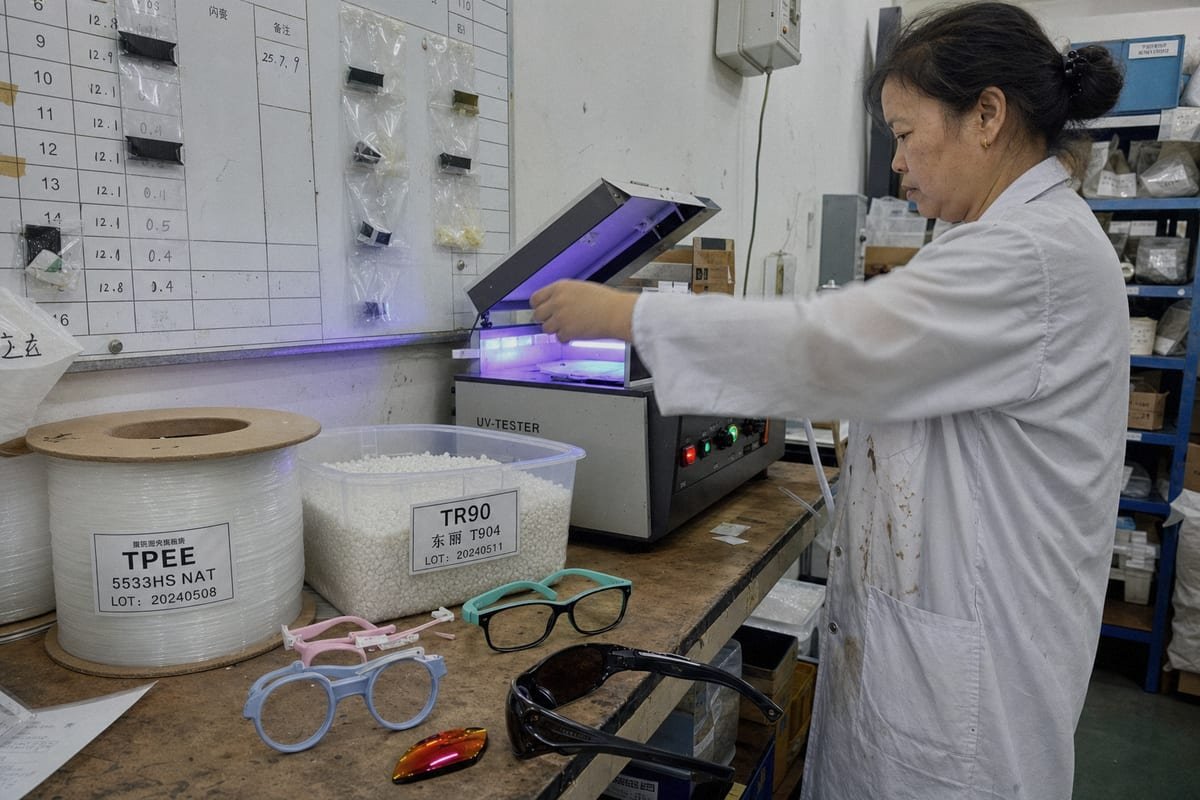
The word "warranty" causes more confusion than any other term in eyewear sourcing. A standard warranty is a limited warranty 6 against manufacturer defects. It is a promise that the product left the factory correctly made. It is not insurance against what a four-year-old does at the playground.
Here is the practical breakdown we share with our OEM/ODM clients:
| Issue | Covered by Standard Warranty? | Por quê |
|---|---|---|
| Hinge screw fails during normal use | Sim | Component defect in workmanship |
| Scratch-resistant coating peels or bubbles | Sim | Coating application failure |
| Lens delamination or UV400 layer failure | Sim | Material or lamination defect |
| Frame cracks along a mold line | Sim | Manufacturing flaw |
| Lens scratched on pavement | Não | Normal wear and tear |
| Frame snapped after being sat on | Não | Accidental damage |
| Sunglasses lost at the beach | Não | Loss is never a defect |
| Frame loosens from repeated stretching | Sometimes | Depends on tension-retention terms |
The scratch question deserves special attention
Most warranties categorize lens scratches as normal wear and tear. The exception is when the scratch-resistant coating itself fails, meaning the lens scratches far more easily than it should. That is a defect. A scratch from a drop is not. Your customer-facing policy should make this distinction plainly, because parents will test it.
Separate programs fill the gaps
Retailers and youth brands increasingly layer extras on top of the defect warranty: accidental damage coverage, a one-time replacement in the first year, a lost pair replacement policy, or a 30-day happiness guarantee tied to fit. Some replacement programs run on a shipping-only model, where the frame is free but the parent pays a flat processing fee. These are valuable retention tools, but they are commercial programs, not warranties. Keep them contractually separate from your factory warranty so responsibilities stay clear.
How can I use warranty terms to judge whether a manufacturer is a reliable long-term partner?
Over fifteen years of exporting children's eyewear to buyers in more than twenty countries, I have learned that warranty conversations expose a supplier's character faster than any factory audit.
Warranty terms reveal supplier reliability through four signals: clear written scope, a defined claims process with proof of purchase requirements, willingness to stand behind materials for 24 months, and transparent data on defect rates. Vague or verbal-only warranty promises indicate a supplier to avoid.

A warranty is a window into how a factory thinks about risk, quality, and its customers. When you evaluate a potential supplier, read the warranty terms the way you would read a character reference.
Signals of a dependable partner
First, look for specificity. A reliable factory names exactly what is covered: hinges, frame integrity, coating adhesion, lens lamination. It also names exclusions without hiding them. When we quote a client, we state coverage in writing before the purchase order is signed, because ambiguity always becomes a dispute later.
Second, look at the claims process. A serious supplier defines how claims are documented, what proof of purchase requirements apply, whether product registration is needed for extended terms, and how replacements ship. A supplier who says "just contact us if there is a problem" has no process, and no process means no protection.
Third, look for alignment between warranty and materials. If a factory claims impact-resistant lenses and shatterproof materials but only offers six months of coverage, the claims and the confidence do not match. When materials are genuinely durable, the warranty should reflect it.
Fourth, look at how the warranty supports your brand. Can the supplier help you build a customer-facing return and exchange policy? Can they support a one-time replacement program or size-up credits for growing children with spare parts and consistent restocks across seasons? With roughly 800 existing styles in our catalog, we can keep replacement inventory available for years, which is exactly what a brand needs to honor its own promises to parents. A supplier who discontinues styles every six months quietly breaks your warranty for you.
Finally, ask about defect-rate history 7. A factory that tracks and shares this data is managing quality. A factory that cannot answer is guessing.
Conclusão
The standard warranty period for kids' sunglasses runs one to two years and covers manufacturer defects only. Judge suppliers by warranty clarity, material confidence, and process, not the headline number.
Notas de rodapé
1. Technical overview of thermoplastic elastomers, highlighting their flexibility and durability in consumer product applications. ↩︎
2. Official specifications for Grilamid TR90, a high-performance thermoplastic material widely used in premium eyewear frames. ↩︎
3. Scientific data on the impact resistance and mechanical properties of advanced polymers used in durable manufacturing. ↩︎
4. Technical details on advanced lens coatings designed to provide scratch resistance and durability in high-performance eyewear. ↩︎
5. Explanation of quality management techniques used to ensure consistent production standards and minimize manufacturing defects. ↩︎
6. Federal guidance on the Magnuson-Moss Warranty Act and the legal requirements for limited product warranties. ↩︎
7. ISO 9001 quality management principles support tracking and reducing manufacturing defect rates. ↩︎
Mais Artigos que Você Pode Gostar

1 de agosto de 2026
A Fábrica Deve Lidar com a Embalagem e Rotulagem de Óculos de Sol Infantis, ou Usar um Fornecedor Designado?

1 de agosto de 2026
Armazém Próprio vs. Envio Direto do Fornecedor: Qual Reduz os Custos de Devolução para Marcas de Óculos de Sol Infantis?

1 de agosto de 2026
Armazém Direto ao Porto ou Estiva no Exterior: Qual Economiza Mais no Envio de Óculos de Sol Infantis?
Procurando um Parceiro Confiável em Óculos Infantis?
Explore mais de 800 estilos prontos e suporte completo OEM/ODM adaptado à sua marca.
Entre em Contato English
  Español de México
  Deutsch
  Français
  日本語
日本語  العربية
  Português do Brasil