How Do I Know If Kids’ Sunglasses Require a Prop 65 Warning Label?
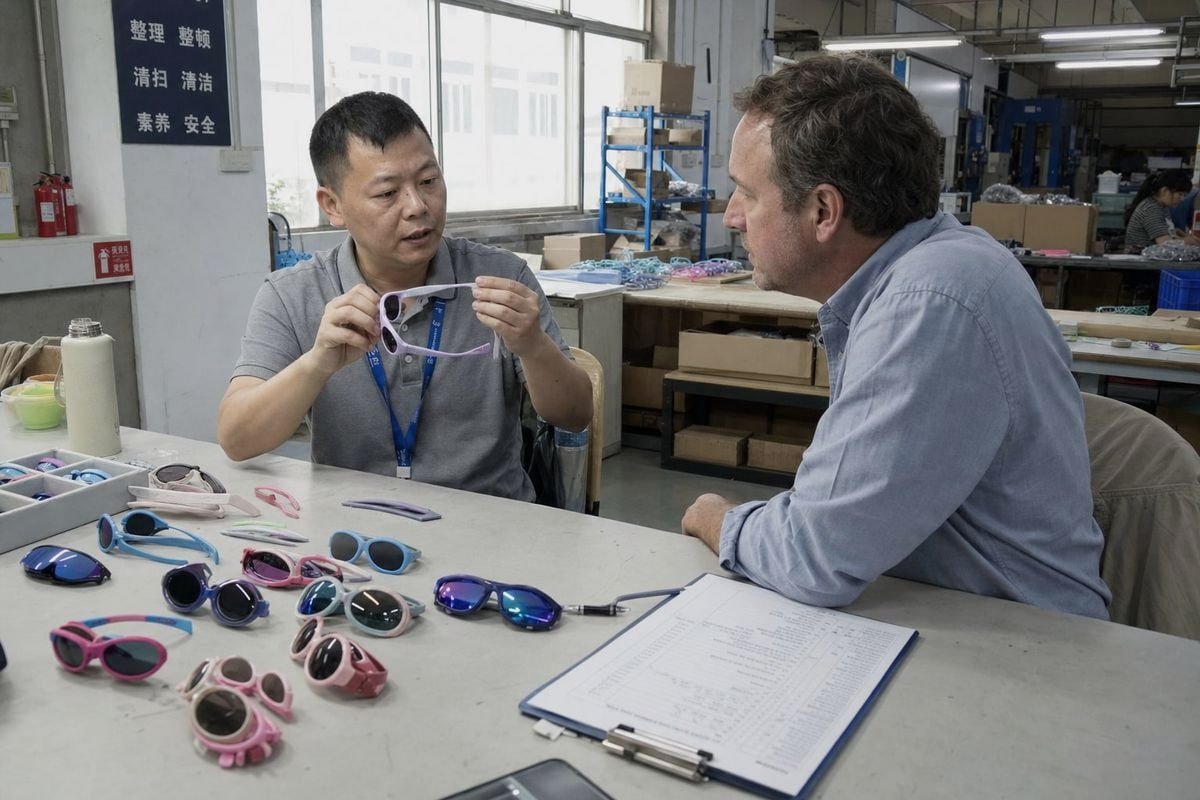
Buyers ask me about Prop 65 warning labels for kids’ sunglasses almost every week. One wrong assumption can trigger costly California litigation. Our factory learned this early, so let me explain clearly.
Kids’ sunglasses require a Prop 65 warning label only if they expose the wearer to a listed chemical—such as BPA, phthalates, or lead—above California’s safe harbor thresholds. Mere presence of a chemical, or the fact that the product is children’s eyewear, does not automatically require a warning.
That short answer hides a lot of practical detail. Below, I will walk you through which materials matter, how to verify your supplier, and exactly what to ask before your next order ships to California.
What materials in kids' sunglasses trigger Prop 65 warnings?
During a lens sourcing review last year, our QC team flagged a batch of soft nose pads from a new sub-supplier. That single component taught us where the real chemical risks hide in children's eyewear.
The main Prop 65 triggers in kids' sunglasses are BPA in polycarbonate lenses, phthalates like DEHP and DBP in soft plastic nose pads and temple tips, lead and nickel in metal hinges and screws, and emerging concerns like PFAS in lens coatings and UV-328 stabilizers.
Prop 65, formally the Lei de Água Potável Segura e Fiscalização de Toxinas 1, lists over 900 chemicals known to California to cause cancer or reproductive harm. A pair of sunglasses is a small product, but it can contain a surprising number of listed substances. In our fifteen years building children's frames, we have seen almost every one of these risks appear in supplier quotes at some point.
The high-risk components, ranked
Not every part of a sunglass carries equal risk. Here is how we rank components internally when we run a chemical exposure assessment on a new style:
| Componente | Common Chemical Risk | Por Que Importa |
|---|---|---|
| Lentes de policarbonato | BPA in polycarbonate lenses | BPA is a listed reproductive toxicant; residual monomer can migrate |
| Nose pads, temple tips | Phthalates (DEHP, DBP, DINP) | Soft PVC parts often exceed safe harbor limits and touch skin |
| Hinges, screws, wire cores | Nickel; lead content in metal components | Nickel is a listed carcinogen; both contact skin daily |
| Paints, inks, decorations | Lead, cadmium | Decorative coatings on cheap frames are a classic violation source |
| Anti-reflective coatings | PFAS "forever chemicals" | An emerging litigation target, still being tested industry-wide |
| Frame plastic stabilizers | UV-328 | New focus of Prop 65 bounty-hunter lawsuits 2 |
Why material choice changes everything
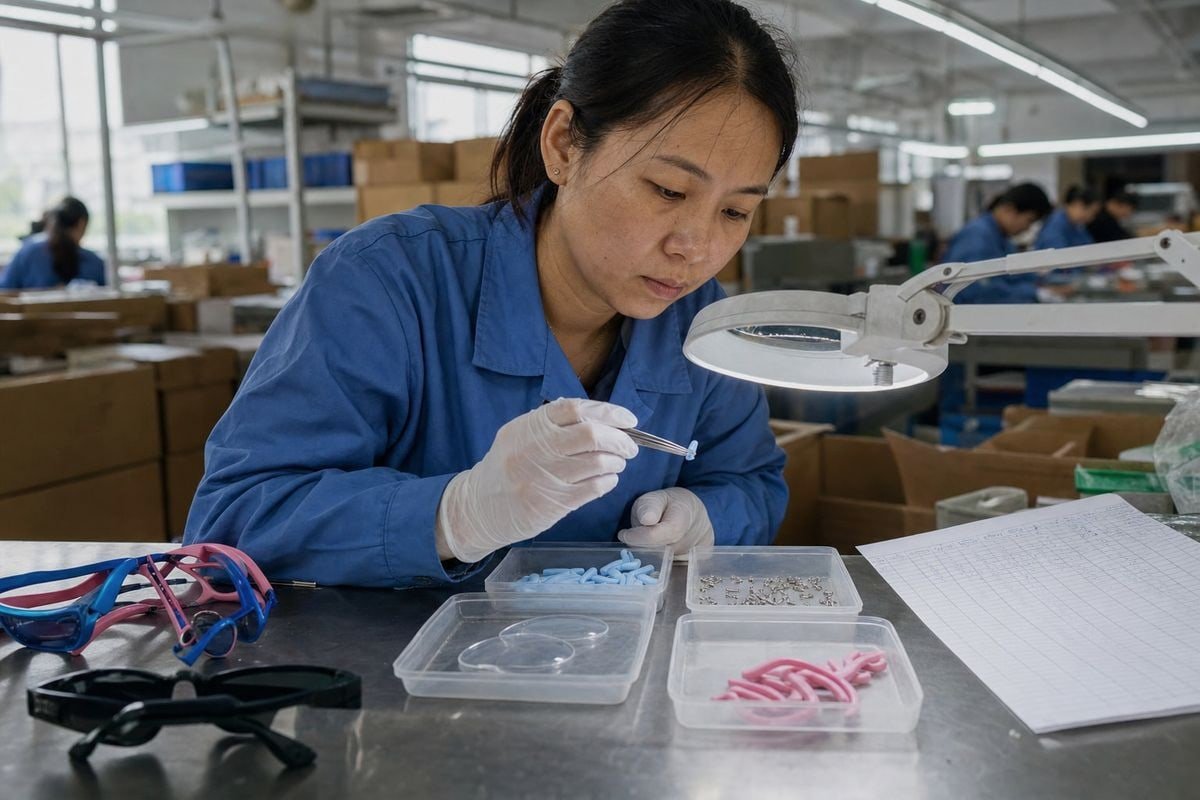
This is exactly why we build most of our children's frames in TPEE and TR90. These flexible, environmentally friendly materials do not rely on BPA-based polycarbonate 3 for the frame body, and they do not need phthalate plasticizers to stay soft and comfortable on a child's face. The flexibility that keeps a frame from snapping against a toddler's cheek comes from the polymer itself, not from added plasticizers. Metal is limited to small hinge screws, which we source against restricted-substance specifications. Skin contact is the main exposure pathway for eyewear, so soft-touch parts and coatings deserve the most scrutiny—far more than the appearance of the product ever reveals.
How do I confirm if my supplier's frames and lenses are Prop 65 compliant?
A European buyer once emailed us at midnight asking for "the Prop 65 certificate." I had to explain gently: there is no such certificate. Compliance is proven through documentation, testing, and traceability instead.
Confirm compliance by requesting third-party lab testing reports against listed chemicals, bills of materials for every component, restricted-substance declarations from the factory, and evidence that measured exposure falls below OEHHA safe harbor levels. No single certificate exists; a documentation chain is the proof.

California Proposition 65 compliance is a self-policing system. The state does not certify products. That means you, the importer or brand 4, carry the burden of knowing what is in your product. In our experience exporting to twenty-plus countries, buyers who treat this as a paperwork exercise get burned; buyers who treat it as a verification process stay safe.
The verification chain we recommend
- Request the full bill of materials. Every polymer, coating, ink, adhesive, and metal part should be named. If your supplier cannot list what is in the nose pad, that is your first red flag.
- Ask for third-party lab testing. Reports from accredited labs like SGS, Intertek, or TÜV should test the actual components against the relevant Prop 65 list items: phthalates, lead, cadmium, nickel, and BPA where polycarbonate is used.
- Check the test scope, not just the result. A "pass" on lead means nothing if phthalates were never tested. Match the test scope to the risk table above.
- Verify batch traceability. One passing report from two years ago proves nothing about this shipment. We keep material lot records in our 5S-managed workshop precisely so a buyer can trace a report to a purchase order.
- Compare results to OEHHA safe harbor levels. For BPA in eyewear, the industry's Safe Use Determination allows omitting a warning where dermal exposure stays below 3 micrograms per day—but that determination is narrow and does not cover other chemicals or products.
Documentation checklist
| Documento | O que Comprova | Refresh Frequency |
|---|---|---|
| Third-party lab test report | Actual chemical levels in components | Per material change, at least annually |
| Lista de materiais (BOM) | Full ingredient transparency | Every new style or revision |
| Supplier declaration of conformity | Factory accountability in writing | Per purchase order |
| Material safety data sheets | Raw material composition | When raw material source changes |
Remember that Prop 65 sits alongside, not instead of, CPSIA safety standards. A children's product sold in the US must meet federal lead and phthalate limits regardless of any California warning decision.
Can I sell kids' sunglasses in California without a Prop 65 label?
One of the trade-offs I weigh with every new brand client is this: warn broadly and look alarming on the shelf, or verify carefully and sell clean. The law actually permits the second path.
Yes, you can legally sell kids' sunglasses in California without a Prop 65 label if exposure to every listed chemical stays below safe harbor levels, if no listed chemicals are present, or if your business has fewer than 10 employees, which exempts it entirely.

This surprises many buyers. They see Prop 65 warnings everywhere and assume every product must carry one. The truth is more nuanced. The warning is required only before knowingly and intentionally exposing a consumer to a listed chemical 5 above the threshold. If your chemical exposure assessment shows levels below the No Significant Risk Level for carcinogens or the Maximum Allowable Dose Level for reproductive toxicants, no warning is legally required.
Three legitimate paths to selling without a warning
- Formulate the risk out. Choose materials that avoid listed chemicals altogether. Our TR90 frames with TPEE temples were designed with exactly this logic: no BPA-based frame plastic, no phthalate-softened parts, restricted-metal hardware.
- Test below thresholds. Document, through third-party lab testing, that any listed chemical present cannot produce exposure above OEHHA safe harbor levels through normal skin contact.
- Small-business exemption. Businesses with fewer than 10 employees are exempt from the warning requirement. Be careful here, though—retailers and distributors in your chain may not qualify, so the obligation can shift, not vanish.
The over-warning objection, addressed
Some buyers tell me they will just slap a warning on everything "to be safe." I understand the litigation logic—bounty-hunter lawsuits are real, and blanket warnings reduce that exposure. But for children's products, this backfires commercially. Parents in Australia, Japan, and Europe read a chemical warning on baby sunglasses 6 very differently than on a power tool. Critics rightly note that over-warning turns Prop 65 into noise, and for a kids' brand, that noise lands directly on your brand trust. The stronger position is a clean product backed by test reports. If you do warn, note the details: since the 2018 OEHHA regulation update, warnings must include the WARNING word, the triangle pictogram 7, at least one named chemical, and the website reference. Short-form warning requirements have also tightened—generic statements on small packaging are no longer acceptable, and if your packaging includes another language, the warning must appear in that language too. For online sales, the warning must appear on the product page or through a clearly marked link before checkout is completed.
What should I ask my manufacturer to avoid Prop 65 compliance risks?
The best pre-order conversation I ever had was with a procurement manager from a Japanese baby brand who arrived with a written question list. Her order shipped without a single compliance hiccup, and that list shaped how we onboard clients today.
Ask your manufacturer for the full material composition of frames, lenses, and soft parts; current third-party test reports covering phthalates, BPA, lead, and nickel; their process for controlling sub-supplier materials; and written confirmation of which safe harbor basis supports selling without a warning.
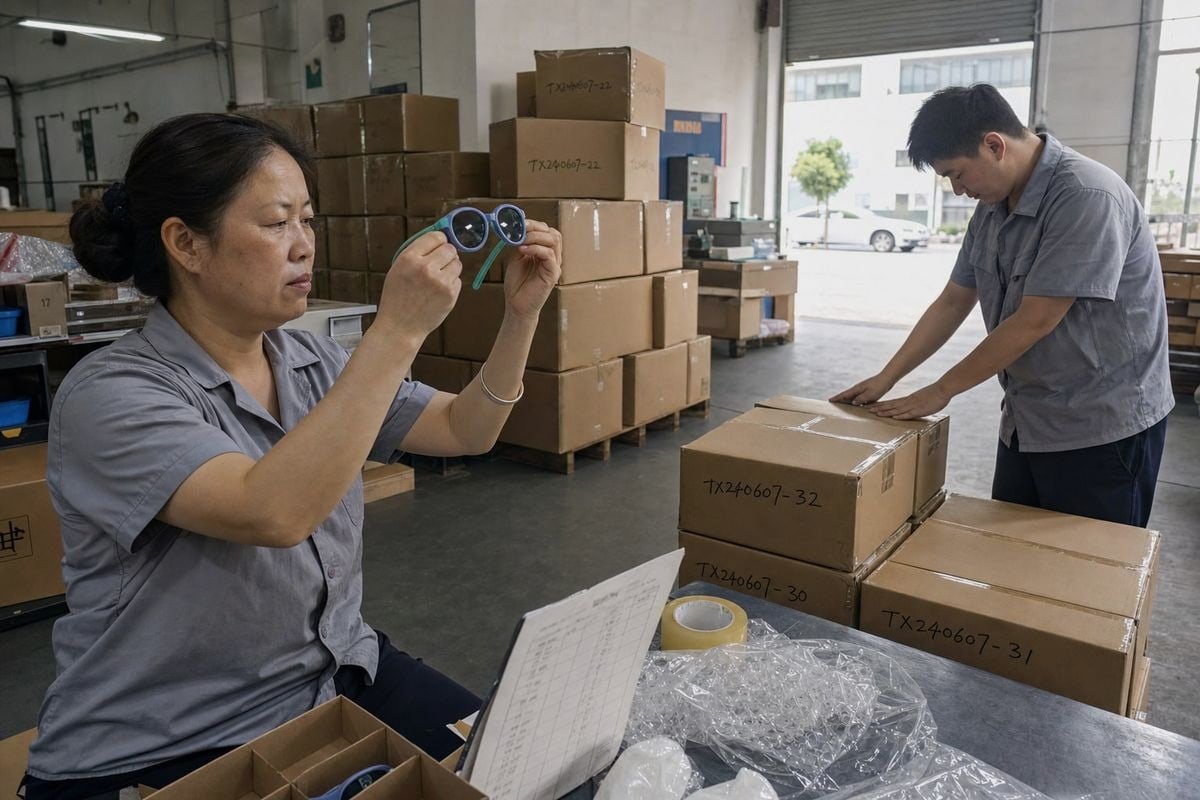
Good questions separate a real factory from a trading company reselling unknown goods. When a buyer visits our Taizhou facility, they can see raw material intake records 8, our 5S workshop discipline, and how we lock sub-supplier specifications. A trader cannot show you any of that. Your question list is how you test this remotely.
The eight questions that matter
| # | Pergunta a Fazer | Como Deve Ser uma Boa Resposta |
|---|---|---|
| 1 | What exact materials are used in frames, temples, and nose pads? | Named polymers (e.g., TR90, TPEE), not vague terms like "eco plastic" |
| 2 | Are lenses polycarbonate, and if so, how is BPA migration controlled? | Awareness of the eyewear Safe Use Determination and its 3 µg/day dermal limit |
| 3 | Can you provide recent third-party lab testing reports? | Accredited lab reports dated within twelve months, matched to your styles |
| 4 | Do your paints, inks, and coatings meet lead and cadmium limits? | Component-level test data, including decorated parts |
| 5 | What metals are in hinges and screws? | Nickel and lead disclosure with restricted-substance sourcing specs |
| 6 | Have you assessed PFAS in lens coatings? | Honest answer plus willingness to test; this risk is still emerging |
| 7 | How do you control material changes between orders? | Locked BOM per style, change notification policy, batch traceability |
| 8 | Will you support labeling or warning decisions in writing? | Written declarations per shipment, not verbal assurances |
Build compliance into the product, not the paperwork
Here is a lesson we learned developing our flexible frame lines: it is far cheaper to design compliance in than to test problems out. Because roughly 800 existing styles already run on verified TPEE and TR90 material systems, a new brand can pick a proven style, add custom colors, logos, and retail-ready packaging, and inherit an already-clean material foundation—without gambling on new molds and unknown chemistry. Whether you work with us or another factory, apply that same principle. Choose partners whose default materials avoid the listed chemicals, then use testing to verify rather than to discover. And keep your documentation live: retest when materials change, when regulations shift, or when a new chemical like UV-328 lands on the enforcement radar.
Conclusão
Prop 65 warning labels on kids' sunglasses come down to chemicals and exposure levels, never age alone. Verify materials, demand testing, ask sharp questions—and your California sales stay safe.
Notas de rodapé
1. Official OEHHA page defines Prop 65 scope and listed chemicals referenced in the article. ↩︎
2. Detailed history and enforcement mechanisms of California’s Proposition 65. ↩︎
3. FDA reference on BPA supports the claim about polycarbonate exposure risk in frames. ↩︎
4. Resources for importers regarding trade regulations and compliance responsibilities. ↩︎
5. Current list of chemicals known to cause cancer or reproductive toxicity. ↩︎
6. General information on the history and types of sunglasses for eye protection. ↩︎
7. Updated regulations regarding the use of specific symbols and text on Proposition 65 warning labels. ↩︎
8. Overview of quality management systems and the importance of material traceability. ↩︎
Mais Artigos que Você Pode Gostar

1 de agosto de 2026
A Fábrica Deve Lidar com a Embalagem e Rotulagem de Óculos de Sol Infantis, ou Usar um Fornecedor Designado?

1 de agosto de 2026
Armazém Próprio vs. Envio Direto do Fornecedor: Qual Reduz os Custos de Devolução para Marcas de Óculos de Sol Infantis?

1 de agosto de 2026
Armazém Direto ao Porto ou Estiva no Exterior: Qual Economiza Mais no Envio de Óculos de Sol Infantis?
Procurando um Parceiro Confiável em Óculos Infantis?
Explore mais de 800 estilos prontos e suporte completo OEM/ODM adaptado à sua marca.
Entre em Contato English
  Español de México
  Deutsch
  Français
  日本語
日本語  العربية
  Português do Brasil