How to Interpret Material, Age, and Warning Info on Kids’ Eyewear Hang Tags?

Kids’ eyewear [hang tags](https://okayeyewear.com/?p=13089) look simple, yet on our production line we’ve watched buyers misread them and ship frames that failed compliance UV400 protection claims 1. Reading the tag correctly prevents that loss.
Kids’ eyewear hang tags communicate three things: the material section names frame and lens compounds like TR90 and polycarbonate, the age section signals fit and design intent, and the warning section states legal use limits such as UV400 protection claims and choking hazard notices.
That is the short version. Below, I break each section of the tag into plain terms. I also explain which lines are law and which lines are branding. By the end, you should be able to read a tag in under 30 seconds and know whether the product behind it deserves your shelf space.
What Material Information Should I Look for on a Kids' Eyewear Hang Tag?
Last season our QC team pulled a sample tag artwork that listed "plastic" and nothing else. We sent it back. A tag for a child's frame needs a named compound.
A kids' eyewear hang tag should name the frame material (TR90, TPEE, acetate, or bio-acetate), the lens material (polycarbonate or Trivex), a chemical safety claim such as BPA-free and phthalate-free, and the tag stock itself, since laminated card resists moisture better than plain recycled paper.

The material line is the first thing I read on any competitor tag. It tells me how the frame will behave on a real child. It also tells me whether the brand understands children's products or just resells adult styles in small sizes.
Frame materials and what each name means
| Material on the tag | O que significa para uma criança | Where we use it at our Taizhou factory |
|---|---|---|
| o plástico de memória TR90 | Bends under stress and returns to shape; light; hard to snap | Fronts on most of our ~800 kids' styles |
| TPEE | Softer, rubber-like flex; gentle on skin behind the ear | Temples on TR90 frames, full frames for toddlers |
| Acetate / bio-acetate | Rigid and glossy; bio-acetate uses castor-based, plant-derived polymers instead of petroleum plasticizers | Older-child and teen looks |
| Metal | Structural and stylish, but stiff | Teen lines, less suited to playground use |
Flexible plastics win for active kids. A Frente TR90 2 paired with TPEE temples is the combination we have refined over 15 years, because it survives being sat on, twisted, and dropped.
Chemical safety claims
Look for BPA-free frames, phthalate-free, and hypoallergenic materials printed as clear claims. These matter because children wear frames for hours against warm skin. Nylon-family compounds like TR90 and TPEE are naturally low-irritation, but the claim should still be stated. A vague "safe materials" line is marketing. A named compound plus a named chemical exclusion is information.
Lens materials
Polycarbonate lenses are the standard in children's eyewear. They are lighter and far more impact-resistant than basic CR-39 plastic. Trivex is a premium alternative with similar toughness. Either one supports impact resistance standards for sports and play. If the tag says only "UV lens" with no material, ask the supplier which resin is used.
The tag stock itself
The card the tag is printed on tells its own story. Plain cardstock or recycled paper signals a temporary retail tag. Laminated or plasticized stock resists moisture and lasts longer in a swing-tag display. Sustainability-minded brands now ask us for FSC-certified cardstock and water-based inks. We can source both, and neither one weakens legibility.
How Do I Understand Age Range Labels on Children's Sunglasses?
A brand buyer from Australia once asked me why two of our styles both said "ages 3–6" but fit so differently. The answer sits in bridge geometry, not age.
Age range labels on children's sunglasses describe design intent and fit, not a safety certification. Manufacturers set them using pediatric frame sizing data like pupillary distance and head width, so treat the label as a fit guide and confirm frame width, bridge, and temple length separately.

Age bands confuse more buyers than any other line on the tag. So let me show the process we use to assign them. It is not a marketing decision. It is a measurement decision with a compliance check at the end.
How we set an age band, step by step
- Measure the target stage. We start with pediatric frame sizing data: average pupillary distance (PD), head width, and ear-to-lens temple length for each developmental stage. Maturity level plays no part.
- Match materials to the stage. Toddler styles get full TPEE or TR90 with TPEE templados, rounded edges, and no detachable decoration. School-age styles get TR90 memory plastic fronts and, on optical frames, flexible spring hinges that open wider without breaking.
- Check bridge geometry. Young children have flatter nasal bridges. We mark those frames as "Low Bridge" or "Global Fit" so the frame does not slide down or rest on the cheeks.
- Cross-check regulatory thresholds. Any style intended for under 36 months must have no small parts. Any style intended for under 12 falls under stricter U.S. children's product rules 3, which affects labeling and testing.
What each age band should prioritize
| Age band on tag | Design priority | What a buyer should verify |
|---|---|---|
| 0–3 anos | Total flexibility, no small parts, soft TPEE contact points | Absence of choking hazard warning triggers; secure hardware |
| 3–8 anos | Impact resistance, memory plastic, low bridge fit | Frame width vs. PD data; polycarbonate lenses |
| 8–12 anos | Durability plus style, spring hinges, adjustable fit | CPSIA compliance labeling for the U.S. market |
| 10+ / teen | Style refinement, acetate or metal options | Kid-appropriate safety language still present |
The lesson from that Australian buyer was simple. Two frames can share an age band and still fit differently because one had a low bridge and one did not. The age band narrows the search. The measurements close the deal. That is why our tags carry lens width, bridge width, and temple length next to the age line, and why we recommend every brand does the same.
What Do the Safety Warnings on Kids' Eyewear Tags Actually Mean?
Every warning line we add competes for space with the brand logo on a tag the size of a business card. We keep the warning and shrink the logo.
Safety warnings on kids' eyewear tags are the product's real-world use rules. UV400 protection means lenses block light up to 400 nanometers; a choking hazard warning flags small parts unsuitable under 36 months; and "not for direct sun viewing" or "not for driving" set legal use limits.

Warning copy is the most important text on the tag, and it is the text most people skip. I read it before I look at color or style. Here is what the common lines actually mean, and whether they are required by law or added by the brand.
Decoding the common warning lines
| Warning text | Plain meaning | Required or brand-added? |
|---|---|---|
| UV400 / 100% UVA and UVB | Lenses block all ultraviolet light up to 400 nm | Required claim if UV protection is advertised; must be true and testable |
| Not for direct sun viewing | Sunglasses do not protect against staring at the sun or eclipses | Required in EU/UK sunglass user information |
| Not suitable for driving / night use | Lens category is too dark or tinted for road use | Required for certain lens categories in the EU/UK |
| Choking hazard – not for children under 36 months | Small detachable parts exist (screws, nose pads, charms) | Required when small parts are present |
| CE marking / UKCA mark | Product meets essential health, safety, and environmental requirements for Europe or Britain | Required for sale in those markets |
| Meets ANSI Z80.3 | Lenses tested to the U.S. nonprescription eyewear standard for optics and UV | Voluntary but expected by U.S. retailers |
| Resistente ao impacto | Polycarbonate or Trivex lens tested to impact resistance standards | Brand-added unless tied to a named standard |
| Blocks X% of HEV light (415–455 nm) | Blue light filtration in a specific band | Brand-added; check the stated percentage |
UV claims: the line that must be exact
"UV protection" alone is not enough. The tag should state UV400 protection or "100% UVA/UVB." That number is a threshold, not a slogan. When we run polarized or UV400 lenses, the spec sheet that backs the tag lists the transmission result. If a supplier cannot show that document, the claim on the tag is just ink.
Choking hazard warning: when it belongs
A choking hazard warning is not a sign of a bad product. It is a sign of an honest one. It appears when screws, nose pads, or clip-on decorations can detach. Our toddler styles are built without those parts, so the warning is not needed there. On older-child frames with metal screws or spring hinges, the warning should be printed. If a frame has detachable parts and no warning, walk away.
Where CE marking and ANSI sit
CE marking and UKCA are market-entry marks. ANSI Z80.3 certification is a performance reference. Neither one replaces the other. A U.S.-bound line and an EU-bound line from the same mold often carry different warning blocks. We print them separately rather than cram both onto one tag.
How Can I Use Hang Tag Details to Choose a Reliable Eyewear Supplier?
Fifteen years of making children's frames taught us one thing: a supplier who cannot explain its own hang tag cannot back up its product either.
Use the hang tag as a supplier audit. A reliable eyewear supplier names exact materials, prints market-specific warnings in the destination language, supports CPSIA compliance and CE marking documentation, links a QR code to a Declaration of Conformity, and matches the tag to retail-ready packaging like cases, cloths, and straps.
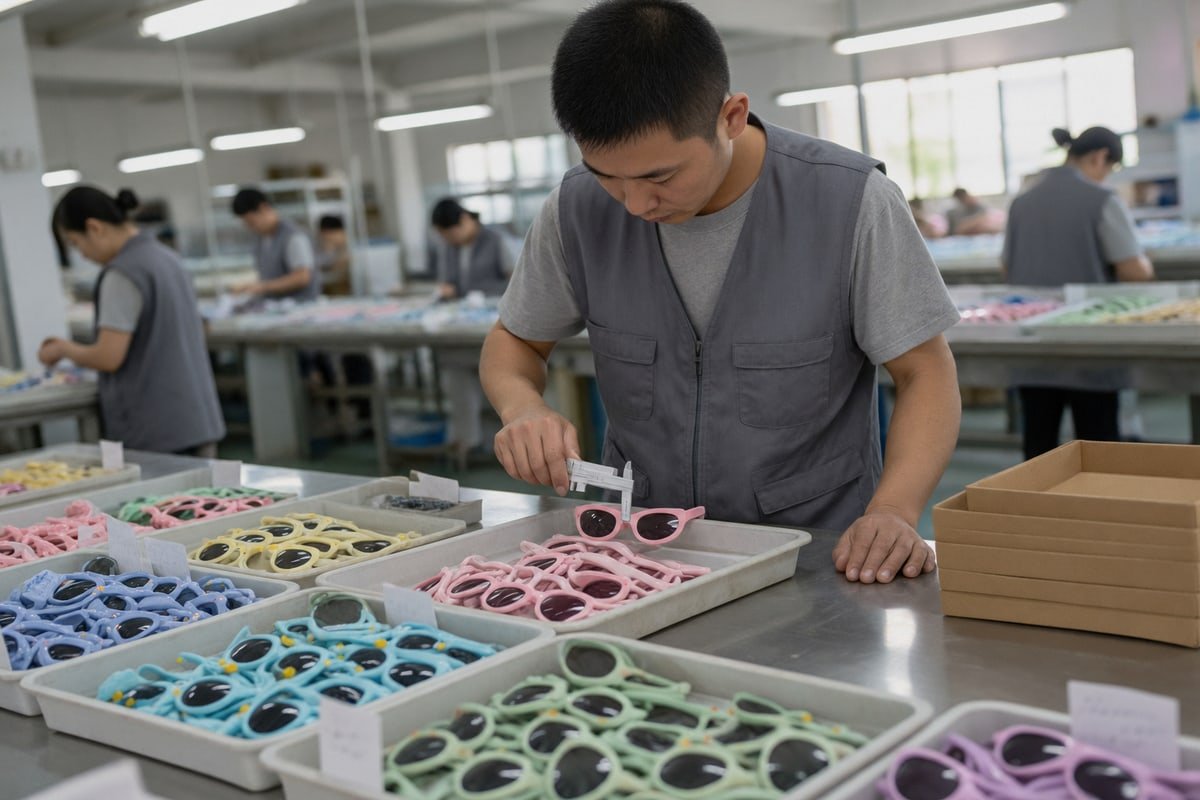
Buyers usually judge a supplier on samples and price. I suggest adding a third test: ask for the hang tag and packaging artwork before you order. The tag exposes how a factory thinks about safety, markets, and presentation. Here are the objections I hear most, and how I answer them.
Three buyer objections, resolved
"Too much text clutters the tag and hurts the look." True, if the text is fluff. The fix is not removal. The fix is editing. Keep material names, age and size, and required warnings. Move care tips and brand storytelling to a QR code. Our rule is less fluff, more clarity.
"We want a smaller, recycled, ink-light tag for sustainability." Good. Recycled or FSC-certified cardstock and water-based inks work fine. But shrink the logo before you shrink the warning block. Legibility is not negotiable.
"Can we put the warnings behind a QR code?" No. Compliance teams in the U.S. and EU expect required warnings to be physically present and legible. A QR code is a great place for a Declaration of Conformity and a batch-level chemical report. It is not a substitute for printed copy.
Market differences a supplier should already know
| Mercado | What the tag and label must handle | What it says about the supplier |
|---|---|---|
| United States (under 12) | Permanent tracking label, third-party testing, CPSIA compliance records | Supplier keeps test files by batch, not just by style |
| UE / Reino Unido | CE marking or UKCA, warnings in the destination language, sunglass user information | Supplier prepares separate artwork per country |
| Australia / Japan | Local sunglass and children's product expectations, often UV400 emphasis | Supplier asks about destination before quoting |
Tag and packaging as one system
The tag should match what is in the box. When we build a retail-ready set — a hard-shell zippered case with a rainbow and smiling-cloud print, a microfiber cloth, an elastic head strap, and an adjustable cord strap — the hang tag lists the same materials and warnings as the case insert. Consistency across those pieces is what a procurement manager should look for. It shows the factory controls its own artwork.
Because we hold around 800 existing styles, a new brand can pick a frame, add its logo, and receive a compliant tag layout without paying for a mold. That lowers the risk of a first order. Full OEM/ODM support then covers custom colors, lens options, packaging, and accessories once the brand is ready to scale.
Conclusão
Kids' eyewear hang tags are compact safety briefs, not price stickers. Read materials first, treat age as fit guidance, obey warnings, and let the tag audit your supplier.
Interessado em adquirir os produtos mencionados neste artigo? Veja detalhes e solicite um orçamento aqui:
Notas de rodapé
1. The Skin Cancer Foundation provides authoritative guidance on the importance of UV400 protection for preventing eye damage. ↩︎
2. ISO 12870 provides the international standard for spectacle frames, ensuring material safety and mechanical stability. ↩︎
3. CPSC provides the official regulatory framework for children’s product safety testing and certification in the United States. ↩︎
4. The European Commission explains the CE marking process for products meeting health and safety standards in the EEA. ↩︎
Mais Artigos que Você Pode Gostar

29 de setembro de 2026
Como Reciclar Acessórios de Óculos Infantis Descartados: Peças de Silicone e Plástico Podem Ser Separadas?
29 de setembro de 2026
Quão Recicláveis São os Materiais de Óculos Infantis e Quais São as Alternativas Ecológicas?

29 de setembro de 2026
Como Evitar que os Acessórios de Óculos Infantis se Deformem Durante o Envio e o Empilhamento?
Procurando um Parceiro Confiável em Óculos Infantis?
Explore mais de 800 estilos prontos e suporte completo OEM/ODM adaptado à sua marca.
Entre em Contato English
 Español de México
 Deutsch
 Français
 日本語
 العربية
 Português do Brasil