Como Coordenar Largura da Lente, Largura da Ponte e Comprimento da Haste em Armações Ópticas Infantis?
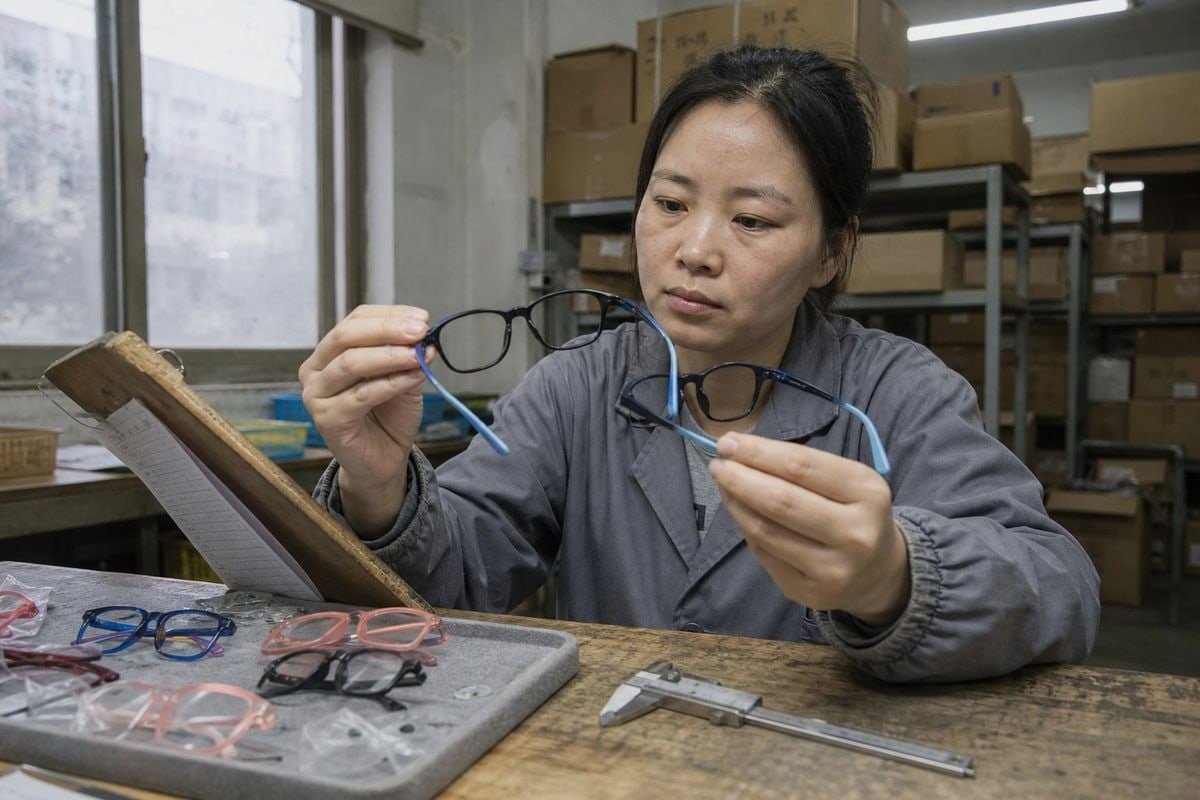
Coordenar a largura da lente, a largura da ponte e o comprimento da haste em armações ópticas infantis é uma pergunta que nossa fábrica em Taizhou responde semanalmente. Erre, e as devoluções se acumulam rapidamente.
Para coordenar a largura da lente, a largura da ponte e o comprimento da haste em armações ópticas infantis, mantenha a largura da lente mais a largura da ponte dentro de 8 mm da distância pupilar da criança, escolha uma ponte que se ajuste de forma estável sem apertar e selecione um comprimento de haste que dobre bem no topo da orelha.
Essa é a versão curta. O quadro completo envolve medir corretamente, entender por que cada número importa e combinar faixas de tamanho com grupos de idade. Deixe-me guiá-lo por cada parte.
Como meço corretamente a largura da lente, a largura da ponte e o comprimento da haste para rostos de crianças?
Durante uma execução de controle de qualidade no ano passado, nossa equipe pegou um lote onde os comprimentos das hastes se desviaram 2 mm da especificação. Esse pequeno desvio ensinou nossos compradores o quanto a medição precisa importa.
Meça a largura da lente na parte horizontal mais larga de uma lente, a largura da ponte na abertura onde a armação repousa no nariz e o comprimento da haste do parafuso da dobradiça até a ponta da haste, incluindo a seção dobrada. Estes aparecem impressos como um código como 48-16-135.
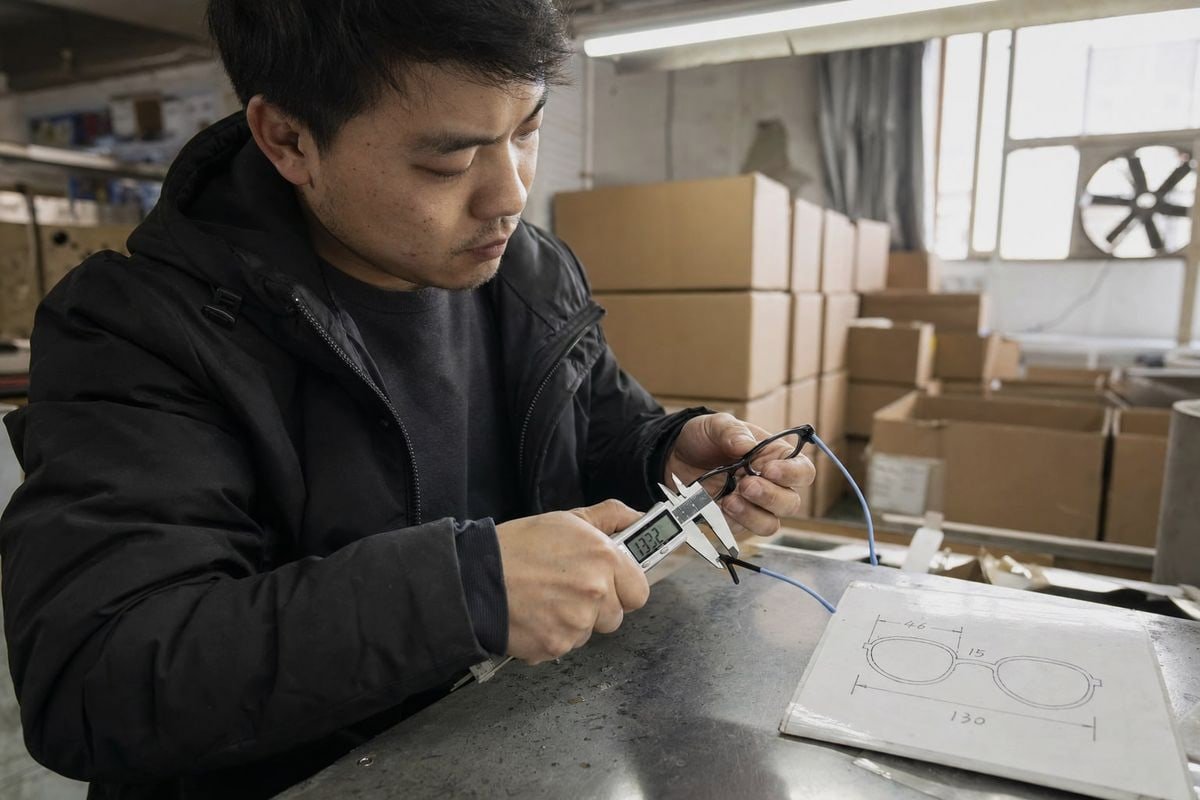
O código de três números é a linguagem compartilhada da indústria. Uma armação marcada 48-16-135 tem uma largura de lente de 48 mm 1, uma largura de ponte de 16 mm e um comprimento de haste de 135 mm. Você geralmente encontrará isso impresso no interior da haste. Quando os compradores nos enviam uma armação de amostra que se ajusta bem, lemos esse código primeiro e, em seguida, verificamos com paquímetros, porque os números impressos e as dimensões reais podem diferir em um milímetro ou dois.
Medindo cada dimensão passo a passo
Aqui está o processo que usamos em nossa própria linha de produção:
- Largura da lente. Faça um régua milimétrica 2 através da parte mais larga de uma abertura de lente. Não inclua o material da borda da armação.
- Largura da ponte. Meça a menor distância entre as duas lentes, no ponto onde a armação toca a anatomia da ponte nasal.
- Comprimento da haste. Meça do centro do parafuso da dobradiça até a ponta da haste, seguindo a curva da dobra atrás da orelha.
Medindo a criança diretamente
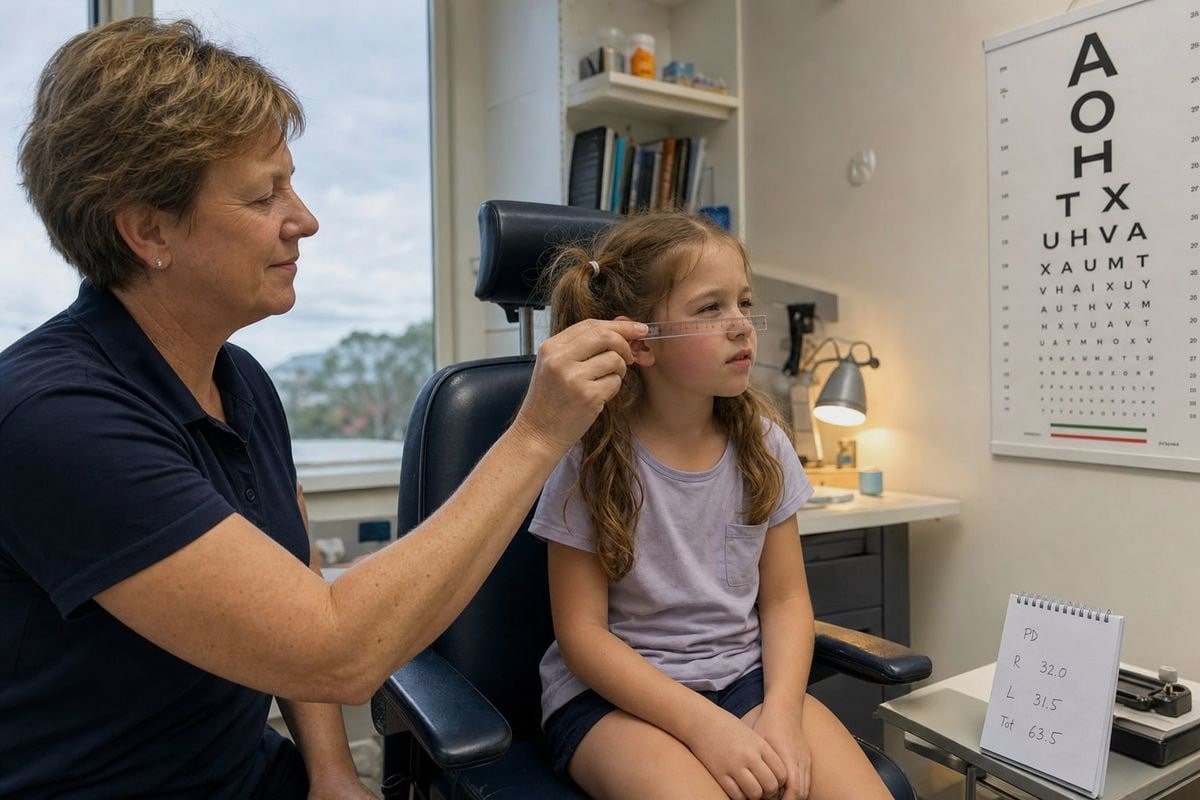
Se você não puder copiar um par existente, meça o rosto da criança em vez disso. A distância pupilar é o número chave. Um profissional de optometria pediátrica pode medi-la com precisão, ou um pai pode usar uma régua milimétrica e um espelho. Você também quer a largura do rosto nas têmporas, pois a largura total da armação deve corresponder à medida de têmpora a têmpora da criança para evitar que os braços se curvem para fora.
| Medição | O que medir | Faixa típica infantil |
|---|---|---|
| Largura da lente | Ponto mais largo de uma lente | 35–58 mm |
| Largura da ponte | Espaço entre as lentes no nariz | 12–18 mm |
| Comprimento da haste | Dobradiça à ponta da haste, incluindo a dobra | 115–135 mm |
Mais uma dimensão merece atenção: a medição B, ou altura vertical da lente. Para crianças em lentes de controle de miopia 3, uma medição B suficiente mantém as zonas de tratamento periférico especializadas eficazes quando a criança olha para baixo em uma mesa ou tablet. Sinalizamos isso para empresas ópticas que encomendam armações destinadas a esses designs de lentes.
Por que tirar estas três medidas incorretamente afeta o ajuste, o conforto e a segurança das crianças?
Uma compradora da Austrália uma vez me disse que sua maior reclamação eram armações escorregando em narizes pequenos. Esse único ciclo de feedback remodelou como projetamos nossas pontes de TR90.
Medidas incorretas desviam as pupilas da criança do centro óptico da lente, reduzindo a clareza visual, enquanto uma ponte mal dimensionada desliza ou aperta e hastes mal dimensionadas causam dor de pressão ou instabilidade. Todos os três erros comprometem o conforto, o desempenho da lente e a segurança durante a brincadeira.
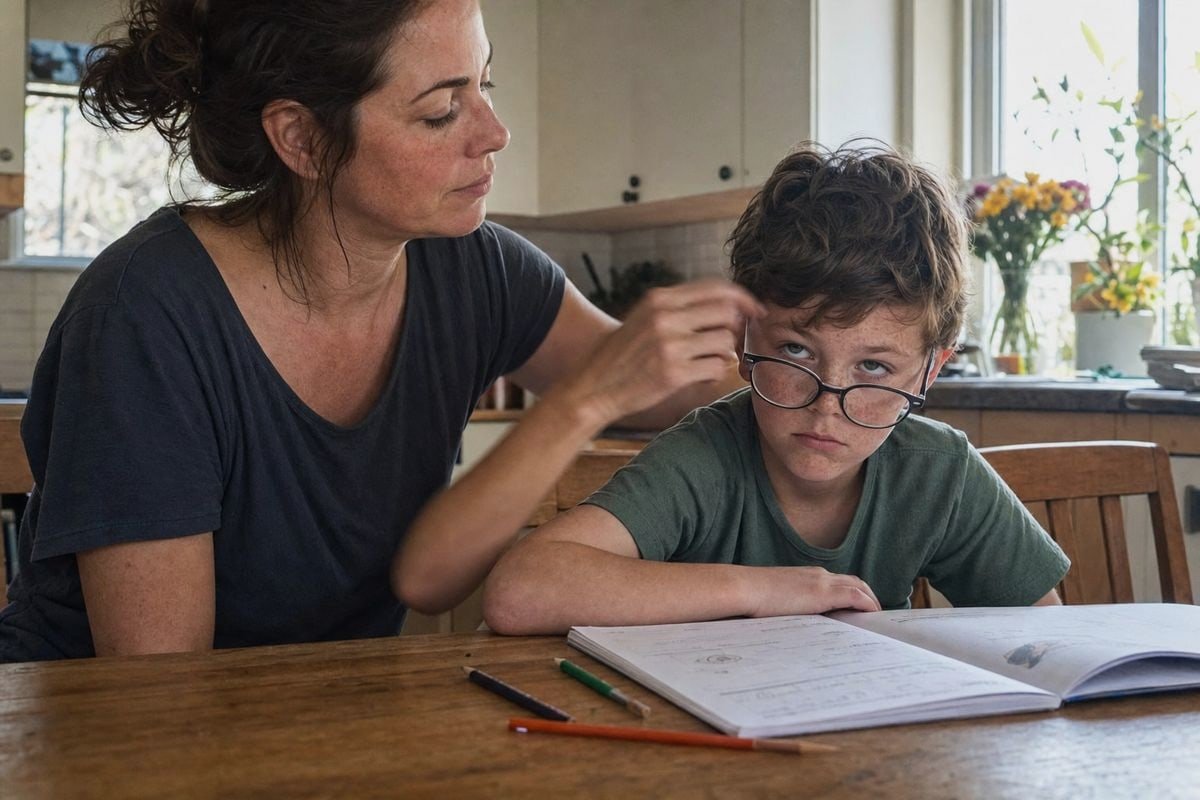
Cada uma das três medições controla um modo de falha diferente. Ajuda a separá-las antes de juntá-las novamente.
Largura da lente e alinhamento do centro óptico
A largura da lente determina onde as pupilas se sentam dentro das lentes. Idealmente, cada olho não deve estar a mais de 3–4 mm fora do centro em sua lente. Se a armação for muito larga, as pupilas se desviam para a borda nasal de cada lente. A criança então olha através de uma parte da lente que nunca foi destinada a ser a zona de visualização primária. Isso causa distorção periférica e, para lentes de prescrição, enfraquece a correção. Centro óptico 4 o alinhamento importa ainda mais para crianças do que para adultos, porque uma criança raramente relata visão turva. Eles simplesmente se adaptam e o problema passa despercebido.
Largura e estabilidade da ponte
Crianças têm pontes nasais subdesenvolvidas 5, então a ponte é onde a maioria das armações infantis falha. Muito larga, e a armação escorrega ou repousa nas bochechas, o que também causa embaçamento das lentes. Muito estreita, e aperta e deixa marcas vermelhas. Almofadas de nariz ajustáveis ou um design de ponte baixa no estilo Global Fit podem resgatar um ajuste marginal, mas a largura da ponte base ainda precisa estar próxima do correto.
Comprimento da haste e fixação segura
Hastes muito curtas pressionam as laterais do crânio. Hastes muito longas passam da orelha e não oferecem nenhuma fixação. A dobra deve ficar precisamente no topo da orelha, pois essa dobra fornece a alavancagem que mantém a armação estável durante a brincadeira ativa. É por isso que equipamos muitos de nossos estilos com ganchos de orelha de silicone macio e hastes tipo cabo para as idades mais jovens: eles agarram suavemente mesmo quando a criança corre.
| Problema de ajuste | Causa provável | Solução prática |
|---|---|---|
| Frame slides down | Bridge too wide | Narrower bridge or adjustable nose pads |
| Marcas vermelhas no nariz | Bridge too narrow | Wider bridge or softer bridge material |
| Pressure at head sides | Temples too short or frame too narrow | Longer temples, wider total frame |
| Frame tips or shifts | Temples too long | Shorter temples or wrap-style silicone ear hooks |
| Eyes far from lens center | Lens + bridge too large vs. PD | Smaller lens width or narrower bridge |
Safety enters the picture too. A frame that constantly slips tempts a child to push it up mid-activity, or to take it off entirely. Combine correct sizing with frame material safety — flexible TR90 fronts and TPEE temples that bend instead of snapping — and you remove both the discomfort and the breakage risk.
Como escolho a faixa de tamanho de armação certa ao encomendar entre diferentes grupos etários?
Balancing SKU count against fit coverage is a trade-off we discuss with almost every new brand. Too few sizes means poor fit; too many means slow-moving inventory.
Escolha intervalos de tamanho de armação por faixa etária como ponto de partida: aproximadamente 35–40 mm de largura de lente para idades 0–3, 41–45 mm para idades 4–6, 46–48 mm para idades 7–9 e 49–58 mm para idades 10–13, em seguida, confirme com verificações de DP e largura do rosto.
Age charts narrow the field quickly, so start there:
| Faixa etária | Largura da lente | Typical bridge width | Typical temple length |
|---|---|---|---|
| 0–3 anos | 35–40 mm | 12–14 mm | 115–120 mm |
| 4–6 anos | 41–45 mm | 14–16 mm | 120–125 mm |
| 7–9 anos | 46–48 mm | 15–17 mm | 125–130 mm |
| 10–13 anos | 49–58 mm | 16–18 mm | 130–135 mm |
But here is the honest caveat I give every buyer: age bands are only starting points. Children's faces vary widely within the same age. A broad-faced five-year-old may need a size from the 7–9 band, while a slender nine-year-old fits the 4–6 band better. The real test is always whether the frame centers the eyes, sits securely on the nose, and reaches the ears comfortably.
The PD coordination rule
The most reliable cross-check is pupillary distance. Add the frame’s lens width and bridge width. That sum should be close to the child's PD — ideally no more than 8 mm larger. So a child with a 52 mm PD fits well in a 42-14 frame (sum 56 mm) but poorly in a 48-18 frame (sum 66 mm). This rule is why coordination beats any single measurement. A frame with the "right" lens width for the age group can still fail if the bridge pushes the sum too high.
Resist the size-up mentality
Parents buy clothing a size up, and buyers sometimes carry that habit into eyewear. Please push back on it. Oversized frames shift the optical center away from the pupils and add lens weight, since larger lens blanks carry more material. In eyewear, standard eye size for the child today beats room to grow. Plan for replacement instead: children's fit needs change quickly, and a frame that fits now will likely need replacing sooner than an adult frame would. For a retail assortment, we usually recommend brands stock at least two adjacent size bands per style rather than one oversized band.
A OKAY EYEWEAR pode me ajudar a selecionar ou personalizar o tamanho dos seus estilos existentes para a minha marca?
When a Japanese baby-brand buyer asked us to adapt one style across three age bands, our sample room turned the request around within two weeks. Sizing support is core to what we do.
Sim. A OKAY EYEWEAR oferece cerca de 800 estilos infantis existentes em várias faixas de tamanho, e nossa equipe de OEM/ODM pode ajustar a largura da lente, o design da ponte, o comprimento da haste, as cores, os logotipos e a embalagem, para que as marcas possam lançar armações infantis bem ajustadas sem um grande investimento em moldes.
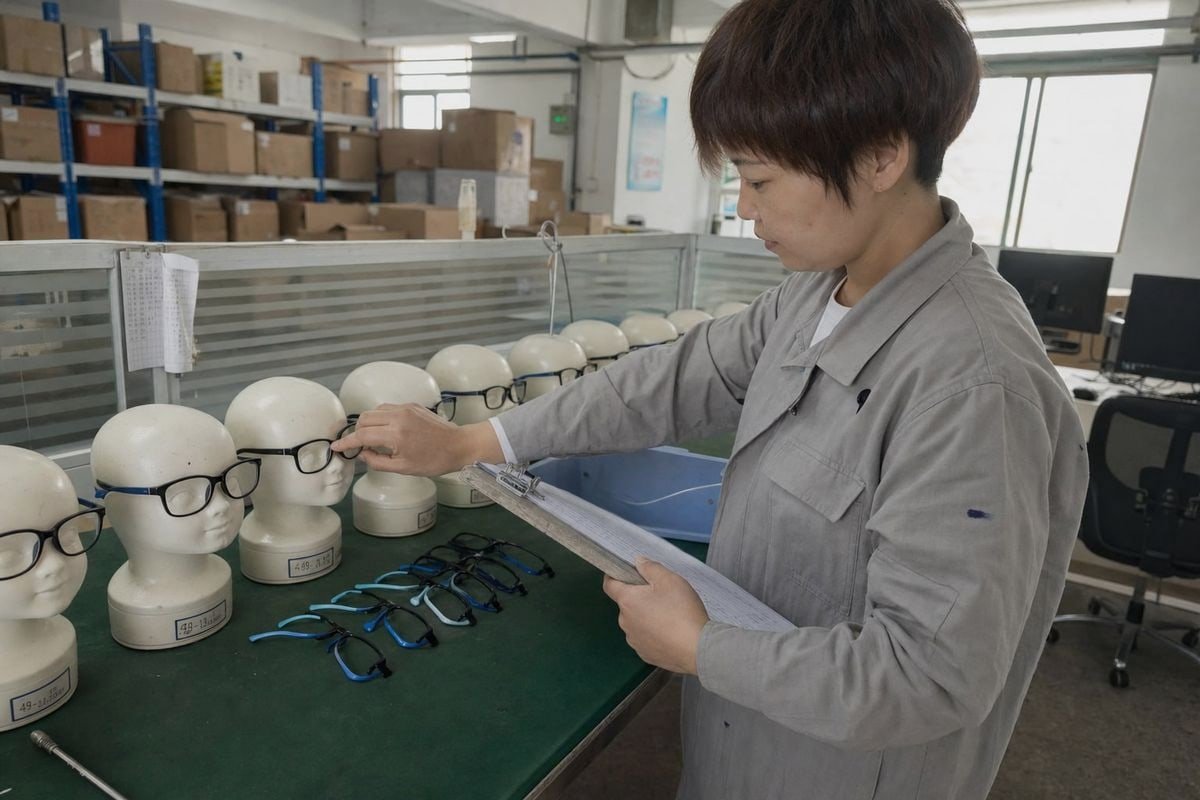
Our factory in Taizhou has spent 15 years building children's eyewear, and sizing coordination is baked into how we develop every style. With around 120 workers and a 5S-managed workshop, we run consistent tolerances on the three measurements batch after batch, which matters when your brand promises the same fit in every reorder.
Starting from existing styles
Most buyers begin by selecting from our catalog of roughly 800 styles. Take two examples from our current range. One is a rectangular-rounded TR90 frame in glossy black with navy TPEE temples that transition into soft sky-blue silicone ear hooks — the curved, adjustable hook keeps the bend seated at the top of the ear during active play. Another is a translucent pale-pink rounded-rectangular frame with a compact, lightweight build sized for younger faces. Both illustrate how we pair frame geometry with flexible materials: spring hinges or flexible TPEE temples absorb the twisting kids inflict, so the coordinated fit survives daily abuse.
What we can customize
Within an existing tooling platform, we can adjust more than most buyers expect:
- Temple length and tip design, including cable temples or silicone ear hooks for toddlers, and custom temple bends where ear-height asymmetry data from 3D facial scanning calls for it.
- Bridge configuration, including lower-profile Global Fit bridges for children with flatter nasal bridges, which maintain consistent vertex distance and prevent cheek-contact fogging.
- Pantoscopic tilt tuning, angling lenses correctly for a child's shorter stature and frequent upward-looking gaze.
- Colors, logos, lens options such as UV400 and blue-light lenses, plus retail-ready packaging and accessories.
We work with children's and baby brands, importers, distributors, and optical companies across 20+ countries. If you send us your target age bands or a well-fitting sample, Alan Kong and our team at sales@okayeyewear.com will map them to specific styles and sizes, and prepare samples so you can run real fit checks before committing to an order.
Conclusão
Coordinating lens width, bridge width, and temple length turns kids' optical frames from a guess into a system. Measure carefully, match PD, and partner with us for sizing done right.
Notas de rodapé
1. Wikipedia section detailing the standard boxing system for frame measurements. ↩︎
2. NIST provides the official standards for metric units used in technical manufacturing measurements. ↩︎
3. AOA provides authoritative clinical information on myopia and pediatric vision management. ↩︎
4. Wikipedia explains the technical role of the optical center in corrective lens design. ↩︎
5. AAO guide on fitting glasses for children with developing nasal bridges. ↩︎
Mais Artigos que Você Pode Gostar


Procurando um Parceiro Confiável em Óculos Infantis?
Explore mais de 800 estilos prontos e suporte completo OEM/ODM adaptado à sua marca.
Entre em Contato English
  Español de México
  Deutsch
  Français
  日本語
日本語  العربية
  Português do Brasil