How to Agree on Inspection Standards and Defect Rates With Kids’ Sunglasses Suppliers?
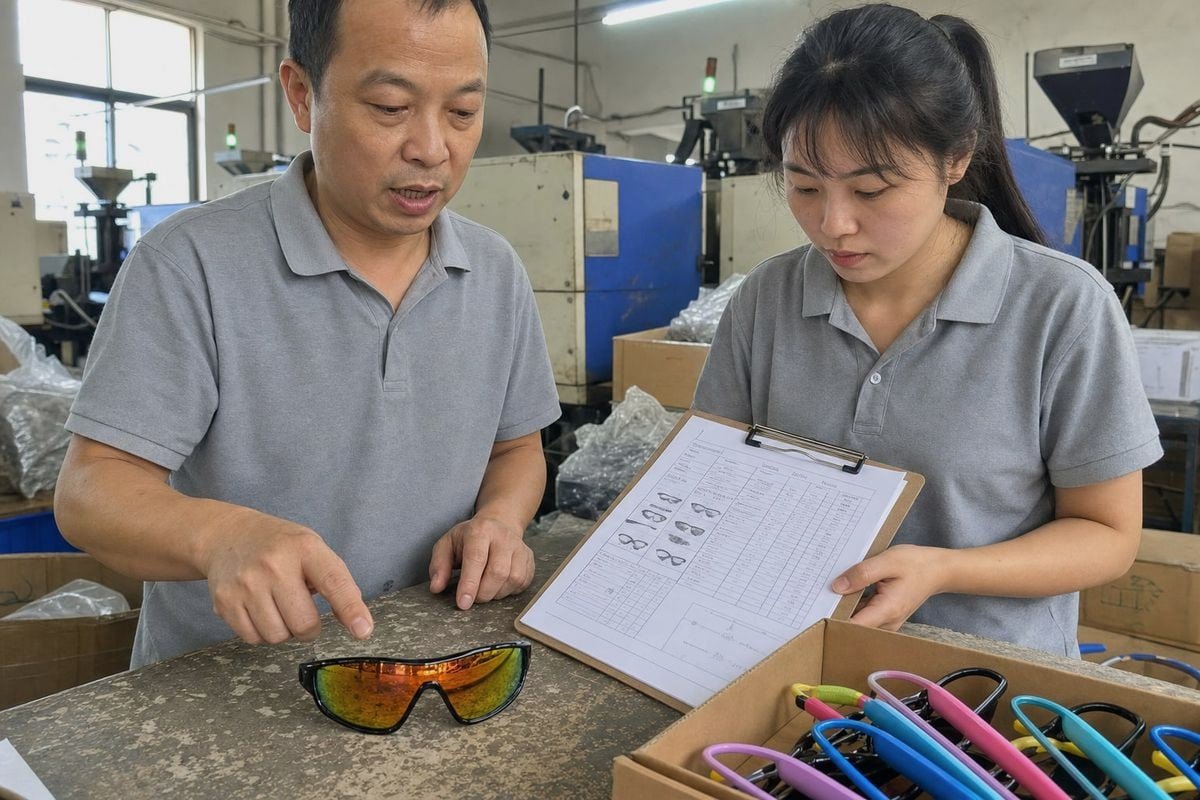
Inspection standards and defect rates cause more buyer-supplier fights than price ever does final pre-shipment inspection 1. On our Taizhou production line, I’ve seen orders stall for weeks because “good quality” was never defined. Vague words become expensive disputes. The fix is a written agreement made before production starts.
Agree on inspection standards and defect rates by attaching a signed specification sheet, a Golden Sample, and a written defect list to the purchase order. Set AQL thresholds — typically 0 for critical, 2.5 for major, 4.0 for minor defects — and tie pre-shipment inspection results to shipment release and final payment.
That is the short answer. Below, I will walk through each step in the order a real order follows: standards first, defect rates second, in-production checks third, and dispute handling last.
What Inspection Standards Should I Request Before Placing a Bulk Order?
A buyer from Australia once sent me a one-line quality clause: "sunglasses must be perfect." Our team had to push back. Perfect is not a standard. For children's eyewear, the standard must be written, specific, and testable.
Request a signed Product Specification Sheet, an approved Golden Sample, a three-tier defect classification, and proof of safety compliance — ISO 12312-1 compliance, UV400 protection testing, impact resistance testing, and BPA-free material certification — all attached to the purchase order as legally binding documents.
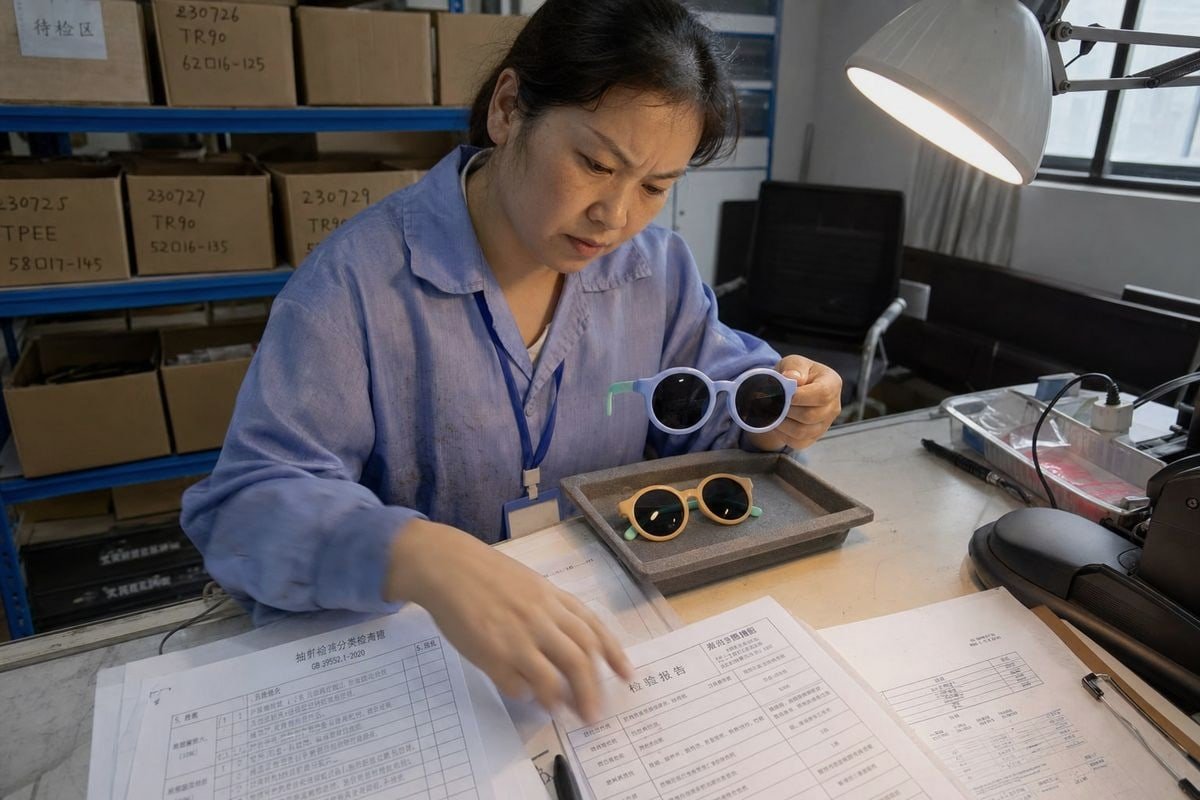
Kids' sunglasses need tighter language than adult fashion eyewear. A small cosmetic flaw on an adult frame is annoying. A sharp edge or a loose lens on a child's frame is a safety issue. So your inspection standards should separate safety, function, and cosmetics from the very beginning.
The four documents that define your standard
In our fifteen years making TR90 and TPEE children's frames 2, every smooth order rested on the same four documents:
- Product Specification Sheet (PSS). It lists materials, dimensions, tolerances, colors, lens type, coatings, and packaging. It should name the exact resin, not just "plastic." This blocks "quality fade," where a factory quietly swaps in a cheaper anti-scratch coating after samples are approved.
- Golden Sample approval. Both sides sign and keep an identical physical sample. Inspectors compare production units against it, not against memory.
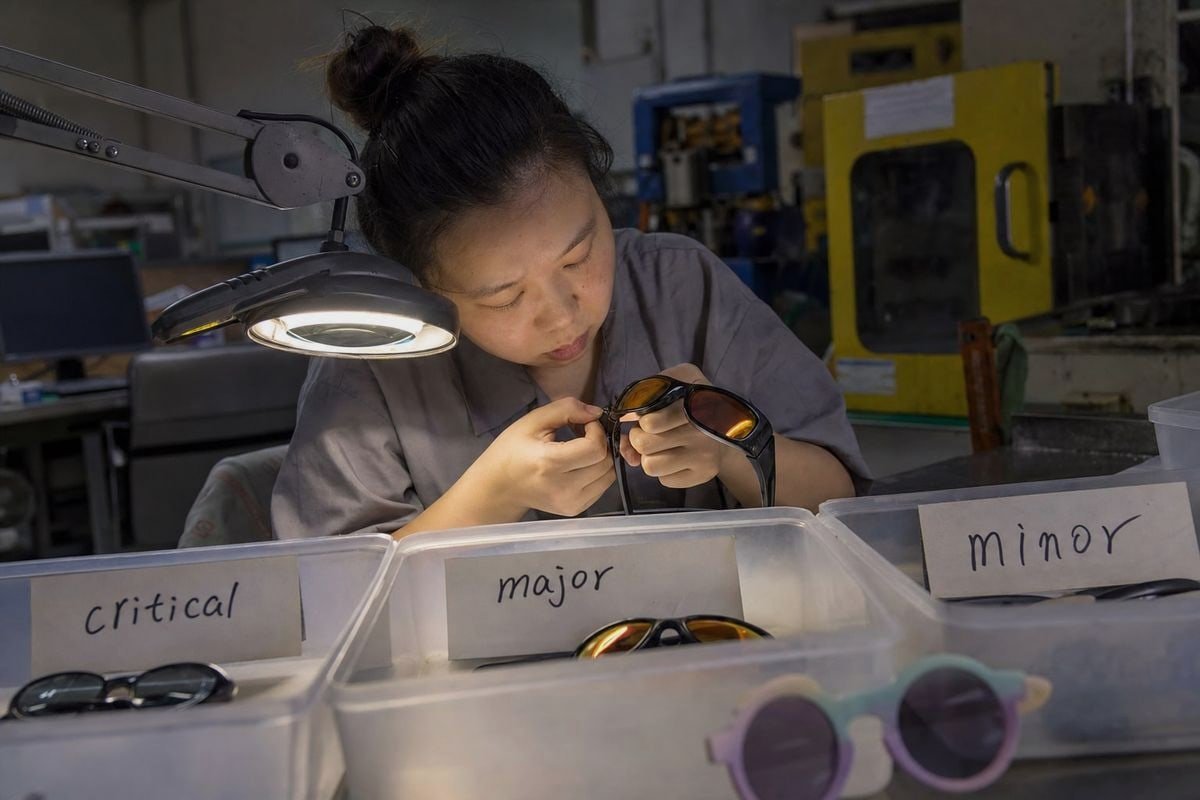
- Defect classification list. Written examples of critical, major, and minor defects for your exact model. Lens distortion, loose hinges, misaligned temples, wrong labels — each gets a category.
- Safety compliance evidence. For the US, that means CPSIA and the Drop Ball impact test 3 for lenses. For the EU, EN 71 and ISO 12312-1 compliance. UV400 protection testing should be verified by third-party lab testing, never by a factory sticker alone.
Sample defect classification for kids' sunglasses
| Categoria | Exemplos | Por que importa |
|---|---|---|
| Crítico | Sharp edges, detached lens, broken hinge, failed UV or impact test, banned chemicals | Direct safety risk to a child; zero tolerance |
| Principal | Optical distortion, loose hinge, crooked temples, peeling coating, wrong lens color | Product fails to function or sell as intended |
| Menor | Faint mold line, tiny cosmetic mark on temple tip, slightly off-center print on box | Noticeable but does not affect safety or use |
Also ask for sub-tier transparency. Know who supplies the lenses and coatings, because that is where silent substitutions usually happen.
How Do I Set an Acceptable Defect Rate With My Kids' Sunglasses Manufacturer?
Early in my export career, a European brand asked us to guarantee zero defects across ten thousand pairs. I had to explain a trade-off honestly: mass production always has variation, and a realistic statistical threshold protects both sides better than an impossible promise.
Set defect rates using the Acceptable Quality Level (AQL) under ISO 2859-1. For kids' sunglasses, agree on AQL 0 for critical defects, AQL 2.5 for major defects, and AQL 4.0 for minor defects, and write the full sampling plan — level, sample size, accept/reject numbers — into the contract.
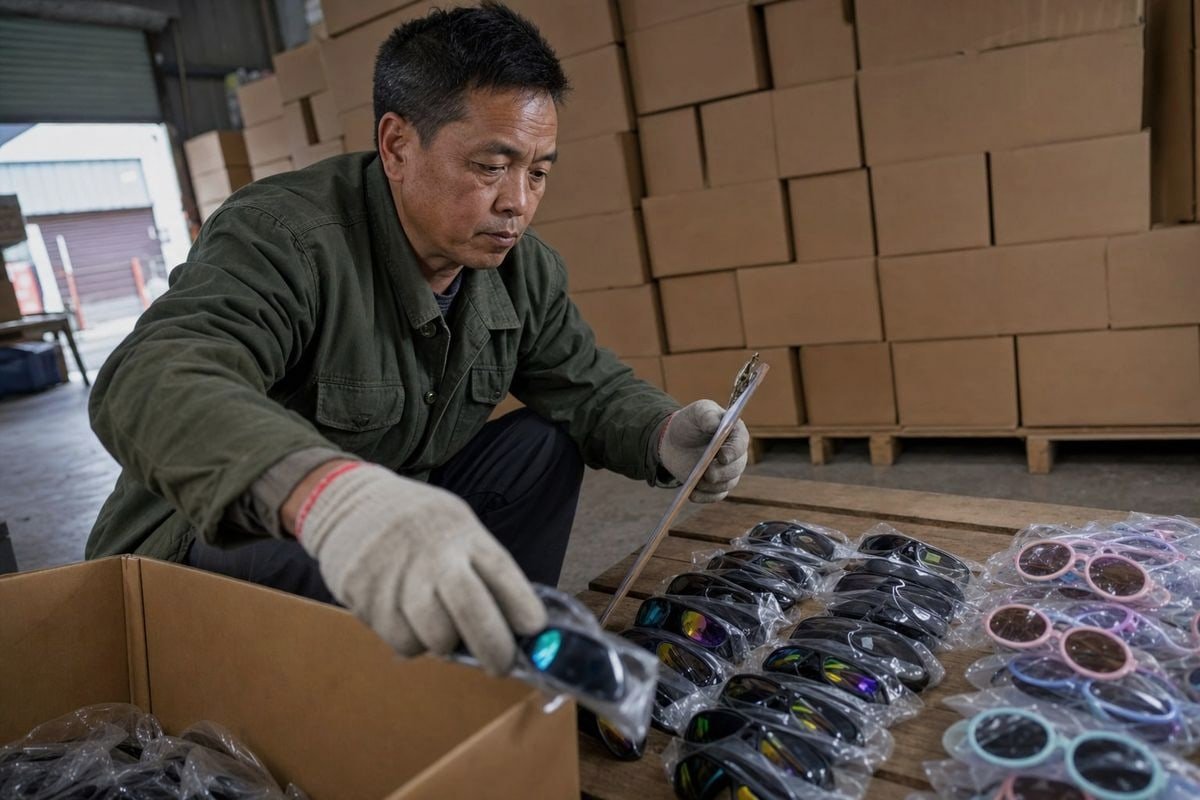
AQL is a statistical acceptance threshold, not a promise that every pair is flawless. It answers one question: based on a random sample, is this batch acceptable? That distinction matters. Buyers who treat AQL 2.5 as "2.5% of my goods will be broken" misread the system. It defines the worst process average an inspector will tolerate before rejecting the lot.
Don't stop at the AQL number
Many contracts just say "AQL 2.5" and stop. That is not enough. Your agreement should state:
- The inspection level (General Level II is the common default).
- The sample size drawn from your order quantity.
- The exact acceptance and rejection numbers for each defect class.
- That the plan follows ISO 2859-1 sampling tables.
Here is a practical example for a typical kids' sunglasses order:
| Order quantity | Sample size (Level II) | Critical accepted | Major accepted (AQL 2.5) | Minor accepted (AQL 4.0) |
|---|---|---|---|---|
| 1,000 pairs | 80 | 0 | 5 | 7 |
| 3,200 pairs | 125 | 0 | 7 | 10 |
| 10,000 pairs | 200 | 0 | 10 | 14 |
If the inspector finds one critical defect — say, a sharp edge or a lens that fails impact resistance testing — the whole lot fails, regardless of how clean everything else looks.
Consider a Dynamic AQL clause
One negotiation tool I respect is a Dynamic AQL clause. The threshold starts at 2.5/4.0 for the first three production runs, then tightens as the factory's process stabilizes. It rewards suppliers who improve and gives buyers a built-in quality trajectory. At our workshop, we actually welcome this structure. It signals a long-term partner, not a one-order buyer, and it makes our 5S process discipline pay off commercially.
Whatever numbers you choose, put them in writing before the first purchase order. A defect rate negotiated after a bad batch arrives is not a negotiation. It is a fight.
What Quality Control Steps Should I Confirm During Production?
Mid-production is where quiet problems grow loud. Our QC team once caught a hinge-screw torque drift 4 halfway through a TR90 optical frame run — invisible on day one, obvious by pair three thousand. Catching it mid-run saved the whole order.
Confirm three checkpoints: pre-production sample approval before mass production begins, an in-process inspection at roughly 20–50% completion, and a final pre-shipment inspection under ISO 2859-1. Require a written Quality Control Plan (QCP) that names each test, its timing, and who performs it.
A single final inspection is a gamble. If the goods fail at the end, the factory reworks under deadline pressure or you accept a compromise. Neither outcome is good. Three staged checkpoints spread the risk across the whole production timeline.
The three-checkpoint structure
| Checkpoint | Timing | What gets verified |
|---|---|---|
| Aprovação pré-produção | Before mass production | Golden Sample match, materials, BPA-free material certification, lens supplier confirmation |
| In-process inspection | 20–50% of units complete | Assembly quality, hinge torque, frame alignment, coating consistency, early defect trends |
| Pre-shipment inspection | 80–100% complete and packed | Full AQL sampling, function tests, labeling, carton counts, packaging integrity |
Functional tests to write into the QCP
Cosmetic checks alone are not enough for children's eyewear. Your Quality Control Plan should list functional and safety tests by name:
- Hinge torque and over-flex stress testing. Kids' frames should survive 180-degree outward bending without snapping. This is exactly why we build with flexible TPEE temples on TR90 fronts — rough play is not an edge case for children, it is the normal use case.
- Frame alignment. Frames should sit flat on a level surface with no rocking.
- Lens checks. Optical distortion, scratch inspection under directed light, and batch-level impact resistance verification.
- Edge finishing. Every touchable surface must be smooth. No burrs, no flash, no sharp mold lines.
- Packaging and labeling. Correct SKUs, age-grading warnings, and accurate carton counts.
Some factories run their own rolling visual checks on 10–20% of units. That is a useful internal routine, and we do it ourselves. But contractual acceptance should still rest on the formal AQL sampling plan 5, not on informal spot checks. Finally, make one rule explicit: no shipment leaves the factory until the pre-shipment inspection is passed and the goods are formally released.
How Can I Handle Disagreements Over Defects After Delivery?
Even careful partners disagree sometimes. A buyer once emailed us photos of scratched lenses three weeks after delivery. Because we had retained inspection photos and sealed reference samples, we traced the damage to transit handling — and resolved it in days, not months, with the relationship intact.
Handle post-delivery disputes through pre-agreed contract terms: a defined incoming-inspection window, evidence requirements, third-party re-inspection at the failing party's cost, explicit remedies of rework, replacement, or credit, and a latent-defect warranty stating that a passed pre-shipment inspection does not waive hidden defects.

The core principle is simple: write the dispute process before the dispute exists. Once a bad batch is sitting in your warehouse, both sides are emotional and money is on the line. A pre-agreed procedure turns an argument into a checklist.
A practical dispute-resolution sequence
- Notify within the inspection window. Your contract should give you a defined period after arrival — commonly 14 to 30 days — to inspect and reject nonconforming goods. Payment made does not equal acceptance.
- Document with evidence. Photos, defect counts, batch numbers, and a comparison against the Golden Sample. Keep inspection records and photos for at least three years.
- Classify against the agreed defect list. Is this a major defect under the contract, or a minor one within tolerance? The written classification decides, not opinion.
- Escalate to third-party re-inspection if needed. A neutral firm such as SGS, Intertek, or TÜV 6 samples, tests, and reports. Agree in advance that the failing party pays the re-inspection fee, typically a few hundred US dollars per man-day, with reasonable notice for factory access.
- Apply the pre-agreed remedy. Rework, replacement, reproduction at the supplier's cost, or a credit note — matched to defect severity.
Protect yourself against latent defects
Some failures only appear after weeks of real use: hinge fatigue, frame brittleness, coating delamination. Your agreement should include a latent-defect clause 7 — often a 6 to 12 month window from ship date — holding the supplier responsible for hidden material or workmanship failures that no pre-shipment inspection could catch. Serious factories accept this. In our experience, a supplier who refuses any post-delivery responsibility is telling you something important about their confidence in their own product.
Conclusão
Vague quality promises destroy kids' eyewear orders. Define defects in writing, fix AQL thresholds, stage three inspections, and pre-agree remedies — then disputes become procedures, not battles.
Notas de rodapé
1. Professional quality assurance services for verifying product compliance and safety before goods are released for shipment. ↩︎
2. Technical details on Nylon 12, the high-performance polymer used to create flexible and durable TR90 eyewear frames. ↩︎
3. Official US government test method for ensuring the impact resistance of sunglass lenses for consumer safety. ↩︎
4. Scientific explanation of torque and its measurement, relevant to maintaining consistent assembly quality in eyewear hinges. ↩︎
5. Authoritative overview of the AQL statistical sampling standards used in manufacturing quality control. ↩︎
6. Leading global inspection company providing specialized quality assurance and laboratory testing for the eyewear industry. ↩︎
7. Legal definition of hidden product flaws that are not detectable during standard pre-shipment quality control inspections. ↩︎
Mais Artigos que Você Pode Gostar
1 de agosto de 2026
A Fábrica Deve Lidar com a Embalagem e Rotulagem de Óculos de Sol Infantis, ou Usar um Fornecedor Designado?

1 de agosto de 2026
Armazém Próprio vs. Envio Direto do Fornecedor: Qual Reduz os Custos de Devolução para Marcas de Óculos de Sol Infantis?

1 de agosto de 2026
Armazém Direto ao Porto ou Estiva no Exterior: Qual Economiza Mais no Envio de Óculos de Sol Infantis?
Procurando um Parceiro Confiável em Óculos Infantis?
Explore mais de 800 estilos prontos e suporte completo OEM/ODM adaptado à sua marca.
Entre em Contato English
  Español de México
  Deutsch
  Français
  日本語
日本語  العربية
  Português do Brasil