Should Kids Optical Frames Be Sized Up or Fitted Right?

Buyers ask me this about kids optical frames almost every trade show. On our production line in Taizhou, oversized “growth room” frames are the return complaint we see most often.
Kids optical frames should be fitted right, not sized up. Oversized frames slip, shift the optical center away from the pupils, cause blurred vision and pressure marks, and reduce daily wear. A frame must match the child’s current bridge, face width, and temple length.
That is the short answer. But the reasons behind it matter for anyone buying, selling, or specifying children’s eyewear. Let me walk through the details, section by section.
How do I know if my child's optical frames are the correct fit?
During a QC session last year, our team rejected a sample batch because the temples bowed outward on our child head forms. That small flaw teaches the same lesson every parent needs: fit shows in specific, checkable details.
A correct fit means the pupils sit centered in each lens, the bridge rests flush on the nose without sliding, frame width matches face width, temples bend right at the top of the ear, and the frame never touches the cheeks or lashes.
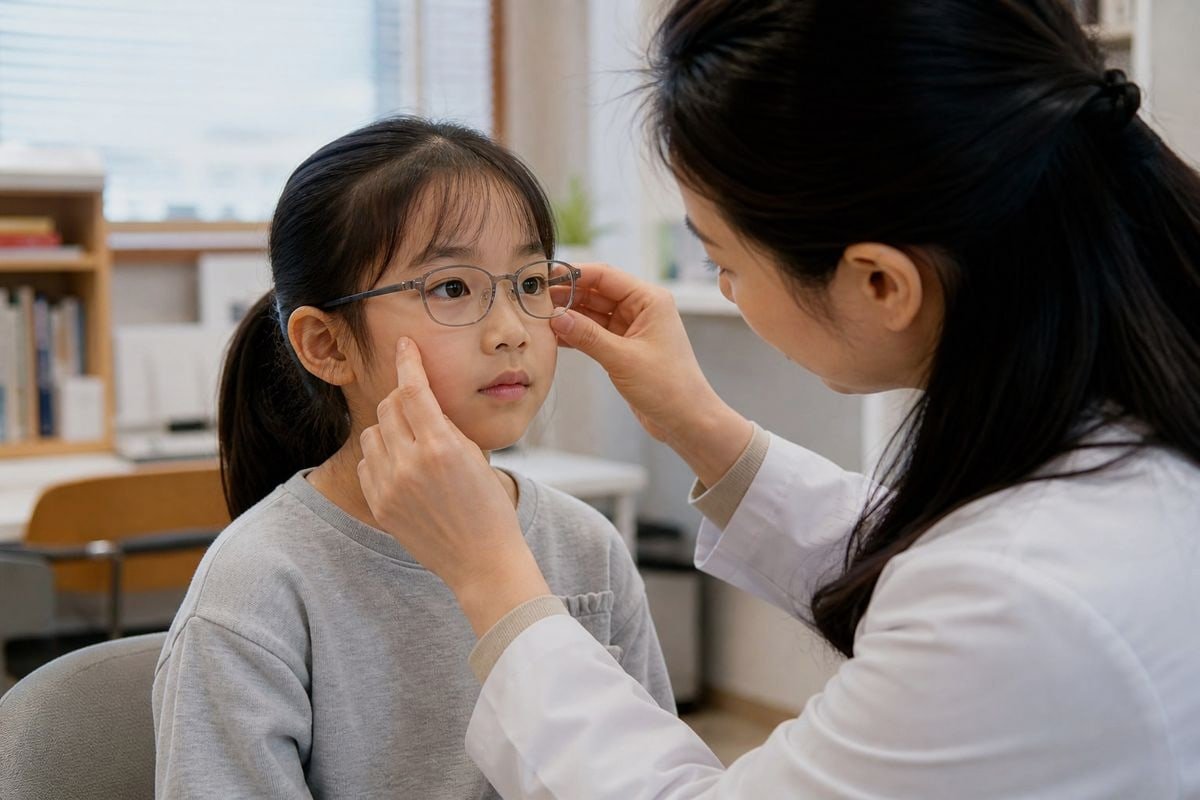
The good news is that you do not need special tools to run a basic fit check at home. You need good light, a still child, and about two minutes. A pediatric optician should confirm the fit, but parents can catch most problems early.
The five-point fit check
Work through these checks in order. Each one maps to a specific part of the child's facial anatomy 1.
| Check point | What correct looks like | Warning sign |
|---|---|---|
| Lens centration 2 | Pupils centered horizontally and vertically | Eyes sit high, low, or toward the inner edge |
| Bridge fit | Bridge sits flush on the nose, no gap | Frame slides down within minutes |
| Frame width | Frame edge lines up with the face edge | Frame extends well past the temples |
| Temple length | Temples bend right at the top of the ear | Bend lands behind or before the ear |
| Cheek and lash clearance | Clear gap at cheeks and eyelashes | Lenses fog from lash contact, frames ride on cheeks |
Lens centration matters most for vision. The prescription is ground around an optical center, and that center should align with the pupillary distance 3 measured by the optician. When a frame is too wide, the lenses sit too far apart, and optical center alignment breaks down.
Bridge fit matters most for stability. Children have low, soft nasal bridges, so a poor bridge fit is the most common cause of frame slippage — and slipping frames are the single biggest driver of pediatric non-compliance. Watch your child for ten minutes of normal play. If they push the glasses up more than once or twice, the bridge fit is wrong.
Finally, check vertex distance — the gap between the lens and the eye. If frames sit far off the face, the effective power of the prescription changes, especially in stronger prescriptions.
What risks come with sizing up children's glasses for growth?
One of our European distributors once asked us to ship frames one size up "so parents get two years of wear." We ran the numbers with them, and the return data from their optical partners changed their mind fast.
Sizing up causes the optical center to shift away from the pupils, inducing prismatic effects, blurred vision, headaches, and binocular strain. Oversized frames also slip constantly, concentrate weight on soft nasal cartilage, and force poor head postures during near work.
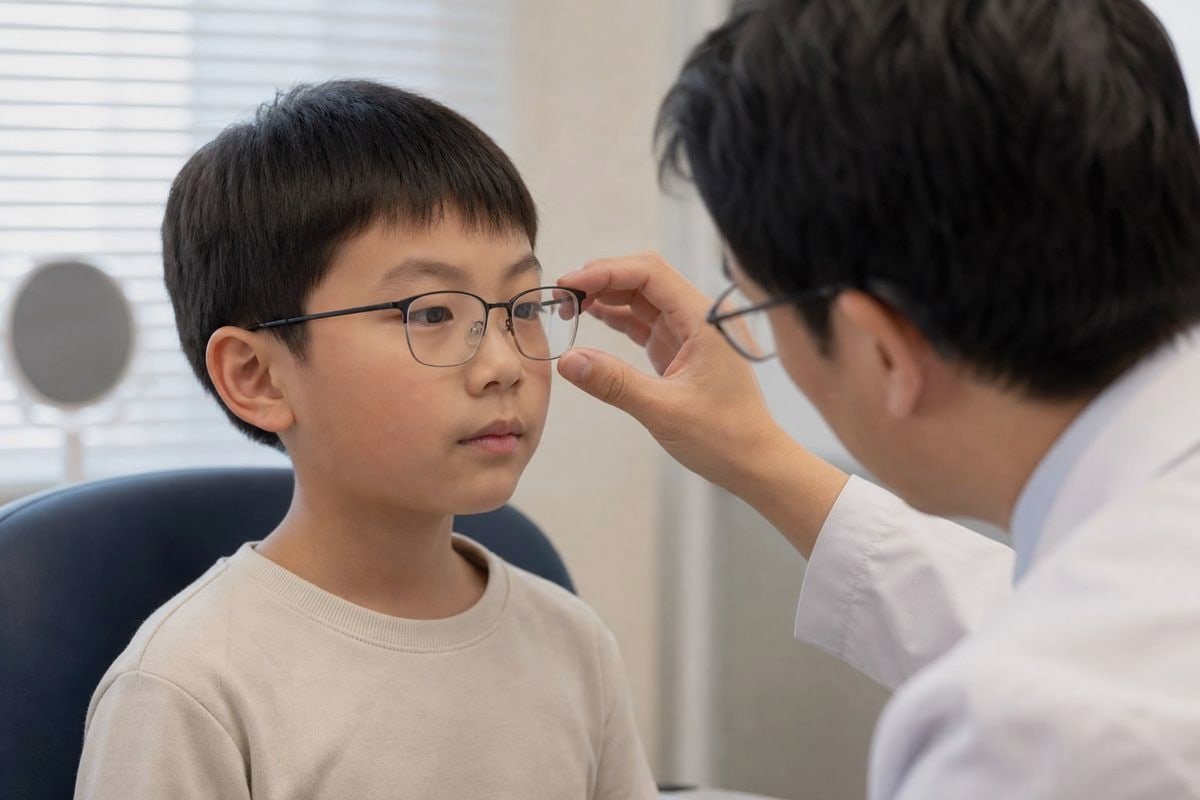
The instinct behind sizing up is understandable. Glasses cost real money, and children grow. But the growth math is weaker than most parents assume. Infants and small children may only gain one or two millimeters in lens width over a full year. That tiny margin does not justify a frame that fits badly for twelve months.
The optical risks
When lenses sit wider than the child's pupillary distance, the optician must decenter the prescription. Larger decentration makes lenses thicker and heavier. Worse, when the eye looks through a point away from the optical center, the lens acts like a prism. That induced prismatic effect causes headaches and binocular vision strain — problems a young child often cannot describe, so they simply stop wearing the glasses.
The stakes are even higher for modern myopia control. For advanced myopia management 4 lenses such as DIMS or HALT designs, even a 1mm vertical drop in frame position can significantly reduce the lens's ability to slow axial eye growth. An oversized frame that slides down the nose can quietly undermine a treatment the family paid a premium for.
The physical and behavioral risks
| Risk | Cause | Consequence |
|---|---|---|
| Frame slippage | Bridge and width too large | Child looks over the lenses, constant pushing up |
| Skin damage | Weight concentrated on soft nasal cartilage | Irritation, red marks, even lasting indentations |
| Poor posture | Frame sits too low on the face | Head tilted back to see through the near zone during screen use |
| Abandonment | Pinching, marks, wobble during play | Child refuses to wear the glasses at all |
Immediate comfort drives compliance. If frames pinch or leave red marks, children are far more likely to abandon them — and abandoned glasses correct nothing.
Which frame materials help kids' glasses stay comfortable as they grow?
Material choice is the trade-off we weigh every day at our factory. Fifteen years of building children's eyewear has taught us that the right material lets a well-fitted frame adapt to small growth without ever being oversized.
Flexible materials like TR90 and TPEE keep well-fitted frames comfortable as children grow. They are lightweight, impact-resistant, and gently adjustable at the temples and bridge, so an optician can fine-tune the fit repeatedly without buying a larger frame.

Here is the nuance most buying guides miss: material is not a substitute for correct sizing, but it is the bridge between "fits today" and "still fits in eight months." A rigid frame either fits or it does not. A flexible frame with the right components gives an optician room to keep adjusting as the face changes slightly.
How the main materials compare
| Material | Weight | Flexibility | Best use in kids' frames |
|---|---|---|---|
| TR90 | Very light | High, returns to shape | Frame fronts and full frames for active kids |
| TPEE | Very light | Extremely high, near-unbreakable feel | Temples and full frames for toddlers and babies |
| Acetate | Moderate | Low to moderate | Style-led frames for older children |
| Metal with silicone parts | Moderate | Depends on hinges | School-age kids needing adjustable nose pads |
In our workshop, our most-requested construction is a TR90 front paired with TPEE temples. The TR90 front holds lens centration stable, while the TPEE temples flex around the ears during rough play instead of snapping or digging in. Soft silicone temple tips add grip without pressure, which reduces frame slippage during sport.
Components that extend comfortable wear
Materials only tell half the story. Three components do the rest:
- Spring hinges absorb the outward pull when a child yanks the frames off with one hand, so the temples do not stretch wider over time.
- Adjustable nose pads or a molded soft bridge let the optician raise or lower the frame to maintain optical center alignment as the nose develops.
- Polycarbonate lenses are the standard safety choice — impact-resistant and lighter than standard plastic, which reduces the load on that soft nasal cartilage.
Environmentally friendly material grades matter too. Parents in markets like Japan, Australia, and Europe increasingly ask about skin-safe, eco-conscious materials, and brands that answer well win shelf space.
How can I work with a manufacturer to get accurate kids' frame sizing?
A procurement manager from an Australian baby brand once sent us a single sample and asked us to "make it in three sizes." We sent back a sizing questionnaire instead — and that conversation turned into a three-year partnership built on proper age-banded specs.
Share your target age bands, market, and prescription use case with your manufacturer. Ask for age-specific specs covering lens width, bridge width, and temple length, then validate samples on child head forms or real fit models before committing to production.
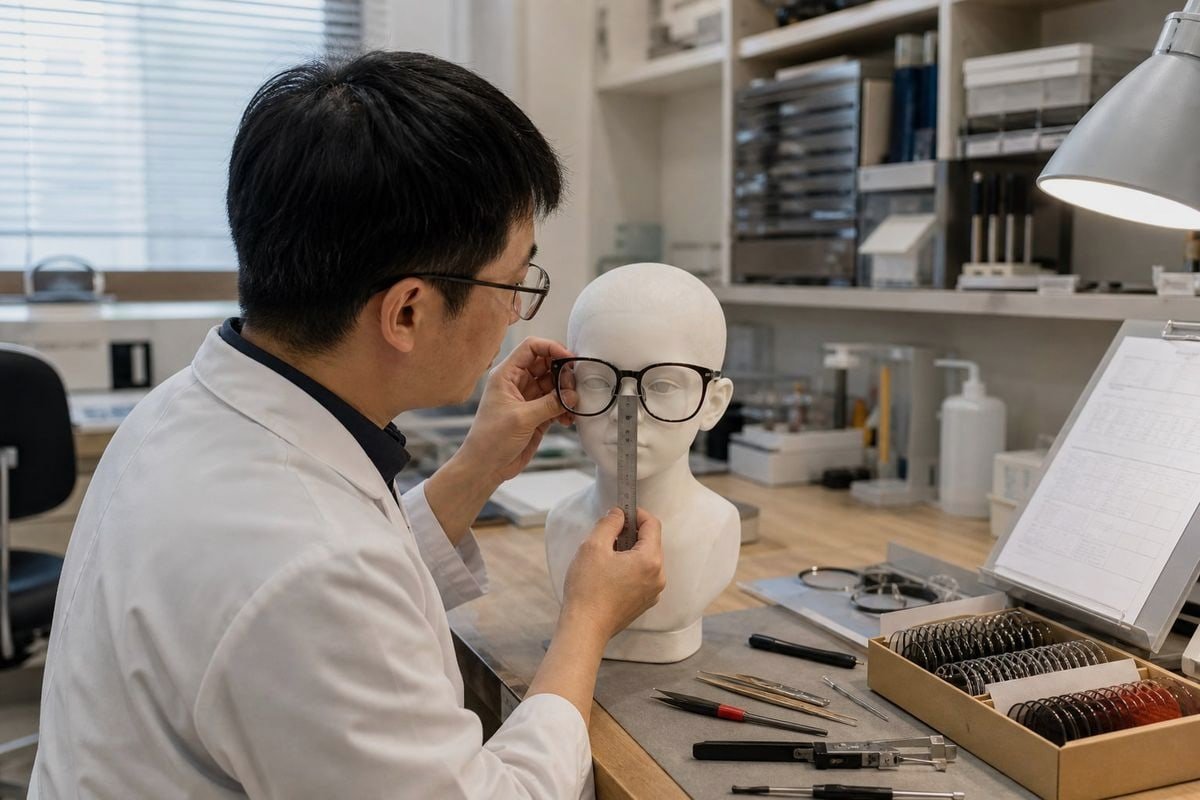
Accurate sizing is a collaboration, not a catalog lookup. Adult frames scaled down do not work, because children’s facial anatomy is not a miniature adult face. Kids have flatter, lower bridges, shorter temple-to-ear distances, and narrower pupillary distances. Even a petite adult frame usually carries an adult temple length, which leaves the bend hanging in the air behind a child's ear instead of locking the frame in place.
A practical process for getting sizing right
Based on how we run OEM and ODM projects at our factory, here is the sequence that avoids expensive mistakes:
- Define the age band first. A frame for a 3-year-old and a frame for a 9-year-old are different products, not different sizes of one product. Bridge fit, temple length, and lens width all change.
- Start from existing tooling where possible. We maintain around 800 existing styles across age bands, so a new brand can select proven geometry and test the market without heavy mold investment. Sizing risk drops sharply when the base shape has already been worn by real children.
- Request a full spec sheet. It should state lens width, bridge width, temple length, total frame width, and lens height for every SKU — not just the eye size printed on the temple.
- Fit-test physical samples. Ask your supplier to check samples on child head forms, and run your own trials with children in your target age band. Watch for the temple bend position and cheek clearance specifically.
- Lock QC tolerances before mass production. In our 5S-managed workshop, we hold dimensional checks on bridge and temple geometry through production, because a few millimeters of drift is invisible in a photo but obvious on a child's face.
- Customize where it counts. Full OEM/ODM support should cover colors, logos, lens options, and packaging — but the sizing geometry should always be driven by the fit data, not by the design mood board.
One more tip for brands serving optical channels: tell your manufacturer whether frames will carry prescription lenses. Prescription use raises the bar on lens centration stability and vertex distance consistency, and a serious factory will adjust materials and hinge choices accordingly.
Conclusion
Kids optical frames should fit today's face, never next year's. Oversized frames compromise vision, comfort, and compliance. Choose flexible materials, verify the fit, and partner with an experienced factory.
Footnotes
1. Scientific overview of pediatric facial development and its implications for medical device and frame fitting. ↩︎
2. Peer-reviewed PMC article explaining the clinical importance of optical center alignment. ↩︎
3. Authoritative guide from the American Academy of Ophthalmology on measuring distance between pupils for correct lens alignment. ↩︎
4. Authoritative NIH/NCBI book chapter on clinical myopia treatment and management strategies. ↩︎
More Articles You Might Like

August 5, 2026
Bio-Based vs Regular Cellulose Acetate: What's the Difference for Kids' Frames?

August 5, 2026
How Recyclable Are Kids' Optical Frame Materials, and What Eco-Friendly Alternatives Exist?
August 5, 2026
Do Kids Optical Frames Whiten or Age in Storage, and How to Control Warehouse Conditions?
Looking for a Reliable Kids Eyewear Partner?
Explore 800+ ready styles and full OEM/ODM support tailored to your brand.
Get in Touch English
  Español de México
  Deutsch
  Français
  日本語
日本語  العربية
  Português do Brasil