Which Retail Display Methods Suit TR90 Kids Sunglasses Packaging Types?
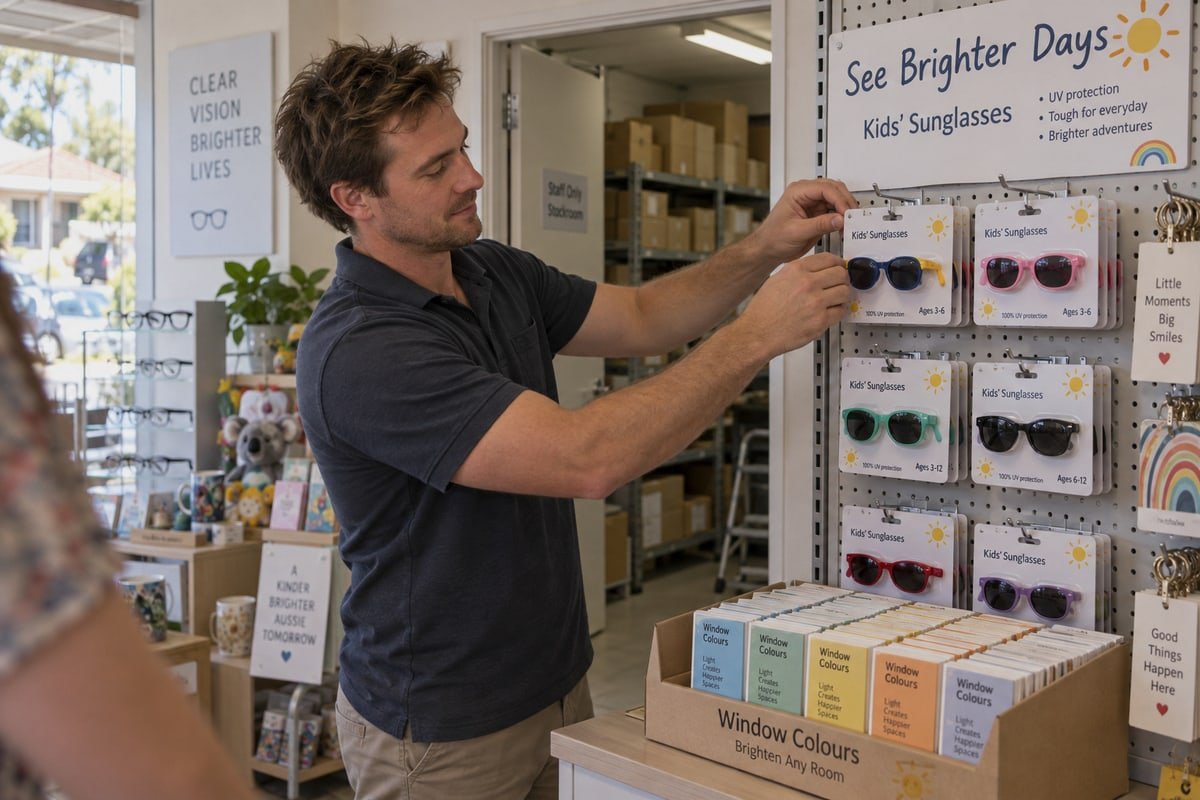
Retail display methods for TR90 kids sunglasses 1 often fail for one reason: the packaging was chosen after the fixture. On our Taizhou production line, we see the damage that causes.
The best retail display methods for TR90 kids sunglasses match the packaging type: hang-tag boxes and blister cards go on peg hooks, color boxes go in shelf-ready trays or countertop displays, hard cases suit premium gift shelves, and bulk packs belong only in the backroom.
That is the short answer. The longer answer depends on your channel, your fixture, and how much handling your stores can absorb. I will walk through each of those below, using what we see every week when we pack TR90 and TPEE frames for buyers in more than 20 countries.
How do I choose the right display packaging for TR90 kids sunglasses in my store?
A procurement manager in Australia once asked me for the cheapest display box. I asked her which fixture the store used first. She did not know yet.
Choose display packaging for TR90 kids sunglasses by working backward from three things: the sales channel, the fixture already on the shelf, and the handling model. Pre-packed retail units suit chain stores, while loose or bulk supply only fits samples and very low-cost channels.
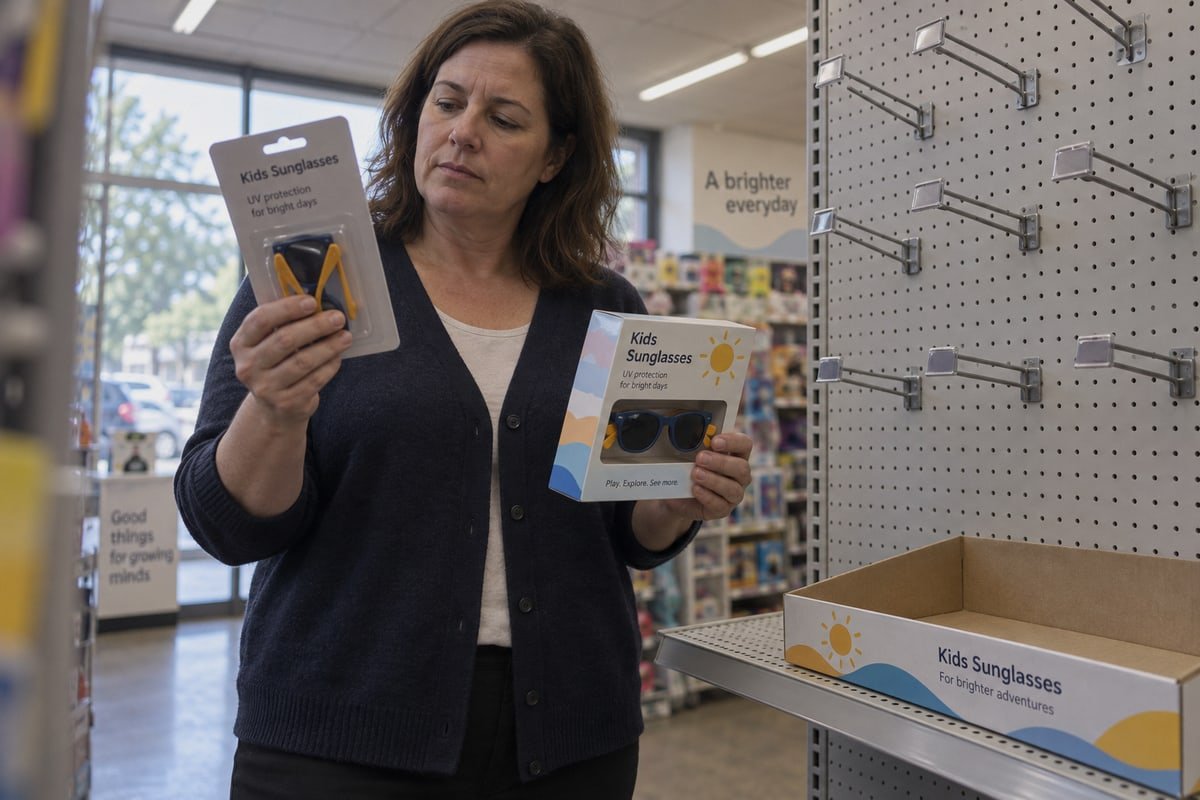
That conversation changed how we run our packaging briefs 2. Now we ask about the fixture before we quote the box. It sounds backward, but it saves buyers from re-packing a whole shipment in a warehouse.
Start with the channel, not the box
Different channels tolerate different amounts of labor. A supermarket or pharmacy chain wants the product to go from carton to shelf with almost no touching. A small boutique can afford to unbox and arrange frames by hand. An online seller shipping to an overseas warehouse cares most about the box surviving the journey. The packaging has to serve the channel first, and the display method follows from there.
The four supply formats we ship
In our experience, most TR90 kids sunglasses orders fall into one of four packout formats. Each one points to a different display method.
| Supply format | What the buyer receives | Best display method | 通常の使用 |
|---|---|---|---|
| Bulk, no retail packaging | Frames in OPP bags, 12 per inner box, about 300 per carton | Backroom storage or sample trays only | Samples, promotional programs, very low-cost channels |
| Product plus separate packaging | Frames and flat-packed boxes or pouches shipped apart | Assembled at the store or distributor, then shelf or hook | Distributors who add their own tags |
| Plastic-sealed retail pack | Blister card or sealed hang-tag pack | Peg hooks and vertical towers | Chain retail, sporting goods, travel retail |
| Individually boxed unit | Printed color box, often with insert and pouch | Shelf-ready trays, countertop displays, gift shelves | Brand programs, e-commerce, overseas warehousing |
Why TR90 changes the brief
TR90 is a flexible thermoplastic frame material. It bends instead of snapping, which is why we use it so heavily for active kids. It is also described as BPA-free, phthalate-free, hypoallergenic, and ISO 10993 biocompatibility certified. Those are strong claims for a parent to read at the shelf. But a loose frame in a bin says none of that. Only the packaging carries the message. So the more your positioning leans on safety and durability, the more you need a retail-ready format that can print the message where a parent will see it, next to the UV400 protection mark and the warning text.
What packaging types best showcase flexible TR90 frames without hiding their durability?
Every color box we print hides the one thing TR90 does best: bend. We weigh that trade-off on almost every OEM project.
Window color boxes, blister cards, and hang-tag boxes showcase flexible TR90 frames best because they keep the frame visible while carrying safety text and barcodes. Pair them with one unboxed demo frame so parents can feel the flexibility before they buy.
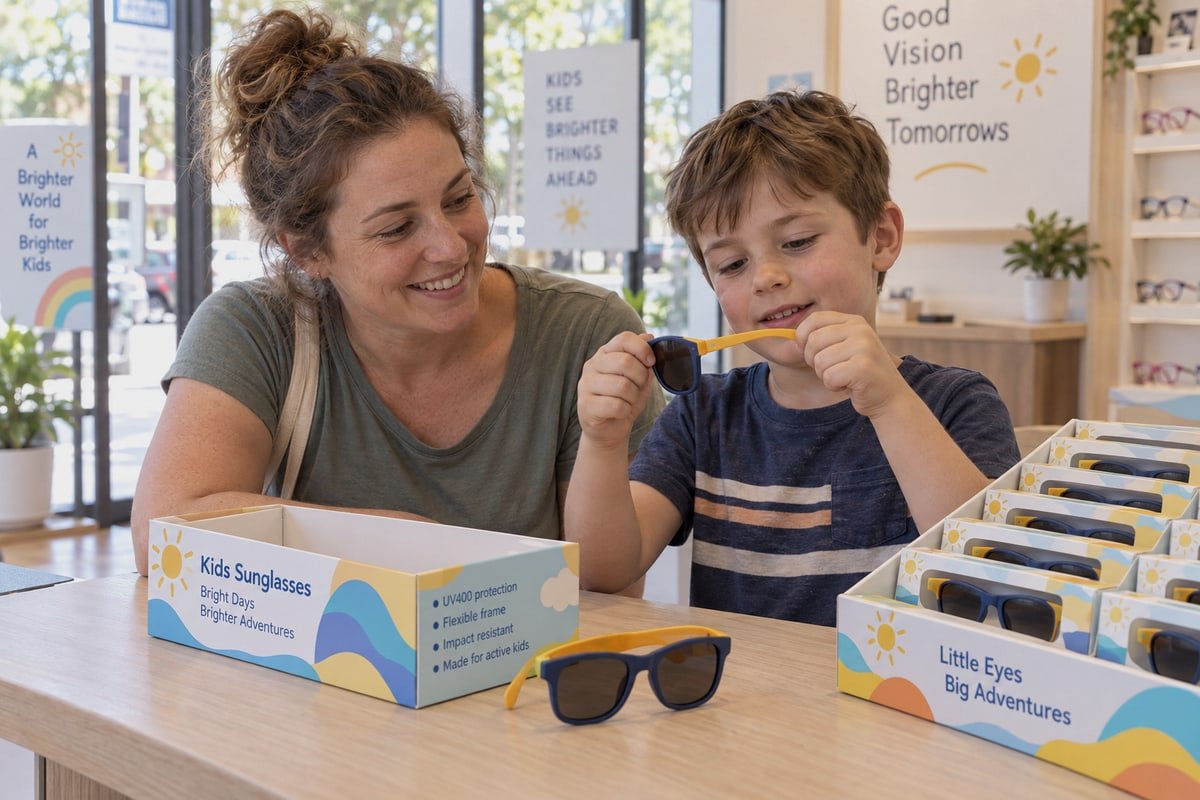
Visibility and protection pull in opposite directions. The more you wrap a frame, the safer it travels and the less a parent can see. Here is how the common packaging types compare when the goal is to show durability instead of hiding it.
| Packaging type | Frame visibility | Shipping protection | Perceived value | Unit cost and shelf space | Where it displays best |
|---|---|---|---|---|---|
| Window color box | 高い | 接触点に集中 | 高い | 中程度 | Shelf-ready tray, countertop, slatwall |
| Closed printed box with insert | None until opened | 非常に良い | 高い | Medium to high | Gift shelf, countertop, e-commerce |
| Blister card | 非常に高い | 接触点に集中 | 中程度 | 低 | Peg hooks, pegboard |
| Hang-tag box or sealed pack | 高い | 接触点に集中 | Medium to high | 低〜中程度 | Peg hooks, vertical towers |
| Microfiber drawstring pouch | 低 | 普通 | 中程度 | 低 | Countertop rotating racks, checkout |
| Hard case, including car-shaped kids' cases | None until opened | 素晴らしい | 非常に高い | 高い | Premium counter, gift zones |
| OPP polybag | High but cheap-looking | 普通 | 低 | 非常に低い | Backroom, samples |
Two objections I hear often
The first objection is cost. Hard cases and full-color printed boxes with inserts do raise unit cost and take more shelf footprint. For a discount or high-volume program, I usually recommend a color box or a hang-tag blister instead. You keep the safety message and the barcode without paying for a case that the shelf cannot fit.
The second objection is the opposite one. Some brand owners tell me blister cards 3 look less premium than a box-and-case system. They are right. A blister card is honest and secure, but it reads as value, not gift. If your line sells at a higher price point, a window box with a microfiber drawstring pouch inside gives you both the view and the gift feel. Eco-friendly packaging solutions, such as recycled board with a plant-based window film, also match the non-toxic story that TR90 already tells.
Let the material speak for itself
Packaging can only describe flexibility. A demo frame proves it. Some of the best point-of-purchase displays we have supplied include one unboxed sample on a tether, sometimes labeled as a small durability station. Parents bend the temple, feel how light it is, and then pick the boxed unit next to it. Our matte navy wraparound sport style, with its gradient impact-resistant lenses, works well for this because the curved temples show the flex clearly.
Which display fixtures keep kids sunglasses organized and appealing on my retail shelves?
During a pre-shipment check, our QC team found hang-tag holes punched slightly off center. On peg hooks, every box would have hung crooked.
Peg hooks and vertical towers keep hang-tag and blister packs organized, slatwall display hooks give boxed frames a clean gallery look, pre-packed trays suit chain stores, and countertop rotating racks drive impulse sales for pouches and slim boxes near checkout.
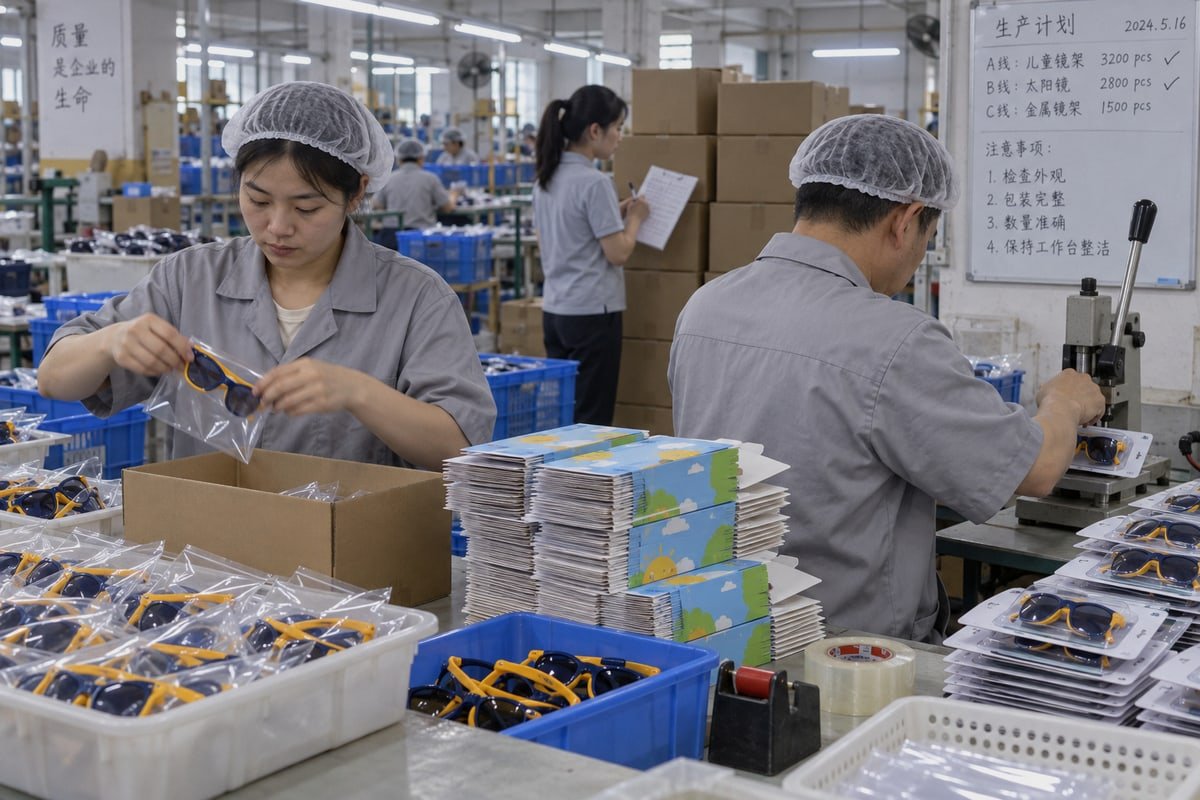
We caught that hole problem before the carton was sealed. It taught me that visual merchandising starts at the die line, not at the store. The fixture and the packaging have to be tested together. Below is how I match the two, by channel.
Fixture match by channel
| チャネル | Packaging type that fits | Fixture that fits | Why it works |
|---|---|---|---|
| Supermarket and pharmacy chains | Color box, hang-tag box, blister card, barcode-ready | Pre-packed tray or PDQ-style shelf-ready carton, peg hooks | Fixed assortment ratio, scannable barcode, minimal store handling |
| Sporting goods and travel retail | Hang-tag pack, compact case, sealed multipack | Floor-standing vertical tower with adjustable hooks, slatwall display hooks | Hooks accept varied pack sizes and keep products at a child's eye level |
| Gift shops and boutiques | Window box, hard case, branded pouch | Slatwall or grid-wall gallery, countertop rotating racks | Clean spacing signals premium value and encourages browsing |
| Marketplace or warehouse club | Individually boxed unit or sealed multipack | Shelf-ready carton on pallet or shelf | Survives long-distance shipping and needs no repacking |
Keeping the fixture organized
Peg hooks are the workhorse. They hold blister cards and hang-tag boxes in tidy columns, and they keep bundled accessories, like microfiber cloths or neck straps, from separating on the shelf. Vertical towers with adjustable hooks add flexibility when your range mixes a slim wayfarer box and a thicker sport pack. Slatwall display hooks work best for boxed frames when you want a gallery look with even spacing.
For trays, the chain retail checks we run before rollout are simple. We confirm barcode scanability 4, hanger fit, label placement, warning visibility, and the assortment ratio inside each tray. If a tray holds twelve units, the mix of styles and colors is fixed at the factory, so the store never sorts. That matches our standard inner box of 12 pieces, with about 300 pieces per carton.
Making it appealing to a child and a parent
Brightly colored, character-themed acrylic headers pull a child's eye toward the flexible TR90 line and away from standard plastic frames. Modular corrugated cardboard displays do the same job at lower cost and echo the eco-friendly message. Some buyers now add a QR code in the header for a virtual try-on, which bridges the physical box and the phone. And I like the adventure kit idea a lot. Placing our glossy black retro oval and the navy-and-orange wayfarer beside kids' hats and water bottles sells more than an isolated eyewear rack.
Can custom packaging designs help my brand stand out while protecting TR90 sunglasses?
We learned this lesson the hard way: a beautiful printed box that crushes in the carton is worse than a plain one. Now we test the packout first.
Yes. Custom packaging helps a brand stand out when the design and the protection are planned together: printed color boxes with inserts, branded microfiber pouches, and warning inserts add value, while inner boxes and carton counts protect TR90 frames from factory to fixture.
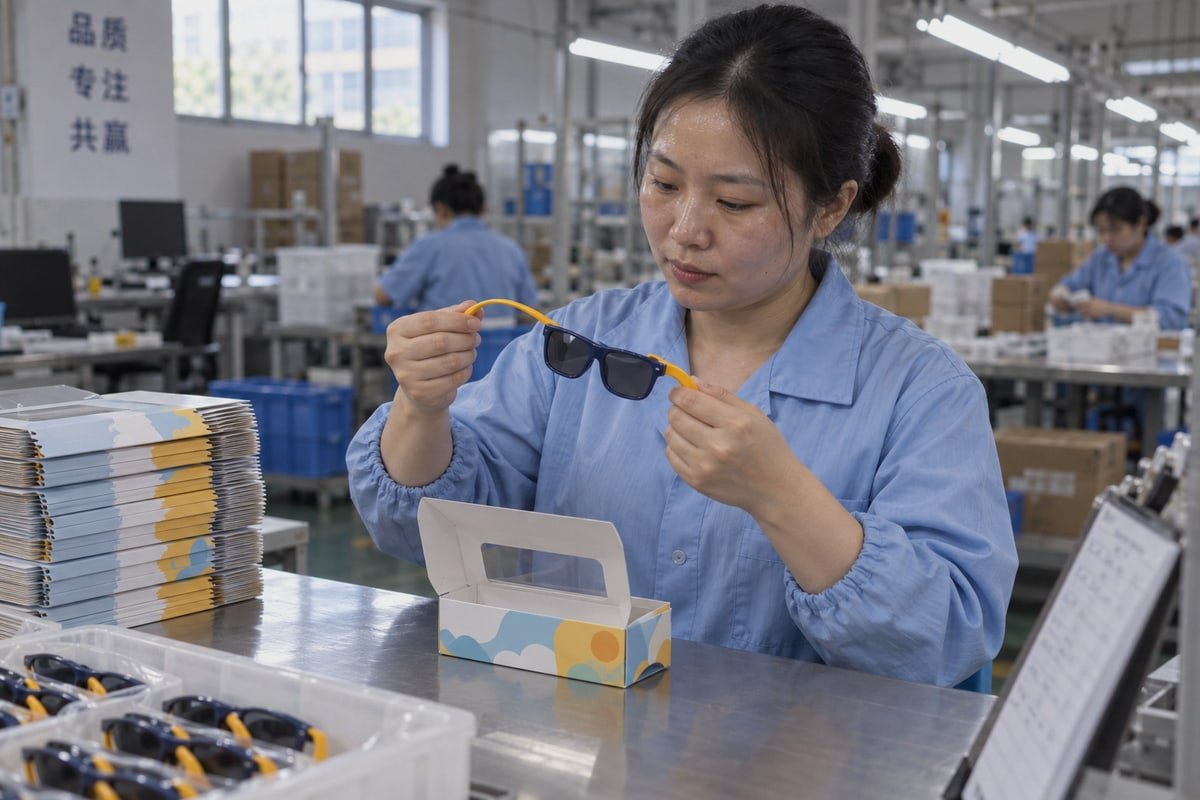
Since that crushed-box order, every custom packaging project at our factory runs through a fixed process. It is not complicated, but the order of the steps matters. Design comes last, not first.
How we build a custom packaging program
- Confirm the channel and fixture. We ask for a photo of the shelf or hook if the buyer has one. That decides box shape, hang-hole position, and tray count.
- Choose the style from our existing range. With around 800 styles already tooled, a new brand can pick frames, colors, and lenses without paying for a mold. That lowers launch risk and keeps budget for packaging.
- Set the accessory bundle. Common programs are a microfiber drawstring pouch with a cleaning cloth and store tag, or a color box with a glasses bag and a lens test card.
- Print the message that matters. For kids, that means the UV400 protection mark, polarized lens technology where fitted, the material safety statement, the warning insert, and the market-specific label.
- Test the packout before artwork approval. We drop, stack, and shake the inner box and carton. Then we check barcode scanability, hang fit, warning text visibility, and packaging durability on the real fixture.
Where custom design earns its cost
Custom packaging is not decoration. It does three jobs at once. It protects impact-resistant lenses and flexible temples 5 through shipping. It tells a parent, in under five seconds, that the frame is safe and durable. And it fits the fixture without help from store staff. When a box does all three, the brand stands out because the shelf looks intentional. Eco-friendly packaging solutions, like recycled kraft board and soy inks, strengthen that impression for buyers in Europe, Japan, and Australia, where parents read the box closely.
I will be honest about the trade-off. A full-color box with an insert costs more than a blister. But it also opens gift shelves and premium counters that a blister never reaches. For most brand programs we support, the extra unit cost is small compared to the price gap between a value peg and a gift shelf.
結論
Loose display wastes TR90's safety story. Mismatched packaging wastes your fixture. Plan both together, and retail display methods for TR90 kids sunglasses become a strength.
Interested in sourcing the products mentioned in this article? See details and request a quote here:
脚注
1. ISO provides the international standards for materials like TR90 used in eyewear manufacturing. ↩︎
2. Overview of the packaging design process and its role in retail and logistics. ↩︎
3. Technical definition and retail application of blister card packaging systems. ↩︎
4. GS1 is the global authority on barcode standards and retail scanability requirements. ↩︎
5. Scientific explanation of thermoplastic properties that allow for flexible eyewear components. ↩︎
 English
  Español de México
  Deutsch
  Français
  日本語
日本語  العربية
  Português do Brasil