What Do TR90 Kids’ Sunglasses Markings Mean, and Which Matter Most?
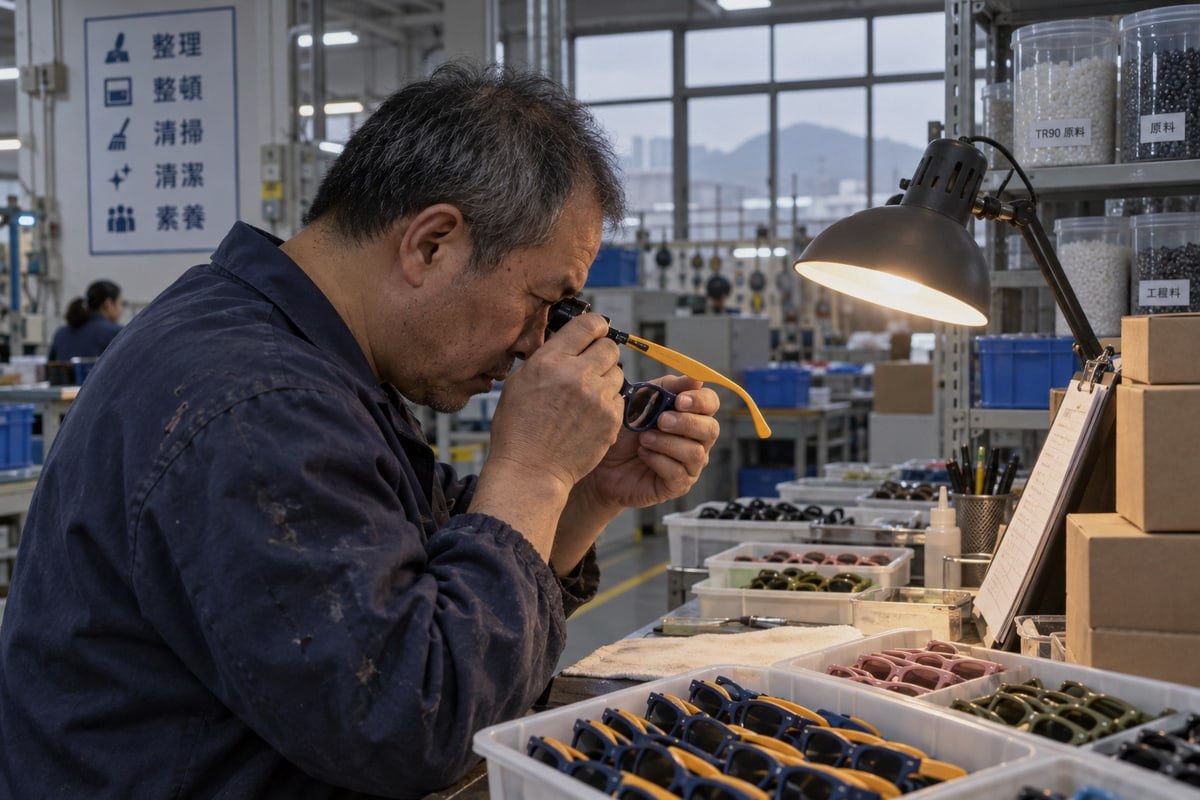
Every week, buyers send us photos of TR90 kids’ sunglasses markings and ask what they mean. Misread one, and your brand ships unsafe lenses. Our Taizhou factory decodes them daily.
TR90 kids’ sunglasses markings identify the frame material (TR90), lens protection (UV400), filter category (0–4), fit dimensions (e.g., 46-16-125), and compliance (CE, UKCA, FDA). UV400 protection matters most for eye safety, followed by fit numbers, then verified frame material and certification.
That is the short answer. The longer answer is where brands win or lose. A frame stamp tells you about comfort and durability. A lens marking tells you about eye safety. Buyers often confuse the two. Below, I walk through each marking, rank them by importance, and show you how to check them before you order.
How Can I Tell If My TR90 Kids' Sunglasses Meet Real UV400 Safety Standards?
On our lens inspection bench, we check incoming lens batches with a UV transmittance meter before assembly. One mislabeled batch years ago taught us never to trust a sticker alone.
A genuine UV400 marking means lenses block 99–100% of UVA and UVB rays up to 400 nanometers. Confirm it with a UV transmittance test report referencing the ISO 12312-1 standard, not just a sticker, and check the filter category (ideally Category 3) for bright outdoor use.

The UV400 stamp is the single most important marking on any pair of children's sunglasses. Yet it is also the easiest one to fake. A sticker costs almost nothing. A tested lens costs more. So you need to understand what the marking claims, and how to confirm it.
What UV400 Actually Measures
UV400 refers to wavelength. It means the lens filters ultraviolet light 1 up to 400 nanometers. That range covers UVA and UVB, the two types that reach a child's eye and damage it over time. A child's lens is clearer than an adult's, so more UV reaches the retina. This is why we treat UV400 protection as non-negotiable on every kids' style we produce, whether the frame is TR90, TPEE, or a TR90 front with TPEE temples.
Note that UV400 is a lens property. It has nothing to do with tint darkness. A very dark lens with no UV filter is worse than no sunglasses at all. The pupil opens wider behind the dark tint, and more UV gets in. I have seen samples from trading companies with deep black lenses and zero UV blocking. They looked great. They were dangerous.
Filter Category: The Second Lens Number
Alongside UV400, look for a filter category marking. It runs from 0 to 4 and describes 可視光線透過率 2, not UV. Here is how we explain it to buyers:
| フィルターカテゴリ | Visible Light Transmitted | 一般的な用途 | Suitable for Kids' Everyday Sun Wear? |
|---|---|---|---|
| 0 | 80–100% | 明るい日差し(ほとんどの子供用サングラス) | いいえ |
| 1 | 43–80% | Low light, overcast | 限定的 |
| 2 | 18–43% | いいえ — 運転には使用できません | 許容できる |
| 3 | 8–18% | Bright sun, beach, snow | Yes, the ideal standard |
| 4 | 3–8% | Extreme glare, high altitude | No, not for driving or general use |
Category 3 lenses are what we recommend for most children's sunglasses sold in Australia, Southern Europe, and Japan. The gradient gray lens on our matte navy wraparound style, for example, sits in Category 3 while keeping the lower edge slightly lighter for close-range vision.
Polarized Is Not the Same as UV Protection
Polarized lens technology reduces glare from horizontal surfaces such as water and roads. It is a real benefit for active kids. But a "P" or "Polarized" marking does not mean UV400. The two are separate filters. We offer both UV400 and polarized lens options, and we always mark them separately so your packaging can state each claim honestly.
How to Confirm the Claim
Ask for a test report that measures UV transmittance against the ISO 12312-1 3 standard. The report should show the transmittance curve, the tested wavelength range, and the lab name. Then spot-check samples with a handheld UV meter. If the supplier cannot provide the report, the marking is just ink.
Which Markings Should I Check to Confirm Genuine TR90 and TPEE Materials?
We weigh one trade-off constantly: a stiffer TR90 front holds lens shape better, but a TPEE temple survives a toddler's twisting far longer. Markings should tell you which is which.
Check the inner temple for a TR90 or TPEE stamp, a Bio-TR90 or G850 mark if bio-based, frame dimensions like 46-16-125, and a weight under about 20 grams. Then verify with a bend-and-recover test and a material data sheet, since "TR90-style" plastic is often mislabeled.
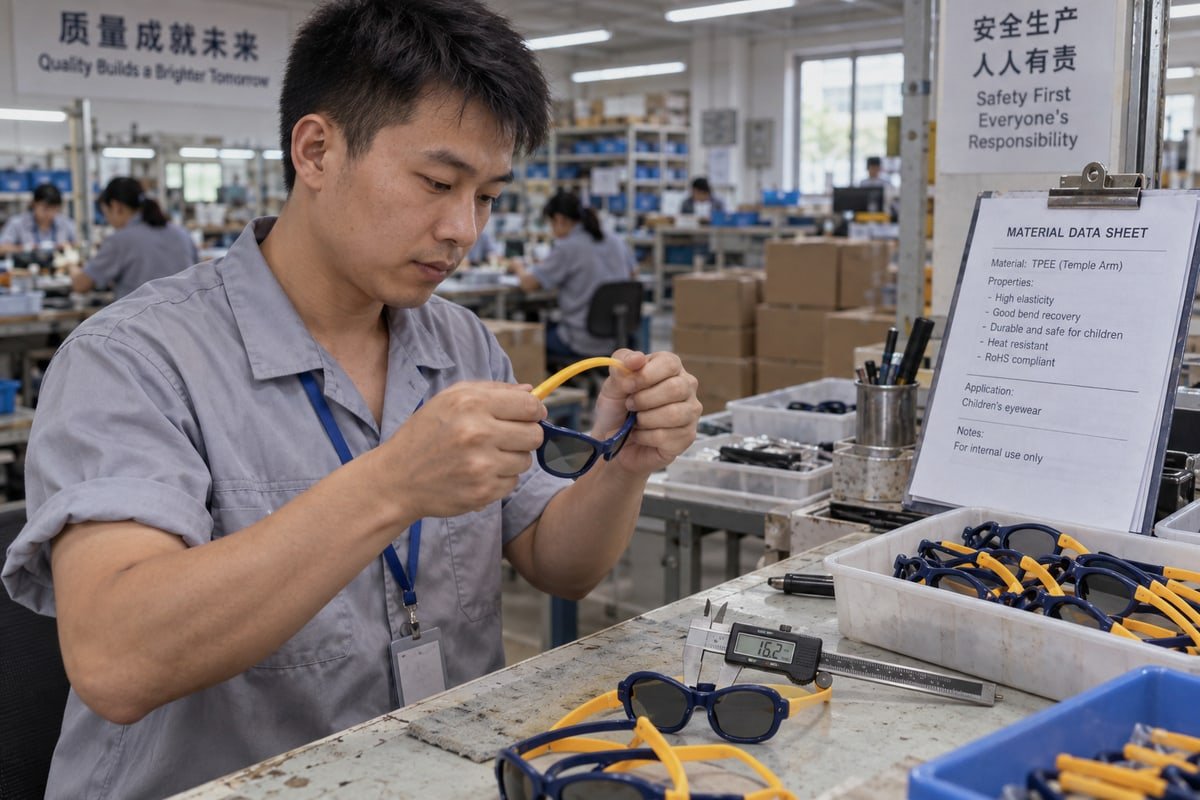
TR90 is a thermoplastic material from the polyamide family. Many suppliers call it a Swiss-developed flexible memory polymer. The nickname fits. It bends, twists, and springs back to shape. TPEE is a thermoplastic polyester elastomer. It is even softer and more rubber-like. Our best-selling kids' construction pairs a TR90 front with TPEE temples, because each material does the job it is best at.
TR90 vs. TPEE: What the Marking Tells You
| 特徴 | TR90 | TPEE |
|---|---|---|
| Material family | Thermoplastic polyamide (nylon) | 熱可塑性ポリエステルエラストマー |
| 柔らかく、ゴムのような、非常に柔軟 | Firm but flexible, structured | Soft, rubbery, very bendable |
| 耐衝撃性 | High, resists cracking on drops | Very high, nearly impossible to snap |
| Memory recovery | Returns to shape after bending | Returns to shape after extreme twisting |
| Typical weight (kids' frame) | Often under 20 grams | Similar or lighter |
| テンプル、フルフレックスベビーフレーム | Frame fronts, older children 3–12+ | Temples, toddler and baby styles |
| Heat sensitivity | Can deform in a hot car | More heat tolerant |
The stamp on the inner arm near the hinge is your first clue. On our navy and yellow-orange dual-tone style, that etched text sits right where a parent or inspector can read it. A real TR90 frame will carry the material name. A generic plastic frame usually carries nothing, or a vague "PC" or "plastic" mark.
Reading the Frame Dimensions
Next to the material stamp you will often see three numbers, such as 46-16-125. These are the frame dimensions in millimeters: lens width, bridge width, and temple length. For children's eyewear, these numbers matter more than on adult frames. A bridge that is too wide slides down a small nose. A temple length that is too long lets the frame flop forward. We size our 800 existing styles across age bands, and we give buyers the full dimension set so they can match a style to a target age group without guessing.
Newer Marks You May See
Bio-TR90 or G850 markings point to castor-oil-based polymers. These are non-petroleum options that some premium European brands now request. AF or O marks on the inner lens indicate anti-fog or oleophobic coatings, which are useful on sport styles. A small laser-etched QR code on the inner temple is also becoming common. It links to authenticity and warranty pages.
The Markings You Will Rarely See but Should Ask About
BPA-free frames and hypoallergenic properties are rarely stamped, but they are critical for toddlers who chew on their glasses. Good TR90 and TPEE are inherently BPA-free. Ask your supplier for the raw material data sheet to confirm it. We keep those sheets on file for every resin grade we run.
The Five-Second Bend Test
Here is what I do on the factory floor. I twist the temple through a full 90 degrees, hold it, and release. Genuine TR90 or TPEE returns flat with no white stress mark. Cheap plastic either snaps or stays warped. That test is not a lab certificate, but it catches most "TR90-style" imitations before they reach your shelf.
Do CE and FDA Markings Actually Guarantee Safety for My Children's Eyewear Line?
A procurement manager from Melbourne once asked me why a CE mark alone wouldn't satisfy her Australian retailer. That conversation reshaped how we explain compliance to every buyer.
No. CE marking is a manufacturer's self-declaration of conformity to EU standards, and FDA marking mainly signals US impact-resistance and registration requirements. Neither replaces a third-party test report. Real safety comes from documented testing to ISO 12312-1, verified materials, and consistent factory quality control.
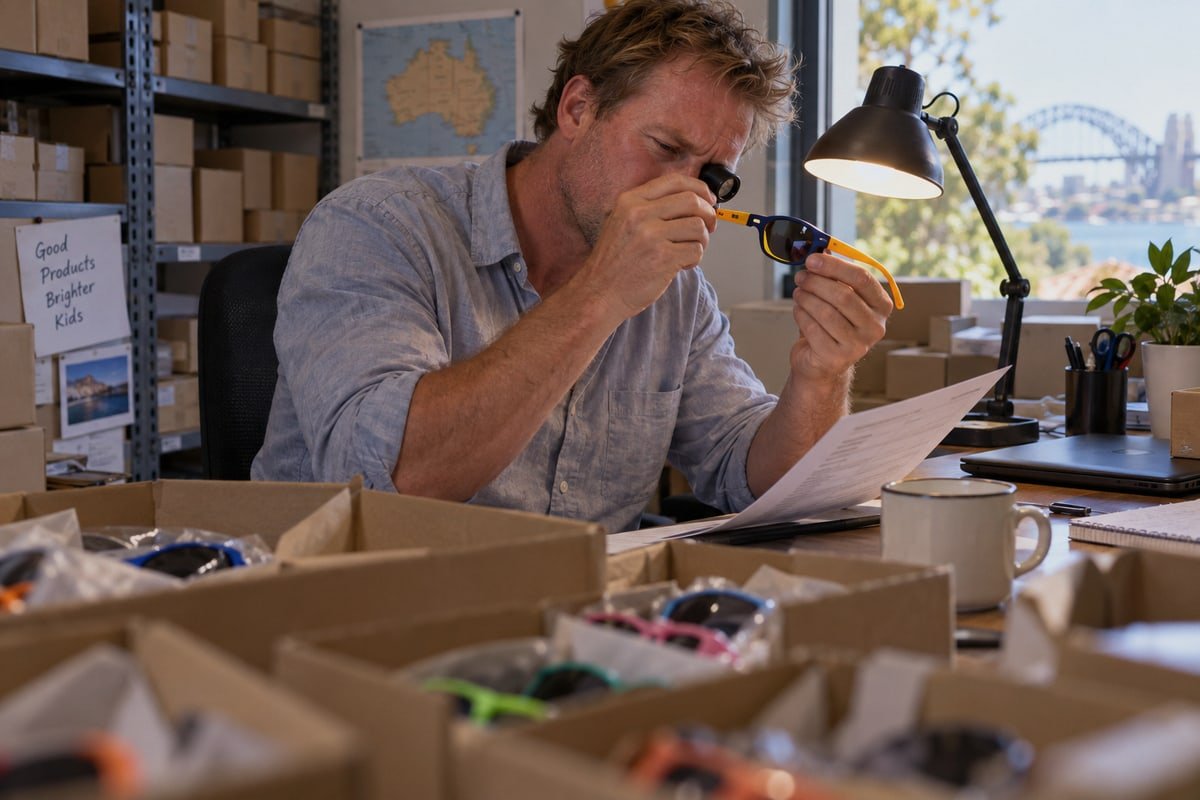
Compliance marks are useful. They tell you which legal framework a product was made for. But they are not safety guarantees, and each one means something different depending on the market. Let me break down the marks that buyers ask about most.
What Each Mark Really Means
| マーク | 地域 | What It Claims | Who Verifies It | What It Does Not Prove |
|---|---|---|---|---|
| CE | 欧州連合 | Product meets EU health, safety, and environmental requirements (sunglasses fall under PPE rules) | Manufacturer self-declares, backed by a technical file | That an independent body tested this batch |
| UKCA | イギリス | UK equivalent of CE after Brexit | Manufacturer self-declares | Same as CE |
| FDA | アメリカ合衆国 | Sunglasses are regulated as medical devices; lenses must pass a drop-ball impact test | Manufacturer or importer must comply and register | That the FDA "approved" the product (it does not approve sunglasses) |
| ISO 12312-1 | 国際的 | The technical standard for UV transmittance, filter category, and optical quality | Accredited test lab issues a report | Nothing on its own; the report is the proof |
| AS/NZS 1067 | オーストラリア / ニュージーランド | Mandatory sunglass standard with its own lens categories | Test lab report required for retail | Not covered by a CE mark alone |
Why CE Marking Is Not a Test Certificate
CE marking is a legal statement 4 by the manufacturer. It says, "We have checked this product against the relevant EU standard." For sunglasses, that standard is ISO 12312-1, referenced under the PPE Regulation. The mark itself proves only that someone made the declaration. It does not tell you whether the declaration is honest. That is why we always supply the Declaration of Conformity together with the underlying lab test report. One without the other is incomplete.
Why "FDA Approved" Is a Warning Sign
The FDA does not approve sunglasses. It regulates them, mainly through an impact resistance requirement for lenses and facility registration for manufacturers or importers. When a supplier writes "FDA approved" on a product page, that is either careless language or a deliberate overstatement. Either way, treat it as a reason to ask more questions.
Marketing Words vs. Verifiable Markings
Some product listings use words like "unbreakable" or "skin-safe." Those are not markings. They are claims. A marking references a standard or a measurable property. A claim references nothing. In my experience exporting to 20+ countries, the buyers who stay with us longest are the ones who learned to separate the two early.
What Our Factory Does Instead
We do not ask buyers to trust a mark. We provide the lab report for UV transmittance, the impact test result for the lens grade used, the resin data sheets for TR90 and TPEE, and a signed Declaration of Conformity. Then we hold every production run to the same specifications under our 5S-managed workshop system. The mark is the last step, not the first.
How Do I Verify a Supplier's Marking Claims Before Placing a Bulk Order?
The hardest lesson from fifteen years on the factory floor is simple: a marking is only as honest as the paperwork behind it. We built our verification process around documents.
Request third-party test reports for UV400 and impact resistance, material data sheets for TR90 and TPEE, a signed Declaration of Conformity, and pre-production samples. Test samples yourself with a UV meter and bend test, then audit the factory, and lock specifications into a written purchase agreement.
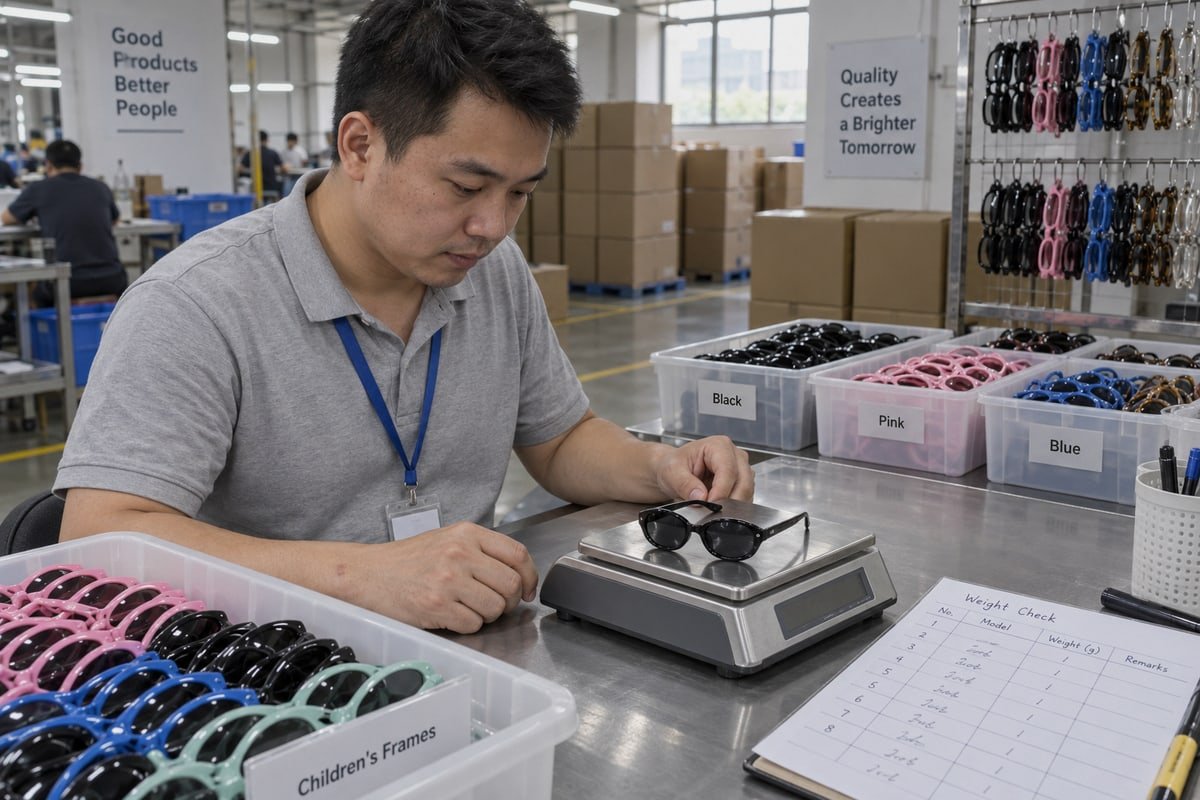
Verification is not about distrust. It is about building a repeatable process so that the tenth container matches the first sample. Here is the sequence we recommend to brands launching their first children's eyewear line.
A Six-Step Verification Process
-
Request the document set before sampling. Ask for the UV transmittance report to ISO 12312-1, the impact test result for the lens material, and the raw material data sheets for the frame and temples. A real factory has these on file. A trading company has to go and ask someone.
-
Match the report to the product. Check that the lens code, tint, and category on the report match the sample you were sent. We have seen reports for a Category 2 lens attached to a Category 3 product. That is a mismatch, not a certificate.
-
Test the sample yourself. Use a handheld UV meter on the lenses. Do the 90-degree temple bend test. Weigh the frame. Measure the frame dimensions and compare them to the stamp. If the temple length is marked 125 mm and measures 118 mm, ask why.
-
Scan the QR code if there is one. A laser-etched QR code on the inner temple should lead to a live page with the model number and warranty information. A dead link tells you the "authenticity" feature is decoration.
-
Audit the factory, in person or by video. Ask to see the injection molding line, the lens inspection station, and the packing area. Our 120-person workshop runs on a 5S system, so a buyer can see the material bins labeled by resin grade and the inspection records for each batch.
-
Write the markings into the purchase agreement. Specify UV400, filter category, material grade, dimensions, and required markings on frame and packaging. Attach the approved sample. That way, a marking is a contract term, not a hope.
レッドフラッグとグリーンフラッグ
| What You See | Red Flag or Green Flag | 理由 |
|---|---|---|
| "UV400" sticker but no test report | Red | The sticker is unverified ink |
| Test report with lab name, date, and lens code | Green | Traceable and repeatable |
| "FDA approved" on a product page | Red | Inaccurate claim; suggests weak compliance knowledge |
| Declaration of Conformity plus ISO 12312-1 report | Green | Full CE marking documentation |
| Frame marked TR90 but stays bent after twisting | Red | Likely generic plastic |
| Resin data sheet showing polyamide grade, BPA-free | Green | Material claim is backed |
| Supplier cannot say where the lenses come from | Red | No control over the most important safety component |
| Factory shows lens inspection station on video | Green | Quality control exists at the source |
Why Existing Styles Reduce Your Risk
One more point from experience. New brands often assume they need custom molds to launch. That means heavy tooling costs before a single marking has been verified. We keep roughly 800 existing styles, each already dimensioned, sampled, and documented. A buyer can test the market with a proven frame, add custom colors, logos, lenses, and packaging through our OEM/ODM service, and move to a custom mold only after the product sells. It is a lower-risk way to launch, and it means the marking documentation already exists before you order.
結論
Misread markings put children's eyes and your brand at risk. Decode UV400, fit, material, and compliance in that order, verify every claim, and partner with a factory that documents it.
Interested in sourcing the products mentioned in this article? See details and request a quote here:
脚注
1. EPA explanation of ultraviolet radiation and its measurement. ↩︎
2. Wikipedia overview of sunglasses including light transmission categories. ↩︎
3. Official ISO page for the international sunglasses safety standard. ↩︎
4. Official EU page explaining the legal framework for CE marking. ↩︎


 English
  Español de México
  Deutsch
  Français
  日本語
日本語  العربية
  Português do Brasil