What Age Categories Exist for Kids’ Eyewear, and How Do Infant vs School-Age Styles Differ?
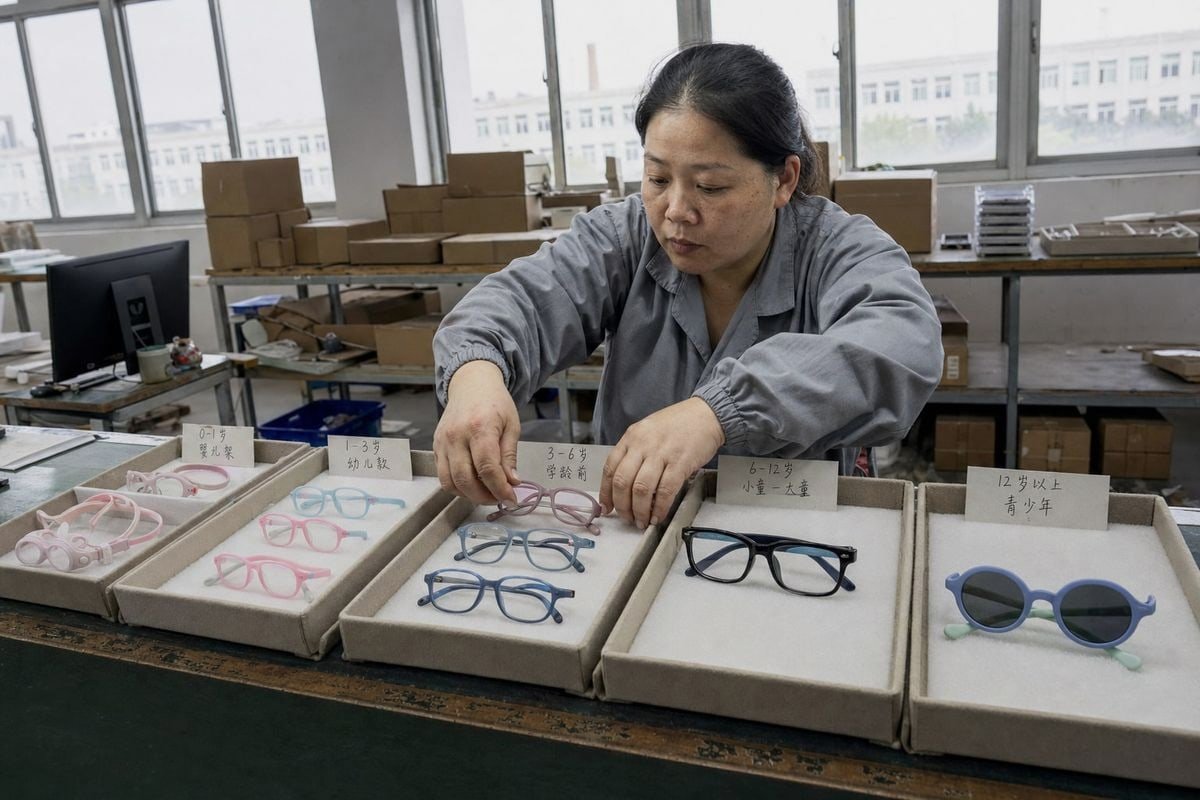
Age categories for kids’ eyewear confuse many buyers who visit our Taizhou factory. Order the wrong size band, and a whole container of frames simply won’t sell.
Kids’ eyewear age categories typically include infants (0–2), toddlers (2–4), preschoolers (4–6), school-age children (6–10), and tweens (10–13). Infant styles prioritize soft flexible materials, straps, and hinge-free retention, while school-age styles emphasize durability, standard temples, and fashion-forward designs.
Those labels are only the starting point. Below, I break down sizing, materials, flexibility, and lens choices for each age group, so you can build a range that actually fits.
How do I choose the right eyewear size and fit for each children's age group?
A buyer from Australia once asked us why her "toddler" frames kept sliding off two-year-olds. The answer was simple: she had picked frames by age label, not by measurement. Our team re-specced her whole line using bridge fit data.
Choose kids' eyewear by frame measurements, not age labels alone. Match lens width to the age band — roughly 35–39 mm for infants, 40–44 mm for toddlers, 43–47 mm for school-age kids, and 47–52 mm for tweens — then verify bridge fit and temple length.
Age categories for kids' eyewear are really shorthand for average head dimensions. Retailers band children into groups like 0–2, 2–4, 4–6, 6–10, and 10–13. But those bands are not standardized. One store's "big kids" overlaps another store's "juniors." So when brands tell me they want to organize purely by age, I push back gently. Age labels are great for browsing. Measurements are what make glasses stay on a face.
The three measurements that matter
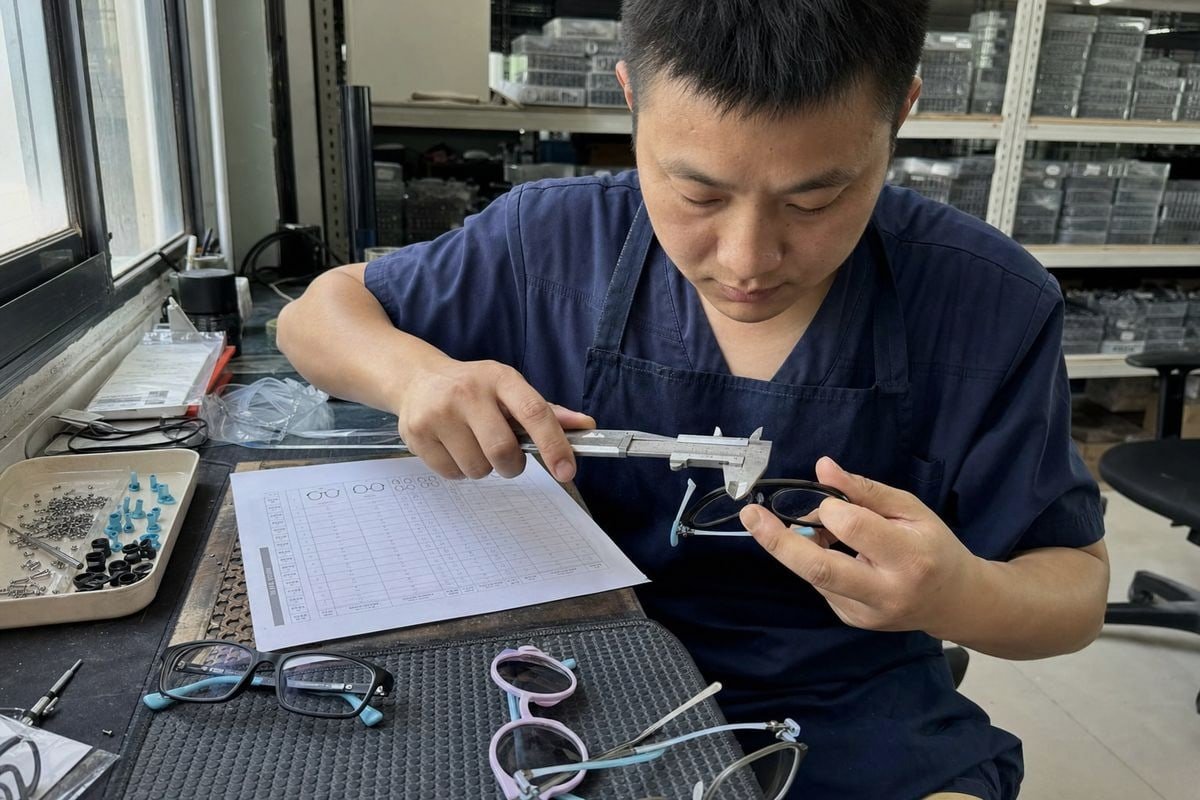
Every frame has three key numbers: lens width, bridge width, and temple length. For children, bridge fit is the most critical. Kids have low, soft nasal bridges — especially under age four. A bridge that is too wide lets the frame slide down, which pushes the child to look over the lenses. That defeats the entire optical purpose, particularly for myopia management programs where consistent wear matters.
A practical sizing reference
| Age category | Typical age band | レンズ幅 | Key fit priority |
|---|---|---|---|
| Infant | 0–2 years | 35–39 mm | Saddle bridge, strap retention |
| トドラー | 2–4 years | 40–44 mm | Low bridge fit, short temples |
| Preschool | 4–6 years | 42–45 mm | Stable bridge, light weight |
| School-age | 6–10 years | 45–48 mm | Standard temples, durability |
| Tween | 10–13 years | 47–52 mm | Adult-like proportions, style |
In our sampling process, we always ask buyers for their target market's demographics first. Head sizes vary widely within the same age band, so we recommend offering at least two sizes per category. We also encourage brands to coordinate with optical partners, since pediatric eye exams often reveal that a child needs a smaller or larger frame than their age suggests.
What materials and safety features should I prioritize for infants versus school-age kids?
Material selection is where we spend the most engineering hours at our workshop. Fifteen years of building children's frames taught us one rule: an infant frame and a school-age frame are almost different product categories.
For infants, prioritize hinge-free, soft flexible silicone frames or TPEE with no small parts, saddle bridges, and adjustable head straps. For school-age kids, prioritize impact-resistant TR90 memory plastic, spring hinges, polycarbonate lenses, and hypoallergenic, BPA-free finishes that survive daily classroom wear.
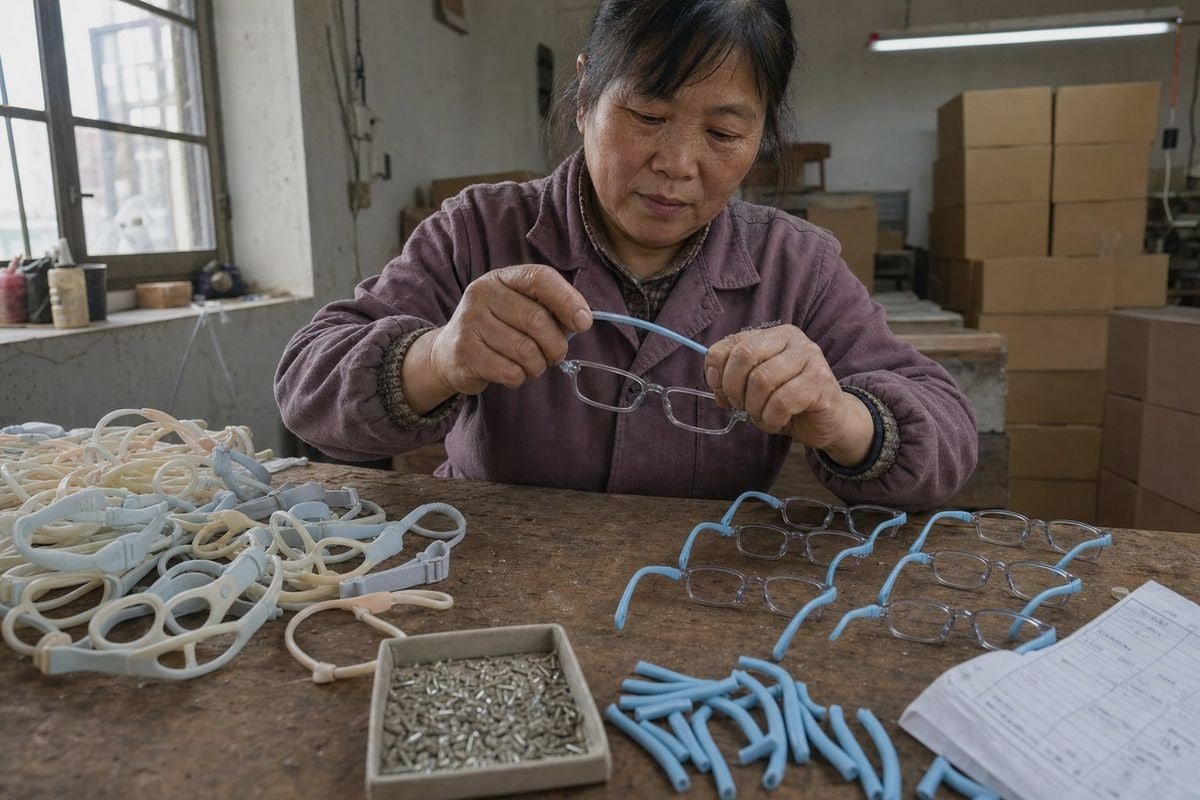
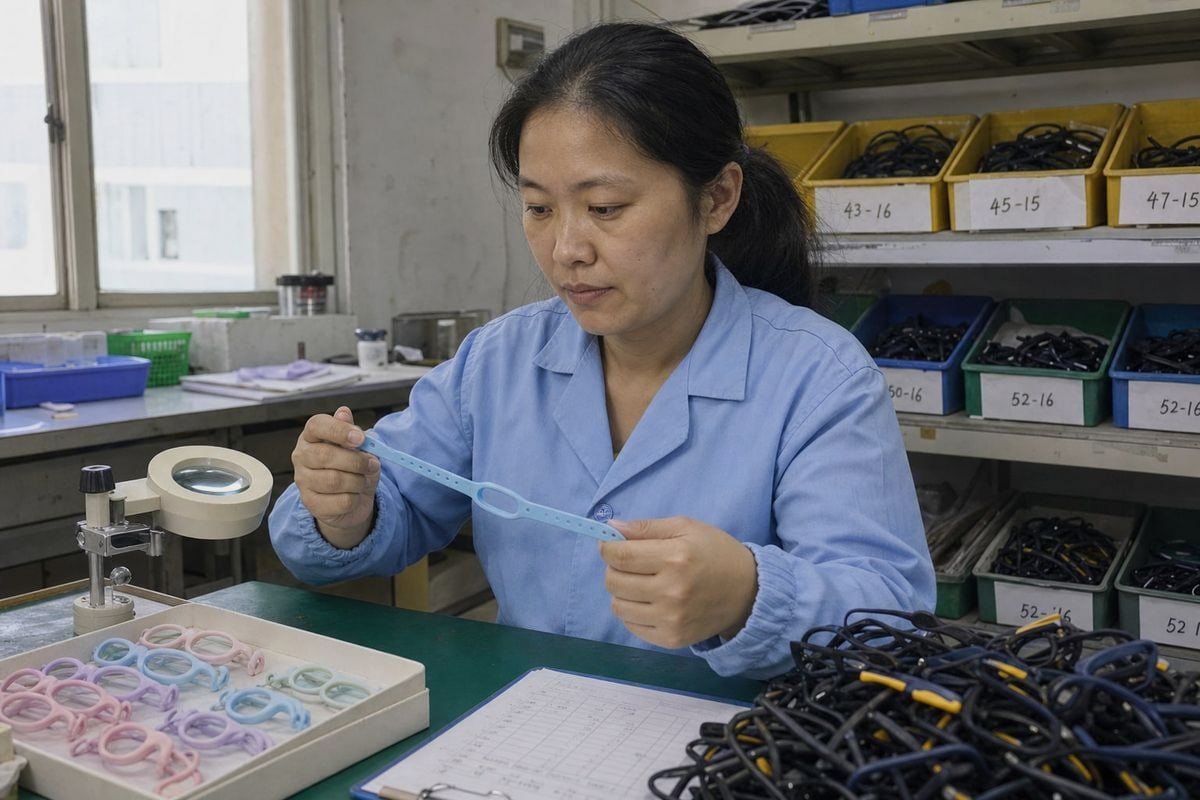
Infants explore the world with their hands and mouths. So the first safety question for baby eyewear is not impact resistance — it is small parts. A traditional hinge uses tiny screws. Screws can loosen. A loose screw near a baby is a hazard. That is why quality infant frames use hinge-free, one-piece constructions in soft, food-grade-adjacent materials. On our production line, infant styles skip metal hardware entirely wherever possible.
School-age children present the opposite challenge. Their frames get stuffed into backpacks, sat on, and dropped on playgrounds. Here, TR90 memory plastic 1 earns its reputation. It flexes under stress and returns to shape. We pair TR90 fronts with TPEE temples on many of our roughly 800 existing styles, because the combination gives structural stability at the front and forgiving softness where the frame touches skin.
Safety checklist by age
| Safety feature | Infants (0–2) | School-age (6–10) |
|---|---|---|
| Hinge type | Hinge-free or covered | テンプルが頭に対して剛性に押し付けられるのではなく、外側に曲がるようにすることで快適さを向上させます。TPEEは、1つのヒンジポイントではなく、アーム全体にわたって素材自体を通じて同様の効果を達成します。一部のスタイルでは、両方を組み合わせています。その結果、座られたり、片手で引っ張られたり、バックパックに詰め込まれたりしても耐えられる、ぴったりとした、許容範囲の広いグリップが得られます。 2 |
| Small parts | None allowed | Minimized, secured |
| フレーム素材 | Soft silicone / TPEE | TR90 memory plastic |
| Retention | Adjustable head straps | Standard temples, grip tips |
| Lens standard | Polycarbonate, shatter-resistant | Polycarbonate or Trivex |
| Skin contact | Ultra-soft, non-irritating | Hypoallergenic, sweat-resistant |
One objection I hear from buyers: "Soft materials sound flimsy — won't parents see them as cheap?" The opposite is true when you communicate it well. Flexibility in children's eyewear is a deliberate safety engineering choice, not a cost-cutting one. A frame that bends instead of snapping cannot leave a sharp broken edge near a child's eye. We also see growing interest in antimicrobial coatings for school-age frames, since classrooms are high-contact environments. Environmentally friendly material sourcing rounds out the safety story for modern parents.
How can I match frame flexibility and durability to my target age category's activity level?
There is a trade-off we weigh on every new development project: the softer a frame, the safer it feels, but the less it holds an optical lens in precise alignment. Getting that balance right for each age group is the core of our OEM work.
Match flexibility to activity: infants need maximum softness with strap retention since they pull at frames; toddlers and preschoolers need full-flex frames that survive twisting; school-age kids need semi-flexible TR90 with spring hinges; active tweens benefit from sporty wraparound durability.
Activity level changes everything about how a frame fails. A baby does not drop glasses from a bicycle. A ten-year-old does not chew on temple tips. So durability must be defined per age category, not as one universal spec.
Infants and toddlers: survive the twist
Small children grab their glasses and twist them in ways adults never would. During our QC process, we twist-test flexible frames far beyond normal wearing angles, because that is exactly what a toddler will do on day one. Full-flex TPEE constructions handle this abuse. Adjustable head straps keep the frame on during tantrums and naps. Textured silicone temple tips 3 — like the embossed grip patterns we mold into several of our optical styles — stop frames from sliding during floor play.
Preschool to school-age: survive the drop
Once children start school, the failure mode shifts from twisting to impact and crushing. This is where spring hinges matter. They let temples flex outward when a child yanks the glasses off with one hand, which is how most kids remove them. TR90 fronts absorb drops onto hard classroom floors. We advise buyers targeting this segment to spec reinforced hinge zones, because that joint takes the most daily stress.
Active tweens: survive the sport
For sport-focused lines, wraparound shield designs in matte polycarbonate offer coverage and stay put during running, cycling, or skiing. The oversized single-lens format protects a wide field of view and shrugs off scratches from gravel and gear.
Here is a simple decision path I share with new brand buyers:
- Define the child's dominant activity: mouthing and grabbing, classroom wear, or sport.
- Pick the flex level: full-flex for under 4, semi-flex for 6–10, structured sport frames for active tweens.
- Choose the retention method that matches: strap, grip tips, or wraparound temples.
- Test samples with real children before committing to a production run.
That last step sounds obvious. Yet it is the step most often skipped, and the one that saves the most money.
What lens options and design differences should I offer between toddler and pre-teen styles?
A Japanese buyer once told me her pre-teen customers rejected an entire collection because it looked "babyish." The lenses were excellent. The styling killed it. That lesson shaped how we now split our design catalog by developmental stage.
Offer toddlers polycarbonate lenses with UV400 protection in playful pastel, rounded frames focused on comfort. Offer pre-teens adult-like "mini-me" silhouettes with options like blue light filtering, polarized sunglass lenses, and photochromic upgrades that support screen time and outdoor activity.
Lens safety is the one constant across all ages. ポリカーボネートレンズ 4 are the non-negotiable pediatric standard because they resist impact and carry built-in UV protection. Children's eyes admit more UV than adult eyes, so UV400保護 5 is essential on every sunglass we produce, from infant sizes upward. Beyond that baseline, lens and design choices diverge sharply between toddlers and pre-teens.
Lens options by age stage
| Lens feature | Toddler (2–4) | Pre-teen (10–13) |
|---|---|---|
| Base material | ポリカーボネート | Polycarbonate or Trivex |
| UV400保護 | Standard, always | Standard, always |
| Polarized option | Nice-to-have for sun styles | Strong seller for outdoor lines |
| Blue light filtering 6 | Rarely needed | High demand for screen use |
| Tint style | Solid dark, full coverage | Gradient, mirror, fashion tints |
| Prescription-ready | Yes, with pediatric eye exams | Yes, including myopia management lenses |
Design language: cute versus credible
Toddler design succeeds through softness. Think fully rounded circular shapes, matte pastel two-tone colorways like periwinkle and mint, and no sharp edges anywhere. Parents choose these frames, so the design must reassure the parent first.
Pre-teen design succeeds through credibility. Tweens increasingly reject anything that reads as childish. The winning approach is the "mini-me" trend: scaled-down adult silhouettes such as classic wayframe shapes in glossy black, lifted with subtle color-blocking on the temples. The child chooses, or at least vetoes, these frames. Compliance depends on the child actually liking them. For screen-heavy pre-teens, blue light filtering lenses give parents a functional reason to say yes, while polarized sunglass lenses 7 appeal to sporty families. When we help brands build a full range, we always recommend covering both design languages rather than stretching one aesthetic across all ages. That is why we now split our design catalog by developmental stage.
結論
Age bands guide browsing, but fit, materials, and style acceptance decide success. Match softness to infants, durability to school-age kids, and credible design to tweens — measurement first, always.
脚注
1. Background on the nylon-based polymer family that TR90 memory plastic belongs to. ↩︎
2. Professional advice on selecting durable frames and hinges for children’s eyewear. ↩︎
3. Background on silicone material properties used for soft, grippy temple tips. ↩︎
4. Explains the impact-resistant polymer used as the pediatric lens standard. ↩︎
5. FDA guidance confirming UV protection standards recommended for eyewear and sunglasses. ↩︎
6. Expert medical review of blue light filtering effectiveness from the AAO. ↩︎
7. Authoritative medical explanation of polarized lens technology and its benefits. ↩︎
 English
  Español de México
  Deutsch
  Français
  日本語
日本語  العربية
  Português do Brasil