How Long Do TR90 & TPEE Kids Sunglasses Last, and When to Replace Them?
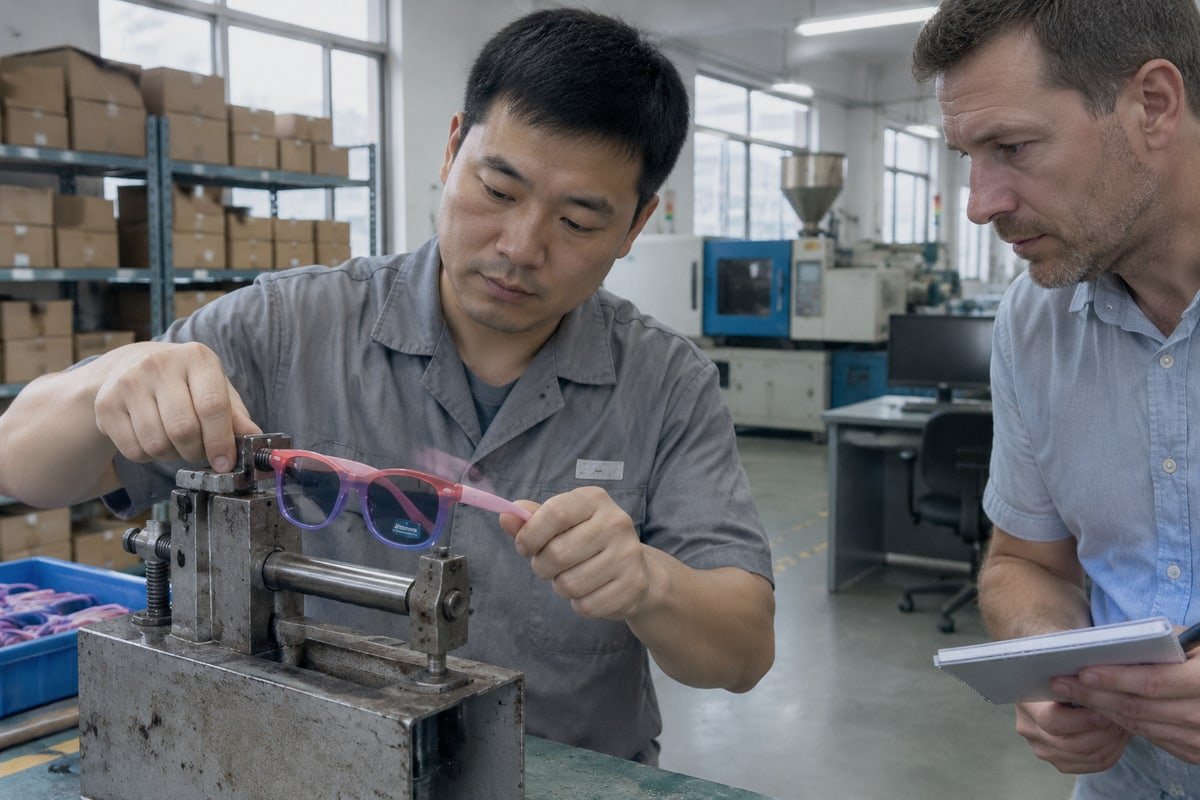
Buyers visiting our Taizhou factory often ask why TR90 & TPEE 子供用サングラス 1 fail early. The frame rarely dies first. Fit, lenses, and care habits usually end the story.
TR90 & TPEE kids sunglasses typically last 1–3 years in daily use, and well-cared TR90 frames can reach 3–5 years. Replace them sooner when lenses scratch, the frame loses elasticity, hinges loosen, or your child outgrows the fit and coverage.
That range is wide on purpose. A frame material has one lifespan. A growing child gives it another, shorter one. In this article I will separate the two, list the warning signs that matter, and show how activity and care change the numbers.
How long can I expect TR90 and TPEE kids sunglasses to last in daily use?
Our QC line runs every TR90 sample through repeated temple bends before approval. Yet the frames buyers return to us years later almost never failed that way.
In daily use, TR90 kids sunglasses last about 1–3 years, while supplier tests suggest 3–5 years is possible with good care. TPEE frames for toddlers usually get replaced within 6–18 months, because growth, chewing, and lens damage matter more than material failure.
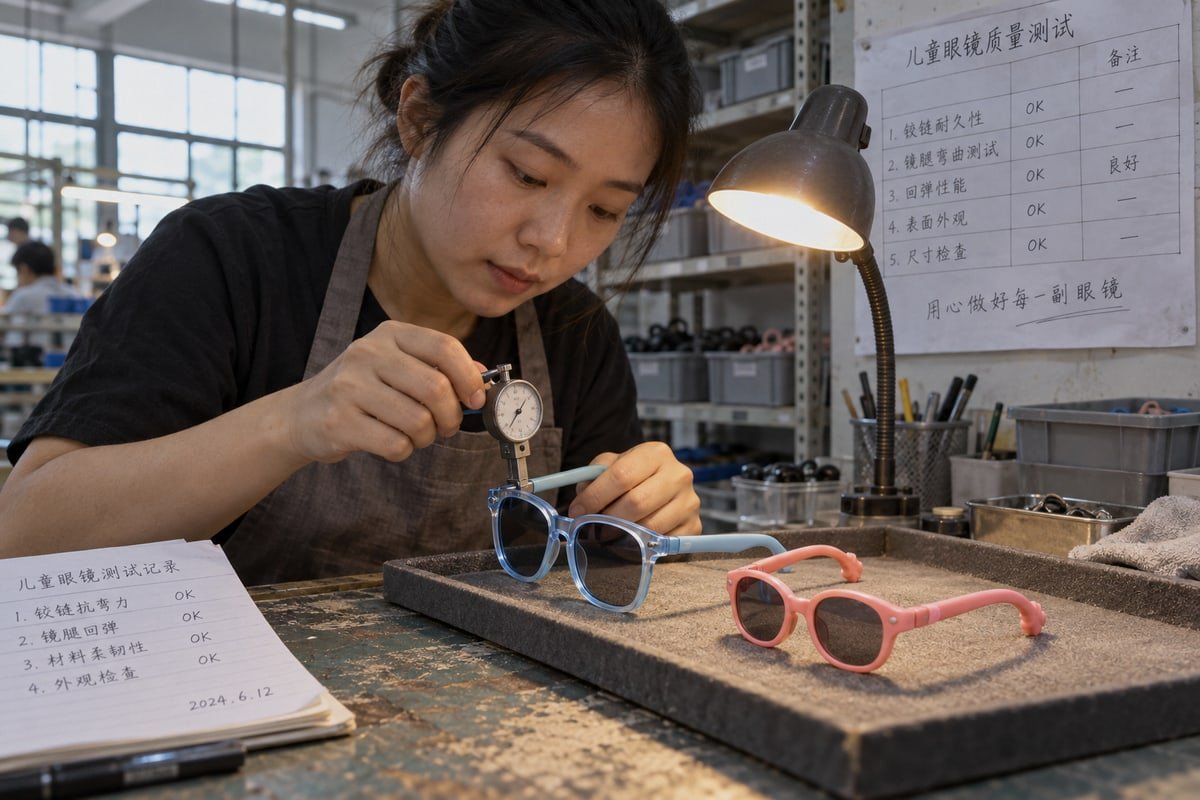
The honest answer has two parts. There is the life of the material. And there is the life of the product on a child's face. These are not the same number, and confusing them is the biggest source of frustration I see among brand buyers.
Why do lifespan claims disagree so much?
A procurement manager once put three competing spec sheets in front of me. One said TR90 lasts one year. One said two to three. One said five or more. She asked which one was lying. None of them were. They were measuring different things.
| Source type | Claimed lifespan | How I read it |
|---|---|---|
| Promotional / retail listings | About 1 year in normal use | Conservative, often tied to a one-year free-replacement offer |
| Consumer buying guides | 12–18 months, or 6–12 months for one growth phase | Child-use lifespan, with growth as the limit |
| Independent reviews | 1–3 years, sometimes 2–3 years | Realistic family use with average care |
| Supplier / B2B test data | 3–5+ years, 5,000+ flex cycles without cracking | Material lifespan under controlled lab conditions |
The lab numbers are real, but they describe memory polymer properties 2 on a test rig. A rig does not sit on the frame, leave it on a dashboard, or grow a wider head. So I tell buyers to print the conservative figure and design for the longer one. That way the product over-delivers.
TR90 versus TPEE: what actually wears out
TR90 is a nylon-based memory plastic. Bend it, and it returns to shape. Kids' versions weigh roughly 12–15 g, which is part of why children keep them on. Over time the surface can scratch, and long sun exposure can slowly yellow it or reduce flex. TPEE is a thermoplastic elastomer. It behaves more like rubber. It absorbs impact well and feels gentle on a toddler's face. Both materials in our range are BPA-free, so material safety is not the reason either one gets retired.
In practice, our translucent gradient fronts pair a glossy TR90 front with a matte TPEE temple. The front holds the lens shape. The temple takes the twisting. That hybrid usually outlives the child's need for that size. So the real finish line is fit, not fatigue.
What signs tell me it's time to replace my child's sunglasses?
A distributor in Europe once asked us to define a replacement date for her packaging. We told her honestly: the frame will not tell you. The fit and lenses will.
Replace your child's sunglasses immediately if you see deep lens scratches, micro-fractures, a bent or loose frame, wobbly hinges, detached nose pads, or lost elasticity. Also replace them when the frame leaves indentations or no longer covers the eyes fully, because outgrown sunglasses give poor UV coverage.
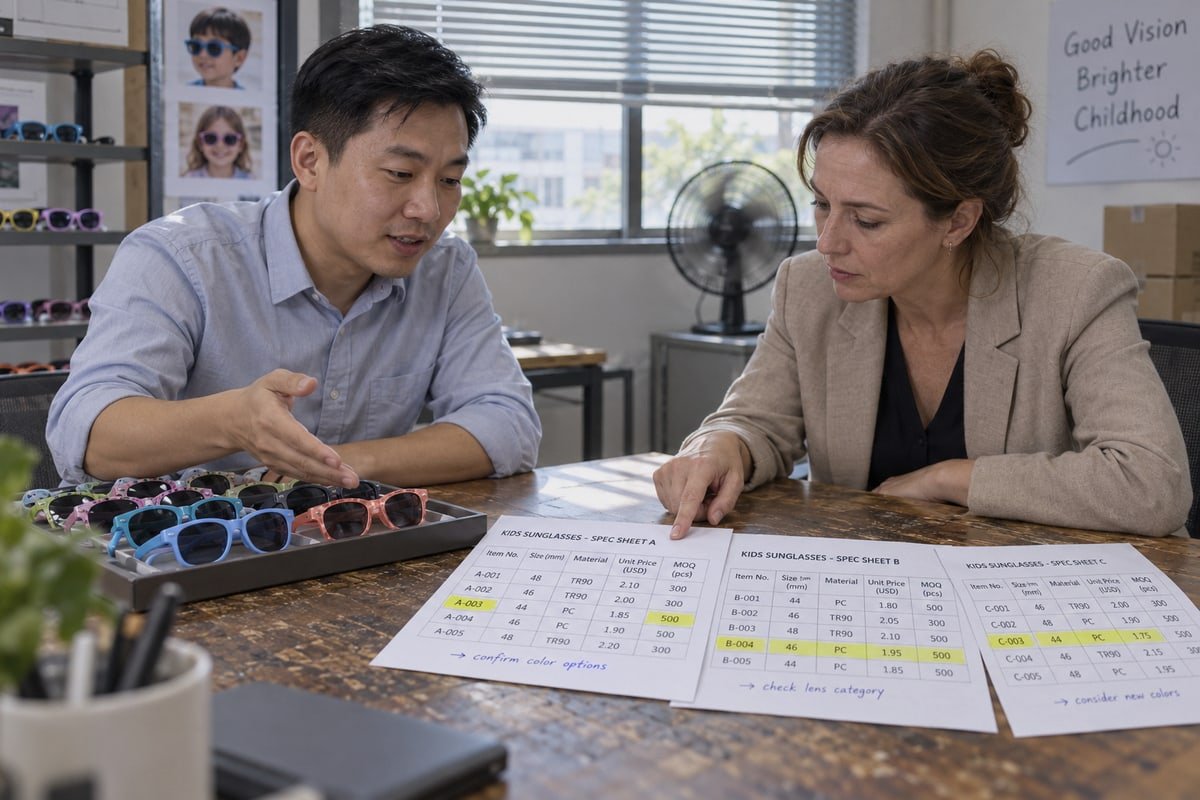
Kids' sunglasses are a safety product first and a fashion item second. So I group the warning signs by what they put at risk. Some threaten the eyes directly. Some threaten comfort, which means the child stops wearing them. Both end in the same result.
| 警告サイン | 通常、それは何を意味するか | What to do |
|---|---|---|
| Deep or crossing lens scratches | Light scatters, eye strain rises, coating integrity is broken | Replace now |
| Micro-fractures or cloudy patches | Coating delaminating or lens stressed by impact | Replace now |
| Frame will not return to shape | Elasticity lost, molecular fatigue building | Replace now |
| Loose hinge or missing screw | Frame can fall or twist off during play | Repair if possible, otherwise replace |
| Detached nose pad or worn temple tip | Slipping, pressure points, unsafe fit | Replace |
| Red marks or indentations on nose or temples | Child has outgrown the size | Move up a size |
| Lenses sit low or gaps appear at the sides | Coverage lost, UV enters around the frame | Move up a size |
Lens condition comes first
Parents notice frame damage. They miss lens damage. That order should be reversed. Scratches do more than look bad. They scatter incoming light and break the UV filter layer. Many experts recommend replacing kids' sunglasses every 12 to 24 months for this reason, because UV400 protection lifespan is limited by abrasion and solar exposure. Polarized lens degradation shows up as haze or rainbow patches, especially after heat. When you see either, the pair is done, even if the frame looks new.
Frame condition is the quiet risk
TR90 rarely gives warning before it breaks. High-flex polymers can pass a threshold of bend cycles and then snap with no discoloration at all. So a frame that has been sat on many times deserves suspicion, not trust. TPEE fails differently. Its high flexibility can create an elasticity gap. During a minor knock, the soft frame stretches away from the lens and the lens pops out. If a toddler's lens keeps falling out, the groove has stretched. Replace the pair rather than pressing the lens back again.
Fit is the sign parents feel guilty ignoring
Toddler eyewear sizing changes fast. If the temples splay outward or the frame leaves marks, the child has moved on. Poor fit means poor coverage, so this is a safety issue, not a comfort one.
How does my child's activity level affect the lifespan of their eyewear?
Softness versus snap-back is the trade-off we weigh on every new kids' style. A softer TPEE frame forgives chewing; a stiffer TR90 frame survives a football hit.
Active children shorten eyewear lifespan mainly through impacts, sitting on frames, and heat exposure. TR90's memory polymer suits sporty older kids, while soft TPEE suits toddlers who chew and tug. Expect a high-energy child to need replacement in roughly 6–12 months, versus 2–3 years for calm wearers.
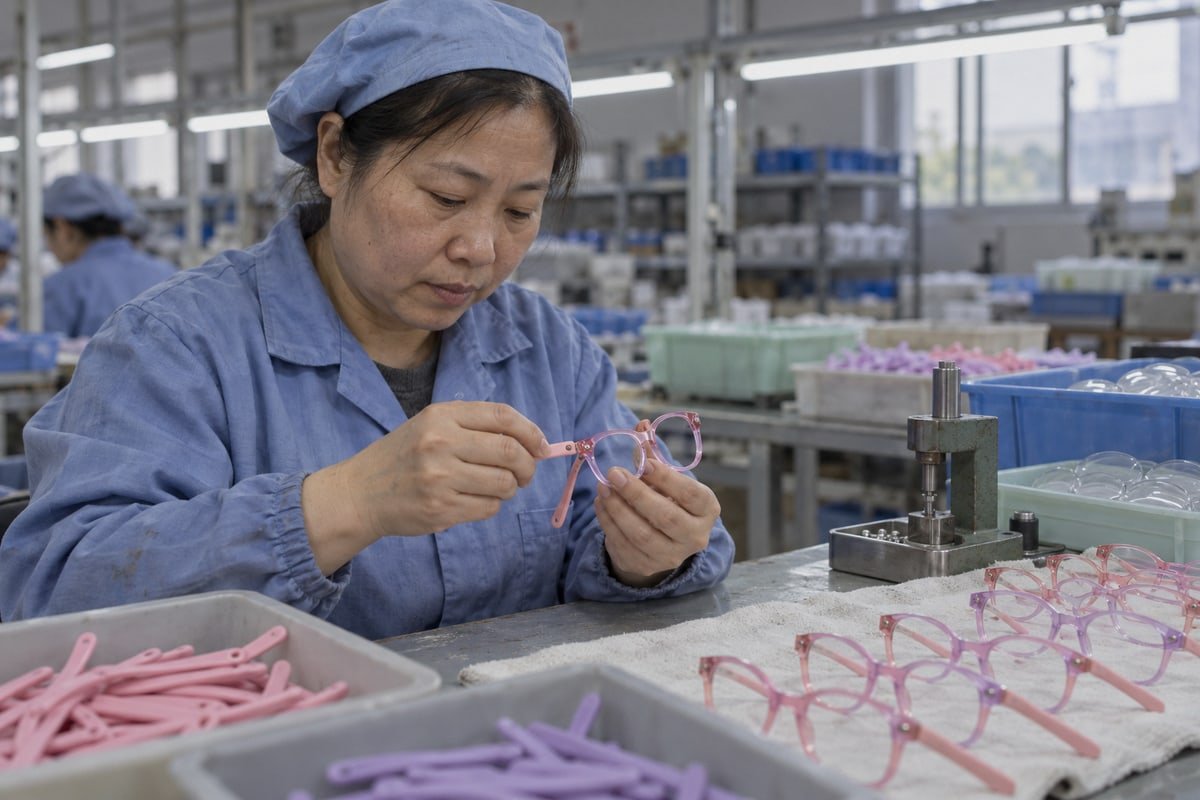
Two children can buy the same pair on the same day and retire them years apart. Activity is the reason. So instead of one lifespan, I find it more useful to think in profiles.
| Activity profile | Main stress on the frame | Better material | Realistic replacement window |
|---|---|---|---|
| Toddler, 0–3 years | Chewing, tugging, dropping, drooling | TPEE, or TR90 front with TPEE temples | 6–12 months, driven by growth |
| Calm school-age child | Occasional drops, bag storage | TR90 | 2~3年 |
| Sporty child, ball games and bikes | Direct impacts, sitting on frames, sweat | TR90 with impact-resistant lenses | 6–12 months to 1–2 years |
| Beach and pool regular | Sunscreen, salt, sand, heat | TR90, rinsed after every use | 1~2年 |
| Winter sports child | Cold snaps, helmet pressure, goggle swaps | TPEE-heavy designs for cold stability | 1–2 seasons |
Impact and flex are different loads
A ball hit is a single, sharp load. 素材の選択が第一 handles this well. TR90 bends and returns. Shatterproof lens technology in the lens keeps fragments away from the eye. Sitting on a frame is a slow, repeated load. This is where molecular fatigue builds up. A sporty child who stuffs sunglasses into a back pocket ages a frame far faster than one who drops them on grass. When we design for sport, we shorten the temples slightly and use a screwless hinge design where possible. Fewer parts means fewer things to loosen during rough play.
Climate matters more than most brands admit
TR90 resists heat well. It copes with sun, sweat, and sunscreen better than standard plastic. But it shows cold-weather brittleness. A frame that survives a summer of soccer can snap on a January ski slope. TPEE stays more stable in the cold, so for winter-heavy markets I steer buyers toward more TPEE in the design. Heat goes the other way. A car dashboard in July can warp a TR90 front and delaminate lens coatings in a single afternoon. Neither material is universal. The right answer depends on where and how the child plays, and a good spec sheet should say so.
What care and storage habits can help me extend the life of these frames?
One lesson from fifteen years of eyewear work: a hard case in the box changes how long a pair survives. Frames shipped without one come back scratched far sooner.
Rinse frames with lukewarm water and mild soap, dry with a microfiber cloth, and store them in a rigid case. Avoid paper towels, alcohol cleaners, and hot car dashboards. Wipe off sunscreen promptly. These simple habits can add months, and some vendors claim up to 40% longer life.
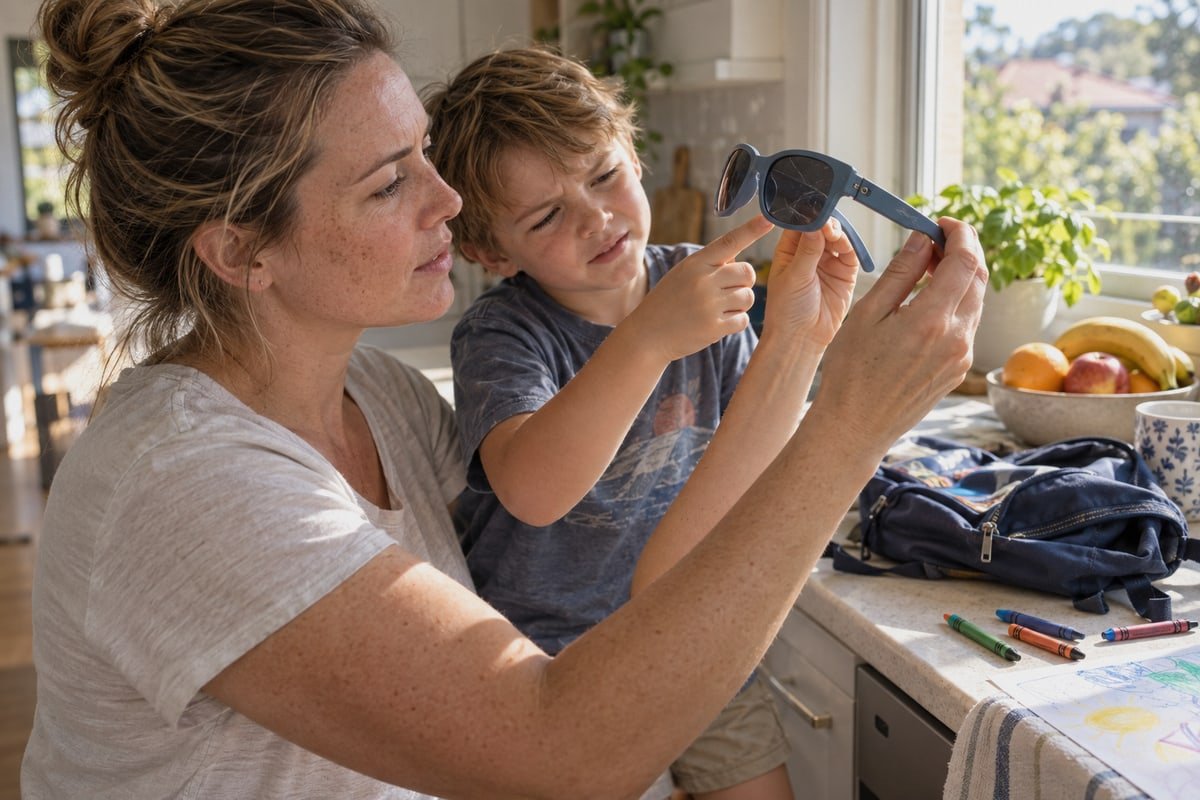
Care sounds boring next to material science. But in our experience, the difference between a one-year pair and a three-year pair is often the case and the cleaning cloth, not the polymer. Here is the routine I recommend brands print on their packaging inserts.
A simple weekly routine
- Rinse the whole pair under lukewarm running water. Never hot. Hot water stresses coatings.
- Add a drop of mild dish soap and rub gently with fingertips. Pay attention to the nose bridge and hinge area where sunscreen collects.
- Rinse again until no residue remains.
- Dry with a clean microfiber cloth. Do not use a shirt, a tissue, or a paper towel. Paper fibers act like fine sandpaper on a scratch-resistant coating.
- Check the hinges. On screwed hinges, tighten gently if loose. On a screwless hinge design, look for cracks at the pivot.
- Put the pair in a rigid case. A soft pouch protects against dust, not against a school bag.
Chemicals that quietly shorten life
| Habit | Effect on the frame or lens | Better alternative |
|---|---|---|
| Alcohol-based sprays or wipes | Strip anti-reflective and polarizing layers | Mild soap and water |
| Sunscreen left on the frame | Softens and dulls petroleum-based plastics | Rinse after beach days |
| Bug spray contact | Can craze the surface and speed brittleness | Apply spray before putting glasses on |
| Leaving pair on a dashboard | Warps TR90, delaminates coatings | Case in the glove box or bag |
| Storing lenses face down | Micro-scratches accumulate | Store in case, lenses up |
Bio-based TR90, made from castor oil, resists sunscreen and insect repellent solvents 3 better than traditional petroleum plastics. It is one of the reasons we moved much of our kids' range in that direction. Still, no material is immune. The frame that gets rinsed after the beach will outlast the one that does not, whatever it is made of.
Treat the 40% figure as a promise, not a proof
One vendor claims that biweekly rinsing and case storage extend lifespan by about 40%. I have not seen that verified independently, and I would not print it. But the direction of the claim matches everything we observe on returned samples. Clean, cased frames come back with clear lenses and tight hinges. Uncased frames come back scratched, even when the frame itself still bends perfectly.
結論
Kids' sunglasses carry no expiry date. Fit, lens clarity, and frame elasticity decide replacement. Choose TPEE for toddlers, TR90 for active kids, and let simple care handle the rest.
Interested in sourcing the products mentioned in this article? See details and request a quote here:
脚注
1. International standard for sunglasses and related eyewear safety requirements. ↩︎
2. Technical background on the shape-memory characteristics of polymers like TR90. ↩︎
3. EPA information on insect repellent ingredients and their chemical properties. ↩︎
 English
  Español de México
  Deutsch
  Français
  日本語
日本語  العربية
  Português do Brasil