How to Design Packaging to Prevent Damage to TPEE Kids’ Sunglasses in Transit?
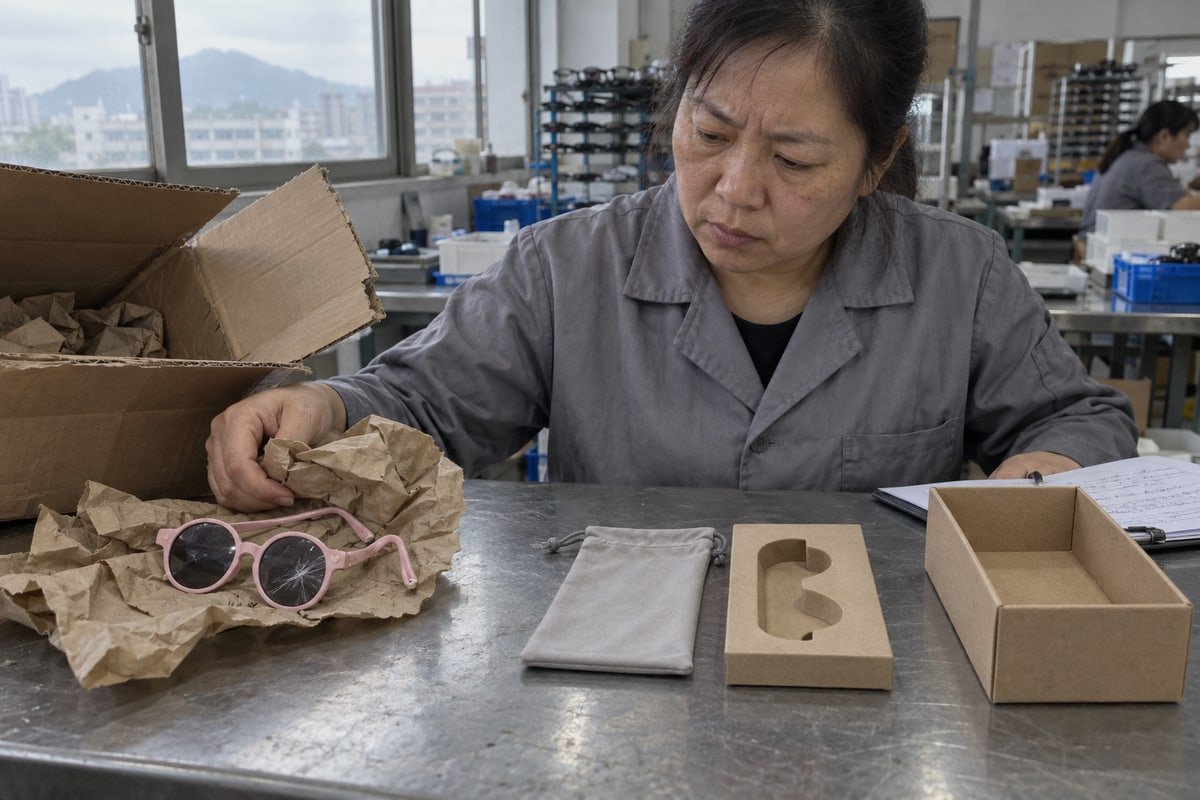
Our QC team once opened a returned carton and found scratched lenses and bent temples. Good packaging to prevent damage to TPEE kids’ sunglasses in transit stops that loss.
Packaging to prevent damage to TPEE kids’ sunglasses in transit uses three layers: a snug primary holder such as a hard case or microfiber pouch, a fitted inner box with custom inserts that stop movement, and a rigid corrugated outer carton, all validated by drop and compression testing.
Below, I walk through materials, inserts, testing, and presentation. Each part builds on the last. Together they form a full system for packaging to prevent damage to TPEE kids’ sunglasses in transit, and none of them works alone.
What packaging materials work best to protect flexible TPEE frames during long-distance shipping?
Every quote we prepare for a new sunglasses order forces one trade-off: how much protective material to add before the shipping cost outweighs the damage it prevents.
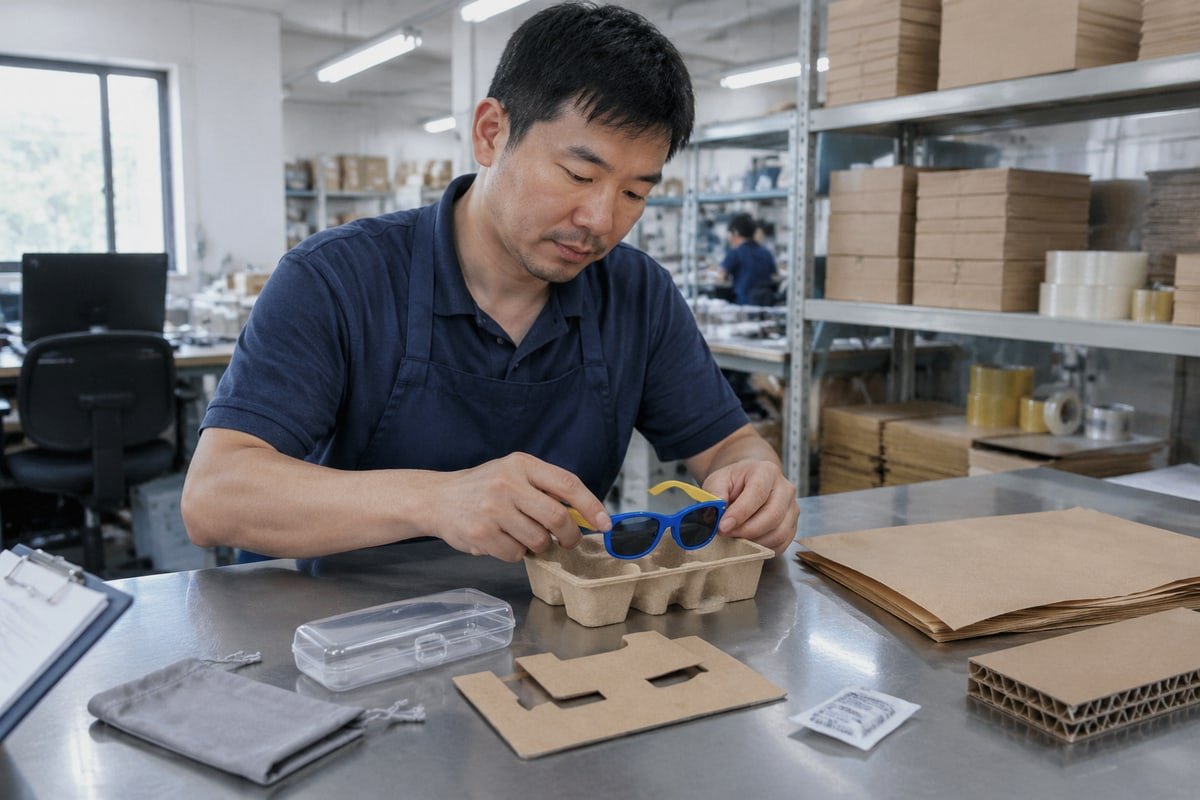
The best packaging materials for flexible TPEE frames combine a microfiber pouch or hard case, a molded pulp or die-cut cardboard insert, and a double-walled corrugated outer box. Together they block scratches, absorb shock, and resist crushing during long-distance shipping.
Why flexible frames still need protection
TPEE bends and springs back. That is exactly why we use it for children. A child can sit on the frame or twist the temples, and the frame recovers. But flexible frame durability is a property of the frame, not of the parcel. Flexibility does not protect the lens surface from rubbing against cardboard for three weeks at sea. It does not protect a small hinge screw from a point load when a heavy carton lands on one corner. And it does not stop a temple from taking a new set if the frame stays squeezed in a hot container. In our workshop, these are the three transit failures we see most: fine lens scratches, hinge cracks or loosened screws from crush pressure, and temple warping from long-duration storage in the wrong position.
Comparing the main material options
| 素材 | Main job | 残高トリガーはプロフォーマインボイスに記載する必要があります | Added bulk | Sustainability note |
|---|---|---|---|---|
| Microfiber storage pouch | Scratch and dust barrier for lenses | 低〜中程度 | 非常に低い | Reusable by the child; becomes part of the product |
| Hard clamshell case | Rigid shell around the frame | 高い | 中程度 | Often plastic; recycled options exist |
| Die-cut custom cardboard insert | Immobilize frame inside the box | Medium to high | 低 | Fully recyclable with the box |
| Molded bamboo or sugarcane pulp insert | Immobilize frame and absorb shock | 高い | 低〜中程度 | Compostable; matches the eco profile of TPEE |
| EVA foam insert | Shock absorption | 高い | 低 | Petroleum-based and hard to recycle |
| Recycled kraft paper void fill | Fill gaps so nothing shifts | 中程度 | 低 | フレームは使用後に現実的にリサイクルできます |
| Air pillows | Fill gaps | 中程度 | 非常に低い | Plastic, but very light to ship |
| Double-walled corrugated carton | Crush resistance during stacking | 高い | 中程度 | フレームは使用後に現実的にリサイクルできます |
| Silica gel and moisture barrier packaging | Control humidity around coatings and inserts | Supports finish quality | Negligible | Varies by product |
The objection we hear most: heavy or lean?
Procurement managers often tell us that lean packaging is cheaper and greener, so why not use a padded mailer and a tissue wrap? I understand the goal. But a mailer has no crush resistance, and thin tissue does not stop lens movement. The answer is not more mass. It is better rigidity. A right-sized double-walled corrugated carton with a molded pulp insert 1 weighs little, yet it resists stacking pressure and gives real shock absorption. Molded pulp performs very close to foam for small, light items like children's eyewear. So lean and protective are not opposites. You simply spend material only where it does work.
Small details that matter for TPEE
TPEE frames with a soft-touch finish can attract fine grit through static. Anti-static treated interior surfaces keep that grit from being ground into the frame during vibration. For shipments through non-climate-controlled containers, a thermal-insulating liner in the master carton keeps the frames well below the heat deflection point of the material. A silica gel packet and a light moisture barrier protect lens coatings and keep paper inserts firm. A peelable protective lens film adds one more scratch barrier that the parent removes at home.
How can I design inner packaging inserts that keep kids' sunglasses secure without adding bulk?
During a packing trial for a blush-pink round frame, our line supervisor shook the sealed inner box beside her ear. She heard a rattle. We redrew the insert.
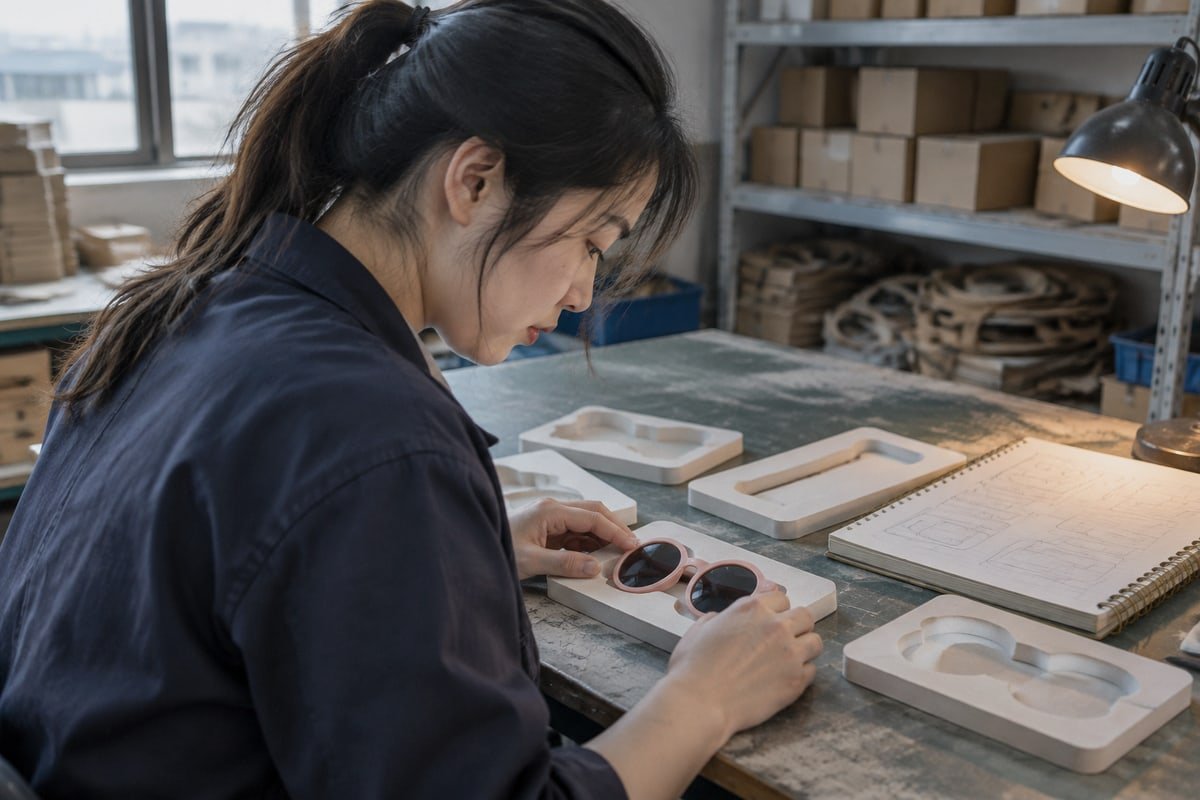
Design inner inserts as a die-cut cardboard or molded pulp cradle that holds the folded frame in its relaxed shape, supports the bridge and hinges, keeps lenses off every surface, and fits the inner box so tightly that nothing shifts. Slim cradles protect without bulk.
A five-step insert design process
- Measure the folded frame in its relaxed state. We place the frame on a flat surface with the temples folded naturally. We do not force the temples flat. The cavity must match this natural curvature. If TPEE is held in a tighter fold for weeks, it can develop a compression set and arrive slightly warped.
- Choose where the frame touches the insert. The safest contact points are the bridge, the temple folds, and the outer rim edges. The lens faces should touch nothing but air or microfiber. This is why custom cardboard inserts 3 beat loose tissue. Tissue rubs; a cradle holds.
- Protect the hinges from point pressure. The hinge is the weakest spot on any kids' frame. We shape a small shoulder on each side of the cavity so a downward load on the box lid goes into the insert, not into the hinge barrel.
- Match the insert footprint to the inner box. The insert should press lightly against all four walls. Then we run the shake test. No rattle means no movement, and no movement means no scratches.
- Keep the height minimal. For a child's frame, the retail box rarely needs to be deeper than the folded temple stack plus a few millimeters. A slim cradle is lighter and cheaper, and it still immobilizes the product.
Insert types compared
| Insert type | Added bulk | クッションオプション | 相対コスト | 最適な用途 |
|---|---|---|---|---|
| Die-cut cardboard cradle | 低 | 接触点に集中 | 低 | Most retail and e-commerce orders |
| Molded pulp tray | 低〜中程度 | 非常に良い | 中程度 | Brands with a strong sustainability story |
| EVA foam cutout | 低 | 非常に良い | Medium to high | Premium hard-case presentation |
| Tissue wrap only | 非常に低い | 悪い | 非常に低い | Never for parcel shipping |
Designing around the frame shape
Different silhouettes need different cavities. A thick, glossy two-tone square frame with a deep royal blue front and yellow temples needs a wider, deeper cradle because the front is chunky. A slender lavender cat-eye frame with upswept corners needs small corner supports, because those tips are the first parts to snag. A compact round blush-pink frame is the easiest to hold, but it also has the least mass, so it moves the most in an oversized box. We design each insert from the actual sample, not from a generic template.
Mistakes that add risk without adding protection
Loose product in a box is the most common failure. Oversized inner boxes are the second. A big box needs void fill, and void fill compresses over time, so the product starts moving halfway through the journey. Skipping the microfiber storage pouch is the third. The pouch costs very little, and it is the last barrier between the lens and any hard surface.
What packaging tests should I request from my manufacturer to confirm my sunglasses can survive transit?
A procurement manager from Australia asked us a fair question last spring: could we prove our cartons survive a courier depot, not just describe them?
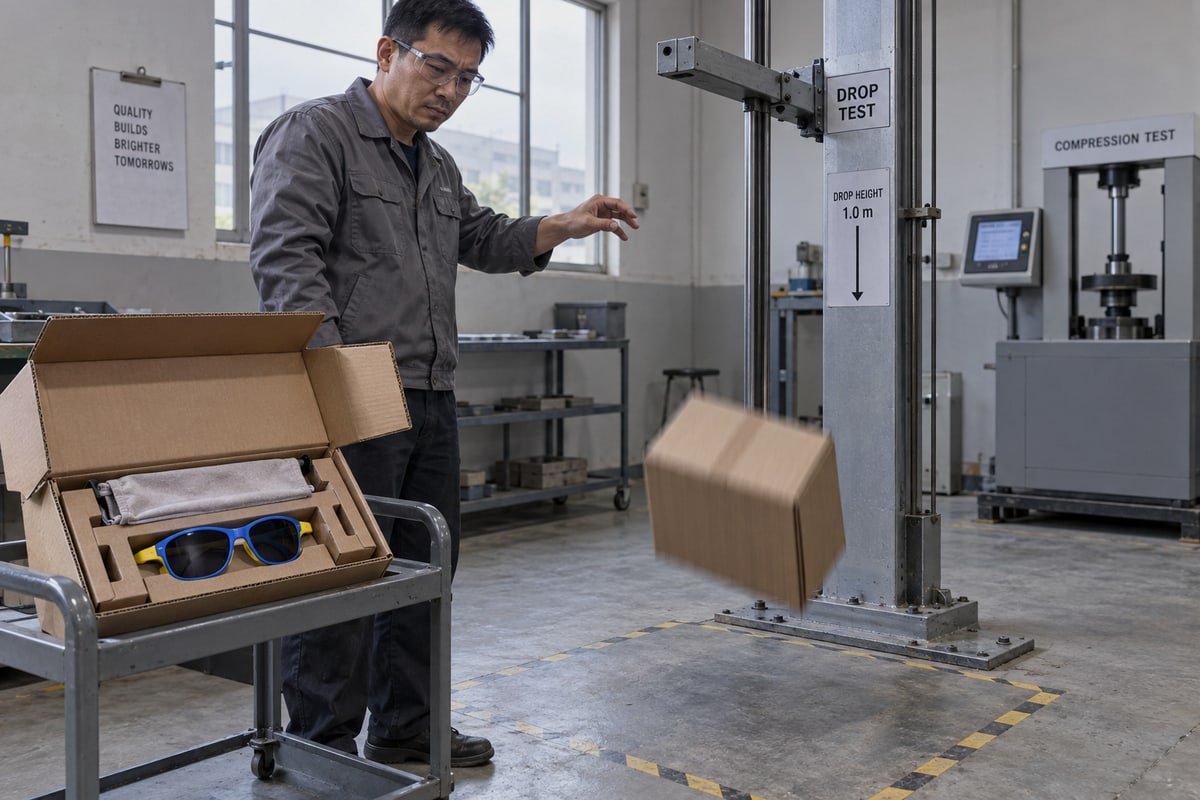
Request ISTA drop testing such as ISTA 1A on fully packed cartons, plus compression, vibration, and humidity tests. Ask for photos, pass/fail records, and a sample shipping trial before mass production. Tests should confirm hinges, bridges, and lenses arrive undamaged.
The tests that matter for small eyewear cartons
| テスト | What it simulates | What to check on the frame afterward | When to run it |
|---|---|---|---|
| ISTA 1A drop test | Parcel drops onto corners, edges, and faces | Hinge cracks, lens scratches, insert displacement | On the fully packed master carton before mass production |
| Compression test | Pallet stacking and warehouse loads | Carton crush, lid dents, hinge point pressure | On the master carton and the retail inner box |
| Vibration test | Truck and container transport over long routes | Lens abrasion, grit in soft-touch finish, screws loosening | Combined with the drop sequence |
| Humidity or climate test | Sea freight and tropical warehouses | Insert softening, coating haze, finish changes | For routes without climate control |
| Transit simulation | The whole journey in one sequence | Overall damage rate per carton | For new packaging designs or new markets |
| Sample shipping trial | Real couriers, real handling | Everything above, in real conditions | Before the first bulk order ships |
Test the carton, not the sunglasses alone
A common misunderstanding is that a strong frame passes a transit test. It does not work that way. ISTA drop testing is done on the packed shipping unit. The test tells you whether the insert, inner box, and outer carton keep the frames safe together. We always test with the final artwork and the final insert, because a change in board grade or cavity depth changes the result. If a buyer changes the retail box after testing, we test again.
Match your claims to real data
Sunglass lenses sold in the United States fall under the 耐衝撃性要件 4 of 21 CFR 801.410. That is a product safety standard for the lens itself, and it is separate from packaging. But the two connect in one important way. If your packaging or marketing says the product is protected and tested, the transit results and the lens results must back that up. We advise brands to keep claims tied to actual reports, not to generic "fragile" language or vague protection wording.
What to ask for in the report
I recommend requesting five things from any supplier. First, the test standard name and the drop heights used. Second, photos of the carton before and after each drop. Third, photos of the frames inside after the full sequence. Fourth, a clear pass or fail record with the failure mode if any. Fifth, a written packing specification 5 that lists the insert, pouch, inner box, and carton grade. At our factory, we also photograph packed units on the line, so a buyer can compare an incoming carton to the reference image. This is how packaging to prevent damage to TPEE kids' sunglasses in transit becomes part of quality control, not an afterthought.
How do I balance protective packaging with retail-ready, brand-friendly presentation for my sunglasses?
One lesson took us years to fully accept: a beautiful box that arrives dented has failed at both jobs, protection and branding, at the same time.
Balance protection and presentation by engineering the retail box as a structural layer, not a decoration. Use a rigid printed inner box with a fitted insert, add branding to the pouch and lid, then protect everything inside a plain corrugated shipper sized to the channel.
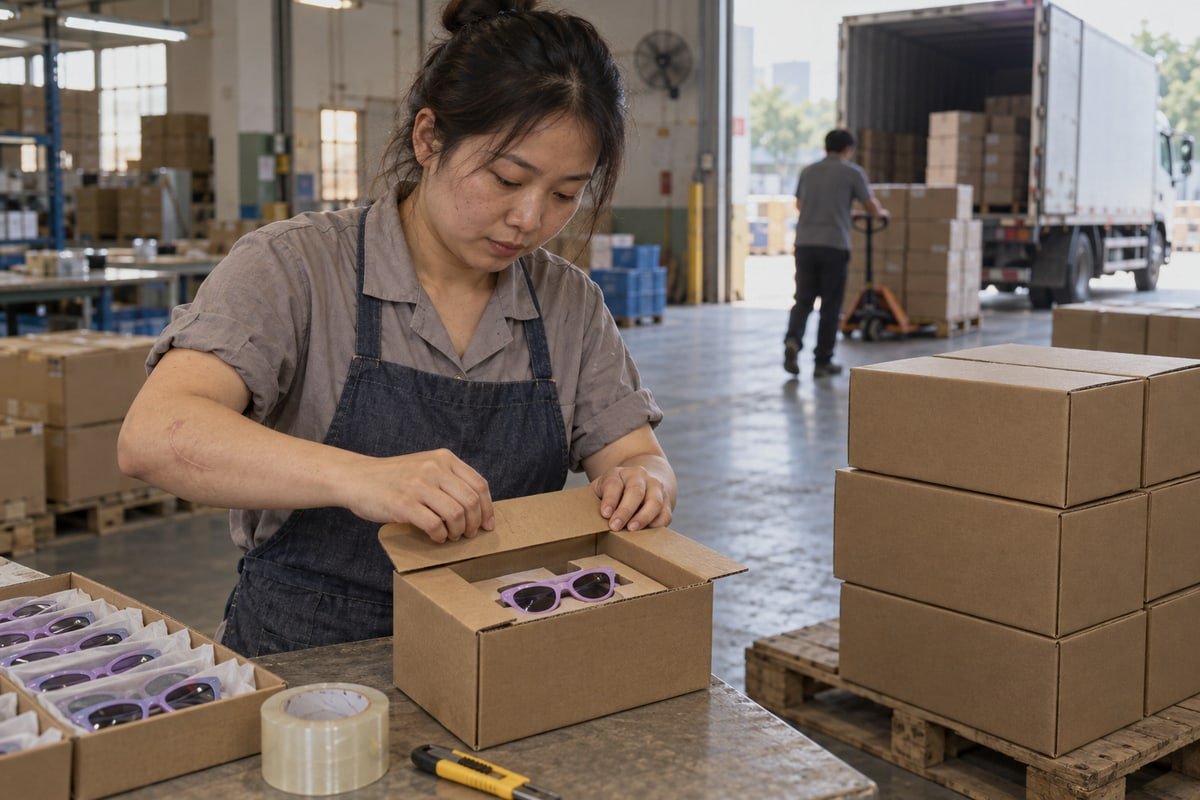
Presentation and protection are the same design job
When we develop custom packaging with a brand, the first question is not the artwork. It is the distribution channel. A shelf display box at a children's boutique faces very different forces than a single pair mailed to a parent's home. The structure has to fit the route. The artwork comes second, and it sits on that structure.
The objection we hear from marketing teams is that retail-display packaging looks better, so it must be the priority. I agree that shelf appeal sells sunglasses. But decorative boxes are often built from thin folding board with a large window cutout. That box can look premium and still fold under stacking pressure. The solution is not to choose between pretty and strong. It is to reinforce the pretty box. A thicker board grade, a smaller window, and a fitted insert turn a display box into a structural part of the system.
Match the packaging to the channel
| チャネル | Primary layer | インナーボックス | Outer shipper | Presentation focus |
|---|---|---|---|---|
| Retail shelf via distributor | マイクロファイバーポーチ | Printed rigid or reinforced folding box with insert | Double-walled master carton, twelve to twenty-four units | Front graphics, window, hang tag |
| E-commerce direct to consumer | Microfiber pouch or slim hard case | Printed rigid box with insert | Right-sized corrugated mailer box, single unit | Unboxing moment, inside-lid print |
| Promotional or bulk orders | マイクロファイバーポーチ | Simple kraft box or pulp tray | Master carton with dividers | Logo on pouch and box lid |
Sustainable box design without weaker structure
Many of our buyers in Europe, Japan, and Australia ask for sustainable box design. This fits TPEE well, because the material itself is chosen for its environmentally friendly profile. The good news is that the strongest small-item packaging is also fairly sustainable. Corrugated mailer boxes, molded pulp inserts, and kraft void fill are all recyclable or compostable. The key is to remove the wrong things, not the structural ones. We remove oversized boxes, plastic windows where possible, and excess void fill. We keep the rigid walls, the fitted cradle, and the pouch. That gives a lighter parcel and a cleaner story, without a higher damage rate.
Where branding lives
Branding does not have to add bulk. A printed microfiber pouch 6 carries the logo and becomes a daily-use item for the child. The inside of the box lid gives a full-color surface that the parent sees first. The insert itself can be printed or embossed. The outer shipper stays plain, because it takes the abuse. Through our OEM/ODM support, we handle custom colors, logos, lenses, and packaging together, so the box and the frame are developed as one product. Packaging to prevent damage to TPEE kids' sunglasses in transit and packaging that sells on the shelf are, in the end, the same box built correctly.
結論
Damaged sunglasses cost you returns and trust. Fix it with snug inserts, rigid corrugated cartons, and drop-tested packaging. Our team designs that system alongside every OKAY EYEWEAR order.
Interested in sourcing the products mentioned in this article? See details and request a quote here:
脚注
1. EPA resource on recycling and sustainable materials like molded pulp used in protective packaging. ↩︎
2. ISTA is the leading authority on testing protocols for shipping units and outer cartons. ↩︎
3. ISO standards for packaging and distribution of goods, including internal protective components. ↩︎
4. Official FDA guidance on impact resistance requirements for sunglasses and eyewear lenses. ↩︎
5. Fibre Box Association provides industry standards for corrugated carton specifications and grades. ↩︎
6. Technical overview of microfiber materials used for protective pouches and lens cleaning. ↩︎
 English
  Español de México
  Deutsch
  Français
  日本語
日本語  العربية
  Português do Brasil